Fillable Photo Copyright Release Document

Fillable Photo Copyright Release Document

A Photo Copyright Release form is a legal document that allows photographers to transfer the rights of their images to another party, often the client or a publisher. This form ensures that the photographer receives appropriate credit while granting permission for the use of their work. If you're ready to protect your rights and clarify usage, fill out the form by clicking the button below.

Article Guide

The Photo Copyright Release form serves as an important document in the realm of photography and intellectual property. This form is designed to establish clear agreements between photographers and the subjects of their images, ensuring that both parties understand their rights and responsibilities regarding the use of photographs. By signing this form, a subject grants permission for the photographer to use, reproduce, and distribute their images for various purposes, which may include commercial use, marketing, or personal portfolios. Additionally, the form often outlines any limitations or specific conditions under which the photographs can be used, providing clarity and protection for both the photographer and the subject. It is essential for photographers to obtain a signed release to avoid potential legal disputes over copyright and usage rights in the future. Understanding the nuances of this form can help individuals navigate the complexities of photo rights, fostering a respectful and mutually beneficial relationship between artists and their subjects.

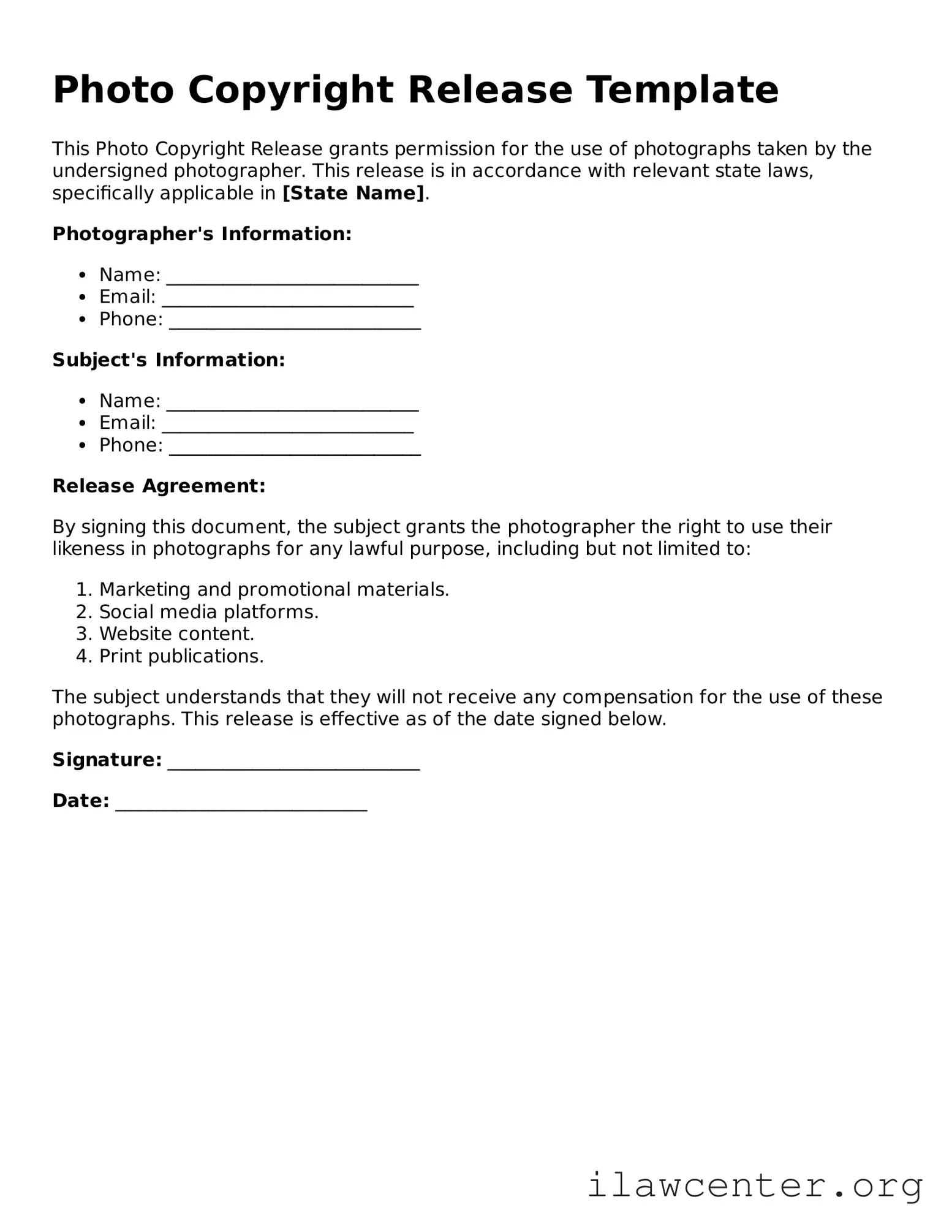
Photo Copyright Release Template

This Photo Copyright Release grants permission for the use of photographs taken by the undersigned photographer. This release is in accordance with relevant state laws, specifically applicable in [State Name].

Photographer's Information:

  • Name: ___________________________
  • Email: ___________________________
  • Phone: ___________________________

Subject's Information:

  • Name: ___________________________
  • Email: ___________________________
  • Phone: ___________________________

Release Agreement:

By signing this document, the subject grants the photographer the right to use their likeness in photographs for any lawful purpose, including but not limited to:

  1. Marketing and promotional materials.
  2. Social media platforms.
  3. Website content.
  4. Print publications.

The subject understands that they will not receive any compensation for the use of these photographs. This release is effective as of the date signed below.

Signature: ___________________________

Date: ___________________________

PDF Form Characteristics

Fact Name Description
Definition A Photo Copyright Release form is a document that grants permission for the use of photographs, transferring copyright from the photographer to another party.
Purpose This form protects the rights of both the photographer and the individual or entity using the images, clarifying usage rights and ownership.
State-Specific Forms Different states may have specific requirements for Photo Copyright Release forms, including consent laws and copyright statutes.
Governing Laws In California, for example, the governing laws include the California Civil Code Section 3344, which addresses the right of publicity.
Revocation Once signed, the release can be difficult to revoke, making it essential to understand the terms before signing.
Duration The rights granted under a Photo Copyright Release form can be perpetual, meaning they last indefinitely unless otherwise specified.

After obtaining the Photo Copyright Release form, it's important to fill it out carefully. This ensures that all necessary information is accurately captured. Once completed, the form will allow for the proper handling and use of the photographs in question.

  1. Begin by entering your name in the designated field. Make sure to include your full legal name.
  2. Next, provide your contact information. This usually includes your email address and phone number.
  3. In the next section, describe the photographs covered by this release. Include details such as the date they were taken and the location.
  4. Specify the purpose for which the photographs will be used. This could be for marketing, promotional materials, or other specified uses.
  5. Indicate whether you are the copyright holder of the photographs. If not, provide the name of the copyright holder.
  6. Sign the form in the designated signature area. Ensure your signature is clear and legible.
  7. Date the form in the appropriate section to confirm when you completed it.

Once you have completed all these steps, review the form for any errors or omissions before submitting it. This will help ensure that the process moves forward smoothly.

What is a Photo Copyright Release form?

A Photo Copyright Release form is a legal document that allows the creator of a photograph to grant permission for others to use, reproduce, or distribute their images. This form helps clarify the rights associated with the photograph and can protect both the photographer and the user from potential copyright disputes.

Why is a Photo Copyright Release important?

This form is crucial because it establishes clear guidelines on how a photograph can be used. Without it, the photographer retains full copyright ownership, which means that others cannot legally use the image without permission. A release form provides peace of mind for both parties by documenting the terms of use.

Who should sign the Photo Copyright Release form?

The form should be signed by the photographer or copyright holder, as well as anyone who will be using the photographs. This can include clients, companies, or organizations that intend to use the images for marketing, advertising, or other purposes. By having all parties sign the form, everyone understands their rights and responsibilities regarding the images.

What information is typically included in the form?

A Photo Copyright Release form generally includes details such as the names of the parties involved, a description of the photographs, the intended use of the images, and any compensation arrangements. It may also specify the duration of the rights granted and any restrictions on how the images can be used.

Can a Photo Copyright Release be revoked?

Once a Photo Copyright Release form is signed, it typically cannot be revoked without mutual agreement from both parties. However, if the form includes specific terms or conditions regarding the use of the images, those terms will guide the ability to revoke or modify the agreement. It's essential to understand these terms before signing.

Is a verbal agreement sufficient instead of a written release?

While a verbal agreement may seem convenient, it is not advisable. Verbal agreements can lead to misunderstandings and disputes, as they lack the clarity and documentation that a written release provides. A Photo Copyright Release form serves as a formal record, ensuring that all parties are on the same page regarding the use of the images.

What should I do if I need to use a photo but don’t have a release?

If you wish to use a photo but do not have a release, it is best to seek permission from the photographer or copyright holder before proceeding. They may be willing to provide a release for your intended use. If obtaining permission is not possible, consider using stock photos or images that are in the public domain to avoid potential legal issues.
Common mistakes

When filling out a Photo Copyright Release form, many people overlook important details that can lead to complications later on. One common mistake is failing to read the entire form carefully. Skimming through the document might seem like a time-saver, but it can result in missing critical information about rights and permissions. Always take the time to understand what you are agreeing to.

Another frequent error is not providing complete information. Whether it’s your name, contact details, or the specifics of the photo being released, incomplete information can create confusion. Ensure that every section of the form is filled out accurately to avoid any misunderstandings down the line.

Many individuals also forget to check the date. A release form is only valid if it is signed and dated properly. Neglecting to include the date can render the form ineffective. This is a simple step that can save a lot of hassle later.

Signing without understanding the terms is a mistake that can have serious implications. Some people may agree to terms they don’t fully comprehend, which can lead to unintended consequences. It’s crucial to grasp what rights you are granting and how your photos may be used.

Additionally, some people overlook the importance of having witnesses or notarization, when required. Depending on the context, a witness signature might be necessary to validate the release. Skipping this step can undermine the legal standing of the document.

Finally, failing to keep a copy of the signed form is a common oversight. After all the effort put into completing the form, it’s essential to retain a copy for your records. This ensures you have proof of the agreement should any disputes arise in the future.

Documents used along the form

When dealing with photography and copyright, several forms and documents often accompany the Photo Copyright Release form. Each of these documents serves a specific purpose, ensuring clarity and legal protection for both the photographer and the subject. Below is a list of commonly used documents.

  • Model Release Form: This document is signed by the subject of a photograph, granting permission for the photographer to use their likeness in promotional materials or publications. It protects both parties by clearly outlining the terms of use.
  • Photography Contract: A detailed agreement between the photographer and the client, this contract specifies the services to be provided, payment terms, and ownership rights of the images. It helps prevent misunderstandings and sets expectations for the project.
  • Licensing Agreement: This form outlines the specific rights granted to a third party for using the photographs. It details the scope of use, duration, and any compensation involved, ensuring that all parties understand their rights and responsibilities.
  • Invoice: This document serves as a request for payment for services rendered. It includes details such as the amount owed, payment terms, and a description of the services provided, facilitating smooth financial transactions.

Having these documents in place can streamline the process of photography projects and protect the interests of all involved. By ensuring that everyone understands their rights and responsibilities, potential disputes can be minimized, fostering a more positive working relationship.

Similar forms

  • Model Release Form: This document grants permission for the use of a person's likeness in photographs. Similar to the Photo Copyright Release, it protects the rights of the photographer while ensuring that the subject has consented to the use of their image.

  • Property Release Form: When a photographer captures images on private property, a Property Release is often required. This document is akin to the Photo Copyright Release as it secures permission from property owners to use their property in the images.

  • Video Release Form: Just like a Photo Copyright Release, a Video Release allows filmmakers to use footage of individuals or property. Both documents serve to protect the rights of creators while ensuring that individuals featured in the work have consented to its use.

  • Art Release Form: Artists may use an Art Release to obtain permission to reproduce or display an artwork. This is similar to the Photo Copyright Release, as both documents ensure that the creator's rights are respected and that they have the authority to use the work.

  • Music Release Form: This document grants permission to use a piece of music in a project. Much like the Photo Copyright Release, it protects the rights of the creator while ensuring that the music can be legally used in conjunction with visual media.

  • Content License Agreement: This agreement outlines the terms under which one party can use another party's content. It parallels the Photo Copyright Release in that both documents specify usage rights and protect the interests of the content creator.

Dos and Don'ts

When filling out a Photo Copyright Release form, it's essential to approach the process with care. This form grants permission for the use of images, and ensuring accuracy is crucial. Here are some guidelines to consider:

  • Do read the entire form carefully before signing. Understanding the terms is vital.
  • Don't rush through the process. Take your time to ensure all information is correct.
  • Do provide complete and accurate information. This includes your name, contact details, and any other requested information.
  • Don't leave any sections blank. Incomplete forms can lead to delays or misunderstandings.
  • Do keep a copy of the signed form for your records. This can be useful for future reference.
  • Don't forget to check the expiration date of the release. Some agreements may have a time limit.

Following these guidelines can help ensure a smooth process when dealing with copyright releases. Taking the time to do it right protects both your rights and those of the parties involved.

Misconceptions

Many people have misunderstandings about the Photo Copyright Release form. Here are ten common misconceptions, along with explanations to clarify each one.

  1. All photos are automatically copyrighted.

    While it is true that original works of art, including photographs, are protected by copyright as soon as they are created, a Photo Copyright Release form is necessary to transfer or clarify ownership rights.

  2. A release form is only needed for commercial use.

    Even if a photo is used for personal purposes, obtaining a release can help avoid potential disputes regarding ownership or usage rights.

  3. Signing a release means giving up all rights to the photo.

    A release typically specifies the rights being transferred, and photographers can retain certain rights, such as the ability to use the image in their portfolio.

  4. Release forms are only for professional photographers.

    Amateur photographers and hobbyists can also benefit from using release forms to protect their work and clarify usage rights.

  5. All release forms are the same.

    Release forms can vary significantly based on the intended use of the photo and the agreement between the parties involved. Customization may be necessary.

  6. A verbal agreement is sufficient.

    While verbal agreements can hold some weight, having a written release form provides clear documentation of the agreement and protects both parties.

  7. Once a release is signed, it cannot be revoked.

    In some cases, a release can be revoked, but this typically depends on the terms outlined in the form and the laws of the jurisdiction.

  8. Release forms are only necessary for people, not objects.

    Releases are also important for images featuring private property or recognizable brands, as permission may be needed to avoid infringement issues.

  9. Photo Copyright Release forms are only for photography.

    These forms can apply to any visual media, including video and digital artwork, where copyright issues may arise.

  10. Once a release is signed, it lasts forever.

    The duration of a release can depend on the terms agreed upon. Some releases may be limited to specific uses or timeframes.

Key takeaways

Filling out and using a Photo Copyright Release form is an important step for photographers and subjects alike. Here are some key takeaways to consider:

  • Understanding Purpose: The form grants permission for the photographer to use the subject's image for specific purposes, such as marketing or promotional materials.
  • Clear Communication: It is essential to communicate the intended use of the photographs to ensure both parties are on the same page.
  • Consent is Key: The subject must willingly provide their consent. This ensures that their rights are respected and protected.
  • Scope of Use: The form should specify the scope of use, including whether the images will be used in print, online, or both.
  • Duration of Use: It is important to outline how long the photographer can use the images. This can help avoid misunderstandings in the future.
  • Revocation of Consent: Subjects should be informed about their right to revoke consent, should they choose to do so, and the process involved.
  • Legal Protection: Having a signed form provides legal protection for both the photographer and the subject, ensuring that all parties are aware of their rights and responsibilities.

By keeping these key points in mind, individuals can navigate the process of filling out and using a Photo Copyright Release form more effectively.