

Police Report PDF Template

Police Report PDF Template

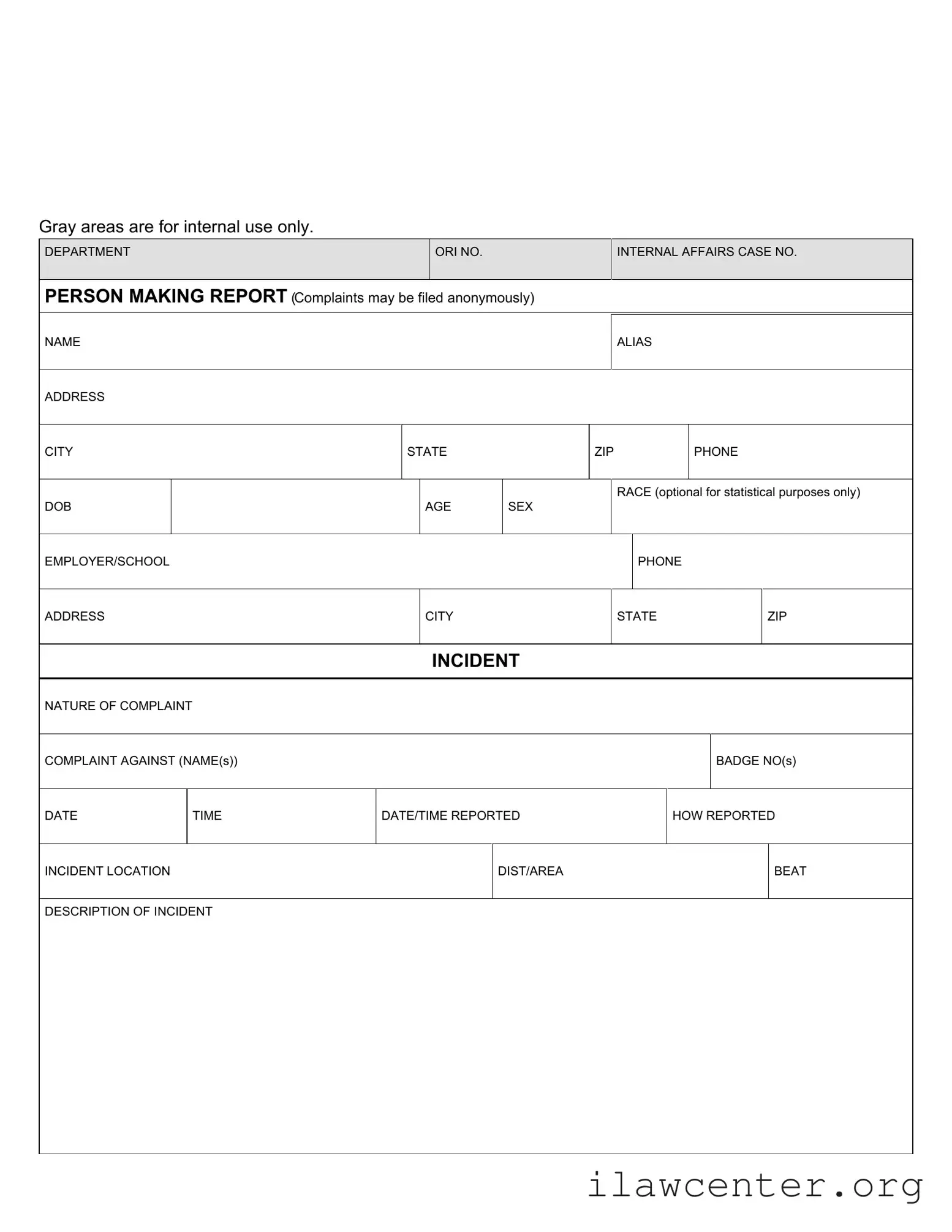
The Police Report form is a crucial document used to formally report incidents to law enforcement agencies. This form facilitates the collection of essential information regarding complaints, ensuring that all relevant details are captured for further investigation. If you need to file a report, please fill out the form by clicking the button below.

Article Guide

The Police Report form serves as a crucial tool for documenting incidents and complaints related to law enforcement activities. This form is utilized by various law enforcement agencies, including the Hanover Township Police Department and the Morris County Prosecutor’s Office, ensuring a standardized approach to reporting. Key components of the form include sections for personal information about the individual making the report, which can be submitted anonymously if desired. Details such as the name, address, and contact information help establish the context of the complaint. The form also requires information about the nature of the complaint, allowing individuals to specify the incident's details clearly. Furthermore, it includes sections for identifying the law enforcement personnel involved, including names and badge numbers, as well as the date, time, and location of the incident. A description of the incident itself is essential, along with any injuries sustained and medical treatment received. This comprehensive structure not only facilitates the reporting process but also aids in the investigation and resolution of complaints, ensuring accountability and transparency within law enforcement agencies.

Police Report Preview

Gray areas are for internal use only.
DEPARTMENT ORI NO.
INTERNAL AFFAIRS CASE NO.
PERSON MAKING REPORT (Complaints may be filed anonymously)
NAME
ALIAS
ADDRESS
CITY
STATE
ZIP
PHONE
DOB
AGE
SEX
RACE (optional for statistical purposes only)
EMPLOYER/SCHOOL
PHONE
ADDRESS
CITY
STATE
ZIP
INCIDENT
NATURE OF COMPLAINT
COMPLAINT AGAINST (NAME(s))
BADGE NO(s)
DATE
TIME
DATE/TIME REPORTED
HOW REPORTED
INCIDENT LOCATION
DIST/AREA
BEAT
DESCRIPTION OF INCIDENT
DESCRIPTION OF ANY INJURIES
PLACE OF
TREATMENT
DOCTOR’S
NAME
DATE OF
TREATMENT
SIGNATURE OF COMPLAINANT (Optional)
DATE
COMMENTS
SIGNATURE BADGE NO. DATE RECEIVED

File Properties

Fact Name Description
Purpose This form is used to file complaints regarding police conduct in Hanover Township and other Morris County law enforcement agencies.
Anonymity Individuals can file complaints anonymously, ensuring that their identity remains confidential if desired.
Required Information The form requests personal details such as name, address, and contact information of the complainant, along with specifics about the incident.
Incident Details Complainants must provide a clear description of the incident, including the nature of the complaint and any injuries sustained.
Governing Law This form is governed by New Jersey state law, specifically under the New Jersey Attorney General's guidelines for Internal Affairs investigations.
Submission Process Completed forms can be submitted to the Hanover Township Police Department or any law enforcement agency in Morris County.
Follow-Up After submission, the complainant may receive updates regarding the status of their report, depending on the agency's policies.

Instructions on Utilizing Police Report

Filling out the Police Report form requires careful attention to detail. Each section is designed to gather specific information about the incident and the individuals involved. Make sure to provide accurate and complete information to ensure that your report is processed effectively.

  1. Begin by entering the DEPARTMENT ORI NO. and INTERNAL AFFAIRS CASE NO. if available.
  2. Fill in the NAME of the person making the report. If you prefer to remain anonymous, this can be left blank.
  3. Provide your ALIAS, ADDRESS, CITY, DOB (Date of Birth), STATE, ZIP, and PHONE number.
  4. Optionally, include your RACE for statistical purposes.
  5. Enter your AGE and SEX.
  6. Fill out your EMPLOYER/SCHOOL name and PHONE number.
  7. Provide the ADDRESS, CITY, STATE, and ZIP of your employer or school.
  8. Describe the NATURE OF COMPLAINT.
  9. List the NAME(s) of the person(s) you are complaining against and their BADGE NO(s).
  10. Enter the DATE and TIME of the incident.
  11. Fill in the DATE/TIME REPORTED and how the incident was REPORTED.
  12. Provide the INCIDENT LOCATION, including DIST/AREA and BEAT if known.
  13. Write a detailed DESCRIPTION OF INCIDENT.
  14. Include any DESCRIPTION OF ANY INJURIES that occurred.
  15. Fill out the PLACE OF DOCTOR’S TREATMENT and the DATE OF TREATMENT.
  16. Provide the NAME of the doctor who treated you.
  17. Sign the report with your SIGNATURE OF COMPLAINANT (this is optional) and date it.
  18. Add any COMMENTS you feel are necessary.
  19. Finally, sign again with your SIGNATURE, include your BADGE NO. if applicable, and the DATE RECEIVED.

Important Facts about Police Report

What is the purpose of the Police Report form?

The Police Report form is designed to facilitate the filing of complaints against law enforcement agencies or officers. It allows individuals to report incidents they believe warrant investigation. This form can be submitted anonymously, ensuring that anyone can voice their concerns without fear of retaliation. The information collected helps maintain accountability within the police department and ensures that community members feel safe and heard.

Who can file a complaint using this form?

Any individual who has witnessed or experienced an incident involving law enforcement can file a complaint using this form. This includes members of the public, as well as employees or students of institutions. The form allows for anonymous submissions, meaning that even those who may be hesitant to disclose their identity can still report their concerns. This encourages transparency and fosters trust between the community and law enforcement.

What information do I need to provide on the form?

The form requires several pieces of information to ensure a thorough investigation. You will need to provide your name, contact information, and details about the incident, including the nature of the complaint, the names and badge numbers of the officers involved, and a description of what occurred. Additionally, if there were any injuries, you should note where treatment was received and the date of that treatment. This information is crucial for the department to address your concerns effectively.

How will my complaint be handled after I submit the form?

Once you submit the Police Report form, it will be reviewed by the Internal Affairs division of the police department. They will assess the details provided and determine the appropriate course of action. Depending on the nature of the complaint, this may involve an investigation, interviews with involved parties, or a review of relevant evidence. You may not receive updates if you filed anonymously, but rest assured that your complaint will be taken seriously and handled according to established procedures.

Common mistakes

Filling out a Police Report form can be a daunting task, and mistakes can lead to delays or complications in processing your report. Here are ten common errors people make when completing this important document.

One frequent mistake is not providing complete contact information. Missing details such as your address or phone number can hinder communication. Ensure all fields are filled out accurately to facilitate follow-up.

Another common error is failing to specify the nature of the complaint. This section is crucial for categorizing the incident. Be clear and concise about what happened to help law enforcement understand your situation better.

People often neglect to include the date and time of the incident. This information is vital for the investigation. Without it, officers may struggle to piece together the timeline of events.

Additionally, some individuals forget to mention the location of the incident. Providing a specific address or description of the area can significantly aid in the investigation process.

Another mistake is not identifying the complaint against individual(s) properly. Ensure that you include full names and any relevant details, such as badge numbers, to avoid confusion.

Many people also fail to describe the incident thoroughly. A vague description can lead to misunderstandings. Take the time to provide a clear and detailed account of what transpired.

Some individuals overlook the section regarding injuries. If you or anyone involved sustained injuries, it is crucial to document this information, including where treatment was received.

Another common oversight is not signing the form. While the signature is optional, it can lend credibility to your report. If you choose to sign, make sure it is done clearly and legibly.

People sometimes submit the report without reviewing it. Errors can easily slip through if you do not double-check your entries. A thorough review can prevent minor mistakes from causing major issues.

Finally, many individuals forget to include any comments that may provide additional context. This section can be an opportunity to clarify any points or add information that may not fit neatly into the other categories.

By being mindful of these common mistakes, you can help ensure that your Police Report is processed smoothly and efficiently. Taking the time to fill out the form accurately can make a significant difference in the outcome of your report.

Documents used along the form

When filing a police report, there are several other forms and documents that may be necessary to provide a complete picture of the incident. Each of these documents serves a specific purpose, helping law enforcement agencies, as well as the individuals involved, to navigate the complexities of legal proceedings and ensure that all relevant information is captured.

  • Incident Report Form: This document details the specifics of the event being reported, including the date, time, and location of the incident. It often includes witness statements and evidence collected at the scene, providing a comprehensive account for law enforcement.
  • Witness Statement Form: Individuals who observed the incident may be asked to fill out this form. It captures their account of what happened, helping to corroborate the details of the police report and providing additional perspectives on the event.
  • Victim Impact Statement: This form allows victims of a crime to describe how the incident has affected them personally. It may be used in court proceedings to inform judges about the emotional and physical toll on the victim.
  • Evidence Submission Form: When physical evidence is collected at a crime scene, this form is used to document what was collected, how it was stored, and who handled it. This ensures a clear chain of custody, which is crucial for legal proceedings.
  • Medical Report: If there are injuries involved, a medical report may be necessary. This document provides details about the injuries sustained, treatment received, and any ongoing medical issues, which can be important for both criminal and civil cases.
  • Internal Affairs Complaint Form: This form is used when a complaint is made against a law enforcement officer. It allows individuals to report misconduct or inappropriate behavior, ensuring accountability within the police force.

Each of these documents plays a vital role in the process of reporting and addressing incidents involving law enforcement. By understanding their purposes, individuals can better navigate the system and ensure that their concerns are adequately documented and addressed.

Similar forms

The Police Report form serves as a critical tool for documenting incidents and complaints within law enforcement agencies. Several other documents share similar functions and structures. Below is a list of eight documents that are akin to the Police Report form, detailing how they are similar.

  • Incident Report Form: This document captures the details of a specific incident, including the parties involved, the nature of the incident, and any injuries sustained. Like the Police Report form, it is designed for law enforcement use and often includes sections for witness statements and evidence collection.
  • Witness Statement Form: This form is used to collect testimonies from individuals who witnessed an event. It typically requests personal information from the witness and details about what they observed, paralleling the Police Report's focus on gathering comprehensive information about an incident.
  • Victim Impact Statement: This document allows victims of crime to describe how the crime has affected them. Similar to the Police Report form, it seeks to record personal experiences and emotional impacts, providing context to the incident reported.
  • Complaint Form: Often used by citizens to report grievances against law enforcement, this form collects information about the complainant, the nature of the complaint, and the incident details. It mirrors the Police Report form in its goal of documenting complaints against police conduct.
  • Accident Report Form: This document records details about traffic accidents, including involved parties, vehicle information, and circumstances of the accident. Like the Police Report form, it aims to create an official account of events for future reference.
  • Field Interview Report: Law enforcement officers use this form to document interactions with individuals during patrol. It includes personal information and the reason for the encounter, similar to how the Police Report form captures details about incidents and parties involved.
  • Arrest Report: This document outlines the circumstances surrounding an arrest, including the suspect's information, charges, and incident details. It shares the Police Report's focus on official documentation of law enforcement actions.
  • Evidence Log: This form tracks physical evidence collected during an investigation. It includes descriptions of items, their location, and chain of custody, paralleling the Police Report's aim of maintaining a clear record of incidents and related materials.

Dos and Don'ts

When filling out the Police Report form, attention to detail is crucial. Here are some important dos and don'ts to keep in mind:

  • Do provide accurate and complete information. Ensure that all fields are filled out to the best of your ability.
  • Do include specific details about the incident. The more information you provide, the better the investigation can proceed.
  • Do report the incident as soon as possible. Timely reporting can be vital for evidence gathering.
  • Do keep a copy of the report for your records. This can be useful for follow-up or reference.
  • Don't leave any fields blank unless absolutely necessary. Missing information can delay the process.
  • Don't include personal opinions or assumptions. Stick to the facts of what occurred.
  • Don't embellish or exaggerate details. Accuracy is essential for a credible report.
  • Don't forget to sign and date the report if required. This step can be important for validation.

By following these guidelines, you can help ensure that your report is effective and contributes positively to the investigation process.

Misconceptions

Misconceptions about the Police Report form can lead to confusion and misunderstandings. Here are eight common misconceptions explained:

  • Only victims can file a report. Anyone can file a report, including witnesses and anonymous complainants.
  • The report must be filed in person. Reports can often be submitted online or via mail, depending on the department's procedures.
  • All information must be provided upfront. While more information is helpful, it is not mandatory to fill out every section of the form.
  • Anonymity is not an option. Complainants can choose to file reports anonymously, ensuring their identity remains confidential.
  • The report guarantees an investigation. Filing a report does not automatically mean an investigation will occur; it depends on the circumstances and department policies.
  • Reports are only for serious incidents. Reports can be filed for any nature of complaint, regardless of severity.
  • Filing a report is a lengthy process. Many departments strive to make the process straightforward and efficient.
  • Once submitted, the report cannot be changed. Complainants may have the opportunity to provide additional information or corrections after submission.

Key takeaways

When filling out and using the Police Report form, it is essential to follow specific guidelines to ensure your report is effective and clear. Here are key takeaways to keep in mind:

  • Provide Accurate Information: Fill in all required fields with correct details. This includes your name, address, and the nature of the complaint.
  • Anonymous Reporting: You have the option to file a complaint anonymously. If you choose this route, ensure you still provide enough detail for the investigation.
  • Incident Details: Clearly describe the incident. Include dates, times, and locations to help law enforcement understand the context.
  • Injury Documentation: If there were any injuries, specify them. Mention where treatment was received and include the date of treatment.
  • Signature: While your signature is optional, signing the report can lend credibility to your complaint.
  • Follow Up: After submitting the report, keep a copy for your records. This will help you track any follow-up actions.
  • Know Your Rights: Understand that you have the right to file a complaint against law enforcement. Your concerns are valid and deserve attention.

By adhering to these takeaways, you can ensure that your Police Report form is completed effectively, contributing to a thorough investigation of your complaint.