Fillable Power of Attorney for a Child Document

Fillable Power of Attorney for a Child Document

The Power of Attorney for a Child form is a legal document that allows a parent or guardian to grant temporary authority to another individual to make decisions on behalf of their child. This form can be essential for situations such as travel, medical care, or education when the parent is unavailable. To ensure the well-being of your child, consider filling out the form by clicking the button below.

Article Guide

The Power of Attorney for a Child form serves as a vital legal instrument that allows a parent or legal guardian to delegate specific parental rights and responsibilities to another individual, often referred to as an agent or attorney-in-fact. This arrangement is particularly useful in situations where the parent or guardian is unable to care for the child due to travel, illness, or other circumstances. The form typically outlines the scope of authority granted, which may include decisions related to education, healthcare, and general welfare. Importantly, the document can be tailored to meet the unique needs of the family, allowing for flexibility in designating powers that can be temporary or long-term. Additionally, it is crucial for the form to comply with state laws, as requirements can vary significantly across jurisdictions. By executing this form, parents can ensure that their child’s needs are met in their absence, providing peace of mind while maintaining control over who is entrusted with their child's care.

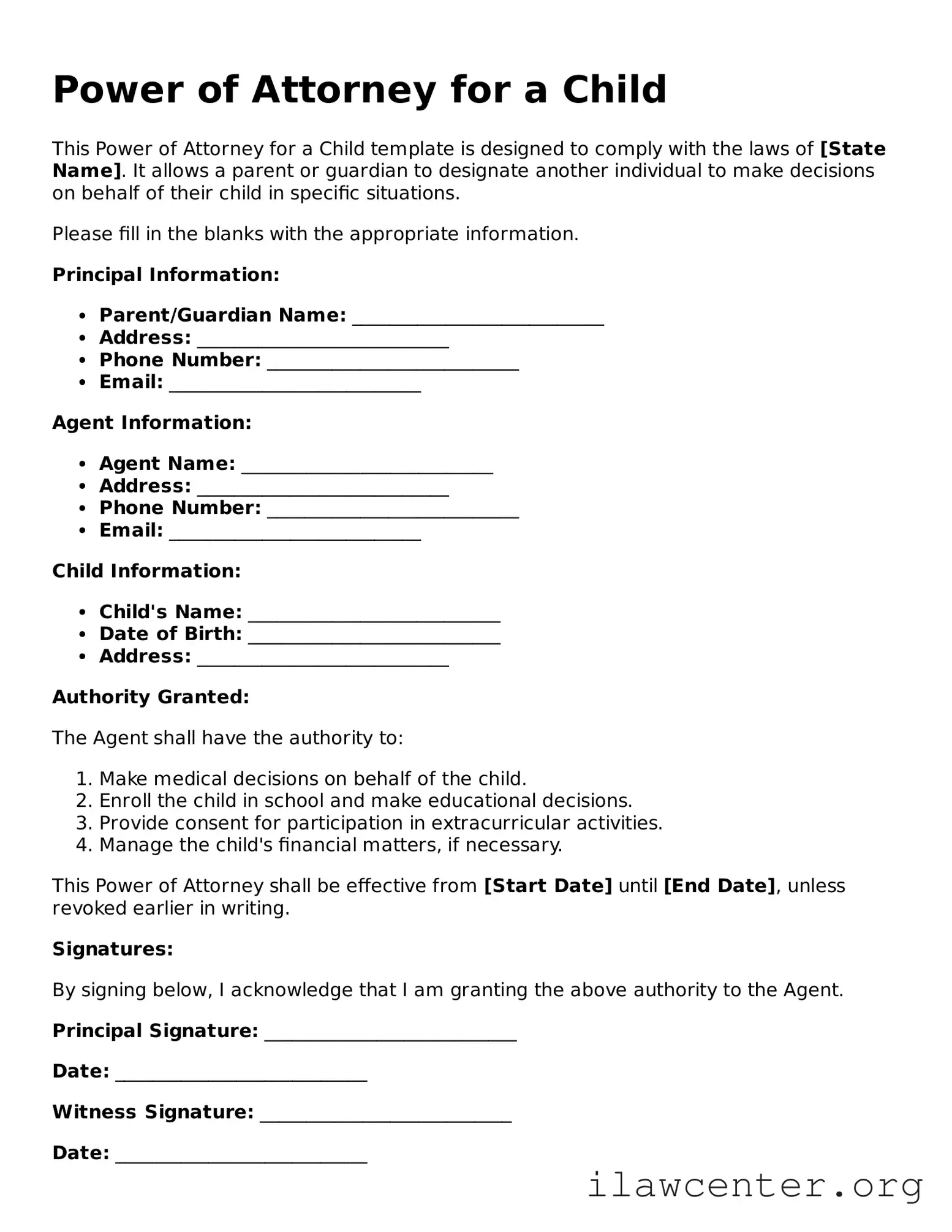
Power of Attorney for a Child Preview

Power of Attorney for a Child

This Power of Attorney for a Child template is designed to comply with the laws of [State Name]. It allows a parent or guardian to designate another individual to make decisions on behalf of their child in specific situations.

Please fill in the blanks with the appropriate information.

Principal Information:

  • Parent/Guardian Name: ___________________________
  • Address: ___________________________
  • Phone Number: ___________________________
  • Email: ___________________________

Agent Information:

  • Agent Name: ___________________________
  • Address: ___________________________
  • Phone Number: ___________________________
  • Email: ___________________________

Child Information:

  • Child's Name: ___________________________
  • Date of Birth: ___________________________
  • Address: ___________________________

Authority Granted:

The Agent shall have the authority to:

  1. Make medical decisions on behalf of the child.
  2. Enroll the child in school and make educational decisions.
  3. Provide consent for participation in extracurricular activities.
  4. Manage the child's financial matters, if necessary.

This Power of Attorney shall be effective from [Start Date] until [End Date], unless revoked earlier in writing.

Signatures:

By signing below, I acknowledge that I am granting the above authority to the Agent.

Principal Signature: ___________________________

Date: ___________________________

Witness Signature: ___________________________

Date: ___________________________

Notary Public:

State of [State Name], County of ___________________________

Subscribed and sworn to before me this ____ day of __________, 20__.

Notary Signature: ___________________________

My Commission Expires: ___________________________

PDF Form Characteristics

Fact Name Description
Definition A Power of Attorney for a Child form allows a parent or guardian to give another person the authority to make decisions on behalf of their child.
Legal Authority This form is governed by state laws regarding powers of attorney and child custody, which can vary by state.
Duration The authority granted can be temporary or permanent, depending on the needs of the child and the specifics outlined in the form.
Limitations Some states may impose restrictions on the types of decisions that can be made under this form, such as medical or educational choices.
Revocation A parent or guardian can revoke the Power of Attorney at any time, as long as they follow the proper legal procedures.

Instructions on Utilizing Power of Attorney for a Child

Filling out the Power of Attorney for a Child form is a straightforward process. This form allows a designated adult to make decisions on behalf of a child when necessary. Follow the steps below to complete the form accurately.

  1. Obtain the Power of Attorney for a Child form. You can find it online or at local legal offices.
  2. Read through the entire form carefully to understand the information required.
  3. Begin by filling in the child's full name and date of birth in the designated fields.
  4. Provide the name and contact information of the person being granted power of attorney.
  5. Clearly state the duration for which the power of attorney will be effective. Specify start and end dates if applicable.
  6. Indicate the specific powers being granted. Be clear about the decisions the designated adult can make.
  7. Include your name and signature as the parent or legal guardian of the child.
  8. Have the form notarized to ensure its validity. This step may require the presence of both the parent and the designated adult.
  9. Make copies of the completed and notarized form for your records and provide a copy to the designated adult.

Once you have filled out the form, ensure that all information is correct and complete. The next step is to keep the form in a safe place and inform relevant parties about the arrangement.

Important Facts about Power of Attorney for a Child

What is a Power of Attorney for a Child form?

A Power of Attorney for a Child form is a legal document that allows a parent or legal guardian to designate another adult to make decisions on behalf of their child. This arrangement is particularly useful in situations where the parent or guardian may be unavailable, such as during travel, medical emergencies, or other circumstances that require someone to step in temporarily. The designated adult, often referred to as the "agent," can make decisions regarding the child's health care, education, and general welfare, depending on the specific powers granted in the document.

Why would I need to create a Power of Attorney for my child?

Creating a Power of Attorney for your child can provide peace of mind. If you are traveling, for instance, this document ensures that your child will have a trusted adult available to make important decisions if necessary. It can also be beneficial in emergency situations where you may not be able to be reached. Additionally, some schools and medical facilities may require a Power of Attorney to allow another adult to act on your behalf, ensuring that your child's needs are met promptly and effectively.

How do I create a Power of Attorney for my child?

To create a Power of Attorney for your child, you typically need to fill out a specific form that outlines the powers you wish to grant to the designated adult. This form may vary by state, so it’s important to use the correct version for your location. After completing the form, both you and the designated adult should sign it in the presence of a notary public to ensure its validity. In some cases, witnesses may also be required. Once the document is properly executed, it is advisable to provide copies to all relevant parties, including the designated adult, schools, and medical providers.

Can I revoke a Power of Attorney for my child once it is created?

Yes, you can revoke a Power of Attorney for your child at any time, as long as you are still legally competent to do so. To revoke the document, you should create a written notice stating your intent to revoke the Power of Attorney. It is also a good practice to inform the designated adult and any institutions that may have a copy of the original document. This ensures that there is no confusion regarding who has the authority to make decisions for your child.

Common mistakes

Filling out the Power of Attorney for a Child form can be a straightforward process, but many individuals make common mistakes that can lead to complications. One frequent error is failing to specify the scope of authority granted to the agent. It’s essential to clearly outline what decisions the agent can make regarding the child’s education, healthcare, and general welfare. Without this clarity, the agent may not have the legal power needed to act in the child's best interests.

Another common mistake involves not including the necessary identification information for both the parent and the agent. This includes full names, addresses, and contact information. Omitting any of these details can result in delays or even rejection of the document. Ensuring that all required information is complete and accurate helps to validate the authority granted.

Additionally, many people overlook the importance of having the document notarized. While some states may not require notarization, having the Power of Attorney for a Child form notarized adds an extra layer of legal protection. It helps to confirm the identities of the signatories and can prevent disputes about the validity of the document in the future.

Lastly, individuals often forget to discuss the arrangement with the child involved. Children, especially those who are older, should be made aware of the Power of Attorney and what it entails. This conversation can help alleviate any confusion or anxiety the child might feel about the arrangement. Open communication fosters trust and ensures that the child understands the role of the appointed agent.

Documents used along the form

When preparing a Power of Attorney for a Child form, it is often helpful to consider additional documents that may be necessary for a comprehensive legal arrangement. These documents can provide clarity and support in various situations concerning the care and welfare of a child. Below are some commonly used forms that complement the Power of Attorney for a Child.

  • Parental Consent Form: This document grants permission for a designated individual to make decisions on behalf of the child, particularly in situations involving medical care or educational needs.
  • Medical Authorization Form: This form allows a caregiver to seek medical treatment for a child. It ensures that the caregiver has the authority to make health-related decisions if the parent is unavailable.
  • Emergency Contact Form: This document lists individuals who can be contacted in case of an emergency. It provides vital information about the child’s medical history and preferences for care.
  • Child Care Agreement: This agreement outlines the responsibilities and expectations between the parent and the caregiver. It can cover aspects such as daily routines, financial support, and educational decisions.
  • School Authorization Form: This form allows a caregiver to enroll a child in school and make educational decisions. It ensures that the caregiver has the authority to act on behalf of the child in an academic setting.

Considering these documents can help ensure that all aspects of a child's care are addressed. It is important to understand each form's purpose and how they work together with the Power of Attorney for a Child to provide a secure and supportive environment for the child.

Similar forms

  • General Power of Attorney: This document allows one person to grant another the authority to make decisions on their behalf, similar to how a Power of Attorney for a Child allows a caregiver to make decisions for a minor.
  • Healthcare Power of Attorney: This form specifically designates someone to make medical decisions for another person, akin to how the Power of Attorney for a Child allows decisions regarding a child's health and welfare.
  • Guardianship Agreement: This legal document establishes a guardian for a child, much like a Power of Attorney for a Child, which appoints someone to care for and make decisions for a minor.
  • Child Custody Agreement: This outlines the custody arrangement for a child, similar to the way a Power of Attorney for a Child defines who has authority over a child's affairs.
  • Educational Power of Attorney: This allows a designated person to make educational decisions for a child, paralleling the authority granted in a Power of Attorney for a Child.
  • Temporary Guardianship Form: This document provides temporary authority to care for a child, similar to the Power of Attorney for a Child, which can be used for specific time periods.
  • Living Will: While primarily focused on healthcare decisions, a living will can relate to the care of a child in emergencies, similar to how a Power of Attorney for a Child can address urgent situations.
  • Consent to Medical Treatment: This form allows a caregiver to consent to medical treatment for a child, similar to the decision-making powers granted in a Power of Attorney for a Child.
  • Travel Consent Form: This document gives permission for a child to travel with someone else, much like a Power of Attorney for a Child allows a designated person to make travel decisions.
  • Financial Power of Attorney: This grants authority to manage financial matters for another person, akin to how a Power of Attorney for a Child allows for the management of a child’s financial needs.

Dos and Don'ts

When filling out the Power of Attorney for a Child form, it’s important to follow certain guidelines to ensure everything is completed correctly. Here are five things you should and shouldn't do:

  • Do read the entire form carefully before starting.
  • Do provide accurate information about the child and the designated agent.
  • Do sign the form in the presence of a notary public if required.
  • Don't leave any sections blank; complete all necessary fields.
  • Don't use outdated forms; always check for the latest version.

Misconceptions

The Power of Attorney for a Child form can be misunderstood in several ways. Here are some common misconceptions:

  • It gives complete control over the child. Many people think that this form grants the agent full parental rights. In reality, it allows the agent to make specific decisions, but it does not replace the legal parents' authority.
  • It is permanent. Some believe that once the form is signed, it lasts forever. However, this form is typically temporary and can be revoked by the parent at any time.
  • It requires a lawyer to complete. While legal advice can be helpful, it is not necessary to have a lawyer to fill out this form. Parents can often complete it on their own, as long as they understand the requirements.
  • It can only be used for emergencies. Some assume this form is only for urgent situations. In truth, it can be used for various circumstances, such as travel or when a parent is unavailable for an extended period.

Key takeaways

Filling out and using the Power of Attorney for a Child form is an important step for parents and guardians. Here are some key takeaways to consider:

  • Ensure that the form is filled out completely and accurately. Missing information can lead to complications.
  • The Power of Attorney should be signed in the presence of a notary public. This adds legal validity to the document.
  • Clearly specify the powers granted to the agent. This helps avoid misunderstandings about what the agent can and cannot do.
  • Keep copies of the completed form in a safe place and provide a copy to the agent. This ensures everyone has access to the necessary information.