Ppd Skin Test PDF Template

Ppd Skin Test PDF Template

The PPD Skin Test form is a document used to record important information regarding tuberculosis screening through a skin test. It captures patient and student details, as well as specifics about the administration and results of the test. To ensure accurate documentation, consider filling out the form by clicking the button below.

Article Guide

The PPD Skin Test Record Form is an essential document used in the administration and tracking of the tuberculin skin test, commonly known as the PPD test. This form collects vital patient information, including the individual's name, address, and contact details, ensuring that healthcare providers can easily identify and communicate with patients. For students, there is a designated section to include their student ID and class year, which is particularly useful in educational settings where health compliance is crucial. The form also captures critical details about the test itself, such as the administrator's name, the date and time the test was given, and the specific arm where the test was administered. Additionally, it includes information about the PPD solution used, including the manufacturer, expiration date, and lot number, which are important for ensuring the test's reliability and safety. After the test is administered, the results section allows for the recording of induration measurements, the date and time of reading, and any comments or adverse reactions observed. Finally, the form requires the printed name and title of the healthcare provider who interprets the results, along with their signature and the date, adding an extra layer of accountability and professionalism to the process.

Ppd Skin Test Preview

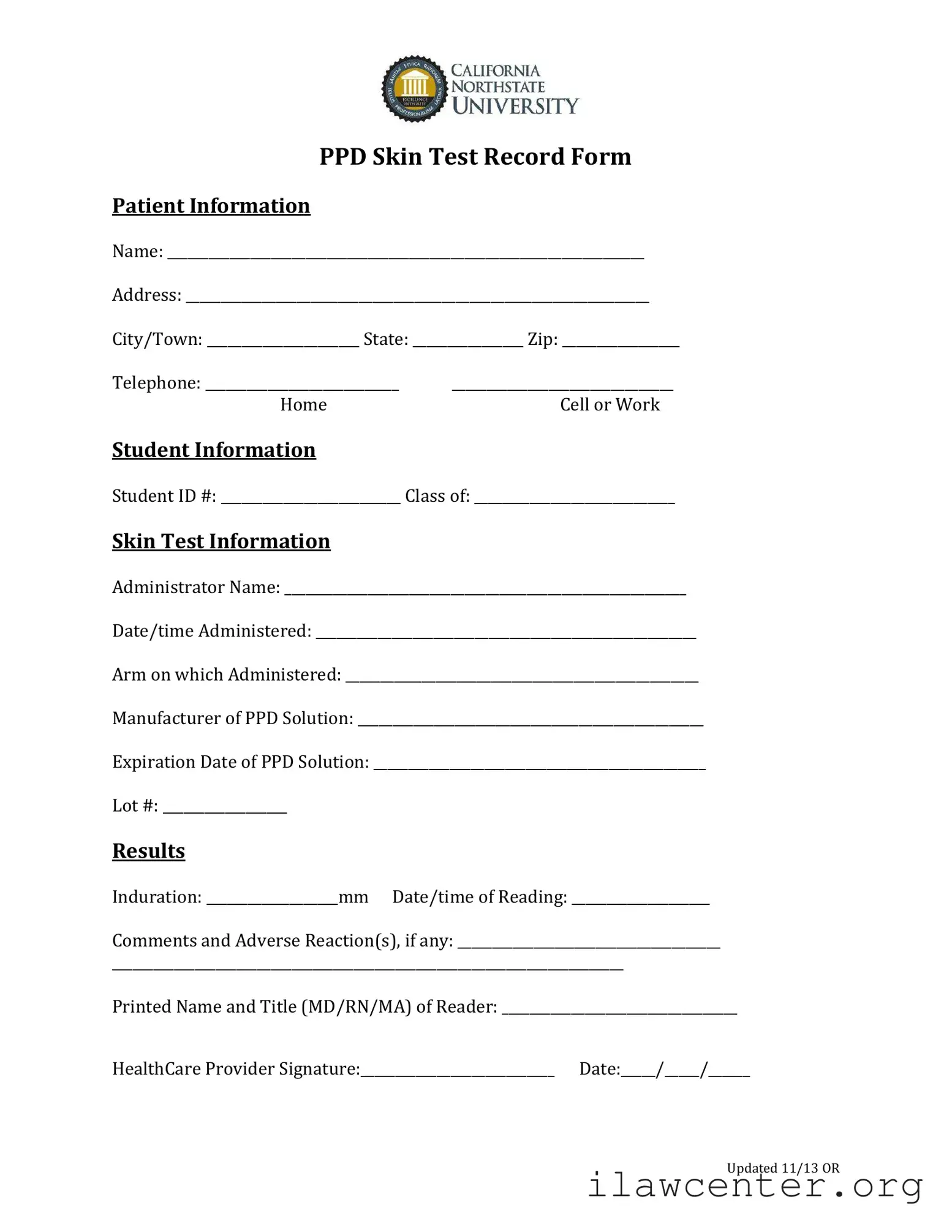
Updated 11/13 OR
PPD Skin Test Record Form
Patient Information
Name: _____________________________________________________________________
Address: ___________________________________________________________________
City/Town: ______________________ State: ________________ Zip: _________________
Telephone: ____________________________ ________________________________
Home Cell or Work
Student Information
Student ID #: __________________________ Class of: _____________________________
Skin Test Information
Administrator Name: __________________________________________________________
Date/time Administered: _______________________________________________________
Arm on which Administered: ___________________________________________________
Manufacturer of PPD Solution: __________________________________________________
Expiration Date of PPD Solution: ________________________________________________
Lot #: __________________
Results
Induration: ___________________mm Date/time of Reading: ____________________
Comments and Adverse Reaction(s), if any: ______________________________________
__________________________________________________________________________
Printed Name and Title (MD/RN/MA) of Reader: __________________________________
HealthCare Provider Signature:____________________________ Date:_____/_____/______

File Properties

Fact Name Description
Patient Information This section collects essential details about the patient, including their name, address, and contact numbers. Accurate information is crucial for follow-up and record-keeping.
Student Information For students, this form requires a Student ID and class year. This helps educational institutions track health compliance among their students.
Skin Test Information The administrator’s name, date and time of administration, and specifics about the PPD solution are documented here. This ensures accountability and traceability of the test.
Results Section This part records the induration measurement and the date/time of reading. It is vital for assessing whether the test result is positive or negative.
Governing Laws State-specific regulations, such as those in California (California Health and Safety Code § 120880), govern the use and documentation of PPD skin tests in healthcare settings.

Instructions on Utilizing Ppd Skin Test

After completing the PPD Skin Test form, the next steps involve submitting it to the appropriate healthcare provider for review. The healthcare provider will then assess the results and determine any necessary follow-up actions based on the findings.

  1. Patient Information: Fill in your full name in the designated space.
  2. Provide your complete address, including city, state, and zip code.
  3. Enter your telephone number, indicating whether it is your home, cell, or work number.
  1. Student Information: If applicable, write your Student ID number.
  2. Indicate your class year in the space provided.
  1. Skin Test Information: Write the name of the administrator who performed the test.
  2. Record the date and time the test was administered.
  3. Specify which arm the test was given on.
  4. Note the manufacturer of the PPD solution used for the test.
  5. Write down the expiration date of the PPD solution.
  6. Fill in the lot number of the PPD solution.
  1. Results: Measure and document the induration in millimeters.
  2. Record the date and time the results were read.
  3. If there were any comments or adverse reactions, include them in the designated space.
  4. Print the name and title of the reader (MD/RN/MA) at the bottom of the form.
  5. Finally, the healthcare provider should sign the form and date it.

Important Facts about Ppd Skin Test

What is the purpose of the PPD skin test?

The PPD skin test, also known as the tuberculin skin test, is used to determine if someone has been exposed to the bacteria that cause tuberculosis (TB). By injecting a small amount of PPD solution under the skin, healthcare providers can assess the immune response, indicating whether a person has been infected with TB.

How is the PPD skin test administered?

The test is administered by a healthcare professional who injects a small amount of PPD solution into the skin, usually on the forearm. The area is then marked, and the individual is instructed to return within 48 to 72 hours for the reading of the results.

What should I expect after the test is administered?

After receiving the PPD skin test, it is common to experience a small bump at the injection site. This reaction is normal. However, it is important to monitor the site for any unusual symptoms, such as excessive redness, swelling, or pain.

How is the test result interpreted?

The test result is measured by the size of induration (the raised area) at the injection site. A healthcare provider will assess the size in millimeters and consider factors such as the individual's risk factors for TB. A larger induration may indicate a positive result, suggesting possible TB exposure.

What if I have a positive result?

If the PPD skin test result is positive, further evaluation is necessary. This may include a chest X-ray or additional tests to determine if active TB is present. It's important to follow up with a healthcare provider for appropriate next steps.

Are there any risks associated with the PPD skin test?

The PPD skin test is generally safe. However, some individuals may experience mild side effects, such as soreness at the injection site. In rare cases, an allergic reaction may occur. It is crucial to inform the healthcare provider of any known allergies prior to the test.

Who should get a PPD skin test?

Individuals at higher risk for tuberculosis exposure, such as healthcare workers, those living in crowded conditions, or individuals with compromised immune systems, should consider getting a PPD skin test. Additionally, some employers or educational institutions may require testing as part of their health protocols.

How long does it take to get results?

Results of the PPD skin test are typically read 48 to 72 hours after administration. The healthcare provider will assess the injection site during this follow-up visit to determine the size of any induration and provide results.

What information is recorded on the PPD Skin Test form?

The PPD Skin Test form captures essential details, including patient information, student identification, the administrator's name, date and time of administration, the arm used, the manufacturer and expiration date of the PPD solution, and the results of the test. It also includes a section for comments on any adverse reactions and the signature of the healthcare provider who read the test.

Common mistakes

Filling out the PPD Skin Test form can seem straightforward, but many people make common mistakes that can lead to confusion or delays. One frequent error is leaving out essential personal information. Fields like name, address, and phone number should be filled out completely. Incomplete information can hinder communication and follow-up.

Another mistake is misidentifying the arm on which the test was administered. It’s crucial to clearly indicate whether the left or right arm was used. This information is vital for accurate record-keeping and for any future tests. Additionally, some individuals forget to include the date and time when the test was administered. This detail is important for monitoring the results and ensuring proper timing for reading the test.

People also sometimes overlook the section for the manufacturer of the PPD solution. This information is necessary for tracking the source of the test material and ensuring its validity. Similarly, the expiration date of the PPD solution should not be neglected. Using expired materials can lead to inaccurate results, so double-checking this date is essential.

Another common oversight involves the results section. Induration, measured in millimeters, must be recorded accurately. A blank or incorrect measurement can lead to misinterpretation of the test results. Furthermore, the date and time of reading should be filled out to provide a clear timeline of the testing process.

People often forget to include comments or any adverse reactions in the designated section. This information can be crucial for healthcare providers to understand how a patient reacted to the test. Lastly, signatures are sometimes missing. Both the healthcare provider’s printed name and signature are necessary to validate the results and ensure accountability.

Documents used along the form

The PPD Skin Test form is an essential document used to record the administration and results of the tuberculosis skin test. Several other forms and documents may accompany this test to ensure comprehensive patient care and accurate record-keeping. Below is a list of additional forms that are often used in conjunction with the PPD Skin Test form.

  • Patient Medical History Form: This document collects detailed information about the patient's medical history, including past illnesses, surgeries, and any medications currently being taken. It provides healthcare providers with crucial context for interpreting test results.
  • Informed Consent Form: Before administering the PPD test, patients must understand the procedure and its potential risks. This form outlines the purpose of the test, what to expect, and any possible side effects, ensuring that patients give informed consent.
  • Immunization Record: This record tracks a patient's vaccination history, which can be relevant when assessing their risk for tuberculosis. It helps healthcare providers determine if additional testing or vaccinations are necessary.
  • Follow-Up Appointment Form: If the PPD test results are positive, a follow-up appointment may be required. This form schedules the appointment and outlines any additional tests or evaluations that may be needed.
  • Referral Form: In cases where further evaluation is necessary, a referral form may be used to direct the patient to a specialist, such as a pulmonologist or infectious disease expert. This document includes relevant patient information and the reason for the referral.
  • Test Result Notification Form: This form is used to communicate the results of the PPD test to the patient. It ensures that patients receive timely information regarding their health status and any recommended next steps.

These documents work together to provide a complete picture of a patient's health and facilitate effective communication between healthcare providers and patients. Proper documentation is vital in ensuring that patients receive the best possible care and follow-up based on their PPD test results.

Similar forms

The PPD Skin Test form serves a specific purpose in documenting tuberculosis screening. However, several other documents share similarities in structure and function. Below is a list of eight such documents, each with a brief description of how they relate to the PPD Skin Test form.

  • Vaccination Record Form: Like the PPD Skin Test form, this document captures essential patient information, the type of vaccine administered, and the date of administration. Both forms require a healthcare provider's signature for validation.
  • Medical History Form: This form collects comprehensive information about a patient's past medical conditions and treatments. Similar to the PPD Skin Test form, it emphasizes patient identification and may include sections for provider notes and observations.
  • Physical Examination Report: This document outlines the findings from a physical examination, including patient details and the examiner's observations. It parallels the PPD Skin Test form in its focus on documenting specific health assessments and results.
  • Allergy Assessment Form: This form details a patient's known allergies and reactions. It shares the PPD Skin Test form's emphasis on patient information and adverse reactions, ensuring that healthcare providers have critical data for safe treatment.
  • Consent Form for Medical Procedures: This document secures patient consent for medical treatments or tests. Like the PPD Skin Test form, it requires clear patient identification and a healthcare provider's signature, ensuring informed consent.
  • Lab Test Requisition Form: This form requests laboratory tests and includes patient details, test type, and physician information. It is similar to the PPD Skin Test form in that both require precise documentation to facilitate accurate medical evaluations.
  • Referral Form: This document is used when a healthcare provider refers a patient to a specialist. It contains patient information and the reason for referral, mirroring the PPD Skin Test form's focus on clear communication of patient data.
  • Follow-Up Visit Note: This form records the details of a patient's follow-up visit, including observations and recommendations. It reflects the PPD Skin Test form's structure by documenting patient information and healthcare provider input.

Dos and Don'ts

When filling out the PPD Skin Test form, it is important to follow certain guidelines to ensure accuracy and compliance. Below are five things you should and shouldn't do:

  • Do provide complete and accurate patient information, including name, address, and contact details.
  • Do fill in all required fields, such as the student ID number and class year, if applicable.
  • Do ensure the administrator’s name and the date/time of administration are clearly recorded.
  • Don't leave any sections blank unless they are marked as optional.
  • Don't forget to sign and date the form after completion to validate the information provided.

Misconceptions

Understanding the PPD skin test is crucial for both patients and healthcare providers. However, several misconceptions can lead to confusion. Here are four common misunderstandings about the PPD skin test form:

  • The PPD test is only for tuberculosis screening. While the PPD skin test is primarily used to detect tuberculosis (TB) infection, it can also be part of broader health assessments. It helps identify individuals who may need further evaluation for TB, but it is not a definitive diagnosis on its own.
  • A negative result means no exposure to TB. A negative result does not necessarily mean that a person has never been exposed to TB. Factors such as recent exposure, a weakened immune system, or certain medical conditions can affect the test's accuracy. Therefore, follow-up testing may be needed for those at high risk.
  • The test can be done at any time without preparation. While the PPD skin test is straightforward, certain preparations are recommended. For instance, individuals should avoid certain medications that can affect immune response. Consulting with a healthcare provider before the test is advisable to ensure accurate results.
  • Results are immediate. Many people believe they will receive results right after the test is administered. In reality, the reading of the test must occur 48 to 72 hours later. This timeframe is necessary for the body to react to the PPD solution, allowing healthcare providers to assess the induration accurately.

Key takeaways

Filling out the PPD Skin Test form accurately is essential for proper record-keeping and patient care. Here are key takeaways to consider:

  • Patient Information: Ensure all sections are filled out completely, including name, address, and phone numbers.
  • Student Information: If applicable, include the student ID and class year to maintain accurate records.
  • Administrator Name: Document the name of the person administering the test for accountability.
  • Date and Time: Record the exact date and time the test is administered to track the timing of results.
  • Arm Selection: Clearly indicate which arm the test was administered on to avoid confusion during the reading.
  • Manufacturer Details: Note the manufacturer and expiration date of the PPD solution to ensure validity.
  • Lot Number: Record the lot number of the PPD solution for traceability in case of adverse reactions.
  • Results Section: Measure and document the induration accurately in millimeters for proper evaluation.
  • Date and Time of Reading: Log the date and time when the test results are read to maintain a clear timeline.
  • Comments: Include any adverse reactions or comments to provide context for the results.

Completing the PPD Skin Test form thoroughly helps ensure patient safety and compliance with health regulations.