Prescription Label PDF Template

Prescription Label PDF Template

The Prescription Label form is a document used to provide essential information about a prescribed medication, including dosage instructions and patient details. This form ensures that patients receive their medications safely and effectively. To get started, fill out the form by clicking the button below.

Article Guide

When it comes to managing medications, the Prescription Label form plays a vital role in ensuring safety and clarity for patients. This essential document provides crucial information about the prescribed medication, including the patient's name, dosage instructions, and the prescribing physician's details. Additionally, it often highlights potential side effects, storage instructions, and refill information, making it a comprehensive guide for anyone taking the medication. Understanding the components of this form can empower patients to adhere to their treatment plans effectively. By familiarizing oneself with the key aspects of the Prescription Label form, individuals can navigate their healthcare journey with confidence, ensuring they take their medications correctly and safely.

Prescription Label Preview

Prescription Labels
When you go to a doctor, for a check-up, or because you are sick, the doctor
may decide that you need prescription medicine.
The label on your prescription has important information. This information will
be on the label. Some labels may have it in a different order.
1
2
3
Main Street Pharmacy
1200 Main Street North, Minneapolis, MN
Dr. R. Wilson
Rx No: 300443
(612) 555-1234
01/04/2005
4
JOHN JOHNSON
5
Dose: TAKE ONE TABLET BY MOUTH, DAILY.
6
Zocor Tabs Mfg Merck
7
8
Qty: 30
REFILLS: 3 BEFORE 12/08/05
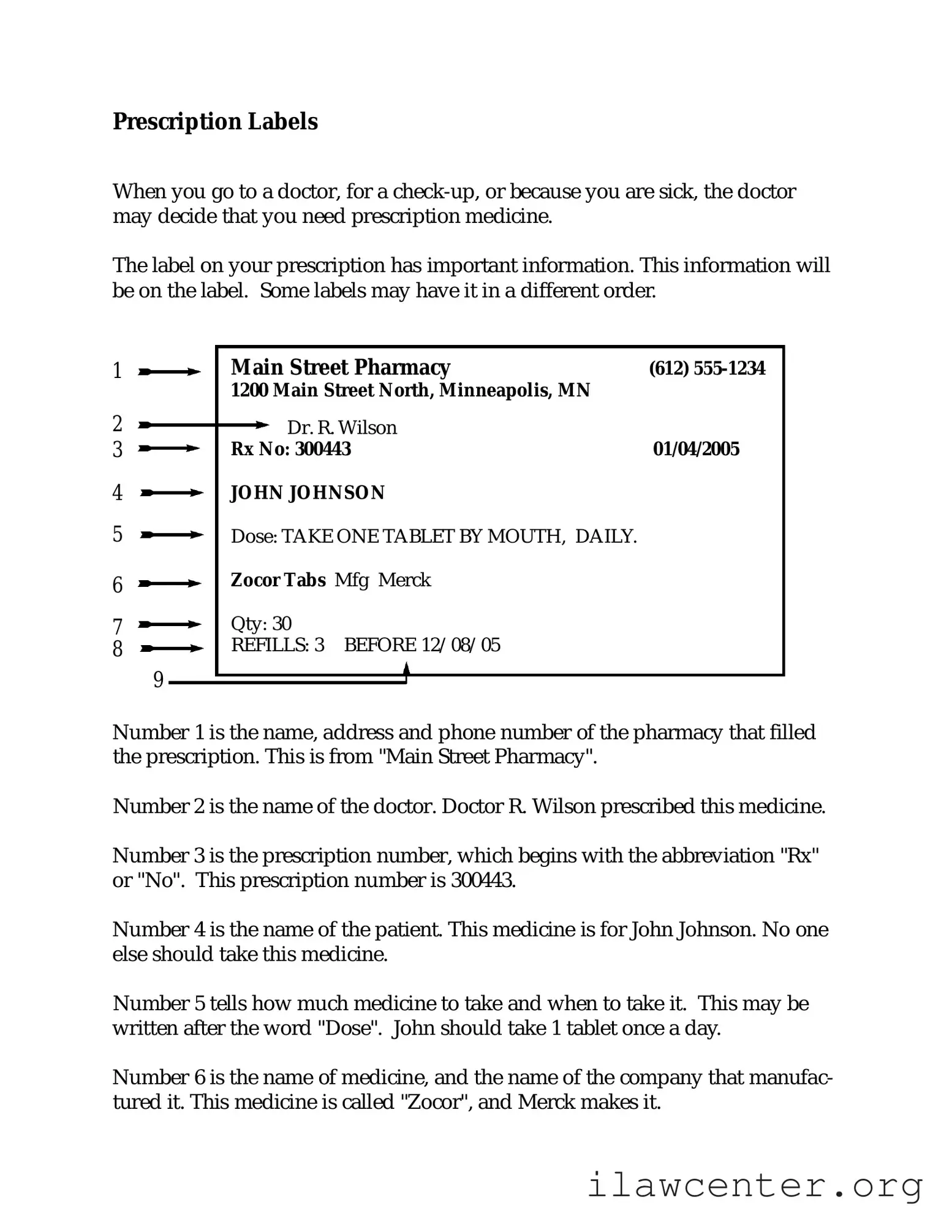
Number 1 is the name, address and phone number of the pharmacy that filled
the prescription. This is from "Main Street Pharmacy".
Number 2 is the name of the doctor. Doctor R. Wilson prescribed this medicine.
Number 3 is the prescription number, which begins with the abbreviation "Rx"
or "No". This prescription number is 300443.
Number 4 is the name of the patient. This medicine is for John Johnson. No one
else should take this medicine.
Number 5 tells how much medicine to take and when to take it. This may be
written after the word "Dose". John should take 1 tablet once a day.
Number 6 is the name of medicine, and the name of the company that manufac-
tured it. This medicine is called "Zocor", and Merck makes it.
9
Number 7 is the number of tablets. This may be written after the abbreviation
"Qty" or the word "Quantity". This prescription is for 30 pills.
Number 8 is the number of refills available. When no refills are available the
number will be "0".
Number 9 is the expiration date of the prescription. This may be written after
"refill before" or the abbreviation "Exp". This is the last date the pharmacy can
refill the prescription.
For more information about OTC medicine labels see OTC Labels.
For more information about warning labels see Warning Labels.
For more information about the side effects of medicine see Side Effects.
The LaRue Medical Literacy Exercises were created by Charles LaRue through a grant from the Minnesota Department of Education
under the supervision of the Minnesota Literacy Council.
©2005 MN Dept of Education

File Properties

Fact Name Details
Purpose The Prescription Label form is used to provide essential information about prescribed medications.
Required Information It typically includes the patient's name, medication name, dosage, and instructions for use.
State-Specific Regulations Each state may have unique requirements for prescription labels, governed by state pharmacy laws.
Governing Law In California, for instance, the governing law is the California Business and Professions Code, Section 4160.
Patient Safety Clear labeling helps prevent medication errors and ensures patient safety.
Pharmacist Responsibilities Pharmacists must verify that all required information is accurate before dispensing medication.
Format Labels are usually printed and must be legible and easy to read.
Expiration Dates Labels must also indicate the expiration date of the medication to ensure its effectiveness.

Instructions on Utilizing Prescription Label

Filling out the Prescription Label form is an important step in ensuring that medication is clearly and accurately communicated. Once you have completed the form, it will be ready for processing, allowing the pharmacy to prepare the medication correctly and efficiently.

  1. Begin by entering the patient's name in the designated field. Make sure to spell it correctly to avoid any confusion.
  2. Next, input the patient's date of birth. This helps in verifying the identity of the patient.
  3. In the following section, provide the prescribing physician's name. This is crucial for any necessary follow-up or clarification.
  4. Enter the medication name as it appears on the prescription. Double-check the spelling to ensure accuracy.
  5. Specify the dosage as indicated by the physician. This is essential for proper administration of the medication.
  6. Indicate the frequency of dosage—how often the medication should be taken each day.
  7. Fill in the number of refills authorized by the physician. This informs the pharmacy how many times the prescription can be refilled.
  8. Finally, review all the information you have entered for any errors or omissions before submitting the form.

Important Facts about Prescription Label

What is the Prescription Label form?

The Prescription Label form is a document used to provide essential information about a medication prescribed by a healthcare provider. This form typically includes details such as the patient's name, the medication name, dosage instructions, and the prescribing physician's information. It serves as a guide for patients to ensure they take their medication correctly and safely.

Why is the Prescription Label form important?

This form plays a crucial role in patient safety. It helps prevent medication errors by clearly outlining how and when to take the medication. Additionally, it ensures that patients have access to important information about potential side effects and interactions with other drugs. By following the instructions on the label, patients can manage their health more effectively.

How can I obtain a Prescription Label form?

You can obtain a Prescription Label form from your healthcare provider or pharmacist. When a prescription is filled, the pharmacy will typically provide a label that includes all necessary information. If you need a new label or have lost the original, do not hesitate to ask your pharmacist for assistance. They are there to help you understand your medication.

What should I do if the information on the Prescription Label form is incorrect?

If you notice any discrepancies on your Prescription Label form, it is vital to address them immediately. Contact your pharmacist or healthcare provider as soon as possible. They can verify the information and make any necessary corrections. Ensuring that the information is accurate is essential for your safety and well-being.

Can I use the Prescription Label form for over-the-counter medications?

The Prescription Label form is primarily designed for prescription medications. However, over-the-counter medications may also come with labels that provide important information. While these labels may not follow the same format as a Prescription Label form, they still contain vital details about dosage and usage. Always read these labels carefully to ensure safe consumption.

What should I do if I have questions about my medication after reading the Prescription Label form?

If you have questions or concerns after reviewing your Prescription Label form, do not hesitate to reach out to your healthcare provider or pharmacist. They can clarify any uncertainties and provide additional guidance. It is essential to feel confident and informed about your medication, so always seek help if you need it.
Common mistakes

Completing a Prescription Label form accurately is essential for ensuring that patients receive the correct medication. However, several common mistakes can lead to confusion or even serious health risks. Understanding these pitfalls can help individuals provide the necessary information more effectively.

One frequent error is illegible handwriting. When patients fill out the form by hand, unclear writing can lead to misinterpretation by pharmacy staff. This can result in the wrong medication being dispensed or incorrect dosage instructions being followed. It is crucial to write clearly and legibly to prevent any misunderstandings.

Another mistake involves omitting important information. Patients sometimes forget to include vital details such as allergies, current medications, or medical history. This information is essential for pharmacists to ensure that the prescribed medication is safe and appropriate for the patient. Providing complete information can help avoid adverse drug interactions and other complications.

Additionally, individuals may fail to double-check the prescription details. This includes verifying the medication name, dosage, and frequency. Errors in these areas can lead to taking the wrong medication or incorrect dosages, which can have serious health consequences. Taking a moment to review the information can make a significant difference in patient safety.

Another common mistake is not updating personal information. Changes in address, phone number, or insurance details should be communicated promptly. Outdated information can lead to delays in receiving medications or problems with insurance coverage. Keeping personal information current ensures a smoother experience when filling prescriptions.

Lastly, some patients may not ask questions if they are unsure about the instructions provided. Failing to seek clarification can result in misunderstandings regarding how to take the medication properly. Patients should feel empowered to ask their healthcare providers or pharmacists for clarification to ensure they understand their treatment plan fully.

Documents used along the form

The Prescription Label form is an essential document used in the medication dispensing process. It provides crucial information about the medication, including the patient's name, dosage instructions, and prescribing physician. Several other forms and documents are often utilized alongside it to ensure proper medication management and patient care.

  • Medication Administration Record (MAR): This document tracks the administration of medications to a patient. It includes details such as the medication name, dosage, route, and time of administration, helping healthcare providers monitor compliance and effectiveness.
  • Patient Medication Profile: This profile contains a comprehensive list of all medications a patient is currently taking. It helps healthcare providers avoid drug interactions and ensure safe prescribing practices.
  • Prescription Order Form: This form is used by healthcare providers to formally request medication for a patient. It includes the patient's information, medication details, and any specific instructions related to the prescription.
  • Medication Reconciliation Form: This document is used to compare a patient's current medications with those being prescribed. It aims to prevent errors and ensure that all medications are accounted for during transitions in care.
  • Patient Education Materials: These materials provide patients with information about their medications, including potential side effects, dosage instructions, and the importance of adherence. They enhance patient understanding and promote safe medication use.

Using these forms in conjunction with the Prescription Label form helps create a comprehensive approach to medication management, ensuring patient safety and effective communication among healthcare providers.

Similar forms

The Prescription Label form serves a specific purpose in the healthcare system, but it shares similarities with several other important documents. Here’s a list of seven documents that are comparable to the Prescription Label form, highlighting their similarities:

  • Medication Administration Record (MAR): Like the Prescription Label, the MAR tracks the administration of medications to patients, ensuring that they receive the correct dosages at the right times.
  • Patient Medication Information Leaflet: This document provides essential information about a medication, similar to the details found on a Prescription Label, such as usage instructions and potential side effects.
  • Drug Utilization Review (DUR): The DUR evaluates prescribed medications for appropriateness, much like how the Prescription Label ensures that the right medication is dispensed to the patient.
  • Medication Reconciliation Form: This form compares a patient's medication orders to all medications the patient is taking, similar to how the Prescription Label confirms the prescribed medication against the patient’s records.
  • Pharmacy Dispensing Record: This document records the details of medications dispensed to patients, echoing the information provided on the Prescription Label regarding dosage and instructions.
  • Controlled Substance Log: This log tracks the dispensing of controlled substances, similar to the Prescription Label, which indicates the classification and dosage of medications.
  • Patient Consent Form: While primarily focused on patient consent, this form often includes medication details, akin to the information provided on a Prescription Label regarding treatment specifics.

Dos and Don'ts

When filling out a Prescription Label form, attention to detail is crucial. Here are five important dos and don'ts to consider:

  • Do ensure all patient information is accurate, including name and address.
  • Do include the correct medication name and dosage instructions.
  • Do check for any allergies or interactions that should be noted.
  • Don't leave any sections blank; all fields should be completed.
  • Don't use abbreviations that may confuse the patient or pharmacist.

Following these guidelines can help prevent errors and ensure that the patient receives the correct medication safely.

Misconceptions

Understanding the Prescription Label form is crucial for both patients and healthcare providers. However, several misconceptions can lead to confusion and potential issues. Here are nine common misconceptions:

  1. Prescription labels are optional. Many people believe that they can ignore the information on a prescription label. In reality, the label contains vital information about dosage, frequency, and potential side effects that are essential for safe medication use.
  2. All prescription labels look the same. In fact, prescription labels can vary by pharmacy and medication. Each label is designed to provide specific information tailored to the patient's needs and the medication prescribed.
  3. Prescription labels are only for patients. This is not true. Caregivers, family members, and anyone involved in a patient's care should also pay attention to the label. It helps ensure that everyone is informed about the medication being administered.
  4. Only the pharmacist can read the prescription label. Patients are encouraged to read and understand their prescription labels. It empowers them to take charge of their health and ask questions if something is unclear.
  5. Prescription labels are always accurate. While pharmacies strive for accuracy, errors can happen. Patients should double-check their labels against the medication they receive and report any discrepancies immediately.
  6. Medication instructions are optional. Some individuals may think they can skip instructions on the label. However, following these guidelines is crucial for the effectiveness of the medication and the patient's safety.
  7. Prescription labels do not change. Labels can be updated based on new information or changes in the patient's treatment plan. Always check for the most current information.
  8. Prescription labels are only for oral medications. This is a misconception. Labels are also important for topical treatments, injections, and other forms of medication delivery.
  9. Reading the label is enough. While reading the label is important, patients should also engage in conversations with their healthcare providers to ensure a full understanding of their treatment.

By addressing these misconceptions, patients can better navigate their healthcare and ensure they are using their medications safely and effectively.

Key takeaways

Understanding how to fill out and use the Prescription Label form is crucial for ensuring accurate medication management. Here are some key takeaways to keep in mind:

  • Accuracy is essential: Double-check all information before submitting the form. Errors can lead to serious health risks.
  • Include all necessary details: Make sure to provide the patient’s name, medication name, dosage, and instructions for use.
  • Use clear language: Avoid abbreviations or complex terms that might confuse the patient or pharmacist.
  • Check for updates: Regulations and requirements for prescription labels can change, so stay informed about current standards.
  • Consider readability: Use a legible font size and style to ensure that the label is easy to read.
  • Provide contact information: Include a phone number or other contact details in case the patient has questions about their medication.
  • Review privacy concerns: Ensure that the patient’s personal information is handled in compliance with HIPAA regulations.
  • Keep a copy: Retain a copy of the completed form for your records, which can be helpful in case of any disputes or questions.

By following these guidelines, you can enhance the safety and effectiveness of medication administration for patients. Don't underestimate the importance of a well-completed Prescription Label form!