Profit And Loss PDF Template

Profit And Loss PDF Template

The Profit and Loss form is a financial statement that summarizes the revenues, costs, and expenses incurred during a specific period. It provides a clear picture of a company's financial performance, helping stakeholders understand profitability. To take the next step in assessing your financial health, fill out the form by clicking the button below.

Article Guide

The Profit and Loss form, often referred to as the income statement, serves as a vital tool for businesses to assess their financial performance over a specific period. This form captures essential elements such as total revenues, cost of goods sold, and operating expenses, providing a clear picture of profitability. By detailing both income and expenditures, it enables stakeholders to understand how effectively a company generates profit from its operations. Additionally, the Profit and Loss form highlights non-operating income and expenses, allowing for a comprehensive view of financial health. Investors, management, and analysts rely on this document to make informed decisions, evaluate trends, and strategize for future growth. Ultimately, the Profit and Loss form is not just a record of past performance; it is a roadmap for future financial planning and business strategy.

Profit And Loss Preview

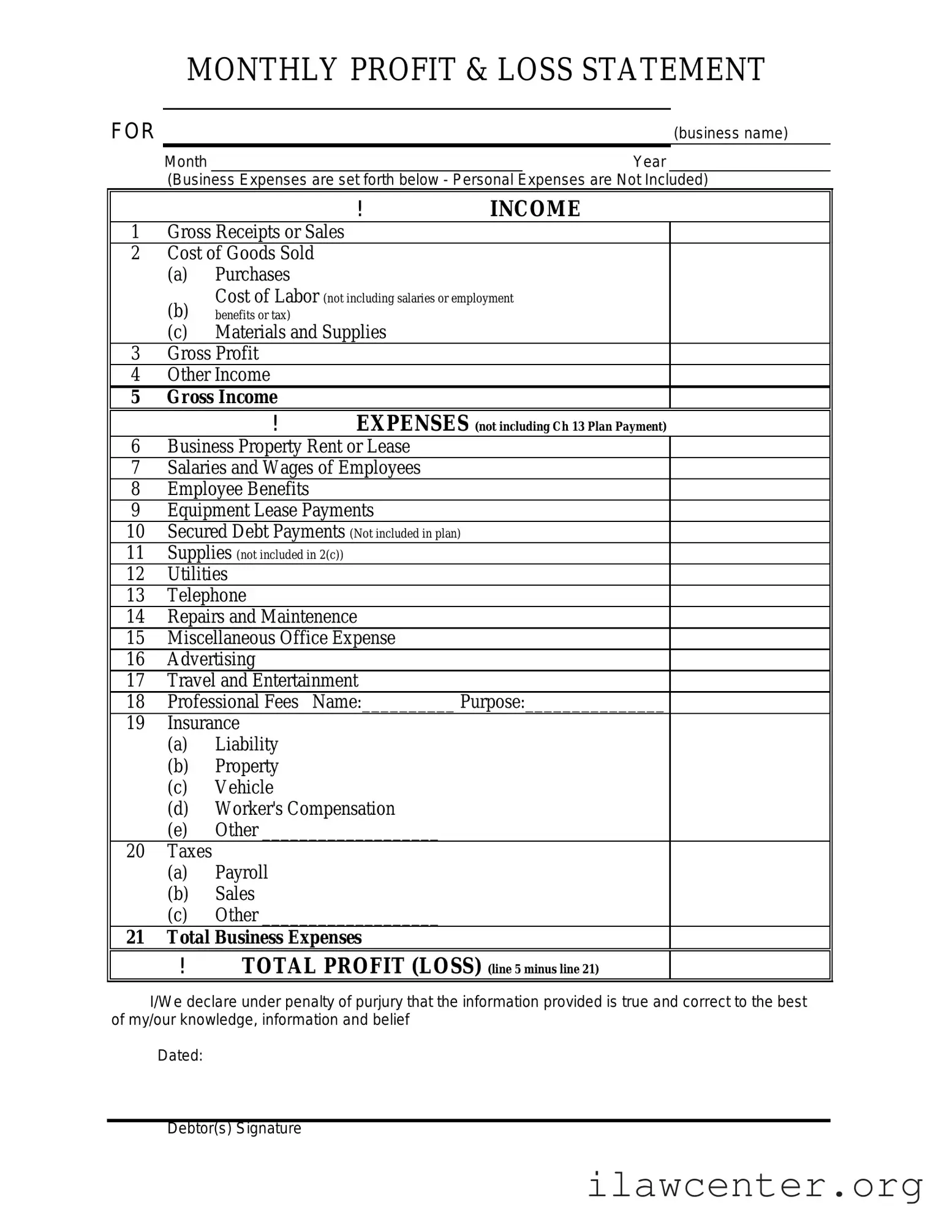
MONTHLY PROFIT & LOSS STATEMENT
FOR (business name)
Month Year
(Business Expenses are set forth below - Personal Expenses are Not Included)
! INCOME
1
Gross Receipts or Sales
2
Cost of Goods Sold
(a)
Purchases
Cost of Labor (not including salaries or employment
(b)
benefits or tax)
(c)
Materials and Supplies
3
Gross Profit
4
Other Income
5 Gross Income
! EXPENSES (not including Ch 13 Plan Payment)
6
Business Property Rent or Lease
7
Salaries and Wages of Employees
8
Employee Benefits
9
Equipment Lease Payments
10
Secured Debt Payments
(Not included in plan)
11
Supplies
(not included in 2(c))
12
Utilities
13
Telephone
14
Repairs and Maintenence
15
Miscellaneous Office Expense
16
Advertising
17
Travel and Entertainment
18
Professional Fees Name:__________ Purpose:_______________
19
Insurance
(a)
Liability
(b)
Property
(c)
Vehicle
(d)
Worker's Compensation
(e)
Other ___________________
20
Taxes
(a)
Payroll
(b)
Sales
(c)
Other ___________________
21 Total Business Expenses
! TOTAL PROFIT (LOSS) (line 5 minus line 21)
I/We declare under penalty of purjury that the information provided is true and correct to the best
of my/our knowledge, information and belief
Dated:
Debtor(s) Signature

File Properties

Fact Name Description
Purpose The Profit and Loss form is used to summarize a business's revenues and expenses over a specific period, providing insights into profitability.
Components This form typically includes sections for income, cost of goods sold, operating expenses, and net profit or loss.
State-Specific Forms Some states may require specific formats or additional information on the Profit and Loss form, governed by local business regulations.
Legal Compliance Filing accurate Profit and Loss statements is crucial for compliance with tax laws and can impact business credit ratings.

Instructions on Utilizing Profit And Loss

Once you have the Profit and Loss form in front of you, it’s time to gather your financial information. You will need details about your income and expenses for the period you are reporting. This process will help you understand your business's financial health and make informed decisions moving forward.

  1. Begin by entering the reporting period at the top of the form. Specify the start and end dates for the financial period you are analyzing.
  2. Next, list all sources of income. Include every stream of revenue your business has generated during this period. Be thorough to ensure accuracy.
  3. After detailing your income, move on to the expenses section. Categorize your expenses clearly. This might include costs such as rent, utilities, salaries, and materials.
  4. Once you have filled in both income and expenses, calculate the total income and total expenses. This is a crucial step to see how your business is performing.
  5. Now, subtract the total expenses from the total income to determine your net profit or loss. This figure will give you a clear picture of your financial standing.
  6. Finally, review all entries for accuracy. Double-check your calculations and ensure that all figures are correct before finalizing the form.

Important Facts about Profit And Loss

What is a Profit and Loss form?

A Profit and Loss form, also known as an income statement, is a financial document that summarizes revenues, costs, and expenses incurred during a specific period. It helps businesses assess their financial performance by showing whether they made a profit or incurred a loss during that time frame.

Why is the Profit and Loss form important?

This form is crucial for understanding a company's financial health. It provides insights into revenue generation and expense management. Business owners, investors, and stakeholders use this information to make informed decisions about operations, investments, and budgeting.

How often should a Profit and Loss form be completed?

Typically, businesses prepare a Profit and Loss form on a monthly, quarterly, or annual basis. The frequency depends on the size of the business and its financial reporting needs. Smaller businesses may find monthly reports useful, while larger organizations might focus on quarterly or annual summaries.

What information is included in a Profit and Loss form?

A Profit and Loss form generally includes several key components: total revenue, cost of goods sold (COGS), gross profit, operating expenses, and net profit or loss. Each section breaks down income and expenses to provide a clear picture of financial performance.

How do you calculate net profit from the Profit and Loss form?

To calculate net profit, subtract total expenses from total revenue. This includes all operating expenses, taxes, and interest. The resulting figure indicates whether the business has made a profit or incurred a loss during the reporting period.

Can the Profit and Loss form help with tax preparation?

Yes, the Profit and Loss form can be a valuable tool during tax season. It provides a clear overview of income and expenses, which is essential for accurate tax reporting. Business owners can use this information to determine taxable income and identify potential deductions.

Who prepares the Profit and Loss form?

The Profit and Loss form is typically prepared by the accounting department or a financial professional. However, small business owners may also complete it themselves, especially if they use accounting software that simplifies the process.

What should I do if my Profit and Loss form shows a loss?

If the Profit and Loss form shows a loss, it’s important to analyze the reasons behind it. Review revenue streams and expenses to identify areas for improvement. Consider adjusting pricing, cutting costs, or exploring new revenue opportunities to enhance financial performance in the future.

Common mistakes

When completing the Profit and Loss form, many individuals overlook crucial details that can lead to inaccuracies. One common mistake is failing to include all sources of income. It's essential to account for every revenue stream, whether it comes from sales, services, or other business activities. Omitting any source can result in a distorted view of profitability.

Another frequent error involves misclassifying expenses. People often group expenses incorrectly, which can skew the financial picture. For instance, mixing personal expenses with business expenses can lead to significant discrepancies. Keeping personal and business finances separate is vital for accurate reporting.

Additionally, some individuals neglect to update their records regularly. Relying on outdated figures can misrepresent the current financial state of the business. It's important to review and adjust the Profit and Loss form periodically to reflect the most accurate data.

Many also underestimate the importance of accuracy in data entry. Simple typographical errors can lead to major miscalculations. Double-checking figures before submission can prevent these mistakes and ensure that the financial report is reliable.

Finally, individuals sometimes fail to seek professional advice when needed. Navigating financial documents can be complex, and consulting with a professional can provide clarity. Engaging an expert can help avoid pitfalls and ensure compliance with relevant regulations.

Documents used along the form

The Profit and Loss form is a vital document that provides an overview of a business's revenues and expenses over a specific period. To gain a comprehensive understanding of a company's financial health, several other forms and documents are often used in conjunction with the Profit and Loss form. Below is a list of some of these essential documents.

  • Balance Sheet: This document presents a snapshot of a company’s assets, liabilities, and equity at a specific point in time. It helps stakeholders assess the company's financial stability and liquidity.
  • Cash Flow Statement: This statement outlines the inflows and outflows of cash within a business over a designated period. It provides insights into how well the company generates cash to meet its obligations.
  • Statement of Changes in Equity: This document details the movement in equity accounts over a reporting period. It includes information on retained earnings, dividends, and any new investments made by owners.
  • Budget: A budget is a financial plan that estimates future income and expenses. It serves as a guide for managing finances and helps in forecasting financial performance.
  • Tax Returns: These are official documents submitted to tax authorities that report income, expenses, and other relevant financial information. They are crucial for compliance and can provide insights into a company’s profitability.

Each of these documents plays a significant role in providing a fuller picture of a business's financial situation. Together with the Profit and Loss form, they help stakeholders make informed decisions and strategize for future growth.

Similar forms

  • Balance Sheet: Like the Profit and Loss form, the balance sheet provides a snapshot of a company's financial health. It lists assets, liabilities, and equity at a specific point in time, helping stakeholders understand the company’s overall financial position.
  • Cash Flow Statement: This document complements the Profit and Loss form by detailing how cash moves in and out of a business. It breaks down cash flows from operating, investing, and financing activities, providing insight into liquidity and cash management.
  • Income Statement: Often used interchangeably with the Profit and Loss form, the income statement also summarizes revenues and expenses over a specific period. It focuses on profitability, showing how much money the business earned or lost.
  • Statement of Changes in Equity: This document tracks changes in equity over a specific period, similar to how the Profit and Loss form tracks changes in profitability. It provides insight into how retained earnings and other equity components are affected by profits or losses.
  • Budget Report: A budget report outlines expected revenues and expenses, serving as a financial plan for a business. It is similar to the Profit and Loss form in that both documents analyze financial performance, but the budget report focuses on projections rather than historical data.

Dos and Don'ts

When filling out the Profit and Loss form, it is important to follow specific guidelines to ensure accuracy and clarity. Here are some dos and don'ts to consider:

  • Do use clear and precise language when describing your income and expenses.
  • Do double-check all figures for accuracy before submitting the form.
  • Don't leave any sections blank; provide information for all required fields.
  • Don't use vague terms; be specific about the sources of income and types of expenses.

Misconceptions

Understanding the Profit and Loss (P&L) form is crucial for effective financial management. However, several misconceptions can lead to confusion. Here are four common misconceptions:

  • Misconception 1: The P&L form shows only profits.
  • This is incorrect. The P&L form details both revenues and expenses, providing a complete picture of a business's financial performance. It highlights not just profits but also losses incurred during a specific period.

  • Misconception 2: A positive net income means the business is financially healthy.
  • While a positive net income is a good sign, it doesn't tell the whole story. Cash flow, liabilities, and other financial metrics must also be considered to assess overall health.

  • Misconception 3: The P&L form is only for large businesses.
  • This is false. Any business, regardless of size, can benefit from using a P&L form. It helps in tracking performance and making informed decisions.

  • Misconception 4: The P&L form is the same as a balance sheet.
  • This is a misunderstanding. The P&L form summarizes revenues and expenses over a period, while a balance sheet provides a snapshot of assets, liabilities, and equity at a specific point in time.

Key takeaways

Understanding how to fill out and use the Profit and Loss form is crucial for managing your finances effectively. Here are some key takeaways:

  • Accurate Data Entry: Ensure that all income and expenses are recorded accurately. This helps in getting a clear picture of your financial health.
  • Regular Updates: Update the form regularly, ideally on a monthly basis. This allows you to track your financial performance over time.
  • Review for Trends: Analyze the completed form to identify trends in your income and expenses. This can help you make informed decisions for your business.
  • Use for Tax Preparation: The Profit and Loss form is an essential tool for preparing your taxes. It provides a summary of your earnings and expenses for the year.