

Progress Notes PDF Template

Progress Notes PDF Template

The Progress Notes form is a crucial document used in medical settings to track a patient's ongoing treatment and progress. It includes essential details such as the patient's identification, date, and specific notes regarding their medical care. For accurate record-keeping and effective communication, it is vital to complete this form promptly; fill it out by clicking the button below.

Article Guide

The Progress Notes form plays a crucial role in the documentation of patient care within medical facilities. This standardized form is designed to capture essential information about a patient's treatment and progress over time. It includes key details such as the patient's identification, which encompasses their name, grade, rank, and hospital or medical facility. Each entry is dated, ensuring a clear timeline of the patient's journey through the healthcare system. The format is structured to facilitate easy updates and revisions, allowing healthcare providers to note changes in a patient's condition or response to treatment. This form not only aids in maintaining accurate medical records but also supports effective communication among healthcare teams. By adhering to the guidelines set forth in Standard Form 509, practitioners can ensure that vital information is consistently recorded and readily accessible for future reference.

Progress Notes Preview

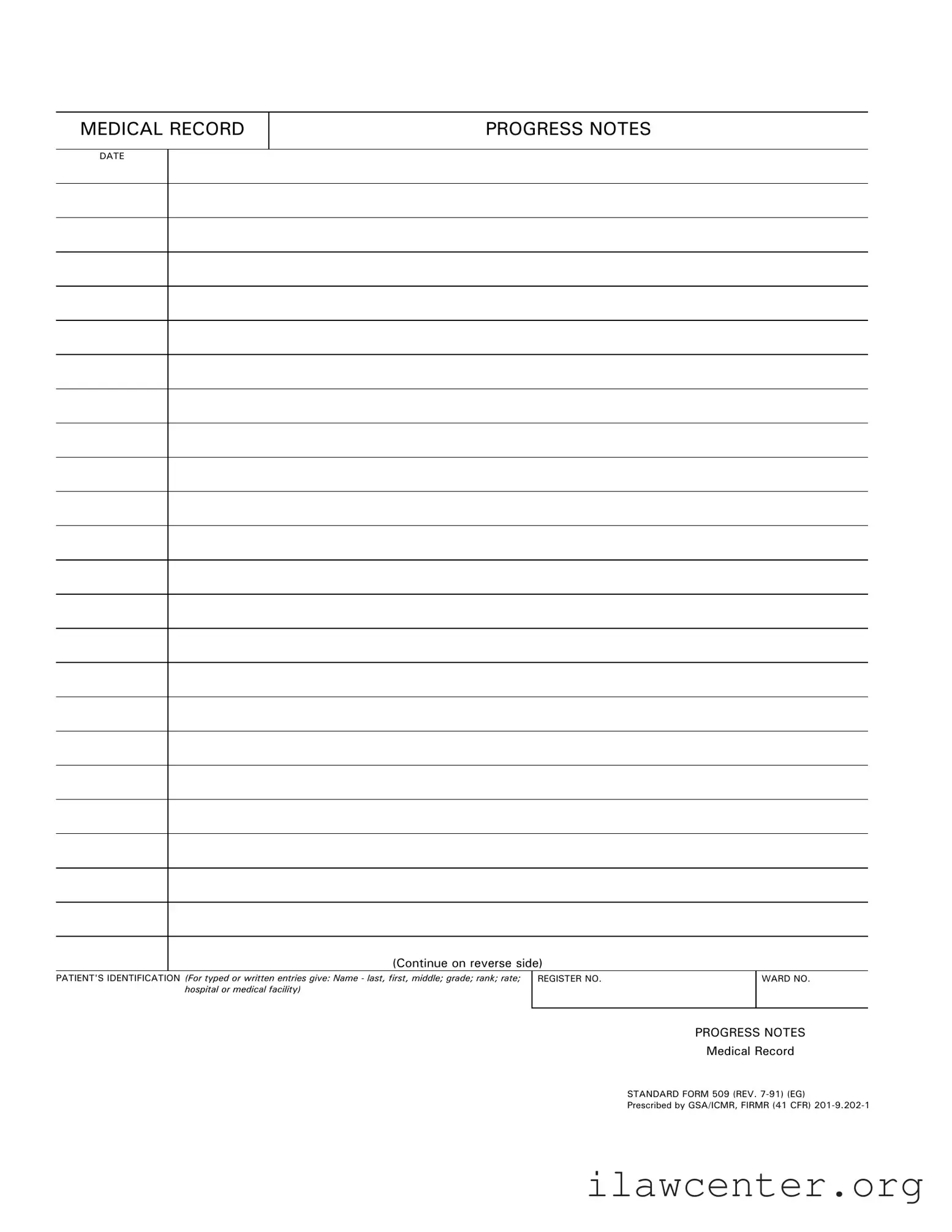
MEDICAL RECORD PROGRESS NOTES
DATE
PATIENT'S IDENTIFICATION
(For typed or written entries give: Name - last, first, middle; grade; rank; rate;
hospital or medical facility)
REGISTER NO. WARD NO.
STANDARD FORM 509 (REV. 7-91) (EG)
Prescribed by GSA/ICMR, FIRMR (41 CFR) 201-9.202-1
PROGRESS NOTES
Medical Record
(Continue on reverse side)
PROGRESS NOTES
DATE
STANDARD FORM 509 (REV. 7-91) BACK

File Properties

Fact Name Description
Form Purpose The Progress Notes form is used to document patient care and treatment updates in a medical record.
Identification Requirements Entries must include the patient's full name, grade, rank, rate, and the medical facility where they are receiving care.
Standardization This form is a standardized document, identified as Standard Form 509, and is prescribed by federal regulations.
Governing Laws The use of this form is governed by the GSA/ICMR and FIRMR under 41 CFR 201-9.202-1.

Instructions on Utilizing Progress Notes

Filling out the Progress Notes form is a straightforward process that helps ensure accurate and organized documentation of patient care. Once you have completed the form, it will be submitted as part of the patient's medical record, contributing to their ongoing treatment and care management.

  1. Date: Write the current date at the top of the form.
  2. Patient's Identification: Fill in the patient's details. Include their last name, first name, and middle initial. Then, provide their grade, rank, or rate, as applicable, along with the name of the hospital or medical facility.
  3. Register Number: Enter the patient's register number in the designated space.
  4. Ward Number: Specify the ward number where the patient is located.
  5. Progress Notes: In the section provided, document the relevant details regarding the patient's condition, treatment, and any other important observations. Be clear and concise.

Once you have filled out the form completely, review it for accuracy before submission. This ensures that all necessary information is captured and helps maintain the integrity of the patient's medical record.

Important Facts about Progress Notes

What is the purpose of the Progress Notes form?

The Progress Notes form is designed to document a patient's medical history and ongoing treatment. It helps healthcare providers track the patient's condition over time and ensures that all relevant information is recorded in one place. This form is essential for maintaining accurate medical records and providing quality care.

What information do I need to include on the Progress Notes form?

You should include the patient's identification details, such as their name (last, first, middle), grade, rank, rate, and the hospital or medical facility where they are receiving care. Additionally, you will document the date of the notes and any relevant observations or updates regarding the patient's condition and treatment plan.

How should I fill out the Progress Notes form?

When filling out the form, ensure that all entries are clear and legible. You can type or write the information. Start with the patient's identification details, followed by the date. Then, provide detailed notes about the patient's progress, including any changes in their condition, treatments administered, and recommendations for future care.

Can I continue writing on the back of the Progress Notes form?

Yes, you can continue writing on the back of the Progress Notes form if you need more space. Make sure to clearly indicate that the notes are a continuation from the front side. This helps maintain a coherent record of the patient's progress without losing important information.

Who is responsible for completing the Progress Notes form?

Typically, healthcare providers involved in the patient's care are responsible for completing the Progress Notes form. This includes doctors, nurses, and other medical staff. It's crucial that the notes are accurate and up-to-date, as they contribute to the overall medical record.

What happens to the Progress Notes after they are completed?

Once the Progress Notes are completed, they become part of the patient's medical record. These records are kept secure and confidential, in accordance with privacy laws. They may be reviewed by other healthcare professionals involved in the patient's care or for administrative purposes, ensuring continuity of care.

Common mistakes

Filling out the Progress Notes form correctly is crucial for maintaining accurate medical records. However, many individuals make common mistakes that can lead to confusion or miscommunication. Understanding these pitfalls can help ensure that the documentation process runs smoothly.

One frequent error is failing to include the patient's full identification. The form requires the patient's name, grade, rank, rate, and the medical facility. Omitting any of this information can result in difficulties in tracking the patient's history and care. Always double-check that every field is filled out completely.

Another mistake involves the date. It is essential to enter the correct date of the progress notes. Using an incorrect date can lead to discrepancies in the patient's medical timeline. This can affect treatment plans and continuity of care, so take a moment to verify the date before submitting the form.

Some individuals neglect to provide detailed progress notes. These notes should reflect the patient's condition, treatment, and any changes observed. Vague entries can create misunderstandings among healthcare providers. Clear and concise notes contribute to a better understanding of the patient's needs and progress.

Inconsistent terminology is another common issue. Using different terms to describe the same condition or treatment can confuse readers of the notes. Sticking to standardized medical language enhances clarity and ensures everyone involved in the patient's care is on the same page.

Additionally, many people forget to sign or initial the form. This oversight can render the document incomplete. A signature not only validates the information provided but also holds the author accountable for the content. Always ensure that the form is signed before submission.

Another mistake is writing in a way that is difficult to read. Whether the form is filled out by hand or typed, legibility is key. Illegible handwriting can lead to misinterpretations of critical information. If handwriting is a concern, consider using a typewriter or computer to fill out the form.

Some individuals also fail to review the completed form before submission. Taking a moment to go over the entire document can catch errors or omissions. This simple step can save time and prevent complications later on.

Lastly, not following the instructions for the back of the form can lead to incomplete documentation. The back of the Progress Notes form often contains additional sections or instructions that are just as important as the front. Ensure that all relevant information is included to provide a comprehensive view of the patient's care.

Documents used along the form

In the realm of medical documentation, the Progress Notes form serves as a vital tool for tracking patient care and treatment. However, it is often accompanied by several other forms and documents that enhance the continuity and quality of care. Below is a list of these essential documents, each playing a unique role in the medical record-keeping process.

  • Admission Form: This document captures critical information about the patient upon their entry into a medical facility. It typically includes personal details, medical history, and the reason for admission.
  • Discharge Summary: After a patient is discharged, this summary outlines the treatment received, the patient's condition at discharge, and any follow-up care needed. It ensures continuity of care after leaving the facility.
  • Medication Administration Record (MAR): This form tracks all medications administered to a patient during their stay. It includes details such as dosage, frequency, and the person administering the medication, which is crucial for patient safety.
  • Consent Forms: These documents are essential for obtaining patient consent for treatments, procedures, or sharing medical information. They protect both the patient’s rights and the healthcare provider's legal interests.
  • Referral Form: When a patient needs specialized care, a referral form is used to communicate pertinent information to the specialist. This ensures that the specialist is fully informed about the patient’s condition and history.
  • Follow-Up Appointment Schedule: This document outlines the recommended follow-up appointments for the patient. It helps ensure that patients receive ongoing care and monitoring after their initial treatment.

Each of these documents works in concert with the Progress Notes form to create a comprehensive medical record. Together, they support effective communication among healthcare providers and enhance patient care.

Similar forms

The Progress Notes form is an essential document in medical records, but it shares similarities with several other important forms. Here’s a list of nine documents that are akin to Progress Notes, along with a brief explanation of how they relate:

  • Patient Encounter Form: This document records details of a patient's visit, including symptoms and treatments, similar to how Progress Notes capture ongoing patient care.
  • SOAP Notes: SOAP stands for Subjective, Objective, Assessment, and Plan. Like Progress Notes, SOAP notes provide a structured way to document patient interactions and treatment plans.
  • Clinical Notes: These notes detail observations and assessments made during patient interactions, just as Progress Notes do for ongoing medical care.
  • Discharge Summary: This document summarizes a patient's hospital stay and treatment, reflecting the progress made, similar to the ongoing updates in Progress Notes.
  • Care Plans: Care plans outline the treatment goals and strategies for a patient, much like how Progress Notes track the progress towards these goals.
  • Medication Administration Record (MAR): The MAR logs all medications given to a patient, paralleling the way Progress Notes document treatment and patient responses.
  • Referral Notes: These notes detail the reasons for referring a patient to another provider, similar to how Progress Notes may indicate the need for further care or consultation.
  • Patient History Form: This form collects a patient's medical history, providing context for Progress Notes that document ongoing treatment and changes in condition.
  • Assessment and Evaluation Forms: These forms assess a patient’s condition and treatment effectiveness, much like Progress Notes that evaluate patient progress over time.

Dos and Don'ts

When filling out the Progress Notes form, it is essential to approach the task with care and attention to detail. Here are some important guidelines to follow:

  • Do ensure that you enter the date clearly at the top of the form.
  • Do include the patient's full identification, including last name, first name, middle name, grade, rank, rate, and the medical facility name.
  • Do use clear and concise language to describe the patient's progress and any relevant observations.
  • Do write legibly, whether typing or handwriting, to avoid any misinterpretations.
  • Don't leave any sections of the form blank; every part should be filled out as completely as possible.
  • Don't use abbreviations or medical jargon that may not be understood by everyone who reads the notes.
  • Don't forget to sign and date the form after completing it to validate the entries.

By following these guidelines, you help ensure that the Progress Notes are accurate and useful for future reference.

Misconceptions

Understanding the Progress Notes form is essential for accurate medical record-keeping. However, several misconceptions can lead to confusion. Here are seven common misunderstandings about this important document:

  • Progress Notes are only for doctors. Many believe that only physicians can fill out Progress Notes. In reality, other healthcare professionals, such as nurses and therapists, can also document their observations and interventions.
  • Progress Notes are optional. Some people think that Progress Notes are not mandatory. However, they are a critical part of a patient's medical record and are required for continuity of care.
  • All Progress Notes look the same. While there is a standard format, the content of Progress Notes can vary significantly based on the patient's condition and the healthcare provider's observations.
  • Progress Notes are only for negative findings. A common myth is that Progress Notes are only used to document problems or negative outcomes. In fact, they can also highlight improvements, treatment responses, and positive developments.
  • Progress Notes are not reviewed by anyone. Some individuals assume that Progress Notes are written and forgotten. In reality, they are often reviewed by other healthcare providers to ensure coordinated and effective care.
  • Progress Notes can be vague. There is a belief that Progress Notes can be informal or vague. However, they should be clear, concise, and specific to ensure that anyone reading them understands the patient's status and care plan.
  • Progress Notes do not require training. Many think that anyone can fill out Progress Notes without any training. In truth, proper training is essential to ensure that all entries are compliant with legal and medical standards.

By dispelling these misconceptions, healthcare providers can better utilize Progress Notes to enhance patient care and ensure accurate medical documentation.

Key takeaways

Filling out and using the Progress Notes form is essential for maintaining accurate medical records. Here are key takeaways to consider:

  1. Always include the date on the form to establish a clear timeline of patient care.
  2. Patient identification must be complete. Include the name (last, first, middle), grade, rank, rate, and the hospital or medical facility.
  3. Use the correct REGISTER NO. and WARD NO. to ensure the notes are linked to the appropriate patient and location.
  4. Document progress notes in a clear and concise manner. Avoid unnecessary jargon.
  5. Make sure to use the latest version of the form, which is STANDARD FORM 509 (REV. 7-91).
  6. Progress notes should reflect ongoing patient assessments and treatment plans.
  7. Ensure all entries are legible, whether typed or handwritten, to prevent miscommunication.
  8. Sign and date each entry to confirm the authenticity of the information provided.
  9. Review completed notes regularly to maintain continuity of care.
  10. Store the form securely to protect patient confidentiality and comply with regulations.

Following these guidelines will enhance the effectiveness of the Progress Notes form in documenting patient care.