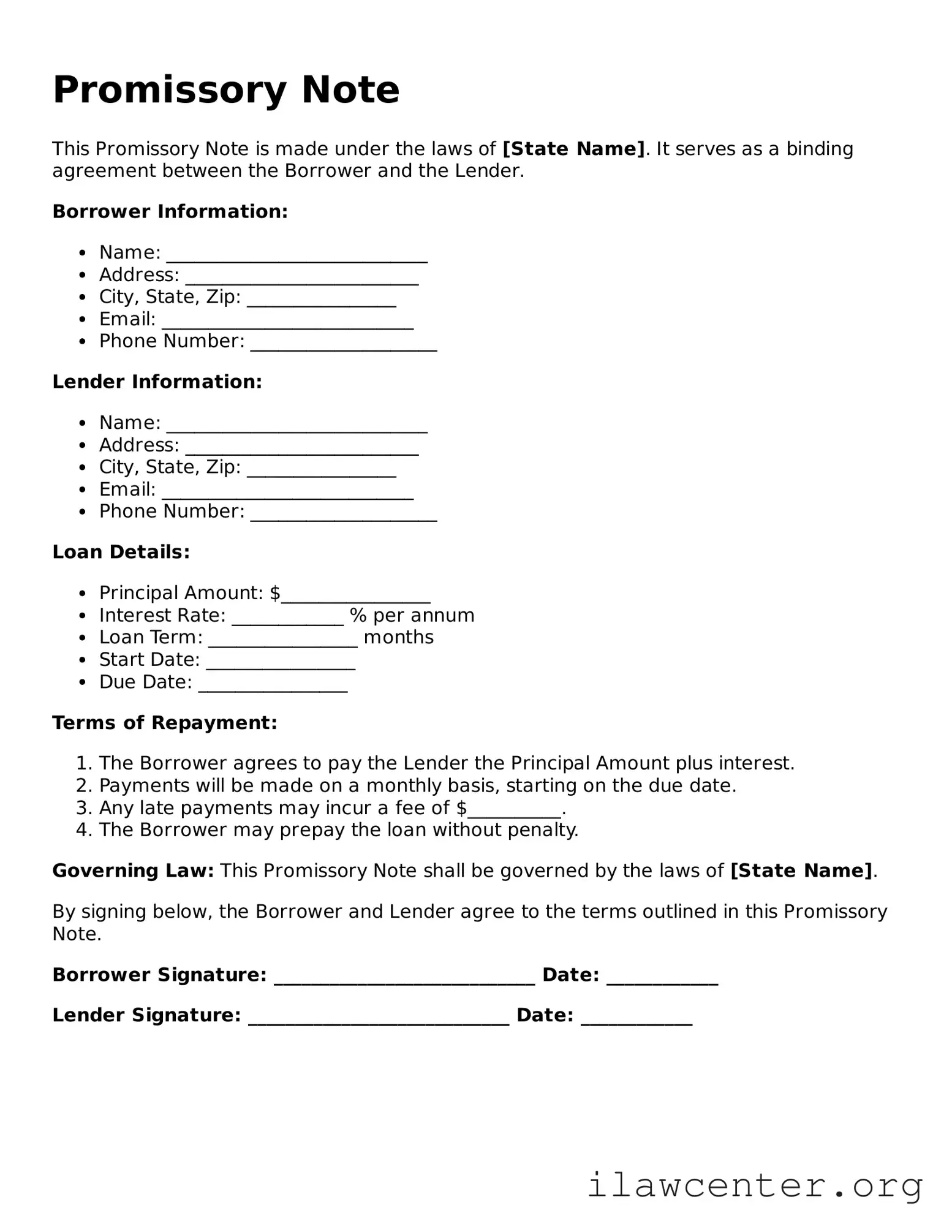
Fillable Promissory Note Document

Fillable Promissory Note Document

A Promissory Note is a written promise to pay a specified amount of money to a designated person or entity at a defined time or on demand. This financial document outlines the terms of the loan, including interest rates and repayment schedules, ensuring clarity and legal protection for both parties involved. If you need to create or fill out a Promissory Note, click the button below to get started.

Article Guide

The Promissory Note form serves as a crucial document in financial transactions, establishing a clear agreement between a borrower and a lender. This form outlines the specific terms of the loan, including the principal amount, interest rate, and repayment schedule. It also specifies the consequences of default, ensuring both parties understand their obligations. Additionally, the Promissory Note may include details about collateral, which secures the loan and provides the lender with a form of protection. By clearly delineating these aspects, the Promissory Note not only facilitates trust between the parties involved but also serves as a legal safeguard in case disputes arise. Understanding the intricacies of this form is essential for anyone engaging in borrowing or lending, as it lays the foundation for a transparent financial relationship.

Promissory Note Preview

Promissory Note

This Promissory Note is made under the laws of [State Name]. It serves as a binding agreement between the Borrower and the Lender.

Borrower Information:

  • Name: ____________________________
  • Address: _________________________
  • City, State, Zip: ________________
  • Email: ___________________________
  • Phone Number: ____________________

Lender Information:

  • Name: ____________________________
  • Address: _________________________
  • City, State, Zip: ________________
  • Email: ___________________________
  • Phone Number: ____________________

Loan Details:

  • Principal Amount: $________________
  • Interest Rate: ____________ % per annum
  • Loan Term: ________________ months
  • Start Date: ________________
  • Due Date: ________________

Terms of Repayment:

  1. The Borrower agrees to pay the Lender the Principal Amount plus interest.
  2. Payments will be made on a monthly basis, starting on the due date.
  3. Any late payments may incur a fee of $__________.
  4. The Borrower may prepay the loan without penalty.

Governing Law: This Promissory Note shall be governed by the laws of [State Name].

By signing below, the Borrower and Lender agree to the terms outlined in this Promissory Note.

Borrower Signature: ____________________________ Date: ____________

Lender Signature: ____________________________ Date: ____________

PDF Form Characteristics

Fact Name Description
Definition A promissory note is a written promise to pay a specific amount of money to a designated person or bearer at a specified time.
Key Elements It typically includes the principal amount, interest rate, payment schedule, and the names of the borrower and lender.
State-Specific Forms Each state may have its own version of a promissory note, reflecting local laws and requirements.
Governing Laws In the U.S., the Uniform Commercial Code (UCC) governs promissory notes, but state laws can also apply.
Enforceability For a promissory note to be enforceable, it must be signed by the borrower and include all essential terms.

Instructions on Utilizing Promissory Note

After obtaining the Promissory Note form, it is essential to complete it accurately. This document serves as a written promise to pay a specific amount of money under agreed-upon terms. Follow these steps to ensure the form is filled out correctly.

  1. Begin by entering the date at the top of the form.
  2. Write the name of the borrower. Include the borrower's full legal name.
  3. Provide the borrower's address. This should be the current residential address.
  4. Enter the name of the lender. Use the lender's full legal name as well.
  5. List the lender's address. This should be the current address of the lender.
  6. Specify the principal amount. Clearly state the total amount of money being borrowed.
  7. Indicate the interest rate. Write the percentage that will be applied to the principal amount.
  8. Detail the repayment terms. Include the schedule for payments, such as monthly or quarterly, and the duration of the loan.
  9. Include any late fees. Specify the amount that will be charged if a payment is missed.
  10. Sign the document. The borrower must sign and date the form at the designated area.
  11. Have the lender sign the document. The lender must also sign and date the form.

Important Facts about Promissory Note

What is a Promissory Note?

A promissory note is a written promise to pay a specific amount of money to a designated person or entity at a specified time. This document outlines the terms of the loan, including the interest rate, repayment schedule, and any penalties for late payments. It serves as a legal record of the agreement between the borrower and the lender.

Who can use a Promissory Note?

Individuals, businesses, and organizations can all use promissory notes. They are commonly used in personal loans, business loans, and real estate transactions. Anyone who is lending money or borrowing money can create a promissory note to formalize the agreement and protect their interests.

What information should be included in a Promissory Note?

A promissory note should include several key pieces of information. This includes the names and addresses of both the borrower and the lender, the principal amount of the loan, the interest rate, the repayment schedule, and any fees or penalties for late payments. Additionally, it should specify the date the note is executed and any collateral involved, if applicable.

Is a Promissory Note legally binding?

Yes, a promissory note is a legally binding document. Once both parties sign it, they are obligated to adhere to the terms outlined in the note. If the borrower fails to make payments as agreed, the lender has the right to take legal action to recover the owed amount. However, it is important for both parties to understand their rights and responsibilities before signing.

Can a Promissory Note be modified after it is signed?

Yes, a promissory note can be modified, but both parties must agree to the changes. Any modifications should be documented in writing and signed by both the borrower and the lender. This ensures that the updated terms are clear and legally enforceable. Verbal agreements or informal changes are generally not advisable, as they may lead to misunderstandings.

Common mistakes

Filling out a Promissory Note form requires careful attention to detail. One common mistake is failing to include the correct names of the parties involved. It is essential to accurately list the lender and borrower to avoid confusion or disputes later on. Incorrect names can lead to complications in enforcing the note.

Another frequent error is omitting the date of the agreement. Without a clear date, it can be challenging to establish when the terms of the note take effect. This omission may lead to misunderstandings regarding payment schedules and deadlines.

People often neglect to specify the loan amount clearly. The amount borrowed should be stated in both numerical and written form to eliminate any ambiguity. If the amount is unclear, it can result in disputes over how much is owed.

Additionally, failing to outline the interest rate is a significant mistake. The interest rate should be clearly defined, whether it is fixed or variable. This information is crucial for understanding the total repayment amount and the cost of borrowing.

Another common error involves not detailing the repayment schedule. Borrowers need to know when payments are due and how much they should pay. A vague repayment schedule can lead to missed payments and potential legal issues.

Some individuals forget to include the consequences of defaulting on the loan. Clear terms regarding what happens if the borrower fails to make payments can protect the lender's interests. Without these terms, both parties may face uncertainty in case of default.

People also sometimes overlook the need for signatures. Both the lender and borrower must sign the Promissory Note for it to be legally binding. A missing signature can render the document unenforceable.

Lastly, not keeping a copy of the signed Promissory Note is a common oversight. Both parties should retain a copy for their records. This step ensures that everyone involved has access to the agreed-upon terms and can refer back to them if necessary.

Documents used along the form

A Promissory Note is a crucial document in lending transactions, but it often works alongside other forms to ensure clarity and legal protection for both parties. Here are four commonly used documents that complement a Promissory Note:

  • Loan Agreement: This document outlines the terms of the loan, including the amount borrowed, interest rate, repayment schedule, and any conditions or covenants the borrower must meet. It serves as a comprehensive guide to the expectations of both the lender and the borrower.
  • Security Agreement: If the loan is secured by collateral, this agreement details the collateral being offered. It specifies the rights of the lender in the event of default and provides legal recourse to recover the owed amount through the collateral.
  • Personal Guarantee: This form is used when an individual agrees to be personally responsible for the debt if the primary borrower defaults. It adds an extra layer of security for the lender, ensuring that they have additional avenues for recovery.
  • Disclosure Statement: This document provides essential information about the loan terms, including total costs, fees, and the annual percentage rate (APR). It ensures that borrowers understand the financial implications of the loan before signing.

Using these documents alongside a Promissory Note helps establish clear expectations and protects the interests of both parties involved in the transaction. Always consider consulting a legal professional to ensure that all documents meet your specific needs and comply with applicable laws.

Similar forms

A Promissory Note is a financial document that outlines a borrower's promise to repay a loan under specific terms. There are several other documents that share similarities with a Promissory Note. Here are five of them:

  • Loan Agreement: This document details the terms of a loan, including the amount borrowed, interest rate, and repayment schedule. Like a Promissory Note, it establishes the borrower's obligation to repay the loan.
  • Mortgage: A mortgage secures a loan with property as collateral. It includes repayment terms and, similar to a Promissory Note, it outlines the borrower's commitment to repay the loan amount.
  • Installment Agreement: This document allows for repayment in installments over time. It shares the same fundamental principle as a Promissory Note by specifying the payment terms and obligations of the borrower.
  • Secured Note: A Secured Note is a Promissory Note backed by collateral. It functions similarly by detailing the borrower's promise to repay while providing additional security for the lender.
  • Personal Guarantee: This document involves a third party who agrees to repay the debt if the borrower defaults. It resembles a Promissory Note in that it creates a binding obligation, ensuring that the lender has recourse if payments are not made.

Dos and Don'ts

When filling out a Promissory Note form, it's important to follow certain guidelines to ensure accuracy and legality. Here’s a list of what you should and shouldn’t do:

  • Do read the entire form carefully before starting.
  • Do provide clear and accurate information about the borrower and lender.
  • Do specify the loan amount clearly.
  • Do include the interest rate if applicable.
  • Do outline the repayment schedule in detail.
  • Don't leave any sections blank unless instructed.
  • Don't use vague language; be specific in your terms.
  • Don't forget to sign and date the document.
  • Don't ignore local laws that may apply to promissory notes.

By following these guidelines, you can help ensure that your Promissory Note is completed correctly and is legally binding.

Misconceptions

Understanding the Promissory Note form is essential for both lenders and borrowers. However, several misconceptions can lead to confusion. Here are five common misconceptions:

  1. Promissory Notes are only for large loans.

    This is not true. Promissory notes can be used for loans of any size, whether it's a small personal loan between friends or a significant mortgage. The form serves as a written promise to repay the borrowed amount, regardless of the total.

  2. All Promissory Notes must be notarized.

    While notarization can add an extra layer of security, it is not a legal requirement for all promissory notes. A simple written agreement signed by both parties is often sufficient to create a binding contract.

  3. Promissory Notes are the same as IOUs.

    Although both documents signify a debt, they differ significantly. An IOU is a more informal acknowledgment of a debt, while a promissory note includes specific terms such as repayment schedule, interest rate, and consequences for default.

  4. Once signed, a Promissory Note cannot be changed.

    This is a misconception. Parties involved can amend the terms of a promissory note if both agree to the changes. It is advisable to document any amendments in writing to avoid future disputes.

  5. Promissory Notes are only used in financial transactions.

    While they are commonly associated with loans, promissory notes can also be utilized in various other agreements, such as business transactions or personal arrangements, where one party agrees to pay another specific amounts.

Clarifying these misconceptions can help ensure that both lenders and borrowers understand their rights and responsibilities when using promissory notes.

Key takeaways

When dealing with a Promissory Note, understanding the key components and their implications is crucial for both parties involved. Here are some essential takeaways to consider:

  • Clear Identification: Ensure that both the borrower and lender are clearly identified in the document. This includes full names and addresses.
  • Loan Amount: Specify the exact amount being borrowed. This figure should be unambiguous to avoid future disputes.
  • Interest Rate: If applicable, include the interest rate. Be clear whether it is fixed or variable and how it will be calculated.
  • Payment Schedule: Outline the repayment terms. Indicate the frequency of payments (monthly, quarterly) and the due dates.
  • Maturity Date: State when the loan will be fully paid off. This date is critical for both parties to know.
  • Default Terms: Clearly define what constitutes a default and the consequences that will follow, such as penalties or acceleration of the loan.
  • Governing Law: Indicate which state’s laws will govern the agreement. This is important for legal clarity.
  • Signatures: Both parties must sign the document. Consider having it notarized to enhance its enforceability.

By keeping these points in mind, you can create a comprehensive and effective Promissory Note that protects the interests of all parties involved.