Fillable Real Estate Earnest Money Deposit Contract Document

Fillable Real Estate Earnest Money Deposit Contract Document

The Real Estate Earnest Money Deposit Contract is a crucial document used in real estate transactions to secure a buyer's commitment to purchase a property. This form outlines the amount of earnest money the buyer will deposit and the terms surrounding its use. Understanding this contract is essential for both buyers and sellers to ensure a smooth transaction process.

Ready to take the next step? Fill out the form by clicking the button below.

Article Guide

The Real Estate Earnest Money Deposit Contract form plays a crucial role in real estate transactions, serving as a commitment from the buyer to the seller. This document outlines the amount of earnest money being deposited, which demonstrates the buyer's serious intent to purchase the property. It specifies the terms under which the deposit may be forfeited or refunded, providing clarity on the conditions that must be met for the transaction to proceed. Additionally, the form includes details about the purchase agreement, timelines for closing, and contingencies that may affect the sale. By establishing these terms upfront, both parties can navigate the complexities of the transaction with greater confidence, ensuring that their rights and obligations are clearly defined. Understanding the components of this form is essential for buyers and sellers alike, as it lays the foundation for a successful real estate deal.

Real Estate Earnest Money Deposit Contract Preview

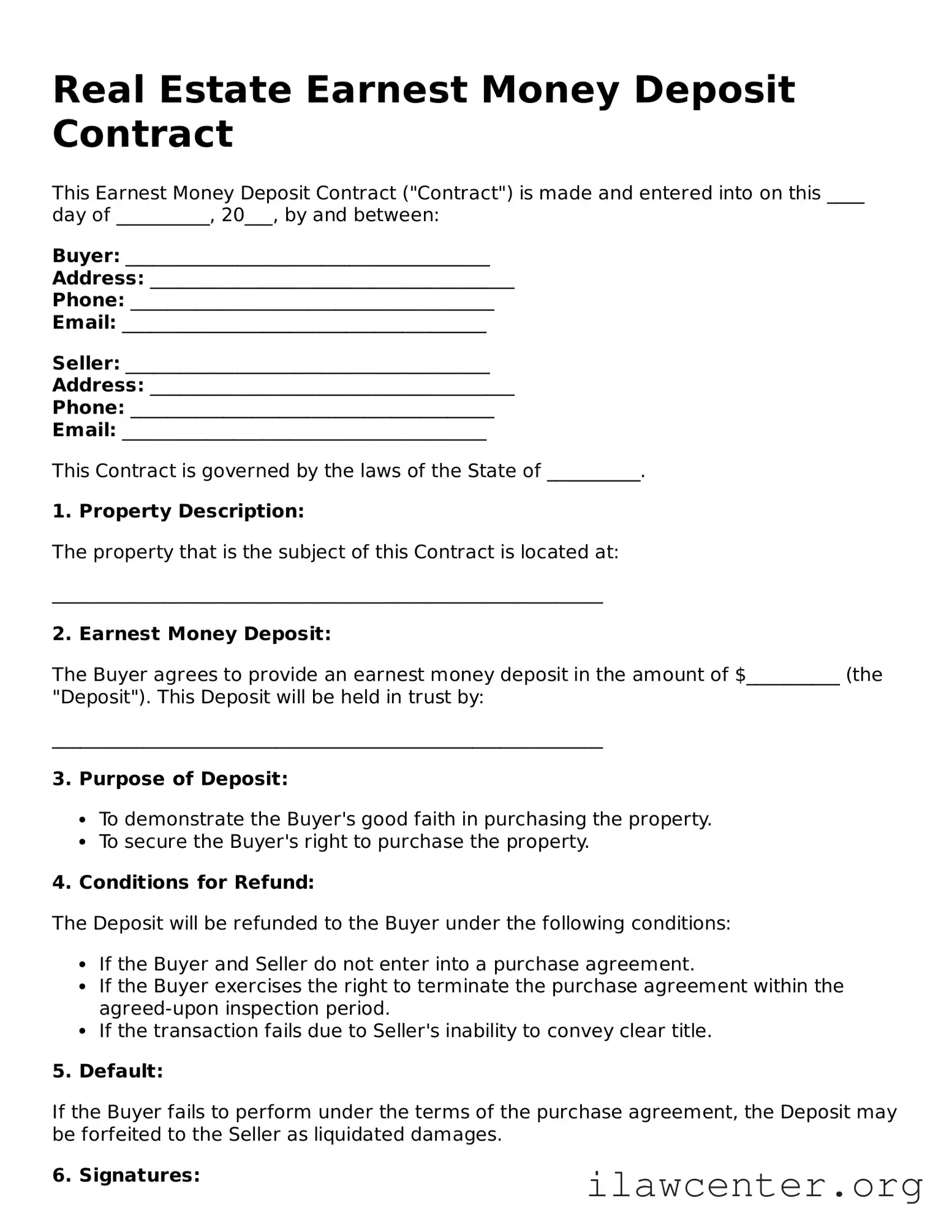
Real Estate Earnest Money Deposit Contract

This Earnest Money Deposit Contract ("Contract") is made and entered into on this ____ day of __________, 20___, by and between:

Buyer: _______________________________________
Address: _______________________________________
Phone: _______________________________________
Email: _______________________________________

Seller: _______________________________________
Address: _______________________________________
Phone: _______________________________________
Email: _______________________________________

This Contract is governed by the laws of the State of __________.

1. Property Description:

The property that is the subject of this Contract is located at:

___________________________________________________________

2. Earnest Money Deposit:

The Buyer agrees to provide an earnest money deposit in the amount of $__________ (the "Deposit"). This Deposit will be held in trust by:

___________________________________________________________

3. Purpose of Deposit:

  • To demonstrate the Buyer's good faith in purchasing the property.
  • To secure the Buyer's right to purchase the property.

4. Conditions for Refund:

The Deposit will be refunded to the Buyer under the following conditions:

  • If the Buyer and Seller do not enter into a purchase agreement.
  • If the Buyer exercises the right to terminate the purchase agreement within the agreed-upon inspection period.
  • If the transaction fails due to Seller's inability to convey clear title.

5. Default:

If the Buyer fails to perform under the terms of the purchase agreement, the Deposit may be forfeited to the Seller as liquidated damages.

6. Signatures:

By signing below, both parties agree to the terms of this Contract.

_____________________________
Buyer Signature

_____________________________
Seller Signature

_____________________________
Date

PDF Form Characteristics

Fact Name Description
Purpose The Earnest Money Deposit Contract is designed to secure the buyer's intent to purchase a property, demonstrating their seriousness to the seller.
Amount The earnest money deposit is typically a small percentage of the purchase price, often ranging from 1% to 3%, but this can vary based on local practices.
Governing Laws Each state has its own laws governing earnest money deposits. For instance, in California, the relevant laws can be found in the California Civil Code.
Refund Conditions Buyers may receive a full refund of their earnest money deposit if the sale falls through due to contingencies outlined in the contract, such as financing or inspection issues.
Escrow Account Earnest money is often held in an escrow account, managed by a neutral third party, until the transaction is completed or terminated.
Default Consequences If the buyer defaults on the contract without a valid reason, the seller may be entitled to keep the earnest money as compensation for their time and effort.
Written Agreement It is essential for the earnest money deposit to be documented in writing, as this provides clarity and protection for both parties involved in the transaction.

Instructions on Utilizing Real Estate Earnest Money Deposit Contract

Filling out the Real Estate Earnest Money Deposit Contract form is an important step in the home buying process. This form captures key information that helps facilitate the transaction between the buyer and the seller. It is essential to provide accurate details to ensure a smooth process moving forward.

  1. Begin by entering the date at the top of the form.
  2. Identify the parties involved. Write the full names of the buyer(s) and seller(s) in the designated sections.
  3. Provide the property address. This should include the street address, city, state, and zip code.
  4. Specify the amount of the earnest money deposit. This is the sum that the buyer intends to put down as a show of good faith.
  5. Indicate the method of payment for the earnest money. Common options include a personal check, bank transfer, or cashier's check.
  6. Include the closing date. This is the date when the transaction is expected to be finalized.
  7. Review any contingencies that may apply. If there are specific conditions that must be met for the sale to proceed, note them in the appropriate section.
  8. Sign and date the form. Both the buyer and seller should provide their signatures to acknowledge agreement to the terms outlined in the contract.
  9. Make copies of the completed form for all parties involved. Keeping a record is important for future reference.

Important Facts about Real Estate Earnest Money Deposit Contract

What is an Earnest Money Deposit?

An earnest money deposit is a sum of money that a buyer provides to show their serious intent to purchase a property. This deposit is typically held in escrow until the transaction is finalized. It serves as a good faith gesture to the seller, indicating that the buyer is committed to completing the purchase.

How much should the Earnest Money Deposit be?

The amount of the earnest money deposit can vary based on local customs and the price of the property. Generally, it ranges from 1% to 3% of the purchase price. However, in competitive markets, buyers may offer a higher percentage to strengthen their offer.

Is the Earnest Money Deposit refundable?

Whether the earnest money deposit is refundable depends on the terms outlined in the purchase agreement. If the buyer backs out of the deal for reasons that are covered by contingencies, they may receive their deposit back. However, if they withdraw without a valid reason, the seller may keep the deposit.

What happens to the Earnest Money Deposit if the sale falls through?

If the sale falls through due to contingencies that were agreed upon, the earnest money deposit is typically returned to the buyer. If the buyer fails to meet the terms of the contract, the seller may be entitled to keep the deposit as compensation for taking the property off the market.

Who holds the Earnest Money Deposit?

The earnest money deposit is usually held in an escrow account by a neutral third party, such as a title company or real estate broker. This helps ensure that the funds are secure until the transaction is completed or a decision is made regarding the sale.

What is included in the Earnest Money Deposit Contract form?

The Earnest Money Deposit Contract form typically includes details about the buyer and seller, the property in question, the amount of the deposit, and the conditions under which the deposit may be refunded. It also outlines the responsibilities of the parties involved and any deadlines that must be met.

Can the Earnest Money Deposit be negotiated?

Yes, the amount of the earnest money deposit can be negotiated between the buyer and seller. It is important for both parties to agree on a figure that reflects the seriousness of the buyer's offer while also considering the seller's needs.

What should buyers do if they have questions about the Earnest Money Deposit?

If buyers have questions about the earnest money deposit or the related contract, they should consult with their real estate agent or attorney. These professionals can provide guidance and help clarify any concerns regarding the process and the contract terms.

Is there a deadline for submitting the Earnest Money Deposit?

Yes, there is usually a deadline for submitting the earnest money deposit, which is specified in the purchase agreement. Buyers should ensure that they meet this deadline to avoid any potential issues with their offer or the transaction.
Common mistakes

When filling out the Real Estate Earnest Money Deposit Contract form, individuals often overlook critical details that can lead to complications later on. One common mistake is failing to specify the exact amount of the earnest money deposit. This figure is crucial as it demonstrates the buyer's commitment to the purchase. Without a clear amount, misunderstandings may arise, potentially jeopardizing the transaction.

Another frequent error involves neglecting to include the correct property address. Accuracy in this detail is vital, as it ensures that all parties are aligned regarding the specific property involved in the transaction. An incorrect address can lead to confusion and may even result in legal disputes if the wrong property is referenced.

Many individuals also forget to include a deadline for the earnest money deposit. This timeline is important because it establishes when the deposit must be made, which protects both the buyer and the seller. Without a specified deadline, there may be delays that could frustrate the process and lead to missed opportunities.

Lastly, some people fail to review the terms and conditions associated with the earnest money deposit. Understanding these terms is essential, as they outline the circumstances under which the deposit may be forfeited or refunded. Ignoring this aspect can result in unintended financial consequences. It is always advisable to thoroughly read and comprehend all sections of the contract before submission.

Documents used along the form

The Real Estate Earnest Money Deposit Contract form is a crucial document in real estate transactions, serving as a commitment from the buyer to purchase a property. Alongside this form, several other documents are often utilized to ensure a smooth transaction process. Here are four commonly used forms and documents that complement the Earnest Money Deposit Contract.

  • Purchase Agreement: This document outlines the terms and conditions of the sale, including the purchase price, closing date, and any contingencies. It serves as the primary contract between the buyer and seller.
  • Disclosure Statements: Sellers are typically required to provide disclosures regarding the property's condition, including any known issues or defects. These statements help buyers make informed decisions.
  • Title Report: A title report provides information about the ownership history of the property, any existing liens, and other legal claims. This document is essential for ensuring that the buyer receives clear title to the property.
  • Closing Statement: This document summarizes all financial transactions related to the sale, including the final sale price, closing costs, and adjustments. It is reviewed and signed at the closing of the transaction.

Understanding these documents is vital for anyone involved in a real estate transaction. They help clarify the roles and responsibilities of both buyers and sellers, ensuring that all parties are informed and protected throughout the process.

Similar forms

  • Purchase Agreement: This document outlines the terms of the sale between the buyer and seller. It includes details such as the purchase price, closing date, and contingencies. Like the Earnest Money Deposit Contract, it establishes the buyer's commitment to the transaction.

  • Option Agreement: An option agreement gives the buyer the right, but not the obligation, to purchase a property within a specified timeframe. Similar to the Earnest Money Deposit, it requires a fee that demonstrates the buyer's serious intent to pursue the purchase.

  • Real Estate Sales Contract: This is a comprehensive agreement that formalizes the sale of real estate. It includes terms and conditions, much like the Earnest Money Deposit Contract, which serves as a precursor to this more detailed document.

  • Lease Agreement: A lease agreement outlines the terms under which a tenant can occupy a property. While it serves a different purpose, it similarly requires a financial commitment, often in the form of a security deposit, to secure the tenant's interest.

  • Letter of Intent: This document expresses a party's intention to enter into a formal agreement. It often includes terms that will later be detailed in a contract. Like the Earnest Money Deposit Contract, it signifies a serious interest in moving forward with a transaction.

  • Closing Disclosure: This document provides details about the final terms of a mortgage loan and the costs associated with closing the transaction. It is similar in that it summarizes financial obligations, including any earnest money that has been applied to the purchase price.

Dos and Don'ts

When filling out the Real Estate Earnest Money Deposit Contract form, it is crucial to follow specific guidelines to ensure accuracy and protect your interests. Here are six important dos and don'ts:

  • Do read the entire contract carefully before filling it out.
  • Do provide accurate information, including names and addresses.
  • Do specify the amount of earnest money clearly.
  • Do sign and date the contract to validate it.
  • Don't leave any sections blank; fill in all required fields.
  • Don't use abbreviations or shorthand that could cause confusion.

Misconceptions

Understanding the Real Estate Earnest Money Deposit Contract form is crucial for anyone involved in a real estate transaction. However, several misconceptions can lead to confusion. Here are ten common misconceptions explained.

  1. Earnest money is non-refundable. Many believe that once earnest money is paid, it cannot be recovered. In reality, it can be refunded under certain conditions, such as if the sale falls through due to contingencies outlined in the contract.
  2. Earnest money is the same as a down payment. While both involve money, earnest money is a deposit made to demonstrate serious intent, whereas a down payment is a portion of the purchase price paid at closing.
  3. There is a standard amount for earnest money. Some think there is a fixed percentage or amount for earnest money deposits. In truth, the amount can vary widely based on local practices and the specifics of the transaction.
  4. Earnest money guarantees the buyer will close the deal. This is not true. The buyer can still back out of the deal if contingencies are not met, and they may receive their earnest money back.
  5. Only buyers need to worry about earnest money. Sellers also have a stake in earnest money deposits. It shows the buyer's commitment and can provide reassurance to the seller.
  6. Earnest money is not legally binding. While the contract itself is a legal document, the earnest money deposit is tied to the terms of that contract, making it legally significant.
  7. Earnest money is held by the seller. Many assume that the seller keeps the earnest money. Typically, it is held in an escrow account by a neutral third party until the transaction is completed.
  8. Paying earnest money is optional. Some believe that earnest money is not required. However, in competitive markets, it is often expected to show good faith.
  9. Earnest money can be paid in any form. While cash is common, some think that any form of payment is acceptable. However, many sellers prefer certified funds or checks to ensure the deposit is secure.
  10. Once the contract is signed, the buyer has no further obligations. This misconception overlooks that buyers must still meet any contingencies and deadlines outlined in the contract to protect their earnest money.

Being aware of these misconceptions can help buyers and sellers navigate real estate transactions more effectively. Understanding the role of earnest money can lead to smoother negotiations and fewer disputes.

Key takeaways

When it comes to real estate transactions, the Earnest Money Deposit (EMD) Contract is a crucial document. Here are some key takeaways to keep in mind when filling out and using this form:

  • Understand the Purpose: The earnest money deposit shows the seller that the buyer is serious about purchasing the property. It can help secure the buyer's position in a competitive market.
  • Deposit Amount: Typically, the earnest money deposit ranges from 1% to 3% of the purchase price. However, the exact amount may vary based on local customs and the specific agreement between buyer and seller.
  • Contingencies: Clearly outline any contingencies in the contract. These may include inspections, financing, or appraisal conditions. If contingencies are not met, the buyer may be entitled to a refund of their deposit.
  • Timeline Matters: Pay attention to deadlines. The contract will specify how long the earnest money will be held and the timeline for fulfilling contingencies. Missing these deadlines can jeopardize the deposit.
  • Refund Scenarios: Familiarize yourself with the conditions under which the earnest money can be refunded. Understanding these terms can prevent misunderstandings and potential disputes later on.

By keeping these key points in mind, buyers and sellers can navigate the earnest money deposit process with greater confidence and clarity.