Fillable Real Estate Non-Disclosure Agreement Document

Fillable Real Estate Non-Disclosure Agreement Document

The Real Estate Non-Disclosure Agreement is a legal document designed to protect confidential information shared between parties involved in a real estate transaction. This agreement ensures that sensitive details, such as financial information and property specifics, remain private. To proceed with your real estate dealings securely, fill out the form by clicking the button below.

Article Guide

In the world of real estate, confidentiality plays a crucial role in maintaining trust and protecting sensitive information. The Real Estate Non-Disclosure Agreement (NDA) serves as a vital tool for parties involved in property transactions, ensuring that proprietary information—such as financial details, business strategies, and personal data—remains secure. This agreement outlines the obligations of the parties regarding the handling of confidential information, specifying what constitutes confidential material and detailing the permissible uses of such information. Additionally, it often includes provisions for the duration of the confidentiality obligation, remedies for breaches, and the governing law that will apply in case of disputes. By establishing clear expectations, the Real Estate NDA fosters an environment of transparency and respect, allowing buyers, sellers, and agents to engage in negotiations without the fear of sensitive information being disclosed to unauthorized individuals. Understanding the nuances of this agreement is essential for anyone involved in real estate transactions, as it not only protects individual interests but also upholds the integrity of the real estate market as a whole.

Real Estate Non-Disclosure Agreement Preview

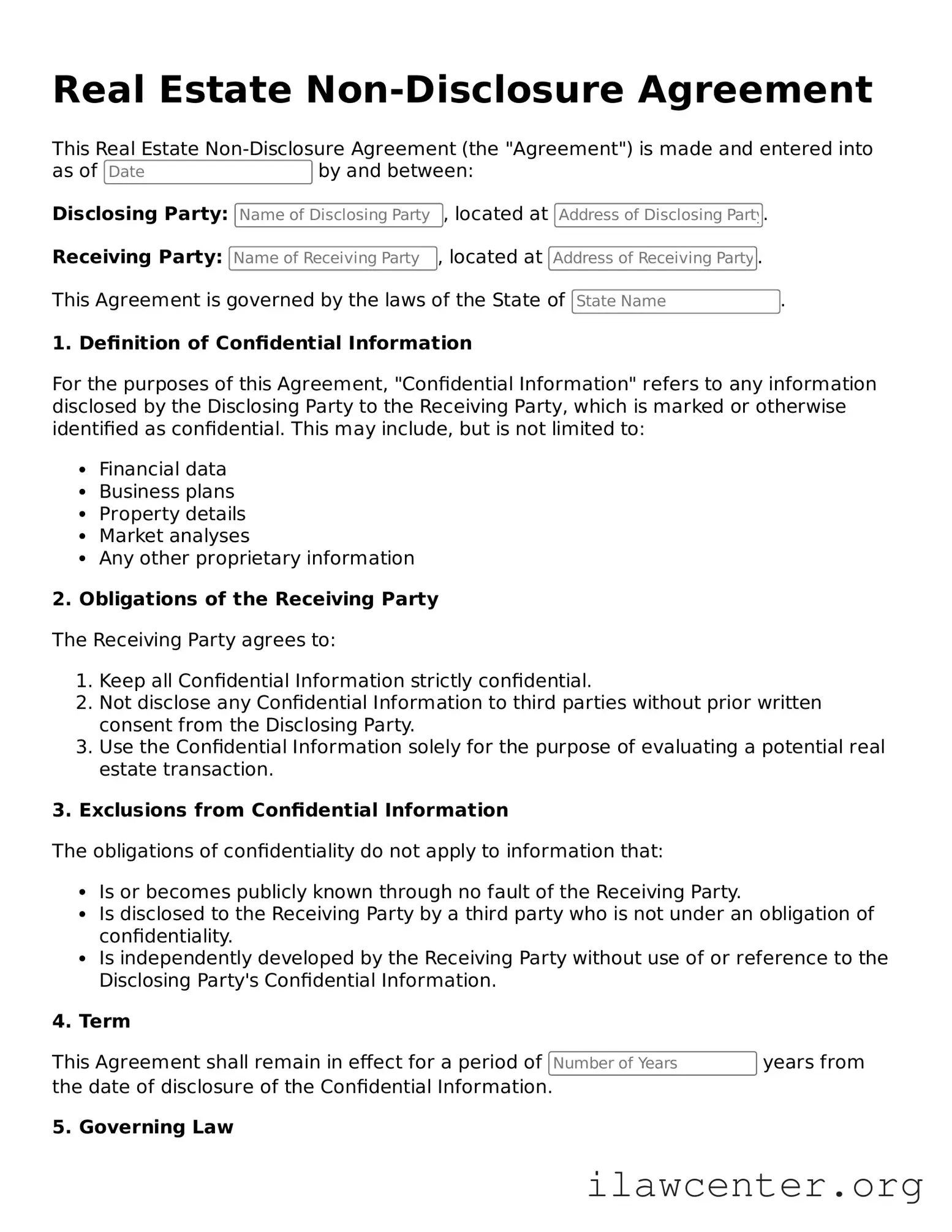
Real Estate Non-Disclosure Agreement

This Real Estate Non-Disclosure Agreement (the "Agreement") is made and entered into as of by and between:

Disclosing Party: , located at .

Receiving Party: , located at .

This Agreement is governed by the laws of the State of .

1. Definition of Confidential Information

For the purposes of this Agreement, "Confidential Information" refers to any information disclosed by the Disclosing Party to the Receiving Party, which is marked or otherwise identified as confidential. This may include, but is not limited to:

  • Financial data
  • Business plans
  • Property details
  • Market analyses
  • Any other proprietary information

2. Obligations of the Receiving Party

The Receiving Party agrees to:

  1. Keep all Confidential Information strictly confidential.
  2. Not disclose any Confidential Information to third parties without prior written consent from the Disclosing Party.
  3. Use the Confidential Information solely for the purpose of evaluating a potential real estate transaction.

3. Exclusions from Confidential Information

The obligations of confidentiality do not apply to information that:

  • Is or becomes publicly known through no fault of the Receiving Party.
  • Is disclosed to the Receiving Party by a third party who is not under an obligation of confidentiality.
  • Is independently developed by the Receiving Party without use of or reference to the Disclosing Party's Confidential Information.

4. Term

This Agreement shall remain in effect for a period of years from the date of disclosure of the Confidential Information.

5. Governing Law

This Agreement shall be governed by and construed in accordance with the laws of the State of .

6. Signatures

By signing below, both parties acknowledge that they have read, understood, and agreed to the terms of this Agreement.

Disclosing Party: ____________________________ Date: _______________

Receiving Party: ____________________________ Date: _______________

PDF Form Characteristics

Fact Name Description
Purpose A Real Estate Non-Disclosure Agreement (NDA) is designed to protect confidential information shared between parties during real estate transactions.
Parties Involved The agreement typically involves at least two parties: the disclosing party and the receiving party.
Confidential Information Confidential information may include financial data, property details, and other sensitive business information.
Duration The NDA specifies a duration for which the confidentiality obligation remains in effect, often ranging from one to five years.
Governing Law Each state may have its own governing laws. For example, California law governs NDAs executed in California.
Enforcement If a party breaches the NDA, the other party may seek legal remedies, including injunctions or monetary damages.
Mutual vs. Unilateral NDAs can be mutual, where both parties share confidential information, or unilateral, where only one party discloses information.

Instructions on Utilizing Real Estate Non-Disclosure Agreement

Filling out the Real Estate Non-Disclosure Agreement form is an important step in ensuring that sensitive information remains confidential. After completing the form, it will need to be signed and dated by all parties involved to make it legally binding.

  1. Begin by entering the date at the top of the form. This establishes when the agreement is effective.
  2. Identify the parties involved. Provide the full legal names of all individuals or entities entering into the agreement.
  3. Clearly state the purpose of the agreement. Briefly describe the information that will be kept confidential.
  4. Specify the obligations of each party. Outline what each party is expected to do regarding the handling of confidential information.
  5. Include the duration of the confidentiality obligation. Indicate how long the information must remain confidential.
  6. Provide any exceptions to the confidentiality obligations. List any circumstances under which the information may be disclosed.
  7. Review the entire form for accuracy. Ensure all information is correct and complete.
  8. Have all parties sign and date the form. Each party should retain a copy for their records.

Important Facts about Real Estate Non-Disclosure Agreement

What is a Real Estate Non-Disclosure Agreement?

A Real Estate Non-Disclosure Agreement (NDA) is a legal document designed to protect confidential information shared between parties involved in a real estate transaction. This agreement ensures that sensitive information, such as financial details, property valuations, and business strategies, remains private and is not disclosed to unauthorized individuals or entities.

Why should I use a Real Estate Non-Disclosure Agreement?

Using an NDA is essential for safeguarding your proprietary information. It establishes a legal framework that prevents the unauthorized sharing of sensitive data, which can be crucial in negotiations, partnerships, or sales. This protection fosters trust between parties and encourages open communication.

Who should sign a Real Estate Non-Disclosure Agreement?

Typically, all parties involved in the real estate transaction should sign the NDA. This includes sellers, buyers, agents, and any third-party consultants or advisors. Ensuring that everyone is bound by the agreement helps maintain confidentiality throughout the process.

What types of information are protected by the NDA?

The NDA protects various types of confidential information, including but not limited to financial records, property appraisals, marketing strategies, and client lists. Any information deemed sensitive or proprietary can be included in the agreement to ensure its confidentiality.

How long does the confidentiality obligation last?

The duration of the confidentiality obligation is typically specified in the NDA. It can vary from a few years to an indefinite period, depending on the nature of the information and the parties' agreement. It is important to clearly outline this duration in the document.

What happens if someone breaches the NDA?

If a party breaches the NDA, they may face legal consequences. The injured party can seek remedies, which may include monetary damages or injunctive relief to prevent further disclosure. The NDA should outline the specific actions that can be taken in the event of a breach.

Can I modify the Real Estate Non-Disclosure Agreement?

Yes, the NDA can be modified to meet the specific needs of the parties involved. Any changes should be clearly documented and agreed upon by all parties. It is advisable to consult with a legal professional to ensure that modifications are valid and enforceable.

Is a Real Estate Non-Disclosure Agreement legally binding?

Yes, a properly executed NDA is legally binding. For the agreement to be enforceable, it must be signed by all parties involved and should clearly outline the terms and conditions. Ensure that all parties understand their obligations under the agreement.

Do I need a lawyer to create a Real Estate Non-Disclosure Agreement?

While it is not mandatory to have a lawyer draft the NDA, it is highly recommended. A legal professional can ensure that the agreement complies with state laws and adequately protects your interests. If you choose to create the NDA without legal assistance, ensure that it is comprehensive and clear.

Where can I obtain a Real Estate Non-Disclosure Agreement form?

Real Estate Non-Disclosure Agreement forms can be obtained from various sources, including legal document preparation services, online legal platforms, and real estate associations. Ensure that the form you choose is tailored to meet your specific needs and complies with local laws.
Common mistakes

When filling out a Real Estate Non-Disclosure Agreement (NDA), individuals often overlook critical details. One common mistake is failing to clearly define the information that is considered confidential. Without a precise definition, parties may have differing interpretations of what should remain private. This ambiguity can lead to disputes down the line.

Another frequent error is neglecting to include the duration of the confidentiality obligation. An NDA should specify how long the parties are bound to keep the information confidential. If this timeframe is not stated, it can result in misunderstandings about when the obligation ends, potentially exposing sensitive information to the public.

People also often forget to identify all parties involved in the agreement. Omitting a party can create gaps in responsibility and accountability. Each person or entity that has access to confidential information should be explicitly named in the NDA to ensure everyone understands their obligations.

Moreover, individuals sometimes fail to consider the consequences of a breach. An effective NDA outlines the repercussions if one party discloses confidential information. Without this clause, the agreement lacks enforceability, and the injured party may have limited options for recourse.

Lastly, many individuals skip the review process before signing the NDA. Rushing through the document can lead to overlooked mistakes or unclear terms. Taking the time to read and understand the agreement ensures that all parties are aligned and reduces the risk of future conflicts.

Documents used along the form

In real estate transactions, several documents often accompany the Real Estate Non-Disclosure Agreement (NDA). Each of these forms serves a specific purpose and helps ensure that all parties are protected and informed throughout the process. Below is a list of common documents used alongside the NDA.

  • Purchase Agreement: This document outlines the terms of the sale, including the price, property details, and closing date. It serves as a binding contract between the buyer and seller.
  • Property Disclosure Statement: Sellers provide this statement to disclose any known issues or defects with the property. This document helps buyers make informed decisions.
  • Confidentiality Agreement: Similar to the NDA, this agreement ensures that sensitive information shared during negotiations remains confidential, protecting both parties' interests.
  • Listing Agreement: This contract is between a property owner and a real estate agent, granting the agent the authority to sell the property on the owner's behalf.
  • Inspection Report: After a property inspection, this report details the condition of the property, highlighting any necessary repairs or concerns that may affect the sale.
  • Closing Statement: This document summarizes the final financial details of the transaction, including costs, fees, and the distribution of funds at closing.

Understanding these documents is crucial for anyone involved in real estate transactions. They help facilitate clear communication and protect the interests of all parties involved.

Similar forms

The Real Estate Non-Disclosure Agreement (NDA) is a crucial document in the real estate industry, designed to protect sensitive information. Several other documents share similar purposes and structures. Here are nine documents that are comparable to the Real Estate NDA:

  • Confidentiality Agreement: This document also ensures that parties keep sensitive information private. Like the NDA, it outlines what information is confidential and the obligations of the parties involved.
  • Non-Compete Agreement: While primarily focused on restricting competition, this agreement can include clauses that protect confidential information, similar to the NDA.
  • Mutual Non-Disclosure Agreement: This is a two-way NDA where both parties agree to protect each other's confidential information, mirroring the protective intent of the Real Estate NDA.
  • Employment Confidentiality Agreement: Often used in employer-employee relationships, this document ensures that employees do not disclose sensitive company information, much like a Real Estate NDA protects proprietary real estate data.
  • Partnership Agreement: In partnerships, confidentiality clauses may be included to protect business secrets and strategies, paralleling the confidentiality goals of a Real Estate NDA.
  • Brokerage Agreement: This document may contain provisions that require the broker to keep certain information confidential, similar to the obligations outlined in a Real Estate NDA.
  • Joint Venture Agreement: When two or more parties collaborate on a project, this agreement can include confidentiality terms to protect shared information, akin to the Real Estate NDA.
  • License Agreement: This document often includes confidentiality clauses to protect proprietary information shared between the licensor and licensee, similar to the protections in a Real Estate NDA.
  • Real Estate Purchase Agreement: While primarily focused on the sale of property, it can include confidentiality provisions to protect sensitive transaction details, reflecting the same protective spirit as the Real Estate NDA.

Understanding these documents can help individuals navigate the complexities of real estate transactions and protect their interests effectively.

Dos and Don'ts

When filling out a Real Estate Non-Disclosure Agreement (NDA) form, it's essential to be thorough and accurate. Here’s a list of things you should and shouldn't do:

  • Do read the entire NDA carefully before filling it out.
  • Do provide accurate and complete information.
  • Do ensure that all parties involved sign the document.
  • Do keep a copy of the signed NDA for your records.
  • Do clarify any terms or conditions you do not understand.
  • Don't rush through the form; take your time to avoid mistakes.
  • Don't omit any required information, as this could invalidate the agreement.
  • Don't sign the NDA without confirming that all parties have agreed to the terms.
  • Don't use vague language when describing confidential information.
  • Don't share the NDA with unauthorized individuals.

Misconceptions

When it comes to Real Estate Non-Disclosure Agreements (NDAs), several misconceptions can cloud understanding. Here are nine common misunderstandings that people often have:

  1. NDAs are only for big companies.

    This is not true. Individuals and small businesses can also benefit from NDAs, especially in real estate transactions where sensitive information is shared.

  2. All NDAs are the same.

    Each NDA can be tailored to fit specific needs. Different situations require different terms and conditions, making it essential to customize the agreement.

  3. Signing an NDA means I can’t talk to anyone.

    This is a misconception. NDAs typically allow for disclosures under certain circumstances, such as when sharing information with legal or financial advisors.

  4. NDAs are only for protecting secrets.

    While they do protect sensitive information, NDAs can also clarify the terms of a transaction, reducing misunderstandings between parties.

  5. Once signed, an NDA lasts forever.

    Most NDAs have a specified duration. After this period, the obligations to keep the information confidential may no longer apply.

  6. NDAs are difficult to enforce.

    While enforcement can be challenging, having a well-drafted NDA increases the likelihood of legal recourse in case of a breach.

  7. Only the disclosing party benefits from an NDA.

    Both parties can benefit. The receiving party gains access to valuable information while the disclosing party protects their interests.

  8. NDAs are unnecessary if I trust the other party.

    Trust is important, but an NDA provides legal protection and clarity. It formalizes the understanding between parties, reducing risks.

  9. Verbal agreements are sufficient.

    While verbal agreements may hold some weight, they are often difficult to prove. A written NDA is more reliable and enforceable in court.

Understanding these misconceptions can help individuals and businesses navigate real estate transactions more effectively. Clarity about NDAs fosters better communication and protects all parties involved.

Key takeaways

When dealing with a Real Estate Non-Disclosure Agreement (NDA), it is important to understand the essential aspects of the form. Here are some key takeaways:

  • The NDA protects sensitive information shared between parties involved in a real estate transaction.
  • Clearly define what constitutes confidential information to avoid misunderstandings.
  • Both parties should sign the NDA before any confidential information is exchanged.
  • Specify the duration of confidentiality to clarify how long the information must remain private.
  • Consider including exceptions to confidentiality, such as information that becomes public or is independently developed.
  • Ensure that the NDA complies with local laws and regulations to maintain its enforceability.
  • Review the agreement periodically to ensure it still meets the needs of both parties.

Using a Real Estate Non-Disclosure Agreement can help foster trust and protect interests during negotiations.