Fillable Receipt Template Document

Fillable Receipt Template Document

A Receipt Template form is a standardized document used to acknowledge the receipt of payment for goods or services. This form helps both the buyer and seller keep accurate records of transactions. To get started, fill out the form by clicking the button below.

Article Guide

When managing personal finances or running a business, keeping track of transactions is essential. One effective way to document these exchanges is through a Receipt Template form. This simple yet powerful tool serves as a written acknowledgment of payment, providing both the buyer and seller with a clear record of the transaction. Typically, a receipt includes important details such as the date of the transaction, the names of the parties involved, a description of the goods or services exchanged, and the amount paid. Additionally, it may feature payment methods, tax information, and even a unique receipt number for easy reference. By utilizing a Receipt Template, individuals and businesses can ensure transparency and accountability in their financial dealings, making it easier to manage budgets and maintain accurate records for tax purposes or future reference.

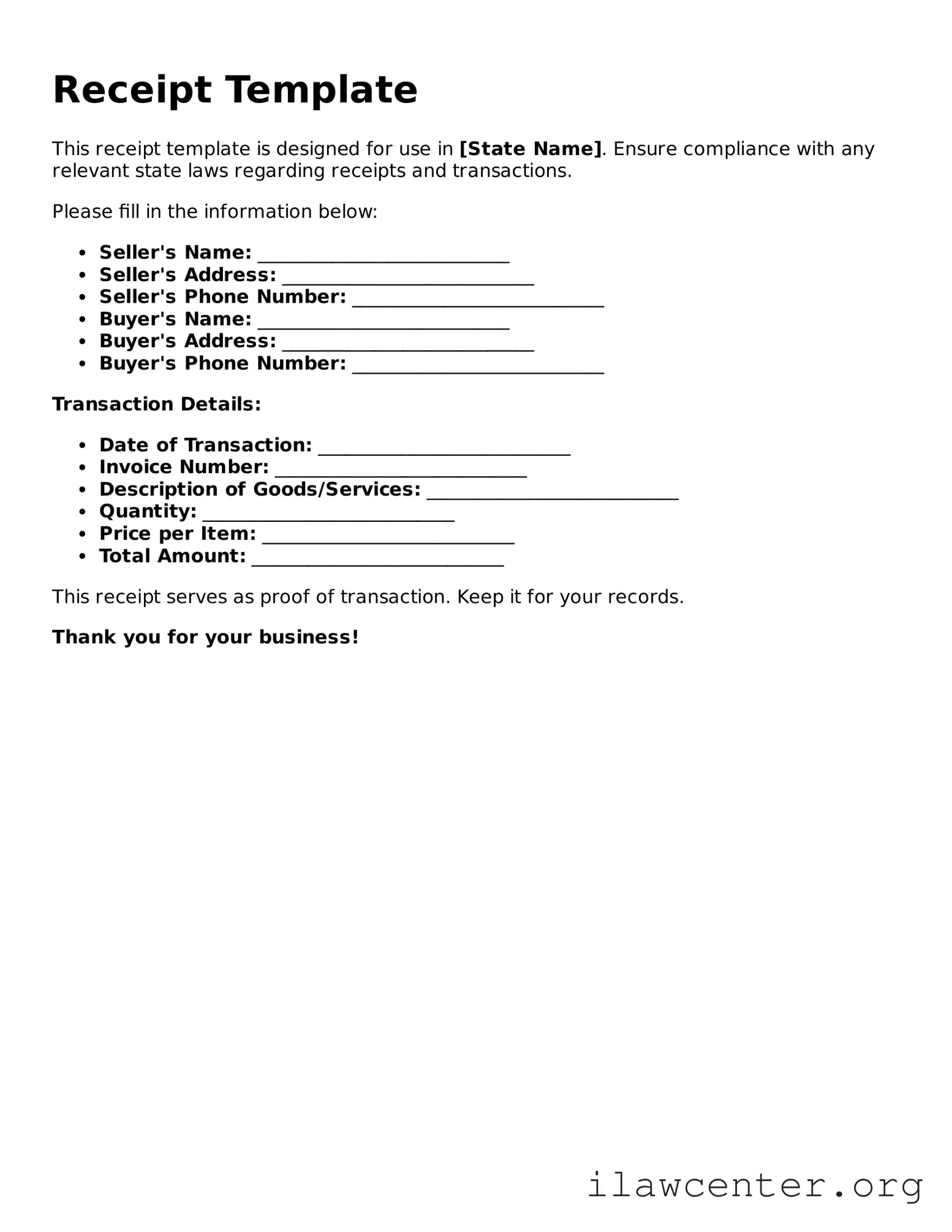
Receipt Template Preview

Receipt Template

This receipt template is designed for use in [State Name]. Ensure compliance with any relevant state laws regarding receipts and transactions.

Please fill in the information below:

  • Seller's Name: ___________________________
  • Seller's Address: ___________________________
  • Seller's Phone Number: ___________________________
  • Buyer's Name: ___________________________
  • Buyer's Address: ___________________________
  • Buyer's Phone Number: ___________________________

Transaction Details:

  • Date of Transaction: ___________________________
  • Invoice Number: ___________________________
  • Description of Goods/Services: ___________________________
  • Quantity: ___________________________
  • Price per Item: ___________________________
  • Total Amount: ___________________________

This receipt serves as proof of transaction. Keep it for your records.

Thank you for your business!

PDF Form Characteristics

Fact Name Description
Purpose The Receipt Template form is used to acknowledge the receipt of goods or services.
Format This form can be printed or filled out digitally, depending on user preference.
State-Specific Variations Some states may have specific requirements for receipts, including additional information.
Governing Law (California) California Civil Code Section 1723 governs the use of receipts in commercial transactions.
Governing Law (New York) In New York, General Business Law Section 396-b outlines receipt requirements.
Essential Elements A complete receipt includes the date, amount, description of goods/services, and seller's information.
Record Keeping Receipts serve as important documents for accounting and tax purposes.
Consumer Rights Consumers have the right to receive a receipt for purchases, which can protect them in disputes.

Instructions on Utilizing Receipt Template

Filling out the Receipt Template form is a straightforward process that allows you to document transactions effectively. By following these steps, you can ensure that all necessary information is captured accurately, making it easier for both you and the recipient to keep track of payments.

  1. Begin by entering the date of the transaction in the designated field.
  2. Fill in the name of the individual or business that made the payment.
  3. Provide a detailed description of the goods or services provided.
  4. Indicate the amount paid, ensuring that you include the correct currency symbol.
  5. If applicable, add any tax or additional fees to the total amount.
  6. Include your name or the name of your business as the seller.
  7. Sign and date the receipt to validate the transaction.

Once you have completed these steps, review the form for accuracy before distributing it to the relevant parties. This will help maintain clear records and ensure that all information is properly documented.

Important Facts about Receipt Template

What is a Receipt Template form?

A Receipt Template form is a pre-designed document that allows individuals or businesses to create a receipt for transactions. It typically includes fields for the date of the transaction, the name of the seller, the name of the buyer, a description of the goods or services sold, the amount paid, and any applicable taxes. This template helps ensure that all necessary information is captured in a clear and organized manner, making it easy for both parties to keep accurate records.

Why should I use a Receipt Template form?

Using a Receipt Template form can simplify the process of documenting transactions. It provides a consistent format, which can enhance professionalism and clarity. Whether you are a small business owner or an individual selling items, having a receipt helps protect both parties. It serves as proof of payment, which can be useful for returns, exchanges, or tax purposes. Moreover, a well-organized receipt can help track expenses and income over time.

Can I customize the Receipt Template form?

Yes, most Receipt Template forms are designed to be customizable. You can modify various elements such as the logo, colors, fonts, and layout to match your branding or personal style. Additionally, you can add or remove fields based on your specific needs. Customization ensures that the receipt reflects your unique business identity while still containing all necessary information.

Where can I find a Receipt Template form?

Receipt Template forms are widely available online. Many websites offer free or paid templates that you can download and use. Additionally, software programs like Microsoft Word, Excel, or Google Docs often have built-in templates that you can easily access. If you prefer, there are also specialized accounting software programs that include receipt generation features, which can streamline the process even further.

Common mistakes

Filling out a Receipt Template form may seem straightforward, but many individuals make common mistakes that can lead to confusion or even legal issues. One frequent error is failing to include the date of the transaction. Without this critical piece of information, it becomes challenging to establish a timeline, which can be crucial for record-keeping or dispute resolution.

Another common mistake is omitting contact information. Whether it’s the buyer’s or seller’s details, having accurate contact information is essential for follow-up communication. Missing this information can hinder the ability to resolve any future questions or issues related to the transaction.

Some people neglect to specify the items or services sold. Simply stating "goods" or "services" is not sufficient. A detailed description helps clarify what was exchanged, which is particularly important for warranty claims or returns. Vague descriptions can lead to misunderstandings later on.

Inaccurate amounts can also cause significant problems. Double-checking the total cost, including taxes and discounts, is vital. Errors in calculation can lead to disputes between the buyer and seller, potentially damaging relationships and complicating financial records.

Another oversight is not signing the receipt. A signature serves as an acknowledgment of the transaction by both parties. Without it, the receipt may lack validity, making it harder to enforce any agreements or claims that arise from the transaction.

Many individuals also forget to keep a copy of the completed receipt for their records. This can be detrimental, especially when proof of purchase is required for returns, exchanges, or warranty claims. Retaining a copy ensures that both parties have access to the same information.

Some people fail to include payment methods, such as cash, credit card, or check. This detail is important for tracking financial transactions and can provide clarity in case of disputes. Without it, the transaction may appear incomplete or questionable.

Lastly, individuals often overlook the importance of using clear and legible handwriting or typing. Illegible writing can lead to misinterpretation of the details, which can create unnecessary complications. Ensuring clarity in communication is vital for effective transactions.
Documents used along the form

When managing financial transactions, several documents often accompany a Receipt Template form. Each of these documents serves a unique purpose, helping to ensure clarity and accountability in financial dealings. Understanding these forms can enhance your record-keeping practices and provide a more comprehensive view of your transactions.

  • Invoice: An invoice is a detailed bill sent to customers, outlining the products or services provided, along with the total amount due. It serves as a request for payment and typically includes payment terms.
  • Purchase Order: A purchase order is a document generated by a buyer to authorize a purchase transaction. It outlines the specifics of the order, including quantities, prices, and delivery details.
  • Bill of Sale: This document serves as proof of the transfer of ownership of an item from one party to another. It includes details about the item sold and the parties involved in the transaction.
  • Payment Voucher: A payment voucher is used to document a payment made to a vendor or supplier. It typically includes information about the transaction, such as the amount paid and the purpose of the payment.
  • Credit Note: A credit note is issued to a buyer when a return or adjustment is made. It indicates that the buyer has a credit balance with the seller, which can be applied to future purchases.
  • Expense Report: This document is used by employees to report and request reimbursement for business-related expenses. It provides details about the expenses incurred and is often accompanied by receipts.
  • Bank Statement: A bank statement is a summary of all transactions in a bank account over a specific period. It can help reconcile financial records and verify transactions recorded in other documents.
  • Contract: A contract is a legally binding agreement between two or more parties. It outlines the terms and conditions of a transaction, providing a framework for the relationship between the parties involved.

Utilizing these documents alongside the Receipt Template form can streamline your financial processes and promote transparency in your transactions. By maintaining organized records, you can better manage your finances and ensure compliance with relevant regulations.

Similar forms

The Receipt Template form serves as a foundational document in various transactions. Below is a list of nine documents that share similarities with the Receipt Template form, each playing a crucial role in record-keeping and financial transactions.

  • Invoice: An invoice outlines the details of a sale, including products or services provided, quantities, and prices. Like a receipt, it serves as proof of a transaction.
  • Bill of Sale: This document transfers ownership of an item from one party to another. It includes details about the item and the transaction, similar to a receipt's function of confirming a purchase.
  • Purchase Order: A purchase order is a buyer's formal request to a seller for goods or services. It includes quantities and agreed prices, resembling the information found on a receipt.
  • Payment Confirmation: This document acknowledges that a payment has been received. It serves as proof, much like a receipt, that a financial transaction has occurred.
  • Delivery Receipt: A delivery receipt confirms that goods have been received by the buyer. It includes details about the items delivered, similar to how a receipt confirms a sale.
  • Credit Note: A credit note is issued to acknowledge a return or adjustment in a transaction. It provides a record of the change, akin to a receipt that details the original sale.
  • Expense Report: This document records expenses incurred by an individual or organization. It often includes receipts for verification, aligning with the purpose of documenting financial transactions.
  • Statement of Account: This document summarizes all transactions between a buyer and seller over a specific period. It provides a comprehensive overview, similar to how a receipt summarizes a single transaction.
  • Contract: A contract outlines the terms of an agreement between parties. While more detailed, it shares the purpose of formalizing a transaction, similar to the role of a receipt.

Dos and Don'ts

When filling out the Receipt Template form, it is essential to be meticulous and thoughtful. Here are nine important dos and don'ts to guide you through the process.

  • Do ensure all required fields are filled out completely.
  • Do double-check the accuracy of the information provided.
  • Do keep a copy of the completed form for your records.
  • Do use clear and legible handwriting if filling out the form by hand.
  • Do follow any specific instructions that accompany the form.
  • Don't leave any fields blank unless instructed to do so.
  • Don't use abbreviations that may cause confusion.
  • Don't submit the form without reviewing it for errors.
  • Don't forget to sign and date the form if required.

By adhering to these guidelines, you can ensure that your submission is accurate and complete, helping to facilitate a smoother process.

Misconceptions

Many people have misunderstandings about the Receipt Template form. Here are six common misconceptions, along with explanations to clarify them.

  1. Receipt templates are only for businesses.

    This is not true. While businesses often use receipt templates for transactions, individuals can also benefit from them. Personal transactions, such as selling items online or renting equipment, can also use receipts for clarity and record-keeping.

  2. All receipt templates are the same.

    Receipt templates can vary widely. Some may include specific fields for tax information, while others may focus on simplicity. Users should choose a template that meets their specific needs.

  3. Receipt templates are complicated to use.

    In reality, most receipt templates are designed for ease of use. Many can be filled out quickly, even by those with minimal experience in document creation.

  4. You need special software to create a receipt.

    This is a misconception. Many receipt templates are available in common formats like Word or PDF. Users can easily fill them out without needing specialized software.

  5. Receipts created with templates are not legally valid.

    As long as the receipt contains the necessary information, such as date, amount, and seller information, it is generally considered legally valid. Templates help ensure that all required details are included.

  6. Once a receipt is created, it cannot be changed.

    This is false. Users can modify the information on a receipt as needed, such as correcting an amount or updating a date. Flexibility is one of the advantages of using a template.

Key takeaways

When filling out and using the Receipt Template form, there are several important points to consider for effective and accurate documentation. Here are the key takeaways:

  • Ensure all fields are completed accurately. Missing information can lead to confusion or disputes later.
  • Keep a copy of the filled-out receipt for your records. This can serve as proof of transaction and is useful for tax purposes.
  • Use clear and legible handwriting or type the information. This helps prevent misunderstandings regarding the details of the transaction.
  • Include the date of the transaction. This is crucial for tracking expenses and for any potential audits.