Fillable Release of Promissory Note Document

Fillable Release of Promissory Note Document

A Release of Promissory Note form is a legal document that signifies the satisfaction of a debt, indicating that the borrower has fulfilled their obligations under the promissory note. This form is essential for both parties, as it provides clarity and finality to the transaction. To ensure a smooth process, consider filling out the form by clicking the button below.

Article Guide

The Release of Promissory Note form serves as a crucial document in the realm of financial transactions, particularly when a borrower has fulfilled their obligations under a promissory note. This form is designed to formally acknowledge that the debt has been paid in full, effectively releasing the borrower from any further liability associated with the note. Key components of the form typically include the names of the parties involved, the original loan amount, and the date of repayment. Additionally, it often requires signatures from both the lender and borrower, ensuring that both parties agree to the release. By utilizing this form, individuals can safeguard their financial records and provide clear evidence that the debt has been settled, thus preventing any future disputes. Understanding the significance of this document can empower borrowers and lenders alike, fostering transparency and trust in financial dealings.

Release of Promissory Note Preview

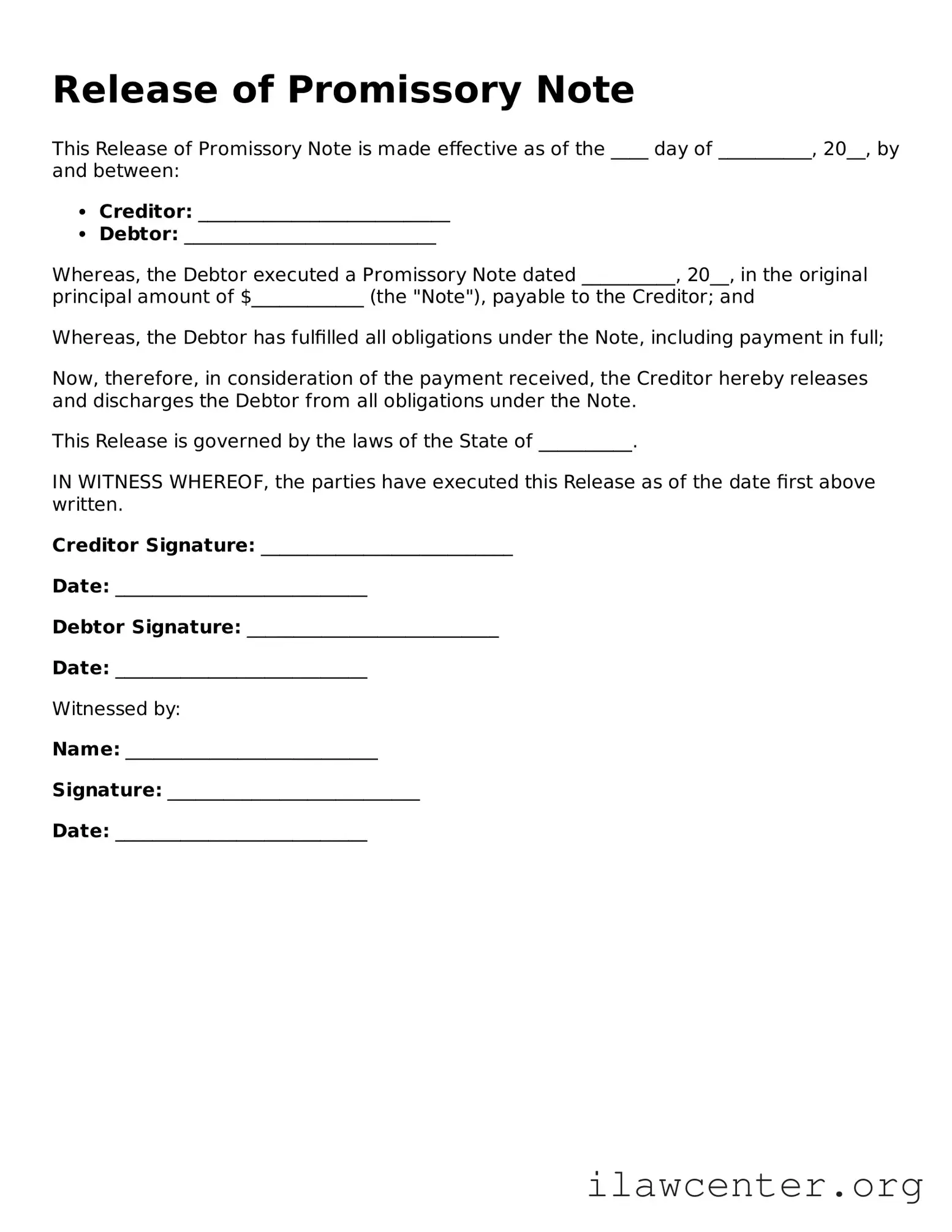
Release of Promissory Note

This Release of Promissory Note is made effective as of the ____ day of __________, 20__, by and between:

  • Creditor: ___________________________
  • Debtor: ___________________________

Whereas, the Debtor executed a Promissory Note dated __________, 20__, in the original principal amount of $____________ (the "Note"), payable to the Creditor; and

Whereas, the Debtor has fulfilled all obligations under the Note, including payment in full;

Now, therefore, in consideration of the payment received, the Creditor hereby releases and discharges the Debtor from all obligations under the Note.

This Release is governed by the laws of the State of __________.

IN WITNESS WHEREOF, the parties have executed this Release as of the date first above written.

Creditor Signature: ___________________________

Date: ___________________________

Debtor Signature: ___________________________

Date: ___________________________

Witnessed by:

Name: ___________________________

Signature: ___________________________

Date: ___________________________

PDF Form Characteristics

Fact Name Details
Definition A Release of Promissory Note form is a legal document used to acknowledge the payment or satisfaction of a promissory note, thereby releasing the borrower from any further obligations under that note.
Purpose This form serves to formally document that the lender has received full payment and no longer holds any claim against the borrower regarding the promissory note.
State-Specific Forms Many states have their own specific forms for the release of a promissory note. It is crucial to use the correct form that complies with local regulations.
Governing Laws The governing laws for promissory notes and their releases can vary by state. For example, in California, the relevant laws are found in the California Commercial Code.
Execution The form typically requires signatures from both the lender and the borrower, confirming that the transaction has been completed and the debt settled.
Record Keeping It is advisable for both parties to keep a copy of the signed Release of Promissory Note form for their records, as it serves as proof of the transaction.

Instructions on Utilizing Release of Promissory Note

Once you have the Release of Promissory Note form, it’s important to fill it out accurately to ensure that all necessary information is documented. This will help in the proper execution of the release process. Follow these steps carefully to complete the form.

  1. Begin by entering the date at the top of the form.
  2. Provide the name of the borrower. This is the individual or entity that originally took out the loan.
  3. Next, include the name of the lender. This is the individual or organization that provided the loan.
  4. Fill in the amount of the promissory note. This should reflect the total amount that was originally borrowed.
  5. Specify the date the promissory note was executed. This is the date when the borrower signed the note.
  6. In the designated area, state that the promissory note is being released. You may write a simple statement indicating that the debt has been satisfied.
  7. Sign the form. The lender should provide their signature to confirm the release.
  8. Finally, include the date of the signature.

After completing the form, make sure to keep a copy for your records. It’s advisable to send the original to the borrower and confirm receipt. This ensures that both parties have documented the release of the promissory note appropriately.

Important Facts about Release of Promissory Note

What is a Release of Promissory Note form?

The Release of Promissory Note form is a legal document used to formally acknowledge the satisfaction of a debt that was secured by a promissory note. When the borrower has fulfilled their obligation to repay the loan, this form is completed to release the lender's claim on the debt. It serves as proof that the borrower has paid off the loan in full and that the lender has no further rights to collect on that note.

Who needs to complete the Release of Promissory Note form?

Both the lender and the borrower should be involved in the completion of the Release of Promissory Note form. The borrower needs to ensure that their debt is officially recognized as paid, while the lender must confirm that they have received all payments and have no further claims against the borrower. Completing this form protects both parties and provides a clear record of the transaction.

What information is required to complete the form?

To complete the Release of Promissory Note form, specific information is necessary. This includes the names and addresses of both the lender and the borrower, the date of the original promissory note, the amount of the loan, and the date on which the loan was fully paid. Additionally, both parties must sign and date the form to validate the release.

What happens after the form is completed?

Once the Release of Promissory Note form is completed and signed, it should be distributed to both parties. The borrower should keep a copy for their records, while the lender may also retain a copy as proof of the transaction. It is advisable for the borrower to file the original form with their personal records or with a legal advisor to ensure that there is a permanent record of the debt being released.

Common mistakes

Filling out a Release of Promissory Note form can seem straightforward, but many people make common mistakes that can lead to confusion or legal issues down the line. One frequent error is failing to include all necessary parties. If the borrower and lender are not both named in the document, it can create problems. Always ensure that everyone involved is listed clearly.

Another mistake is not providing accurate dates. Dates are crucial in legal documents. If the date of the release is incorrect, it may raise questions about when the obligations were actually fulfilled. Always double-check that the date reflects when the release should take effect.

People also often overlook the importance of signatures. A form without the proper signatures can be deemed invalid. Both parties need to sign the document to confirm their agreement. It’s essential to make sure that all required signatures are present before submitting the form.

Lastly, failing to keep a copy of the completed form is a common oversight. After filling out the Release of Promissory Note, it’s wise to retain a copy for your records. This can be helpful if any disputes arise later. Having documentation can provide clarity and peace of mind.

Documents used along the form

When dealing with a Release of Promissory Note, several other forms and documents often come into play. These documents help clarify the terms of the agreement, protect the parties involved, and ensure that everything is legally sound. Here’s a list of some commonly used forms that you might encounter.

  • Promissory Note: This is the original document that outlines the borrower's promise to repay a loan under specific terms. It includes details like the loan amount, interest rate, and repayment schedule.
  • Loan Agreement: This document provides a comprehensive overview of the terms of the loan, including conditions, covenants, and any collateral involved. It serves as a binding contract between the lender and borrower.
  • Security Agreement: If the loan is secured, this document specifies the collateral that the borrower offers to the lender. It protects the lender's interest in case of default.
  • Release of Lien: When the debt is paid off, this document releases the lender's claim on the collateral, confirming that the borrower is free from the obligation.
  • Assignment of Rights: This form allows the lender to transfer their rights under the promissory note to another party, ensuring that the new party can collect payments.
  • Default Notice: If a borrower fails to meet the repayment terms, this document formally notifies them of their default status and outlines the next steps.
  • Settlement Agreement: In cases where the borrower and lender negotiate a settlement for less than the full amount owed, this document outlines the terms of that agreement.
  • Affidavit of Payment: This is a sworn statement confirming that the borrower has fulfilled their payment obligations, often used to document that the debt has been settled.

Each of these documents plays a crucial role in the lending process. By understanding their purposes, you can navigate financial agreements more effectively and ensure that your interests are protected.

Similar forms

The Release of Promissory Note form is similar to several other documents that serve various purposes in financial and legal transactions. Here are seven documents that share similarities with the Release of Promissory Note form:

  • Release of Lien: This document formally removes a lien from a property, similar to how a Release of Promissory Note clears a debt obligation.
  • Debt Settlement Agreement: This agreement outlines the terms under which a debtor pays off a debt for less than the full amount, akin to the release of a promissory note when the debt is satisfied.
  • Loan Payoff Statement: This statement provides confirmation that a loan has been fully paid, much like the Release of Promissory Note indicates that the borrower has fulfilled their obligation.
  • Cancellation of Contract: This document ends a contractual agreement, similar to how a Release of Promissory Note signifies the end of a debt relationship.
  • Settlement Agreement: This document outlines the terms agreed upon by parties to resolve a dispute, paralleling the release of obligations found in a promissory note.
  • Discharge of Mortgage: This document releases a mortgage lien on a property, similar to how a Release of Promissory Note releases the borrower from their debt obligation.
  • Assignment of Rights: This document transfers rights from one party to another, similar to how a Release of Promissory Note transfers the responsibility of the debt obligation.

Dos and Don'ts

When filling out the Release of Promissory Note form, it’s essential to follow certain guidelines to ensure accuracy and compliance. Here are five important do's and don'ts:

  • Do read the entire form carefully before starting.
  • Do provide accurate information about the parties involved.
  • Do sign and date the form in the appropriate sections.
  • Don't leave any required fields blank.
  • Don't use correction fluid or tape on the form.

Misconceptions

Understanding the Release of Promissory Note form can be challenging. Here are four common misconceptions about this form:

  • It only applies to loans between individuals. Many believe this form is only for personal loans. In reality, it can also be used in business transactions and between organizations.
  • Once a promissory note is released, it cannot be reinstated. Some think that releasing a note means it is permanently void. However, depending on the circumstances, it may be possible to negotiate a new agreement.
  • The form is only necessary if the borrower defaults. Many assume that a release is only needed when there is a problem. In fact, it is a good practice to complete the release once the loan is paid off, regardless of the borrower's performance.
  • Legal assistance is always required to complete the form. While having a lawyer can be helpful, individuals can often complete the release on their own if they understand the process and requirements.

Key takeaways

When filling out and using the Release of Promissory Note form, it is essential to keep several key points in mind to ensure clarity and legal compliance.

  • Understand the Purpose: The Release of Promissory Note form serves to formally acknowledge that a debt has been satisfied. This document is crucial for both the borrower and the lender, as it provides proof that the obligation has been fulfilled.
  • Provide Accurate Information: Ensure that all details on the form, including names, dates, and amounts, are correct. Inaccuracies can lead to disputes or complications in the future.
  • Signatures Matter: Both parties should sign the document. This step confirms mutual agreement and helps prevent any misunderstandings about the status of the debt.
  • Keep Copies: After completing the form, make sure to keep copies for your records. This will be important if any questions arise later regarding the release of the debt.

By following these guidelines, you can effectively navigate the process of using the Release of Promissory Note form and protect your interests.