Fillable Repair Escrow Agreement Document

Fillable Repair Escrow Agreement Document

A Repair Escrow Agreement is a legal document designed to ensure that funds are set aside for necessary repairs during a real estate transaction. This agreement protects both buyers and sellers by clearly outlining the terms under which the escrowed funds will be released upon completion of specified repairs. To facilitate a smooth transaction, consider filling out the form by clicking the button below.

Article Guide

The Repair Escrow Agreement form serves as a crucial tool in real estate transactions, particularly when repairs or improvements are needed before the final closing of a property sale. This agreement outlines the terms under which funds are held in escrow to ensure that necessary repairs are completed satisfactorily. It typically details the specific repairs to be made, the timeline for their completion, and the amount of money being set aside. Both the buyer and seller have roles to play in this process, as the buyer wants assurance that the property will be in good condition, while the seller may seek to maintain control over the repair process. The form also includes provisions for how disputes regarding the repairs will be handled and what happens if the repairs are not completed as agreed. Overall, the Repair Escrow Agreement helps protect the interests of both parties and facilitates a smoother transaction by addressing potential concerns upfront.

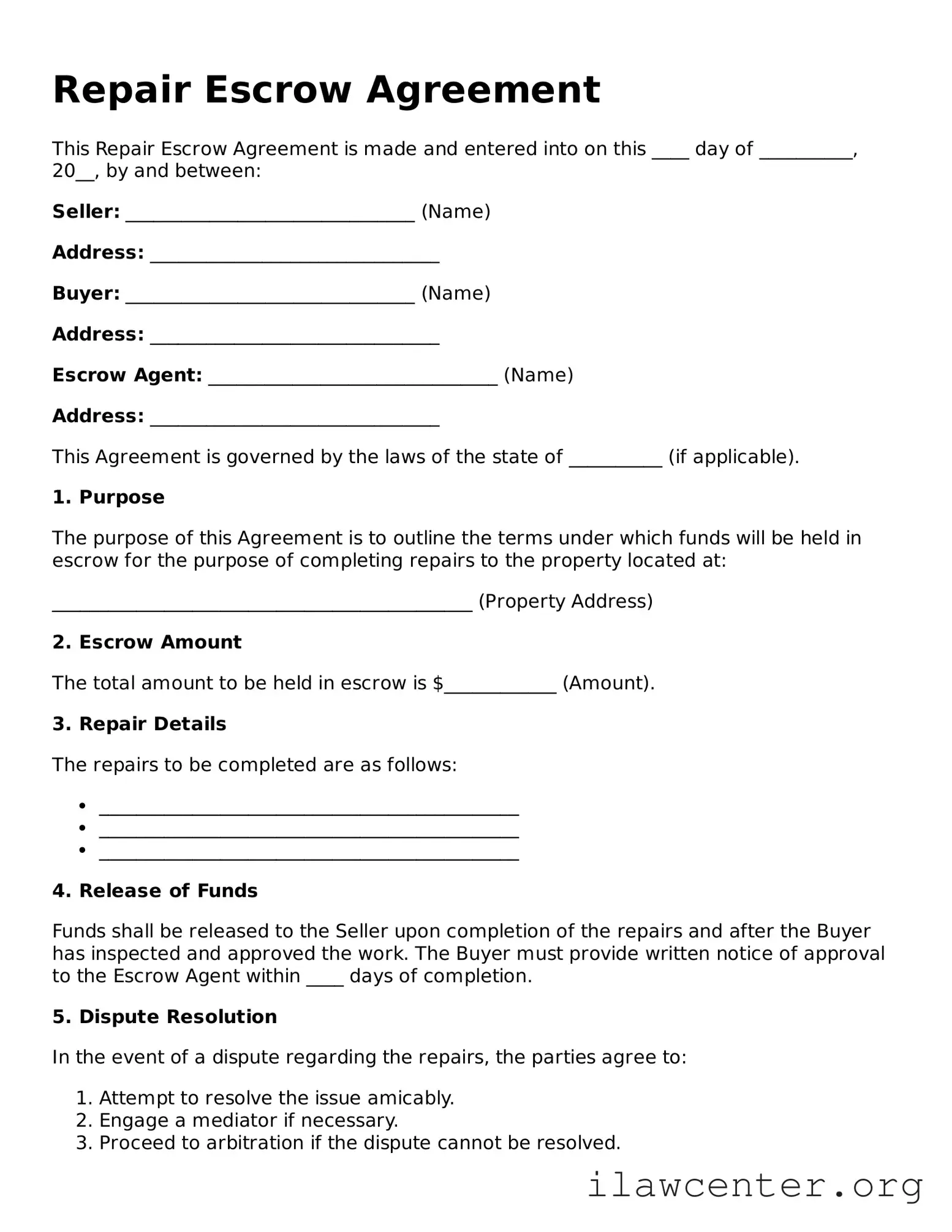
Repair Escrow Agreement Preview

Repair Escrow Agreement

This Repair Escrow Agreement is made and entered into on this ____ day of __________, 20__, by and between:

Seller: _______________________________ (Name)

Address: _______________________________

Buyer: _______________________________ (Name)

Address: _______________________________

Escrow Agent: _______________________________ (Name)

Address: _______________________________

This Agreement is governed by the laws of the state of __________ (if applicable).

1. Purpose

The purpose of this Agreement is to outline the terms under which funds will be held in escrow for the purpose of completing repairs to the property located at:

_____________________________________________ (Property Address)

2. Escrow Amount

The total amount to be held in escrow is $____________ (Amount).

3. Repair Details

The repairs to be completed are as follows:

  • _____________________________________________
  • _____________________________________________
  • _____________________________________________

4. Release of Funds

Funds shall be released to the Seller upon completion of the repairs and after the Buyer has inspected and approved the work. The Buyer must provide written notice of approval to the Escrow Agent within ____ days of completion.

5. Dispute Resolution

In the event of a dispute regarding the repairs, the parties agree to:

  1. Attempt to resolve the issue amicably.
  2. Engage a mediator if necessary.
  3. Proceed to arbitration if the dispute cannot be resolved.

6. Signatures

By signing below, the parties agree to the terms of this Repair Escrow Agreement.

Seller Signature: _______________________________ Date: _______________

Buyer Signature: _______________________________ Date: _______________

Escrow Agent Signature: _______________________________ Date: _______________

PDF Form Characteristics

Fact Name Description
Definition A Repair Escrow Agreement outlines the terms under which funds are held to cover repair costs after a property sale.
Purpose This agreement ensures that necessary repairs are completed before the sale is finalized, protecting both buyer and seller.
Participants The agreement involves the buyer, seller, and an escrow agent responsible for managing the funds.
Funding Typically, a specified amount is deposited into escrow to cover repair costs as agreed upon in the purchase contract.
Conditions Funds are released to the seller or contractors only after the repairs are completed to the buyer's satisfaction.
State-Specific Forms Each state may have its own Repair Escrow Agreement form, governed by local real estate laws.
Governing Law For example, California law governs agreements executed in California, while Texas law applies in Texas.
Dispute Resolution The agreement often includes a clause for resolving disputes, which may involve mediation or arbitration.
Importance A well-drafted Repair Escrow Agreement protects the interests of all parties involved and ensures transparency.

Instructions on Utilizing Repair Escrow Agreement

Filling out the Repair Escrow Agreement form is a straightforward process. Once completed, you can proceed to submit the form to the relevant parties involved in your transaction. Follow these steps to ensure accuracy and clarity.

  1. Begin by entering the date at the top of the form.
  2. Fill in the names of all parties involved, ensuring correct spelling and full legal names.
  3. Provide the property address where repairs will take place.
  4. Specify the total amount of funds to be held in escrow for repairs.
  5. Detail the specific repairs to be completed. Be clear and concise in your descriptions.
  6. Indicate the timeline for completing the repairs, including start and end dates.
  7. Include any conditions that must be met before the funds are released from escrow.
  8. Sign and date the form where indicated, ensuring all parties also sign if required.
  9. Make copies of the completed form for your records before submission.

Important Facts about Repair Escrow Agreement

What is a Repair Escrow Agreement?

A Repair Escrow Agreement is a legal document used in real estate transactions. It sets up a special account where funds are held to cover repairs that need to be made to a property. This agreement ensures that the seller completes necessary repairs before the buyer takes full ownership. It protects both parties by clearly outlining the terms of the repairs and how the funds will be released once the work is completed.

Who typically uses a Repair Escrow Agreement?

Both buyers and sellers in a real estate transaction can benefit from a Repair Escrow Agreement. Buyers often want assurance that repairs will be completed, while sellers may prefer to manage repairs after the sale closes. Real estate agents and attorneys may also be involved in drafting and executing the agreement to ensure that all parties understand their responsibilities.

How does the Repair Escrow process work?

Once the Repair Escrow Agreement is signed, the buyer deposits funds into the escrow account. The seller then has a set period to complete the agreed-upon repairs. After the repairs are finished, the buyer inspects the work. If everything meets the agreed standards, the funds are released to the seller. If there are issues, the buyer can request additional repairs or negotiate the release of funds.

What happens if the repairs are not completed on time?

If the seller fails to complete the repairs by the deadline outlined in the Repair Escrow Agreement, the buyer has options. The buyer may request that the funds remain in escrow until the repairs are done. Alternatively, the buyer can negotiate a reduction in the purchase price or seek compensation for the incomplete work. It’s important for both parties to communicate openly to find a satisfactory solution.

Common mistakes

Filling out a Repair Escrow Agreement form can be a straightforward process, but many people make common mistakes that can lead to complications later on. One frequent error is failing to provide complete information. When individuals leave out important details, it can create confusion and delays in the repair process.

Another mistake is not clearly defining the scope of repairs. Without a precise description of what needs to be fixed, disagreements may arise between parties. This lack of clarity can lead to disputes and ultimately affect the timeline for repairs.

People often overlook the importance of including all necessary signatures. A Repair Escrow Agreement is not valid unless it is signed by all required parties. Missing a signature can render the entire agreement ineffective, complicating the repair process.

Some individuals mistakenly assume that verbal agreements are sufficient. Relying on spoken promises can lead to misunderstandings. It is crucial to document all agreements in writing to ensure that everyone is on the same page.

Inaccurate financial estimates are another common issue. When parties do not provide realistic cost estimates for repairs, it can lead to budget overruns. It is essential to conduct thorough research to ensure that the financial figures included in the agreement are accurate.

People sometimes neglect to specify timelines for repairs. Without clear deadlines, projects can drag on indefinitely. Establishing a timeline helps keep everyone accountable and ensures that repairs are completed in a timely manner.

Not understanding the terms of the escrow can also lead to problems. Some individuals may not fully grasp how the escrow account works, including when funds are released. A lack of understanding can create frustration and confusion later in the process.

Another mistake is failing to communicate with all parties involved. Keeping open lines of communication is vital for a successful repair process. When parties do not share updates or concerns, misunderstandings can arise.

People may also forget to review the agreement thoroughly before signing. Skimming through the document can lead to overlooking important clauses or conditions. Taking the time to read the entire agreement can prevent future issues.

Lastly, some individuals may not seek legal advice when needed. While it is possible to fill out the form independently, consulting a legal expert can provide valuable insights. Legal professionals can help clarify any uncertainties and ensure that the agreement complies with relevant laws.
Documents used along the form

A Repair Escrow Agreement is an important document in real estate transactions, particularly when repairs are needed before the sale is finalized. However, several other forms and documents often accompany it to ensure a smooth process. Here’s a list of those documents, each serving a unique purpose in the transaction.

  • Purchase Agreement: This document outlines the terms of the sale, including the purchase price, contingencies, and responsibilities of both the buyer and seller. It serves as the foundation of the transaction.
  • Disclosure Statements: Sellers are typically required to provide disclosures about the property’s condition. These statements inform the buyer of any known issues, which can affect the decision to proceed with the sale.
  • Inspection Report: After a property inspection, a report is generated detailing the condition of the home. This document helps both parties understand what repairs may be necessary and can influence negotiations.
  • Repair Estimates: These documents provide cost estimates for the repairs needed on the property. They help determine the amount to be held in escrow for repair work.
  • Escrow Instructions: This document outlines the specific instructions for the escrow agent, detailing how funds should be handled and disbursed once the repairs are completed.
  • Closing Statement: Also known as a settlement statement, this document summarizes the financial aspects of the transaction, including the final sale price, closing costs, and any credits for repairs.
  • Title Report: This report provides information on the property’s ownership and any liens or encumbrances. It is essential for ensuring that the buyer receives clear title to the property.
  • Home Warranty: A home warranty offers protection against unexpected repairs for a specified period after the sale. This document can provide peace of mind for the buyer regarding future maintenance costs.
  • Release of Escrow: Once repairs are completed, this document authorizes the escrow agent to release the funds to the appropriate parties. It ensures that all conditions of the escrow agreement have been met.

Each of these documents plays a crucial role in the real estate transaction process. Together, they help protect the interests of both buyers and sellers, ensuring a clear understanding of responsibilities and expectations. Familiarity with these forms can lead to a smoother experience when navigating the complexities of property transactions.

Similar forms

The Repair Escrow Agreement is a useful document in real estate transactions, particularly when repairs need to be completed before closing. Several other documents serve similar purposes in ensuring that agreements are clear and that funds are appropriately managed. Here’s a look at seven documents that share similarities with the Repair Escrow Agreement:

  • Purchase Agreement: This document outlines the terms of the sale, including the price and conditions. Like the Repair Escrow Agreement, it establishes expectations for both parties involved in the transaction.
  • Escrow Agreement: This is a broader document that governs the terms under which funds or assets are held in escrow. It shares the same principle of holding funds until specific conditions are met, similar to how a Repair Escrow Agreement works for repair costs.
  • Home Inspection Report: This report details the condition of a property and identifies necessary repairs. It serves as a basis for the Repair Escrow Agreement, as it informs both parties about what repairs need to be addressed.
  • Repair Addendum: This document outlines specific repairs that need to be completed after a property inspection. It is closely related to the Repair Escrow Agreement, as both address the completion of repairs before closing.
  • Closing Disclosure: This document provides a summary of the final terms of the mortgage, including all costs. While it focuses on financial aspects, it can reference the Repair Escrow Agreement to clarify any repair-related costs.
  • Title Commitment: This document shows the current status of the property title and any claims against it. While it primarily addresses ownership, it can include stipulations related to repairs that must be completed before finalizing the sale.
  • Warranty Deed: This legal document transfers ownership of the property from the seller to the buyer. It may reference conditions related to repairs, similar to how the Repair Escrow Agreement ensures that repairs are completed satisfactorily.

Understanding these documents can help clarify the responsibilities and expectations for both buyers and sellers in real estate transactions.

Dos and Don'ts

When filling out the Repair Escrow Agreement form, it's important to follow certain guidelines to ensure accuracy and compliance. Here’s a list of things to do and avoid:

  • Do read the entire form carefully before starting.
  • Do provide accurate information to avoid delays.
  • Do keep a copy of the completed form for your records.
  • Do consult with a legal expert if you have questions.
  • Don't rush through the form; take your time to fill it out correctly.
  • Don't leave any required fields blank.

Misconceptions

Understanding the Repair Escrow Agreement can be tricky, especially with all the misinformation out there. Here are eight common misconceptions that people often have about this important document.

  • It’s only for major repairs. Many believe that a Repair Escrow Agreement is only necessary for significant issues like roof repairs or plumbing problems. In reality, it can be used for any repairs that need to be completed before closing a real estate transaction.
  • It’s the same as a regular escrow. Some think a Repair Escrow Agreement operates just like a standard escrow account. However, it specifically holds funds for repairs, ensuring that they are completed satisfactorily before the sale is finalized.
  • Only sellers can initiate it. There’s a common belief that only the seller can request a Repair Escrow Agreement. In fact, either party—the buyer or the seller—can propose this arrangement if repairs are needed.
  • It guarantees repairs will be done. While the agreement sets aside funds for repairs, it doesn’t guarantee that the work will be completed to everyone's satisfaction. It's crucial for both parties to agree on the scope of work and who will oversee it.
  • It’s not legally binding. Some people think that a Repair Escrow Agreement is just a suggestion. In truth, it is a legally binding document that outlines the responsibilities of both parties regarding the repairs.
  • All repairs must be completed before closing. Many believe that all repairs must be finished before the transaction can close. However, the agreement can allow for some repairs to be completed after closing, as long as there’s a clear plan in place.
  • It only benefits the buyer. There’s a misconception that only buyers gain from a Repair Escrow Agreement. In reality, it also protects sellers by ensuring that the property is in good condition and that the buyer has a stake in the repairs being completed.
  • It’s a complicated process. Some may think that setting up a Repair Escrow Agreement is overly complex. In fact, with clear communication and guidance, it can be a straightforward process that helps both parties feel secure.

By clearing up these misconceptions, you can approach the Repair Escrow Agreement with a better understanding and greater confidence.

Key takeaways

Filling out and using a Repair Escrow Agreement form is an important step in ensuring that repairs are completed in a real estate transaction. Here are some key takeaways to keep in mind:

  • Understand the Purpose: The Repair Escrow Agreement is designed to hold funds for repairs that need to be completed before closing a property sale.
  • Identify the Parties: Clearly identify all parties involved in the agreement, including the buyer, seller, and any escrow agents.
  • Specify Repair Details: Include a detailed list of repairs that need to be completed, along with timelines for when they should be finished.
  • Determine the Amount: Specify the exact amount of money that will be held in escrow for the repairs. This amount should be sufficient to cover the estimated costs.
  • Outline Release Conditions: Clearly define the conditions under which the escrow funds will be released. This could include completion of repairs or inspection approvals.
  • Consider Legal Requirements: Be aware of any state-specific laws or regulations that may impact the escrow agreement.
  • Get Everything in Writing: Ensure that all terms and conditions are documented in the agreement. This helps prevent misunderstandings later on.

By following these key points, you can navigate the Repair Escrow Agreement process more effectively and protect your interests in a real estate transaction.