Fillable Residency Letter of Intent Document

Fillable Residency Letter of Intent Document

The Residency Letter of Intent form is a crucial document for individuals applying to residency programs, expressing their interest and commitment to a specific program. This form allows applicants to articulate their motivations and qualifications, helping them stand out in a competitive selection process. To take the next step in your residency application, fill out the form by clicking the button below.

Article Guide

When embarking on the journey toward securing a residency position, aspiring medical professionals often encounter a pivotal document known as the Residency Letter of Intent. This essential form serves as a personal declaration, allowing candidates to express their genuine interest in a specific residency program while highlighting their unique qualifications and experiences. It is not merely a formality; rather, it is an opportunity for applicants to convey their passion for medicine and their commitment to the specialty they wish to pursue. Through this letter, candidates can articulate their reasons for choosing a particular program, share their career aspirations, and illustrate how their background aligns with the program's values and goals. Moreover, a well-crafted letter can set an applicant apart from the competition, showcasing their personality and dedication in a way that resumes and transcripts cannot. Therefore, understanding the nuances of the Residency Letter of Intent form is crucial for anyone looking to make a lasting impression in the highly competitive field of medical residencies.

Residency Letter of Intent Preview

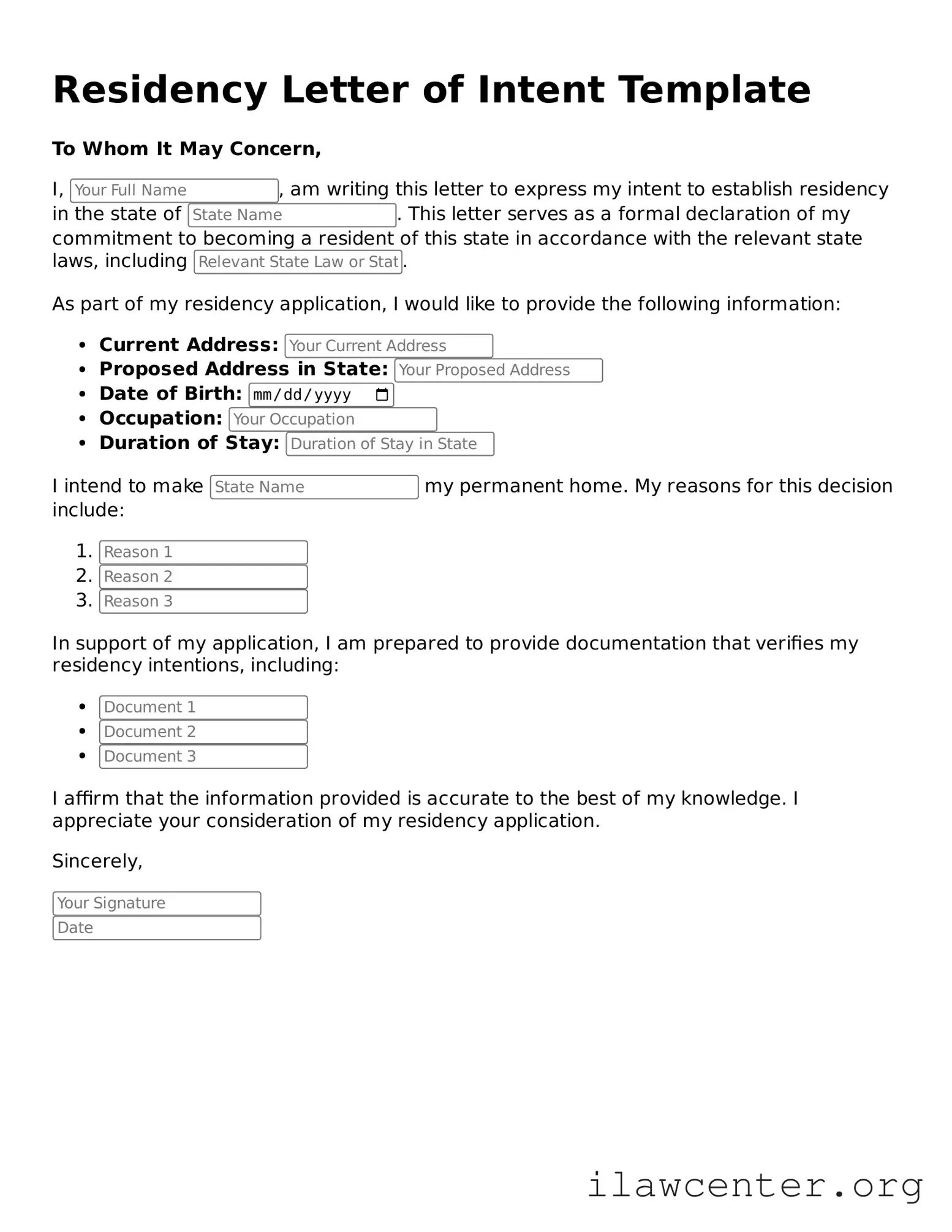
Residency Letter of Intent Template

To Whom It May Concern,

I, , am writing this letter to express my intent to establish residency in the state of . This letter serves as a formal declaration of my commitment to becoming a resident of this state in accordance with the relevant state laws, including .

As part of my residency application, I would like to provide the following information:

  • Current Address:
  • Proposed Address in State:
  • Date of Birth:
  • Occupation:
  • Duration of Stay:

I intend to make my permanent home. My reasons for this decision include:

In support of my application, I am prepared to provide documentation that verifies my residency intentions, including:

I affirm that the information provided is accurate to the best of my knowledge. I appreciate your consideration of my residency application.

Sincerely,


PDF Form Characteristics

Fact Name Description
Purpose The Residency Letter of Intent form is used to declare an individual's intent to establish residency in a particular state.
Eligibility Individuals must meet specific residency requirements set by the state to use this form.
Submission Process The form typically needs to be submitted to a designated state agency or office.
Supporting Documents Applicants may be required to provide proof of residency, such as utility bills or lease agreements.
State-Specific Forms Many states have their own version of the form, tailored to local laws and regulations.
Governing Law Each state’s residency laws govern the use and requirements of the Residency Letter of Intent form.
Deadline There may be specific deadlines for submitting the form, especially for educational or tax purposes.
Consequences of Misrepresentation Providing false information on the form can lead to legal penalties or loss of residency status.
Updates and Changes States may periodically update their forms and requirements, so it’s essential to check for the latest version.

Instructions on Utilizing Residency Letter of Intent

After you have gathered all necessary information, you are ready to complete the Residency Letter of Intent form. This form is important for expressing your commitment and intentions regarding your residency. Follow the steps below to ensure you fill it out correctly.

  1. Start by entering your full name in the designated space at the top of the form.
  2. Provide your current address, including street, city, state, and zip code.
  3. Fill in your contact information, including your phone number and email address.
  4. Indicate the residency program you are applying for by writing its name in the appropriate section.
  5. Write a brief statement explaining your interest in the program and why you are a good fit.
  6. Review the form for any errors or missing information before submitting.
  7. Sign and date the form at the bottom where indicated.

Once you have completed the form, you can proceed to submit it according to the instructions provided by the residency program. Make sure to keep a copy for your records.

Important Facts about Residency Letter of Intent

What is a Residency Letter of Intent form?

The Residency Letter of Intent form is a document that prospective residents submit to express their interest in a specific residency program. This letter typically outlines the applicant's motivations for choosing that program, their relevant experiences, and how they align with the program's goals. It serves as a way for applicants to communicate their enthusiasm and commitment, helping program directors understand why they would be a good fit for the residency. It is an essential part of the application process and can significantly influence selection decisions.

Who needs to submit a Residency Letter of Intent?

All applicants seeking a position in a residency program are generally required to submit a Residency Letter of Intent. This includes medical graduates, students currently in medical school, and those looking to change their residency focus. The letter is particularly important for competitive programs, where demonstrating a clear understanding of the program and a strong personal connection can set candidates apart from others. It's crucial to tailor each letter to the specific program to maximize its impact.

What should be included in the Residency Letter of Intent?

Your Residency Letter of Intent should include several key components. Start with a brief introduction that states your intent to apply and the specific residency program you are interested in. Next, highlight your relevant experiences, such as clinical rotations, research, or volunteer work, that have prepared you for this residency. Discuss your career goals and how this program aligns with them. Finally, express your enthusiasm for the program and mention any faculty or aspects of the program that particularly attract you. A well-crafted letter can make a strong impression on the selection committee.

When is the deadline for submitting the Residency Letter of Intent?

Deadlines for submitting the Residency Letter of Intent vary by program, so it is essential to check the specific requirements for each residency you are applying to. Generally, these letters are due around the same time as other application materials, often during the early part of the application cycle. To avoid any last-minute issues, it is advisable to prepare and submit your letter well in advance of the deadline. This allows for any unforeseen circumstances and ensures that you have ample time to revise and perfect your content.
Common mistakes

Filling out the Residency Letter of Intent form is a crucial step in the application process for residency programs. Unfortunately, many applicants make common mistakes that can hinder their chances of success. Understanding these pitfalls can significantly improve the quality of your submission.

One frequent error is failing to tailor the letter to the specific program. Each residency program has unique values and goals. A generic letter may not resonate with the selection committee. It is essential to express genuine interest in the program and highlight how your experiences align with its mission.

Another mistake is neglecting to proofread the letter. Spelling and grammatical errors can detract from the professionalism of your application. Take the time to review your letter carefully, and consider having a trusted mentor or colleague read it as well. A fresh set of eyes can catch mistakes you may have overlooked.

Some applicants also make the error of being overly vague about their experiences and aspirations. Specificity matters. Instead of stating that you are passionate about patient care, provide concrete examples of experiences that shaped your commitment. This approach not only strengthens your letter but also makes your application more memorable.

Additionally, many individuals forget to express gratitude. A simple acknowledgment of the opportunity to apply and appreciation for the program can leave a positive impression. It reflects humility and respect for the selection committee's time and effort in reviewing applications.

Another common mistake is misrepresenting oneself. Honesty is paramount in your letter. Exaggerating accomplishments or experiences can lead to serious repercussions if discovered. Authenticity fosters trust and demonstrates integrity, qualities that are highly valued in the medical field.

Lastly, some applicants overlook the importance of a strong conclusion. A powerful closing statement can reinforce your enthusiasm and commitment to the program. Avoid ending abruptly; instead, summarize your key points and reiterate your desire to contribute positively to the residency community.

Documents used along the form

The Residency Letter of Intent form is an important document for individuals applying to residency programs. However, several other forms and documents often accompany this letter to support the application process. Below is a list of commonly used forms and documents that may be required or beneficial during residency applications.

  • Curriculum Vitae (CV): A detailed overview of an applicant's educational background, work experience, and relevant skills. This document provides a comprehensive picture of the candidate’s qualifications.
  • Personal Statement: A narrative that explains the applicant's motivations for pursuing a residency, their career goals, and what they hope to contribute to the field. This is an opportunity for candidates to showcase their personality and passion.
  • Letters of Recommendation: Written endorsements from professionals who can speak to the applicant's qualifications and character. Typically, these letters come from mentors, professors, or supervisors.
  • Medical School Transcripts: Official records from the applicant's medical school that detail their academic performance. These transcripts are crucial for demonstrating educational achievements.
  • USMLE or COMLEX Scores: Scores from standardized examinations required for medical licensure in the United States. These scores help residency programs assess the applicant's medical knowledge and readiness.
  • Application Form: A standardized form that collects essential information about the applicant, including personal details, education, and experience. This form is often required by residency programs.
  • Interview Preparation Materials: Resources that help applicants prepare for residency interviews. This may include common interview questions and tips for presenting oneself effectively.
  • Supplemental Application Forms: Additional forms that some residency programs require. These forms may ask for specific information not covered in the primary application.
  • Proof of Citizenship or Visa Status: Documentation that verifies the applicant's legal status in the United States. This is essential for residency programs to ensure compliance with immigration laws.

Each of these documents plays a vital role in the residency application process. Together, they help create a complete and compelling application that highlights the candidate's qualifications and readiness for residency training.

Similar forms

The Residency Letter of Intent form serves an important purpose in the application process for residency programs. While it has its unique features, it shares similarities with several other important documents. Here are four documents that are comparable to the Residency Letter of Intent:

  • Personal Statement: Like the Residency Letter of Intent, a personal statement provides an opportunity for applicants to express their motivations, experiences, and aspirations. Both documents allow candidates to showcase their individuality and passion for their chosen field.
  • Curriculum Vitae (CV): A CV outlines an applicant's educational background, work experience, and accomplishments. While the Residency Letter of Intent focuses on intentions and goals, the CV complements it by providing a comprehensive overview of qualifications and experiences.
  • Recommendation Letters: These letters, written by mentors or colleagues, highlight an applicant's skills and character. Similar to the Residency Letter of Intent, recommendation letters play a crucial role in supporting an applicant's candidacy, emphasizing their fit for the residency program.
  • Application Form: The application form is a formal document that collects essential information about the applicant. While the Residency Letter of Intent adds a personal touch, the application form serves as the foundational document that outlines the applicant's qualifications and interests.

Each of these documents plays a vital role in the residency application process, working together to present a well-rounded view of the applicant.

Dos and Don'ts

When filling out the Residency Letter of Intent form, it's essential to navigate the process thoughtfully. Here’s a list of dos and don’ts to help ensure your application stands out positively.

  • Do be clear and concise in your writing. Clarity helps convey your intentions effectively.
  • Do tailor your letter to the specific residency program. Personalization shows genuine interest.
  • Do highlight your relevant experiences and achievements. This showcases your qualifications and commitment.
  • Do proofread your letter multiple times. Errors can detract from your professionalism.
  • Don't use generic templates. A unique letter reflects your individuality and dedication.
  • Don't include irrelevant personal information. Stick to what pertains to your medical career.
  • Don't exaggerate your qualifications or experiences. Honesty is crucial in maintaining credibility.
  • Don't forget to express gratitude. A simple thank you can leave a lasting impression.

By following these guidelines, you can craft a compelling Residency Letter of Intent that effectively communicates your aspirations and qualifications.

Misconceptions

Understanding the Residency Letter of Intent form can be challenging. Many misconceptions can lead to confusion. Here are nine common misunderstandings about this important document.

  1. It is not important to submit a Letter of Intent. Some believe this letter is optional. In reality, it can play a significant role in the application process, showcasing your interest and commitment to a residency program.
  2. All residency programs require a Letter of Intent. While many programs encourage it, not all require a Letter of Intent. It's essential to check the specific requirements of each program.
  3. A Letter of Intent guarantees acceptance. Submitting this letter does not guarantee admission. It serves as an expression of interest, but acceptance depends on various factors including qualifications and competition.
  4. There is a standard format for the Letter of Intent. Each program may have different expectations. Tailoring your letter to fit the specific program is crucial.
  5. Length is more important than content. Some applicants think a longer letter is better. In truth, clarity and relevance of content are more important than the length of the letter.
  6. It should only focus on academic achievements. While academic accomplishments are important, a well-rounded letter includes personal motivations, experiences, and how they align with the program.
  7. Once submitted, the Letter of Intent cannot be changed. In many cases, applicants can update or revise their letter if new information arises or if they change their minds about their preferred programs.
  8. Letters of Intent are only for applicants who are certain about their choice. Even if you have not made a final decision, expressing interest in a program can still be beneficial.
  9. It is unnecessary to proofread the Letter of Intent. Errors can detract from the professionalism of your application. Thorough proofreading is essential to ensure clarity and correctness.

By clarifying these misconceptions, applicants can better navigate the Residency Letter of Intent process and enhance their chances of success.

Key takeaways

Filling out the Residency Letter of Intent form is an important step in your residency application process. Here are some key takeaways to keep in mind:

  • Be Clear and Concise: Clearly state your intentions and motivations for applying to the residency program.
  • Personalize Your Letter: Tailor your letter to reflect your unique experiences and how they relate to the program.
  • Highlight Relevant Experience: Include any clinical or research experiences that have prepared you for this residency.
  • Express Your Goals: Share your career goals and how the residency will help you achieve them.
  • Follow Guidelines: Adhere to any specific formatting or content guidelines provided by the program.
  • Proofread: Carefully review your letter for spelling and grammatical errors before submission.
  • Be Professional: Use a formal tone and professional language throughout your letter.
  • Include Contact Information: Ensure your contact details are included for easy follow-up.
  • Submit on Time: Pay attention to deadlines to ensure your letter is considered with your application.
  • Seek Feedback: Consider asking a mentor or colleague to review your letter for additional insights.

By keeping these points in mind, you can create a strong Residency Letter of Intent that effectively communicates your qualifications and enthusiasm for the program.