Fillable Response to a Cease and Desist Letter Document

Fillable Response to a Cease and Desist Letter Document

A Response to a Cease and Desist Letter form is a crucial document that individuals or businesses can use to formally reply to a demand to stop certain activities. This form allows you to assert your rights and provide your perspective on the matter at hand. If you find yourself in this situation, it’s important to respond thoughtfully and accurately—fill out the form by clicking the button below.

Article Guide

Receiving a cease and desist letter can be a startling experience, often signaling a dispute that requires immediate attention. This form serves as a formal response to such letters, allowing individuals or businesses to address the claims made against them. It typically includes key elements such as the identification of the sender and recipient, a clear acknowledgment of the allegations, and a detailed explanation of the recipient's position. Responding effectively is crucial; the form provides space to dispute the claims, present evidence, and outline any intentions to resolve the matter amicably. Additionally, it may include requests for further communication or clarification regarding the issues at hand. Understanding how to fill out this form properly can help protect your rights and facilitate a constructive dialogue between parties involved.

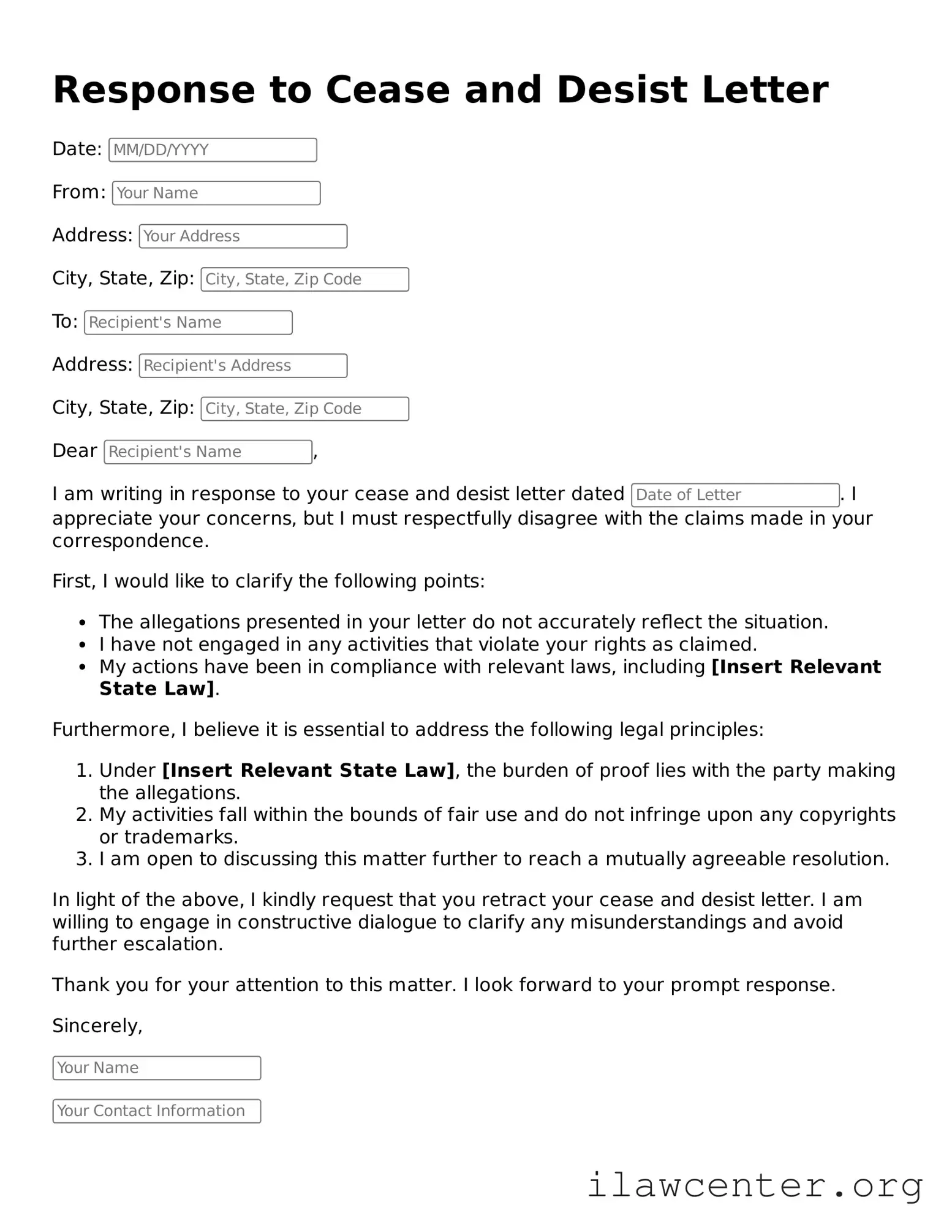
Response to a Cease and Desist Letter Preview

Response to Cease and Desist Letter

Date:

From:

Address:

City, State, Zip:

To:

Address:

City, State, Zip:

Dear ,

I am writing in response to your cease and desist letter dated . I appreciate your concerns, but I must respectfully disagree with the claims made in your correspondence.

First, I would like to clarify the following points:

  • The allegations presented in your letter do not accurately reflect the situation.
  • I have not engaged in any activities that violate your rights as claimed.
  • My actions have been in compliance with relevant laws, including [Insert Relevant State Law].

Furthermore, I believe it is essential to address the following legal principles:

  1. Under [Insert Relevant State Law], the burden of proof lies with the party making the allegations.
  2. My activities fall within the bounds of fair use and do not infringe upon any copyrights or trademarks.
  3. I am open to discussing this matter further to reach a mutually agreeable resolution.

In light of the above, I kindly request that you retract your cease and desist letter. I am willing to engage in constructive dialogue to clarify any misunderstandings and avoid further escalation.

Thank you for your attention to this matter. I look forward to your prompt response.

Sincerely,

PDF Form Characteristics

Fact Name Details
Purpose The Response to a Cease and Desist Letter form is used to formally reply to a request to stop certain actions or behaviors.
Legal Significance This response can help clarify your position and may serve as evidence in future legal disputes.
State-Specific Requirements Each state may have different requirements for the response; it's important to check local laws.
Governing Laws Common laws governing cease and desist letters include contract law and intellectual property law, which vary by state.
Deadline for Response Typically, you should respond within a specified time frame to avoid further legal action.

Instructions on Utilizing Response to a Cease and Desist Letter

After receiving a cease and desist letter, responding promptly and accurately is essential. Completing the Response to a Cease and Desist Letter form will help you articulate your position clearly. Once filled out, you will be able to send your response to the sender, which may help resolve the issue amicably or prepare you for further action.

  1. Begin by carefully reading the cease and desist letter to understand the claims made against you.
  2. Gather all relevant documents and evidence that support your position.
  3. Open the Response to a Cease and Desist Letter form.
  4. In the first section, provide your full name and contact information.
  5. Next, include the date you received the cease and desist letter.
  6. Clearly state your response to the claims made in the letter. Be concise and factual.
  7. If applicable, outline any evidence you have that supports your position.
  8. In the next section, indicate whether you intend to comply with the demands in the cease and desist letter.
  9. Provide any additional comments or explanations that may clarify your stance.
  10. Review the completed form for accuracy and clarity.
  11. Sign and date the form at the bottom.
  12. Make a copy of the completed form for your records.
  13. Send the form to the sender of the cease and desist letter via certified mail or another reliable method to ensure delivery.

Important Facts about Response to a Cease and Desist Letter

What is a cease and desist letter?

A cease and desist letter is a formal request for an individual or organization to stop engaging in certain activities that are believed to infringe on another party's rights. These letters are often used in cases of copyright infringement, trademark disputes, or other legal conflicts. The letter typically outlines the specific actions that are being challenged and may demand that the recipient cease those actions immediately to avoid further legal consequences.

Why would I need to respond to a cease and desist letter?

Responding to a cease and desist letter is crucial because it allows you to address the claims being made against you. Ignoring the letter could lead to legal action, including lawsuits. A well-crafted response can clarify your position, assert your rights, and potentially resolve the issue without further conflict. It can also demonstrate that you are taking the matter seriously and are willing to engage in a dialogue.

What should I include in my response?

Your response should include several key elements. First, acknowledge receipt of the cease and desist letter. Next, address the specific claims made against you. If you believe the claims are unfounded, provide your reasoning and any supporting evidence. If you are willing to negotiate or settle the matter, indicate that as well. Finally, maintain a professional tone throughout your response to foster constructive communication.

What happens if I don't respond to the cease and desist letter?

If you choose not to respond, the sender may interpret your silence as an admission of guilt or a lack of interest in resolving the issue. This could lead to escalated actions, including lawsuits or other legal proceedings. Additionally, failing to respond may limit your ability to defend yourself effectively later on. It is generally advisable to take the letter seriously and engage with the sender, even if you disagree with their claims.

Common mistakes

Receiving a cease and desist letter can be a daunting experience. It often signals a serious legal dispute, and how you respond can significantly impact the outcome. Unfortunately, many individuals make mistakes when filling out the Response to a Cease and Desist Letter form. Here are nine common errors to avoid.

One frequent mistake is not reading the letter carefully. It’s essential to understand the claims being made against you. Ignoring details can lead to a poorly constructed response that fails to address the specific allegations. Take the time to analyze the letter thoroughly before drafting your reply.

Another common error is responding too emotionally. It’s natural to feel defensive when faced with accusations, but letting emotions dictate your response can lead to hasty decisions. A calm, rational approach will serve you better in crafting a well-reasoned reply.

Many individuals also fail to consult with a legal professional before submitting their response. While it may seem straightforward, legal matters can be complex. A qualified attorney can provide valuable insights and ensure that your response is appropriate and effective.

Additionally, some people make the mistake of not addressing the claims directly. A vague response can leave the other party unsatisfied and may escalate the situation. Be clear and concise in addressing each point raised in the cease and desist letter.

Another pitfall is missing deadlines. Cease and desist letters often specify a timeline for response. Failing to meet this deadline can weaken your position and may lead to further legal action. Make sure to respond promptly and within the specified timeframe.

In some cases, individuals include irrelevant information in their responses. Sticking to the facts related to the claims at hand is crucial. Extraneous details can distract from your main points and dilute the effectiveness of your response.

Some people also underestimate the importance of maintaining professionalism. Using aggressive or confrontational language can escalate tensions. A respectful tone can foster a more constructive dialogue and may even lead to a resolution.

Another mistake is failing to document your response. Keeping a record of your correspondence is essential for future reference. This documentation can be vital if the situation escalates and legal action becomes necessary.

Lastly, individuals sometimes overlook the need to consider potential counterclaims. If you believe that the allegations against you are unfounded, it may be wise to outline your perspective and any relevant defenses. This proactive approach can strengthen your position.

In summary, responding to a cease and desist letter requires careful consideration and a strategic approach. By avoiding these common mistakes, you can craft a more effective response that protects your interests and helps navigate the legal landscape.
Documents used along the form

When dealing with a cease and desist letter, several other forms and documents may be necessary to support your position or to respond effectively. Understanding these documents can help you navigate the situation more confidently and ensure that your rights are protected.

  • Cease and Desist Letter: This is the initial document sent by one party to another, demanding that the recipient stop a particular action. It outlines the reasons for the request and may include legal grounds for the demand.
  • Response Letter: In addition to the formal Response to a Cease and Desist Letter, a general response letter may be drafted to address the allegations in a more personal or informal manner, especially if the situation is being negotiated.
  • Affidavit: A sworn statement that can provide evidence supporting your claims or position. This document may be useful in court or negotiations to validate your side of the story.
  • Counterclaim: If the situation escalates, a counterclaim may be filed in response to the original claim. This document asserts your own claims against the party who sent the cease and desist letter.
  • Legal Memorandum: This internal document outlines the legal arguments and research regarding the cease and desist issue. It helps in strategizing your response and understanding the legal landscape.
  • Settlement Agreement: If both parties reach an agreement, a settlement document may be created to outline the terms of the resolution, including any actions to be taken or not taken moving forward.
  • Notice of Intent to Sue: This document informs the other party of your intention to pursue legal action if the matter is not resolved. It often serves as a final warning before litigation begins.
  • Demand Letter: Similar to a cease and desist letter, a demand letter requests specific actions or compensation from the other party. It can be used to assert your rights and demand a remedy.
  • Litigation Documents: If the matter escalates to court, various documents such as complaints, answers, and motions will be needed to formally present your case and arguments.

Each of these documents plays a crucial role in the process of responding to a cease and desist letter. By familiarizing yourself with them, you can better prepare for any potential legal challenges and protect your interests effectively.

Similar forms

  • Demand Letter: A demand letter is similar to a response to a cease and desist letter in that it communicates a specific request or demand. Both documents aim to resolve a dispute without resorting to litigation. However, a demand letter typically initiates a claim, while a response addresses an allegation.
  • Settlement Agreement: A settlement agreement outlines the terms under which parties agree to resolve their disputes. Like a response to a cease and desist letter, it seeks to prevent further legal action. Both documents can help clarify expectations and responsibilities, ensuring both parties are on the same page.
  • Notice of Intent to Sue: This document serves as a warning that legal action may follow if the issue is not resolved. Similar to a response to a cease and desist letter, it expresses dissatisfaction with the current situation. Both documents convey urgency and the need for resolution.
  • Legal Memorandum: A legal memorandum provides an analysis of legal issues surrounding a case. While a response to a cease and desist letter addresses specific allegations, a legal memorandum offers a broader context. Both documents aim to clarify legal standing and guide future actions.
  • Counterclaim: A counterclaim is filed in response to a lawsuit, asserting a claim against the original claimant. Like a response to a cease and desist letter, it challenges the claims made by the other party. Both documents serve to protect one's rights and interests in a legal dispute.

Dos and Don'ts

When responding to a cease and desist letter, it is important to approach the situation thoughtfully. Here are four key actions to consider, as well as some pitfalls to avoid.

  • Do: Carefully read the cease and desist letter to understand the claims being made against you.
  • Do: Gather any relevant documents or evidence that support your position.
  • Do: Respond in a timely manner, ensuring you meet any deadlines specified in the letter.
  • Do: Consider seeking legal advice to help you draft a well-informed response.
  • Don't: Ignore the cease and desist letter, as this may escalate the situation.
  • Don't: Use aggressive or inflammatory language in your response.
  • Don't: Admit to any wrongdoing unless you are certain of the facts.
  • Don't: Delay your response without a valid reason, as this may negatively impact your case.

Misconceptions

Many people have misunderstandings about the Response to a Cease and Desist Letter form. Here are six common misconceptions:

  • It is unnecessary to respond to a cease and desist letter. Some believe that ignoring the letter is a viable option. However, responding can demonstrate good faith and may help to resolve the issue amicably.
  • All cease and desist letters are legally binding. Not all letters carry legal weight. Many are simply requests for compliance, and the sender may not have a strong legal basis.
  • You must comply immediately with the demands in the letter. While it’s important to take the letter seriously, you often have time to evaluate your options and formulate a response.
  • Responding to a cease and desist letter is an admission of guilt. A response does not imply wrongdoing. It can be a strategic move to clarify your position and protect your rights.
  • Only lawyers can respond to a cease and desist letter. While legal counsel can provide valuable advice, individuals can draft their own responses if they understand the issues involved.
  • Cease and desist letters are always sent with malicious intent. Many letters are sent as a precautionary measure to protect intellectual property or other rights, rather than to intimidate.

Understanding these misconceptions can help individuals navigate the situation more effectively and make informed decisions.

Key takeaways

When responding to a cease and desist letter, it is crucial to approach the situation with care and precision. Here are some key takeaways to consider:

  • Understand the purpose of the cease and desist letter. It typically serves as a formal request to stop an alleged illegal activity.
  • Read the letter thoroughly. Ensure you comprehend the claims being made against you and the actions requested.
  • Gather relevant evidence. Collect documentation or other materials that support your position and counter the claims.
  • Draft a clear and concise response. Address each point raised in the letter, providing your perspective and any evidence you have.
  • Consider seeking legal advice. A qualified attorney can help you navigate the complexities of your situation and ensure your response is appropriate.
  • Be respectful and professional in your tone. Even if you disagree with the claims, maintaining a courteous demeanor can be beneficial.
  • Keep a record of all communications. Documenting your response and any subsequent interactions can be crucial if the matter escalates.
  • Respond in a timely manner. Ignoring the letter or delaying your response can lead to further legal complications.