Resume PDF Template

Resume PDF Template

The Resume form is a crucial document that job seekers use to present their qualifications and experiences to potential employers. This form helps to highlight skills, education, and work history in a clear and organized manner. To get started on your job search, fill out the form by clicking the button below.

Article Guide

In today's competitive job market, a well-structured resume form is essential for job seekers aiming to make a strong impression on potential employers. This document serves as a critical tool for showcasing skills, experiences, and qualifications in a concise manner. Key components of the resume form typically include personal information, a summary statement, work experience, education, and relevant skills. Each section plays a pivotal role in presenting a comprehensive picture of the candidate. The personal information section establishes identity, while the summary statement provides a snapshot of career objectives. Work experience details past roles and accomplishments, and education highlights academic achievements. Finally, the skills section emphasizes specific competencies that align with job requirements. Understanding how to effectively fill out each part of the resume form can significantly enhance the chances of landing an interview and ultimately securing a job offer.

Resume Preview

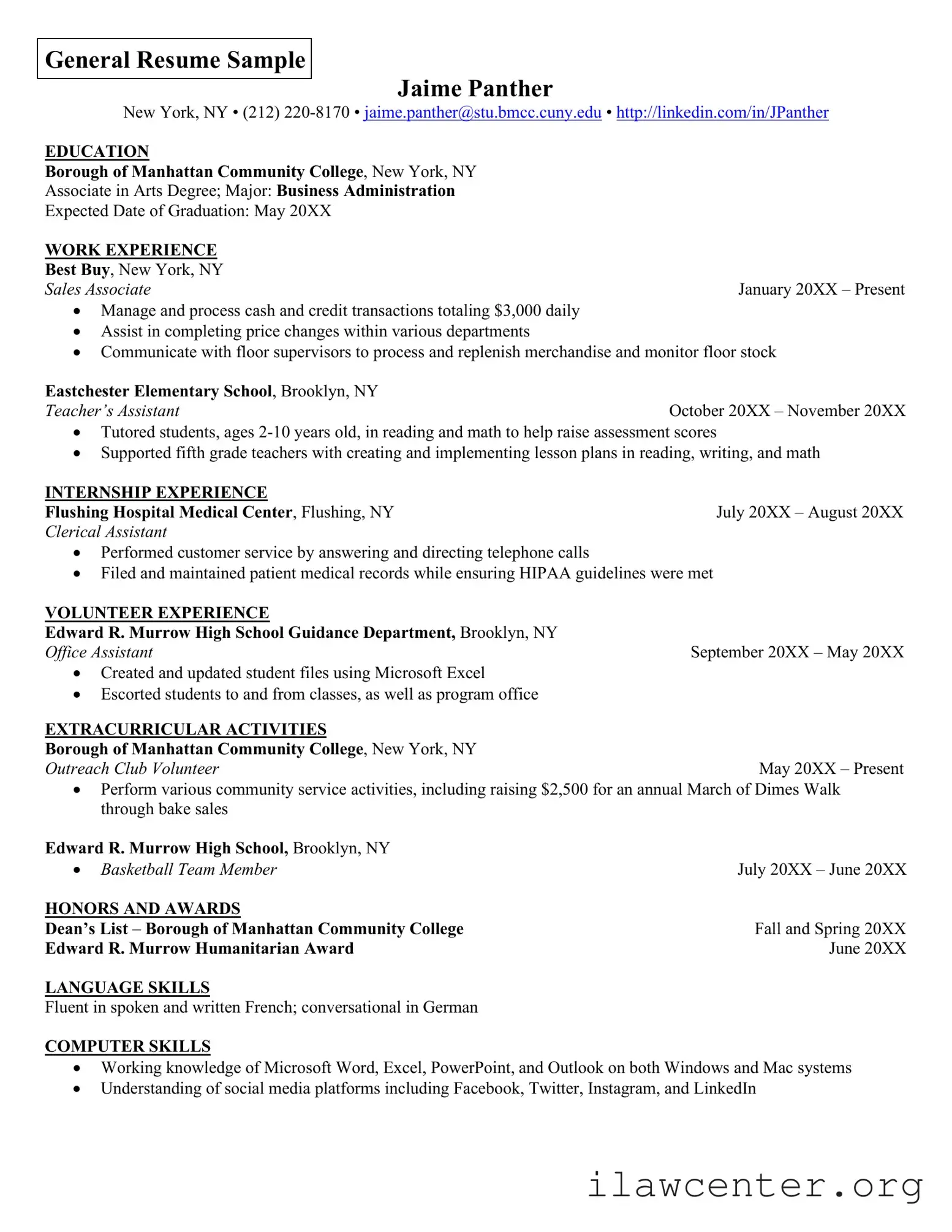
General Resume Sample
Jaime Panther
New York, NY (212) 220-8170 • jaime.panther@stu.bmcc.cuny.eduhttp://linkedin.com/in/JPanther
EDUCATION
Borough of Manhattan Community College, New York, NY
Associate in Arts Degree; Major: Business Administration
Expected Date of Graduation: May 20XX
WORK EXPERIENCE
Best Buy, New York, NY
Sales Associate January 20XX Present
Manage and process cash and credit transactions totaling $3,000 daily
Assist in completing price changes within various departments
Communicate with floor supervisors to process and replenish merchandise and monitor floor stock
Eastchester Elementary School, Brooklyn, NY
Teacher’s Assistant October 20XX November 20XX
Tutored students, ages 2-10 years old, in reading and math to help raise assessment scores
Supported fifth grade teachers with creating and implementing lesson plans in reading, writing, and math
INTERNSHIP EXPERIENCE
Flushing Hospital Medical Center, Flushing, NY July 20XX August 20XX
Clerical Assistant
Performed customer service by answering and directing telephone calls
Filed and maintained patient medical records while ensuring HIPAA guidelines were met
VOLUNTEER EXPERIENCE
Edward R. Murrow High School Guidance Department, Brooklyn, NY
Office Assistant September 20XX – May 20XX
Created and updated student files using Microsoft Excel
Escorted students to and from classes, as well as program office
EXTRACURRICULAR ACTIVITIES
Borough of Manhattan Community College, New York, NY
Outreach Club Volunteer May 20XX – Present
Perform various community service activities, including raising $2,500 for an annual March of Dimes Walk
through bake sales
Edward R. Murrow High School, Brooklyn, NY
Basketball Team Member July 20XX – June 20XX
HONORS AND AWARDS
Dean’s ListBorough of Manhattan Community College Fall and Spring 20XX
Edward R. Murrow Humanitarian Award June 20XX
LANGUAGE SKILLS
Fluent in spoken and written French; conversational in German
COMPUTER SKILLS
Working knowledge of Microsoft Word, Excel, PowerPoint, and Outlook on both Windows and Mac systems
Understanding of social media platforms including Facebook, Twitter, Instagram, and LinkedIn
BLANK RESUME TEMPLATE
HEADING (Do not put the word HEADING in your resume)
Name _______________________________________________
Address ____________________________________________________________________________________________
Phone ______________________________________________________________________________________________
Professional Email (student email is okay too) ______________________________________________________________
EDUCATION
Current or most recent College/University, City, State_________________________________________________________
Degree, Major, Month and Year of Completion or Anticipated Graduation Date_____________________________________
RELATED COURSEWORK (Optional)
Coursework relevant to targeted position
________________________________________
________________________________________
________________________________________
________________________________________
RESEARCH PROJECTS (Optional)
Class or personal projects completed relevant to targeted position
______________________________________________________________________________________________
______________________________________________________________________________________________
LICENSES/CERTIFICATIONS (Be sure to include expiration dates) (Optional)
______________________________________________________________________________________________
WORK EXPERIENCE (“Related Experience” or “Internships”, “Clinical Rotations,” from the most recent to the oldest)
Name of Company/Organization, City, State ______________________________________________________________
Job Title_________________________________________________________Dates of Employment __________________
Brief overview of role and responsibilities, using impact action verbs, accomplishments, and achievements:
______________________________________________________________________________________________
______________________________________________________________________________________________
______________________________________________________________________________________________
Name of Company/Organization, City, State ______________________________________________________________
Job Title__________________________________________________________Dates of Employment__________________
Brief overview of role and responsibilities, using impact action verbs, accomplishments, and achievements:
______________________________________________________________________________________________
______________________________________________________________________________________________
______________________________________________________________________________________________
* ADDITIONAL EXPERIENCE: Use the same format as your work experience to list additional experience such as
Internship, and Volunteer categories
EXTRACURRICULAR ACTIVITIES
______________________________________________________________________________________________
______________________________________________________________________________________________
HONORS AND AWARDS (From college, or work/internship/volunteer experience)
______________________________________________________________________________________________
LANGUAGE SKILLS (indicate written and/or spoken proficiency, English not necessary even if it is your 2
nd
language)
______________________________________________________________________________________________
COMPUTER SKILLS (indicate proficiency level [familiar with, knowledge of, proficient in, intermediate in, or beginner in])
______________________________________________________________________________________________
______________________________________________________________________________________________
____________________________________________________________________________________________
Tips:
Experiences should be listed most recent to past
Save your resume file as “FirstName Last Name – Resume”
this way employers know who you are
File Properties

Fact Name Description
Purpose A resume is a document used to showcase an individual's skills, experience, and qualifications to potential employers.
Length Typically, a resume should be one page for entry-level positions and can extend to two pages for experienced professionals.
Format Common formats include chronological, functional, and combination styles, each serving different job-seeking needs.
Content A resume generally includes sections like contact information, work experience, education, skills, and sometimes a summary or objective.
Customization Tailoring a resume to match the job description increases the chances of catching an employer's attention.
Legal Considerations There are no specific state laws governing resumes, but anti-discrimination laws apply to hiring practices.
Submission Methods Resumes can be submitted via email, online job portals, or in person, depending on the employer's requirements.

Instructions on Utilizing Resume

Completing the Resume form is an important step in showcasing your qualifications and experiences. By providing accurate and relevant information, you can effectively present yourself to potential employers. Below are the steps to guide you through the process of filling out the form.

  1. Begin by entering your full name in the designated field.
  2. Provide your contact information, including your phone number and email address.
  3. List your current address, ensuring that all details are correct.
  4. Fill in your objective statement, summarizing your career goals and what you hope to achieve.
  5. Detail your education history, starting with the most recent institution attended.
  6. Include your work experience, listing jobs in reverse chronological order.
  7. Highlight relevant skills that pertain to the position you are applying for.
  8. Optionally, add any certifications or additional training that may enhance your application.
  9. Review all entries for accuracy and completeness before submission.

Important Facts about Resume

What is the purpose of the Resume form?

The Resume form is designed to collect essential information about an individual's professional background, skills, and education. It helps employers quickly assess a candidate's qualifications for a job position. By providing a clear and concise overview of your experience, the form facilitates the hiring process and increases your chances of being considered for an interview.

What information should I include in my Resume form?

When filling out the Resume form, include your contact information, work experience, education, skills, and any relevant certifications. Highlight your most significant achievements and tailor your content to the specific job you are applying for. This personalization demonstrates your interest in the position and helps you stand out from other candidates.

How long should my Resume be?

Typically, a resume should be one page for early career professionals and can extend to two pages for those with extensive experience. Focus on quality over quantity. Include only the most relevant information that showcases your skills and experiences. Employers often prefer concise resumes that are easy to read.

Can I use a template for my Resume form?

Yes, using a template can be a great way to ensure your resume is well-organized and visually appealing. Many online resources offer free or paid templates. Just be sure to customize the template to reflect your unique experiences and skills, as a generic resume may not capture the attention of hiring managers.

Should I include references in my Resume form?

It's generally best to omit references from your resume unless specifically requested. Instead, you can note that references are available upon request. This approach saves space and allows you to provide references that are most relevant to the position when the time comes.

What if I have gaps in my employment history?

Gaps in employment are not uncommon and can be explained in your resume. Be honest about your situation, whether it was due to personal reasons, further education, or other commitments. You can also emphasize any skills or experiences gained during that time, such as volunteering or freelance work, to demonstrate your continuous growth.

How often should I update my Resume?

Regularly updating your resume is essential, especially after significant achievements or changes in your career. Whenever you complete a new project, earn a certification, or change jobs, take the time to revise your resume. Keeping it current ensures that you are always prepared for new opportunities that may arise.

Common mistakes

When filling out a resume form, individuals often overlook critical details that can make a significant difference in their job applications. One common mistake is failing to tailor the resume to the specific job. Each position may require different skills and experiences, so it's essential to customize the content. A generic resume can easily blend in with the rest, while a targeted one stands out and demonstrates genuine interest in the role.

Another frequent error is neglecting to proofread for spelling and grammatical errors. Typos can create a negative impression, suggesting a lack of attention to detail. Even minor mistakes can lead hiring managers to question an applicant's professionalism. Taking the time to review the resume thoroughly or asking someone else to look it over can help catch these errors before submission.

Additionally, many applicants fail to quantify their achievements. Simply stating responsibilities does not convey the impact of one’s work. Instead, using specific numbers and outcomes can illustrate success more effectively. For example, instead of saying "managed a team," one could say "led a team of 10, resulting in a 20% increase in productivity." This approach provides concrete evidence of capabilities and accomplishments.

Lastly, some individuals forget to include relevant keywords from the job description. Many companies use applicant tracking systems (ATS) to filter resumes based on specific terms. By not incorporating these keywords, candidates risk being overlooked entirely. It's crucial to analyze the job posting and integrate appropriate terminology into the resume to enhance visibility during the selection process.

Documents used along the form

When applying for a job, several documents are typically submitted alongside a resume to provide a comprehensive overview of qualifications and experiences. Each of these documents serves a specific purpose and can enhance the applicant's presentation to potential employers.

  • Cover Letter: This document introduces the applicant to the employer, outlining their interest in the position and summarizing relevant skills and experiences. It allows the applicant to personalize their application and explain why they are a good fit for the role.
  • References List: A list of individuals who can vouch for the applicant's qualifications, work ethic, and character. This document typically includes the names, titles, contact information, and relationship to the applicant for each reference.
  • Portfolio: A collection of work samples that demonstrate the applicant's skills and accomplishments. This is particularly important for creative fields, where visual evidence of work can significantly impact hiring decisions.
  • Transcripts: Official records from educational institutions that detail the courses taken and grades received. Transcripts are often requested by employers to verify educational qualifications.
  • Application Form: Some employers require a specific application form to be filled out. This form may ask for detailed information about the applicant's work history, education, and other relevant details that complement the resume.

Including these documents can provide a more complete picture of an applicant's qualifications. Each document plays a vital role in the job application process and can significantly influence hiring decisions.

Similar forms

The Resume form is a crucial document for job seekers. Several other documents serve similar purposes in showcasing skills and experiences. Here are four documents that share similarities with a Resume form:

  • Cover Letter: This document accompanies a resume. It allows applicants to introduce themselves, explain their interest in a position, and highlight key qualifications.
  • Curriculum Vitae (CV): A CV provides a detailed overview of a person's academic background, work experience, and achievements. It is often used in academic or research fields.
  • Job Application Form: Many employers require candidates to fill out a job application form. This document collects specific information about the applicant and their qualifications, similar to what is included in a resume.
  • LinkedIn Profile: An online profile on LinkedIn serves as a digital resume. It showcases professional experiences, skills, and endorsements, making it easy for employers to find and evaluate candidates.

Dos and Don'ts

When filling out a resume form, attention to detail is crucial. Here are some guidelines to help ensure your resume stands out for the right reasons.

  • Do: Use a clear and professional format. A clean layout helps the reader easily navigate your information.
  • Do: Tailor your resume to the job you are applying for. Highlight relevant skills and experiences that match the job description.
  • Do: Proofread your resume for spelling and grammatical errors. Mistakes can create a negative impression.
  • Do: Include accurate contact information. Ensure your phone number and email address are correct and current.
  • Don't: Use overly complex language or jargon. Keep your descriptions clear and straightforward.
  • Don't: Include irrelevant work experience. Focus on positions that relate to the job you want.
  • Don't: Leave gaps in your employment history unexplained. If there are gaps, briefly explain them in your cover letter.

Following these tips can improve your chances of making a positive impression on potential employers.

Misconceptions

Many people hold misconceptions about the resume form that can impact their job search. Understanding these misconceptions can help applicants present themselves more effectively. Here are eight common misunderstandings:

  1. Length is the most important factor.

    Many believe that a longer resume is better. In reality, clarity and relevance are more important than length. A concise, well-organized resume often makes a stronger impression.

  2. One size fits all.

    Some applicants think they can use the same resume for every job application. Customizing your resume to match the specific job requirements can significantly increase your chances of getting noticed.

  3. Objective statements are essential.

    While some still include objective statements, many employers prefer a summary of qualifications or skills. This shift allows candidates to showcase their strengths more effectively.

  4. Only work experience matters.

    Many believe that only professional experience counts. However, relevant volunteer work, internships, and educational achievements can also demonstrate valuable skills and dedication.

  5. Formatting doesn’t matter.

    Some applicants overlook the importance of formatting. A clean, professional layout helps ensure that your resume is easy to read and visually appealing.

  6. Using fancy fonts makes a resume stand out.

    While creativity is important, overly elaborate fonts can detract from readability. Stick to simple, professional fonts to keep the focus on your content.

  7. Including every job ever held is necessary.

    Some people think they must list all their previous jobs. Focus instead on relevant positions that highlight your skills and experience related to the job you are applying for.

  8. Typos are minor issues.

    Many underestimate the impact of typos. Errors can create a negative impression and suggest a lack of attention to detail, which is crucial in any job.

By addressing these misconceptions, job seekers can create more effective resumes that better showcase their qualifications and improve their chances of landing interviews.

Key takeaways

When filling out and using a Resume form, several key points can enhance its effectiveness. Consider the following takeaways:

  1. Be Clear and Concise: Use straightforward language. Avoid unnecessary jargon to ensure clarity.
  2. Highlight Relevant Experience: Focus on experiences that directly relate to the position you are applying for. Tailoring your resume increases your chances of standing out.
  3. Use Action Verbs: Begin bullet points with strong action verbs. This approach makes your achievements more impactful.
  4. Include Contact Information: Ensure your contact details are prominently displayed at the top. This makes it easy for employers to reach you.
  5. Proofread Carefully: Spelling and grammatical errors can detract from your professionalism. Always review your resume before submitting.
  6. Keep It Updated: Regularly update your resume with new skills and experiences. This practice ensures you are always prepared for new opportunities.