Fillable Revocation of Power of Attorney Document

Fillable Revocation of Power of Attorney Document

The Revocation of Power of Attorney form is a legal document that officially cancels a previously granted power of attorney. This form is essential for individuals who wish to terminate the authority they have given to another person to act on their behalf. Understanding how to properly fill out this form is crucial for ensuring that your decisions and wishes are respected.

Ready to take the next step? Fill out the form by clicking the button below.

Article Guide

The Revocation of Power of Attorney form is a crucial legal document that allows individuals to formally cancel a previously granted power of attorney. This form is essential when a principal decides to terminate the authority given to an agent, whether due to changes in personal circumstances, loss of trust, or the completion of a specific task. By completing this form, the principal ensures that the agent no longer has the legal right to make decisions or act on their behalf. The document typically requires the principal's signature, the date of revocation, and may need to be notarized to enhance its validity. Additionally, it is important to notify the agent and any relevant third parties, such as banks or healthcare providers, to prevent any unauthorized actions. Understanding the significance of this form can help individuals maintain control over their legal and financial matters, ensuring that their wishes are respected and upheld.

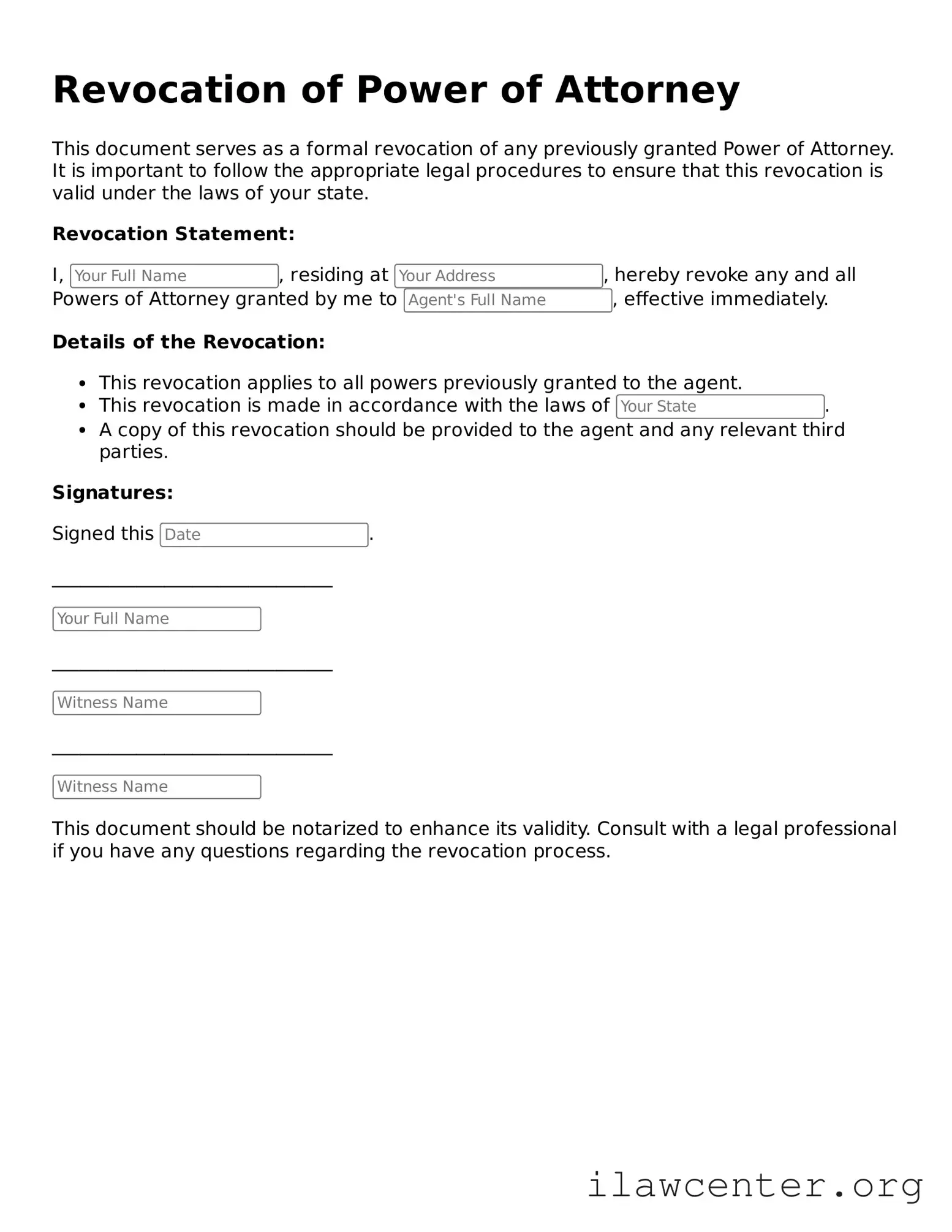
Revocation of Power of Attorney Preview

Revocation of Power of Attorney

This document serves as a formal revocation of any previously granted Power of Attorney. It is important to follow the appropriate legal procedures to ensure that this revocation is valid under the laws of your state.

Revocation Statement:

I, , residing at , hereby revoke any and all Powers of Attorney granted by me to , effective immediately.

Details of the Revocation:

  • This revocation applies to all powers previously granted to the agent.
  • This revocation is made in accordance with the laws of .
  • A copy of this revocation should be provided to the agent and any relevant third parties.

Signatures:

Signed this .

______________________________

______________________________

______________________________

This document should be notarized to enhance its validity. Consult with a legal professional if you have any questions regarding the revocation process.

PDF Form Characteristics

Fact Name Description
Definition A Revocation of Power of Attorney form is a legal document used to cancel a previously granted power of attorney.
Purpose This form serves to inform all relevant parties that the authority granted to the agent is no longer valid.
Governing Law The laws governing the revocation of power of attorney vary by state, typically outlined in state statutes.
Notification Requirement It is advisable to notify the agent and any institutions or individuals who were aware of the original power of attorney.
Signature Requirement The revocation form usually requires the signature of the principal to be effective.
Notarization Some states may require the revocation form to be notarized for it to be legally binding.
Effectiveness The revocation takes effect immediately upon signing, unless otherwise specified in the document.

Instructions on Utilizing Revocation of Power of Attorney

After you have completed the Revocation of Power of Attorney form, ensure that you keep a copy for your records. It is important to notify the person you are revoking the power from, as well as any institutions that may have a copy of the original power of attorney. This will help avoid any confusion or misuse of authority.

  1. Obtain a copy of the Revocation of Power of Attorney form.
  2. Fill in your full name and address at the top of the form.
  3. Clearly state the name of the person whose power of attorney you are revoking.
  4. Include the date the original power of attorney was executed.
  5. Sign and date the form at the designated area.
  6. Have the form notarized, if required by your state.
  7. Make copies of the completed form for your records.
  8. Deliver a copy of the revocation to the person you are revoking the power from.
  9. Notify any institutions or parties that may have relied on the original power of attorney.

Important Facts about Revocation of Power of Attorney

What is a Revocation of Power of Attorney form?

A Revocation of Power of Attorney form is a legal document that allows an individual to cancel or revoke a previously granted Power of Attorney. This means that the person who had the authority to act on behalf of another individual no longer has that power. This form is important for ensuring that the authority is officially terminated and that any actions taken by the previous agent are no longer valid.

When should I use a Revocation of Power of Attorney form?

You should consider using a Revocation of Power of Attorney form when you no longer want someone to have the authority to make decisions on your behalf. This could be due to a change in your personal circumstances, such as a loss of trust in the agent, a change in relationships, or if you simply want to appoint a different person to take over those responsibilities. It is also advisable to use this form if the original Power of Attorney is no longer needed or if you have become capable of managing your own affairs.

How do I properly complete a Revocation of Power of Attorney form?

To properly complete a Revocation of Power of Attorney form, you should start by clearly identifying yourself as the principal. Include your full name and address. Next, you must state that you are revoking the previous Power of Attorney. It is also important to include the name of the agent whose authority you are revoking. After filling in these details, you should sign and date the document. Depending on state laws, you may need to have the document notarized or witnessed to ensure its validity.

What should I do after submitting the Revocation of Power of Attorney form?

After submitting the Revocation of Power of Attorney form, it is essential to notify the agent that their authority has been revoked. This can help prevent any misunderstandings or unauthorized actions. Additionally, you should provide copies of the revocation to any relevant institutions, such as banks or healthcare providers, that may have relied on the original Power of Attorney. Keeping a copy of the revocation for your records is also advisable, as it serves as proof that the authority has been terminated.

Common mistakes

When individuals decide to revoke a Power of Attorney (POA), they often encounter a few common pitfalls while filling out the revocation form. One significant mistake is failing to use the correct form. Each state may have its own requirements, so it is crucial to ensure that the form used is specific to the state in which the original POA was executed. Using an outdated or incorrect form can lead to complications down the line.

Another frequent error is neglecting to provide complete information about the original Power of Attorney. It is essential to include details such as the names of the principal and the agent, the date the original POA was signed, and any other identifying information. Omitting this information can create confusion and may result in the revocation being deemed invalid.

People often forget to sign and date the revocation form. This step is vital, as a lack of signature can render the document ineffective. Additionally, some individuals may not realize that the revocation needs to be notarized or witnessed, depending on state laws. Failing to follow these requirements can lead to further complications.

Inadequate distribution of the revocation notice is another common oversight. Once the form is completed, it is important to inform the agent and any relevant third parties about the revocation. This includes banks, healthcare providers, and other institutions that may have relied on the original POA. Not notifying these parties can lead to misunderstandings and unauthorized actions.

Moreover, individuals sometimes overlook the need to keep a copy of the revocation form for their records. This documentation serves as proof that the original POA has been revoked. Without a copy, it may be challenging to assert that the POA is no longer in effect if questions arise in the future.

Another mistake involves not considering the timing of the revocation. If a person revokes a POA but the agent has already taken action based on the authority granted, complications can ensue. It’s essential to ensure that the revocation is effective immediately and that all parties are aware of this change.

Some people may also fail to clarify the reasons for revocation. While it is not always necessary to provide a rationale, doing so can help prevent misunderstandings. A clear explanation can also be beneficial if disputes arise later regarding the authority of the agent.

In addition, individuals might not realize that revoking a POA does not automatically terminate any related documents, such as a healthcare directive. If a healthcare directive exists, it should be reviewed to ensure it aligns with the new wishes. Overlooking this can lead to conflicting instructions during critical times.

Finally, many individuals do not seek legal advice when revoking a Power of Attorney. Consulting with a legal professional can provide valuable insights and ensure that all necessary steps are taken correctly. This guidance can help avoid potential issues and ensure that the revocation is legally sound.
Documents used along the form

When someone decides to revoke a Power of Attorney, several other documents may be involved in the process. Each document serves a specific purpose and helps ensure that all legal matters are handled correctly. Below is a list of forms and documents commonly used alongside the Revocation of Power of Attorney form.

  • Power of Attorney Form: This is the original document that grants someone the authority to act on behalf of another person. It outlines the powers given and the duration of those powers.
  • Notification Letter: A letter informing relevant parties, such as banks or healthcare providers, about the revocation of the Power of Attorney. This helps prevent any unauthorized actions by the previous agent.
  • Affidavit of Revocation: A sworn statement confirming that the Power of Attorney has been revoked. This document may be required for certain legal processes.
  • New Power of Attorney Form: If a person wishes to appoint a new agent, this form is necessary. It replaces the previous Power of Attorney and outlines the new agent's authority.
  • Will: While not directly related, a will can be important if the individual’s wishes regarding their estate need to be clarified, especially after revoking a Power of Attorney.
  • Healthcare Proxy: This document designates someone to make medical decisions on behalf of an individual. It can be used in conjunction with or instead of a Power of Attorney for healthcare matters.
  • Living Will: This outlines a person's wishes regarding medical treatment in case they become unable to communicate. It works alongside a Power of Attorney for healthcare.
  • Trust Documents: If a trust is involved, these documents detail how assets should be managed and distributed, potentially affecting the need for a Power of Attorney.
  • Change of Beneficiary Forms: These forms are used to update beneficiaries on accounts or insurance policies, especially if the previous agent had authority over these decisions.
  • Release of Liability Form: This document can protect the revoking party from any future claims or actions taken by the previous agent after the revocation.

Understanding these documents can help individuals navigate the process of revoking a Power of Attorney. Each form plays a crucial role in ensuring that the transition is smooth and that all parties are informed of the changes made.

Similar forms

  • Durable Power of Attorney: This document allows someone to make decisions on your behalf even if you become incapacitated. It can be revoked in a similar manner to the Revocation of Power of Attorney.
  • General Power of Attorney: This grants broad powers to an agent to act on your behalf. Like the revocation form, it can be terminated at any time, provided the principal is competent.
  • Limited Power of Attorney: This gives specific powers for a defined period or purpose. Revoking it follows the same process as revoking a general power of attorney.
  • Healthcare Power of Attorney: This allows someone to make medical decisions for you if you cannot. Revoking it requires a formal process similar to the revocation of a general power of attorney.
  • Living Will: This document outlines your wishes regarding medical treatment. While it serves a different purpose, both can be revoked or updated based on your changing preferences.
  • Trust Agreement: This establishes a trust and appoints a trustee. You can revoke or modify a revocable trust, similar to how you would revoke a power of attorney.
  • Advance Directive: This document combines a living will and a healthcare power of attorney. It can be changed or revoked, reflecting your current wishes.
  • Will: A will outlines how your assets should be distributed after death. While it serves a different function, it can be revoked or amended at any time before your passing.
  • Financial Power of Attorney: This specifically deals with financial matters. Like the general power of attorney, it can be revoked when desired.
  • Affidavit of Revocation: This document formally states that a previous power of attorney is revoked. It serves as a clear declaration, similar to the revocation form itself.

Dos and Don'ts

When filling out the Revocation of Power of Attorney form, it is crucial to approach the task with care and attention. Here are some important dos and don'ts to consider:

  • Do ensure you have the correct form for your specific state, as requirements may vary.
  • Do clearly identify the original Power of Attorney document that you are revoking.
  • Do provide your full name and contact information to avoid any confusion.
  • Do sign and date the form in the presence of a notary public, if required by your state.
  • Don't use vague language; be explicit about your intention to revoke the Power of Attorney.
  • Don't forget to notify the agent named in the original Power of Attorney after revocation.
  • Don't leave any sections of the form blank; fill in all necessary information.
  • Don't delay the process; submit the revocation promptly to ensure it takes effect as intended.

Misconceptions

Understanding the Revocation of Power of Attorney form is crucial for anyone who has previously granted this authority. Unfortunately, several misconceptions can lead to confusion. Here are eight common misconceptions:

  1. Revoking a Power of Attorney is complicated.

    Many people believe that the process is overly complex. In reality, revoking a Power of Attorney can be straightforward, typically requiring a simple written notice.

  2. You need a lawyer to revoke a Power of Attorney.

    While consulting a lawyer can be helpful, it is not necessary. Most individuals can complete the revocation themselves, as long as they follow the correct procedures.

  3. The revocation must be filed with the court.

    This is a common misunderstanding. Generally, the revocation does not need to be filed with a court unless there are specific legal proceedings involved.

  4. All copies of the Power of Attorney must be returned.

    People often think they must retrieve all copies of the original Power of Attorney. However, simply informing the agent and relevant parties is usually sufficient.

  5. The revocation is not effective until it is notarized.

    Notarization can add credibility, but it is not always necessary. The revocation is effective once it is signed and delivered to the appropriate parties.

  6. You can only revoke a Power of Attorney if you are mentally competent.

    This is misleading. While it is best to be competent when revoking, there are provisions for individuals who may not be fully competent to express their wishes.

  7. A verbal revocation is sufficient.

    Many believe that simply stating the revocation verbally is enough. To avoid disputes, it is best to document the revocation in writing.

  8. Revocation of Power of Attorney automatically cancels all related documents.

    This is not true. Revoking a Power of Attorney does not automatically affect other legal documents or agreements unless explicitly stated.

Being informed can help you navigate the process with confidence. If you have further questions, consider seeking advice from a legal professional.

Key takeaways

When it comes to the Revocation of Power of Attorney form, understanding its significance is essential. Here are some key takeaways to keep in mind:

  • Purpose of Revocation: This form is used to cancel a previously granted Power of Attorney, effectively ending the authority of the designated agent.
  • Who Can Revoke: Only the principal, the person who originally granted the Power of Attorney, has the authority to revoke it.
  • Notification: It is crucial to inform the agent and any third parties who relied on the Power of Attorney about the revocation.
  • Written Format: The revocation must be documented in writing to be legally effective. Oral revocations are not recognized.
  • Signature Requirement: The principal must sign the revocation form for it to be valid. In some cases, witnesses or notarization may also be required.
  • Filing the Revocation: While not always necessary, it can be beneficial to file the revocation with the same office where the original Power of Attorney was recorded.
  • Keep Copies: Retaining copies of the revocation form is important for your records and for future reference.
  • Legal Advice: Consulting with a legal professional can provide clarity and ensure that the revocation is executed correctly.

By understanding these key points, individuals can navigate the process of revoking a Power of Attorney with confidence and clarity.