Roofing Installation Certification PDF Template

Roofing Installation Certification PDF Template

The Roofing Installation Certification form is a vital document that allows residential property owners to qualify for a credit on their insurance premiums. This form serves to confirm that a roof has been installed according to specific standards, providing homeowners with potential savings. To take advantage of this opportunity, fill out the form by clicking the button below.

Article Guide

The Roofing Installation Certification form plays a crucial role for homeowners seeking to secure a reduction in their residential insurance premiums. By completing this form, property owners can demonstrate that their roofing installation meets specific standards, which can ultimately lead to financial benefits. This document requires essential information, including details about the roofing company, the installer, and the type of roofing materials used. Notably, the form stipulates that the installation must comply with the manufacturer’s specifications and adhere to Underwriters' Laboratory Standard 2218 for impact resistance. Homeowners must ensure that the roofing company provides accurate details, such as the classification of the roof covering and the date of installation. Additionally, the form serves to clarify that while it enables insurance premium credits, it does not serve as a warranty from the manufacturer or installer. Completing this certification accurately and promptly is vital for homeowners to take full advantage of the potential insurance savings.

Roofing Installation Certification Preview

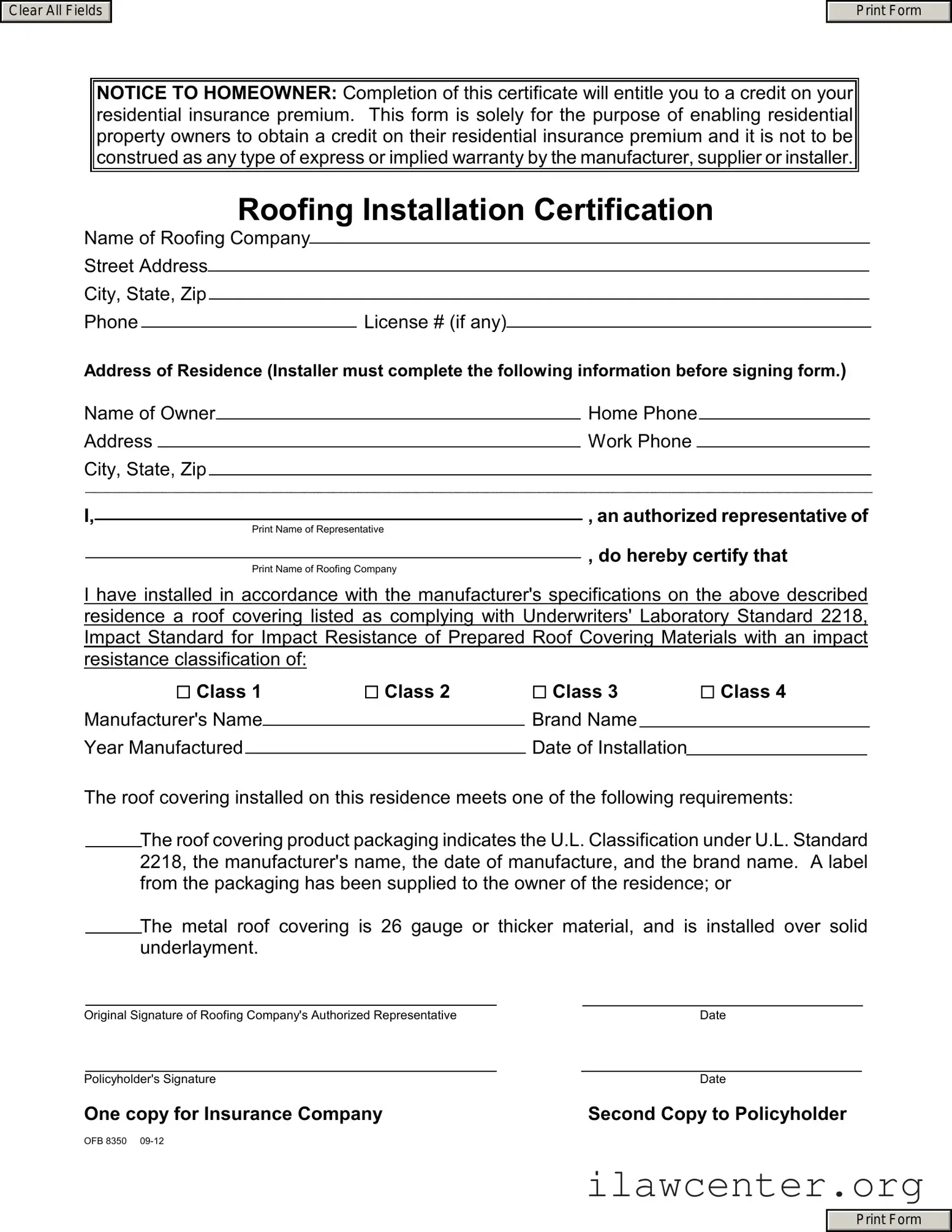
Roofing Installation Certification
Name of Roofing Company
Street Address
City, State, Zip
Phone License # (if any)
Address of Residence (Installer must complete the following information before signing form.
)
Name of Owner Home Phone
Address Work Phone
City, State, Zip
I, , an authorized representative of
Print Name of Representative
, do hereby certify that
Print Name of Roofing Company
I have installed in accordance with the manufacturer's specifications on the above described
residence a roof covering listed as complying with Underwriters' Laboratory Standard 2218,
Impact Standard for Impact Resistance of Prepared Roof Covering Materials with an impact
resistance classification of:
Class 1 Class 2 Class 3 Class 4
Manufacturer's Name Brand Name
Year Manufactured Date of Installation
The roof covering installed on this residence meets one of the following requirements:
The roof covering product packaging indicates the U.L. Classification under U.L. Standard
2218, the manufacturer's name, the date of manufacture, and the brand name. A label
from the packaging has been supplied to the owner of the residence; or
The metal roof covering is 26 gauge or thicker material, and is installed over solid
underlayment.
Original Signature of Roofing Company's Authorized Representative Date
Policyholder's Signature Date
One copy for Insurance Company Second Copy to Policyholder
OFB 8350 09-12
NOTICE TO HOMEOWNER: Completion of this certificate will entitle you to a credit on your
residential insurance premium. This form is solely for the purpose of enabling residential
property owners to obtain a credit on their residential insurance premium and it is not to be
construed as any type of express or implied warranty by the manufacturer, supplier or installer.
Clear All Fields
Print Form
Print Form

File Properties

Fact Name Description
Purpose This form helps homeowners obtain a credit on their residential insurance premium.
Not a Warranty The form does not serve as a warranty from the manufacturer, supplier, or installer.
Roofing Company Information Homeowners must provide the roofing company's name, address, and license number if applicable.
Owner Details The homeowner's name, address, and contact information are required on the form.
Certification Requirement An authorized representative of the roofing company must sign the form to certify compliance with specifications.
Impact Resistance The roof covering must comply with Underwriters' Laboratory Standard 2218 for impact resistance.
Classification Options Homeowners can select from four impact resistance classifications: Class 1, Class 2, Class 3, or Class 4.
Documentation Requirement Packaging must indicate U.L. Classification, manufacturer's name, date of manufacture, and brand name.
Material Specification If using metal roofing, it must be 26 gauge or thicker and installed over solid underlayment.
Copies of the Form One copy goes to the insurance company, and another copy is for the policyholder's records.

Instructions on Utilizing Roofing Installation Certification

Filling out the Roofing Installation Certification form is a straightforward process. This form is essential for homeowners seeking a credit on their residential insurance premium. The following steps will guide you through the completion of the form.

  1. Begin by clearing all fields on the form to ensure accuracy.
  2. Enter the Name of Roofing Company in the designated field.
  3. Provide the Street Address, City, State, and Zip code of the roofing company.
  4. Fill in the Phone number and License # (if applicable) for the roofing company.
  5. Next, enter the Address of Residence where the roofing work was performed.
  6. Complete the homeowner's information by providing the Name of Owner.
  7. Include the Home Phone and Work Phone numbers for the homeowner.
  8. Fill in the City, State, and Zip code of the residence.
  9. The authorized representative of the roofing company should print their name in the Print Name of Representative field.
  10. In the next section, indicate the roofing company name again in the Print Name of Roofing Company field.
  11. Specify the Manufacturer's Name of the roofing material used.
  12. Provide the Brand Name of the roofing material.
  13. Enter the Year Manufactured of the roofing material.
  14. Fill in the Date of Installation for the roofing work.
  15. Check the appropriate box to indicate the impact resistance classification of the roof covering: Class 1, Class 2, Class 3, or Class 4.
  16. Confirm that the roof covering meets the specified requirements by checking the relevant statements about product packaging or metal roof covering.
  17. The authorized representative must provide their Original Signature and the Date of signing.
  18. Lastly, the policyholder should sign and date the form as well.
  19. Make copies of the completed form: one for the insurance company and one for the policyholder.

Important Facts about Roofing Installation Certification

What is the purpose of the Roofing Installation Certification form?

The Roofing Installation Certification form is designed to help homeowners obtain a credit on their residential insurance premiums. It serves as documentation that the roofing installation meets specific standards, allowing homeowners to potentially save on their insurance costs.

Who needs to complete this form?

The form must be completed by an authorized representative of the roofing company that performed the installation. Homeowners should also provide their information to ensure the certification is valid for their property.

What information is required from the roofing company?

The roofing company must provide its name, address, phone number, and license number (if applicable). Additionally, the representative must certify the installation details, including the type of roofing material and its compliance with the Underwriters' Laboratory Standard 2218.

What are the impact resistance classifications listed on the form?

The form includes four impact resistance classifications: Class 1, Class 2, Class 3, and Class 4. These classifications indicate the level of resistance the roofing material has against impacts, with Class 4 being the highest level of resistance.

What should homeowners check on the roofing product packaging?

Homeowners should ensure that the roofing product packaging displays the U.L. Classification under U.L. Standard 2218, the manufacturer's name, the date of manufacture, and the brand name. This information is crucial for validating the certification.

What if the roofing material is a metal roof?

If the roofing material is a metal roof, it must be at least 26 gauge or thicker and installed over solid underlayment. This requirement ensures that the installation meets the necessary standards for impact resistance.

What signatures are needed on the form?

The form requires the original signature of the roofing company's authorized representative, as well as the policyholder's signature. Both signatures confirm that the information provided is accurate and that the installation meets the required standards.

How many copies of the form are needed?

Two copies of the form should be completed. One copy is for the insurance company, while the second copy is retained by the policyholder for their records. This ensures that both parties have the necessary documentation for the insurance credit.

Is this form a warranty for the roofing installation?

No, the Roofing Installation Certification form is not a warranty. It is solely intended to help homeowners obtain a credit on their insurance premiums and should not be interpreted as any type of express or implied warranty by the manufacturer, supplier, or installer.

Common mistakes

Filling out the Roofing Installation Certification form can be straightforward, but many people make common mistakes that can delay their insurance credits. One frequent error is leaving out important contact information. Homeowners often forget to include their phone numbers or the complete address of the residence. This information is crucial for the insurance company to process the certification smoothly. Without it, the application may be rejected or delayed.

Another mistake involves not providing accurate details about the roofing materials used. The form requires specific information about the roof covering, including the manufacturer's name and the brand name. Some people might skip this step or provide incorrect information, thinking it won’t matter. However, inaccuracies can lead to complications when trying to claim insurance credits.

Additionally, many homeowners overlook the importance of the authorized representative's signature. It’s not enough to fill out the form; it must also be signed by someone who is authorized to certify the installation. Failing to include this signature can invalidate the form, meaning the homeowner won't receive the credit they were expecting.

Finally, the date of installation is often filled out incorrectly or omitted altogether. This date is essential for the insurance company to verify the installation and assess eligibility for credits. If this detail is missing or incorrect, it can lead to further delays or denials in processing the claim. Ensuring all sections are completed accurately is vital for a smooth experience.

Documents used along the form

The Roofing Installation Certification form is an important document for homeowners seeking insurance premium credits. However, it is often accompanied by other essential forms that help streamline the roofing installation process and ensure compliance with local regulations. Here are a few commonly used documents:

  • Building Permit: This document is required by local authorities before any roofing work begins. It ensures that the installation complies with local building codes and safety regulations.
  • Contractor Agreement: This is a formal agreement between the homeowner and the roofing contractor. It outlines the scope of work, payment terms, and timelines, ensuring that both parties are clear on their responsibilities.
  • Material Warranty: This warranty provides coverage for the roofing materials used. It typically includes details on what is covered, the duration of the warranty, and the process for making claims.
  • Inspection Report: After the installation is complete, an inspection report may be generated. This document verifies that the work meets all necessary standards and regulations, providing peace of mind to the homeowner.

Understanding these documents can help homeowners navigate the roofing installation process more effectively. Having the right paperwork in place not only protects the homeowner but also ensures a smoother experience with insurance companies and contractors.

Similar forms

The Roofing Installation Certification form serves a specific purpose in the realm of home insurance, but it shares similarities with several other important documents. Understanding these similarities can help homeowners navigate their insurance needs more effectively. Here are four documents that are comparable to the Roofing Installation Certification form:

  • Homeowner's Insurance Declaration Page: This document outlines the coverage details of a homeowner's insurance policy. Like the Roofing Installation Certification, it provides critical information that can influence insurance premiums and coverage options.
  • Certificate of Insurance: This certificate serves as proof that a contractor carries the necessary insurance coverage. Similar to the Roofing Installation Certification, it reassures homeowners that their contractor is compliant with industry standards, which can affect liability and risk assessments.
  • Building Permit: A building permit is required before construction or major renovations can begin. Much like the Roofing Installation Certification, it indicates compliance with local building codes and standards, ensuring that the work meets safety regulations.
  • Warranties: Warranties provide guarantees regarding the quality and longevity of materials used in construction. They share a common goal with the Roofing Installation Certification: to protect the homeowner's investment by ensuring that the installation meets certain standards, although warranties often extend beyond the installation phase.

Each of these documents plays a vital role in protecting homeowners and ensuring compliance with industry standards. By understanding their similarities, homeowners can make informed decisions regarding their property and insurance needs.

Dos and Don'ts

When filling out the Roofing Installation Certification form, it is crucial to follow certain guidelines to ensure accuracy and compliance. Here are four essential dos and don'ts:

  • Do complete all required fields accurately, including the name of the roofing company and the address of the residence.
  • Do ensure that the roofing installation meets the manufacturer's specifications before signing the form.
  • Don't leave any sections blank; incomplete forms may delay the processing of your insurance credit.
  • Don't provide misleading information regarding the roof covering's impact resistance classification.

Misconceptions

Understanding the Roofing Installation Certification form is crucial for homeowners looking to benefit from insurance premium credits. However, several misconceptions can lead to confusion. Here are seven common misunderstandings about this form:

  1. This form guarantees a warranty on the roofing work. Many believe that completing the certification provides a warranty. In reality, it does not imply any warranty from the manufacturer, supplier, or installer.
  2. Only licensed contractors can complete this form. While it is beneficial for licensed contractors to handle roofing installations, the form can also be completed by authorized representatives of the roofing company.
  3. Homeowners need to submit the form to the manufacturer. The form is intended for insurance purposes only. Homeowners should submit it to their insurance company, not the manufacturer.
  4. The form is only for new roofs. Some homeowners think this certification applies only to new installations. However, it can also apply to replacements or upgrades of existing roofs.
  5. All roofing materials qualify for the insurance credit. Not all materials are eligible. The roof covering must meet specific standards, such as the Underwriters' Laboratory Standard 2218.
  6. The certification process is complicated. Many homeowners feel overwhelmed by the process. In truth, the form is straightforward and can be completed with basic information about the roofing installation.
  7. Insurance companies automatically apply the credit. Some homeowners assume that submitting the form guarantees an automatic credit. It’s essential to confirm with the insurance provider to ensure the credit is applied.

By clarifying these misconceptions, homeowners can navigate the certification process more effectively and take full advantage of their potential insurance benefits.

Key takeaways

When filling out and using the Roofing Installation Certification form, it is essential to follow specific guidelines to ensure accuracy and compliance. Here are some key takeaways:

  • Understand the Purpose: This form is designed to help homeowners obtain a credit on their residential insurance premium. It does not serve as a warranty from the manufacturer, supplier, or installer.
  • Complete All Fields: Ensure that all fields are filled out completely. Missing information can delay the certification process and the potential insurance credit.
  • Verify Compliance: The roof covering must comply with Underwriters' Laboratory Standard 2218. Check the impact resistance classification and ensure it is properly indicated on the form.
  • Documentation Required: Include proof of compliance, such as product packaging or labels that show the U.L. Classification, manufacturer’s name, and date of manufacture.
  • Signatures Matter: Both the authorized representative of the roofing company and the policyholder must sign the form. This validates the certification and is necessary for processing the insurance credit.
  • Keep Copies: Retain a copy for your records and provide one to your insurance company. This helps in case of future inquiries or disputes regarding the certification.