
Running Record Sheet PDF Template

Running Record Sheet PDF Template

The Running Record Sheet is a valuable tool used to assess a student's reading abilities by documenting their reading behaviors and errors during a text reading session. This form helps educators track progress and identify areas for improvement in a student's reading skills. To get started with your assessment, please fill out the form by clicking the button below.

Article Guide

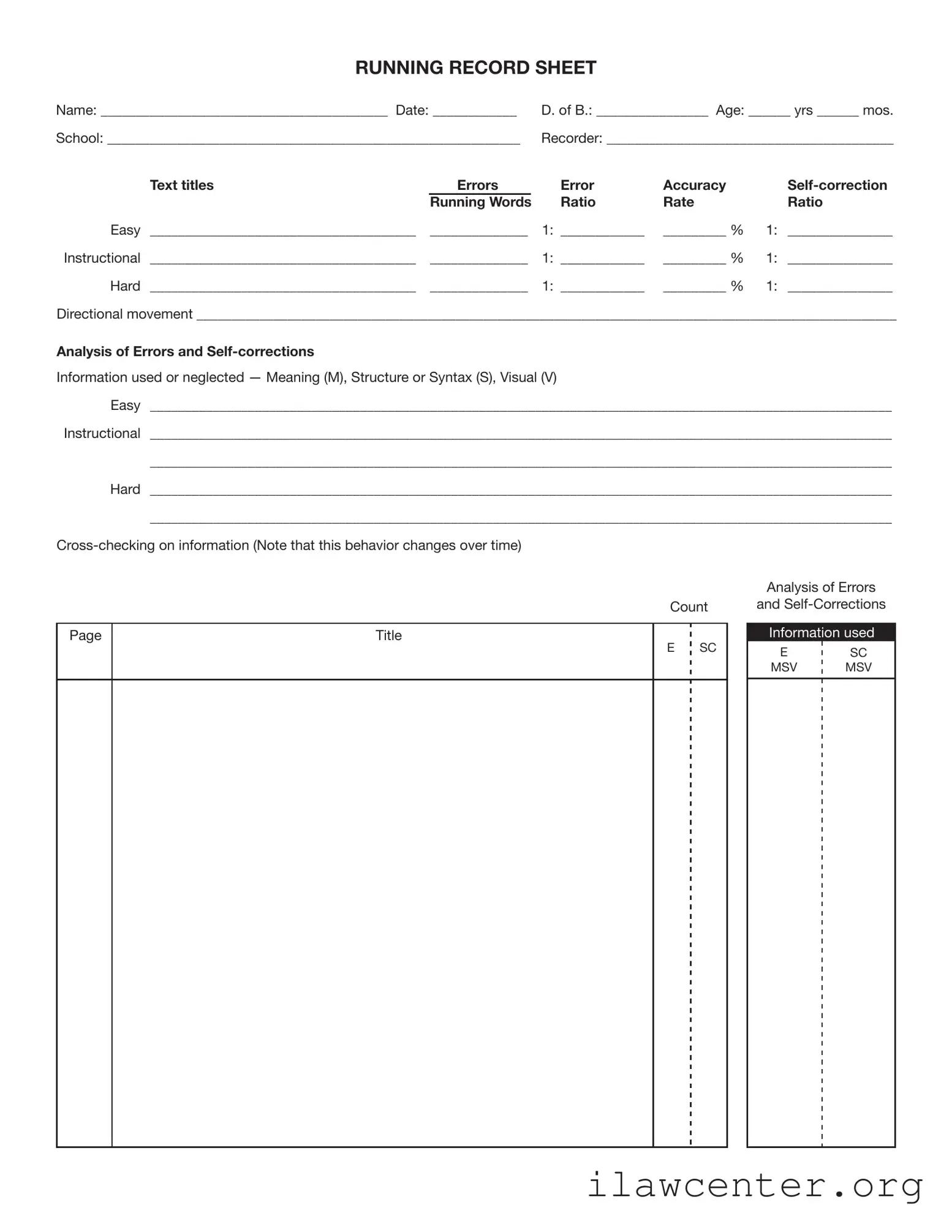
The Running Record Sheet form serves as a vital tool in the assessment of reading proficiency among students. It collects essential information, including the student's name, date of assessment, date of birth, age, and school. This structured format allows educators to record various aspects of a student's reading performance, such as text titles, errors made during reading, and the accuracy of their self-corrections. The sheet categorizes reading material into three levels: easy, instructional, and hard, providing a clear framework for understanding a student's capabilities. Additionally, it calculates critical metrics like the error ratio and self-correction rate, offering insights into a student's reading strategies and challenges. An analysis section further delves into the nature of errors and self-corrections, focusing on meaning, structure, and visual cues. This comprehensive approach not only aids in identifying areas for improvement but also helps educators tailor instruction to meet individual student needs.

Running Record Sheet Preview

Page Title
E SC
Information used
E
MSV
SC
MSV
Count
Analysis of Errors
and Self-Corrections
Name: _________________________________________ Date: ____________
School: ___________________________________________________________
D. of B.: ________________ Age: ______ yrs ______ mos.
Recorder: _________________________________________
RUNNING RECORD SHEET
Text titles Errors Error Accuracy Self-correction
Running Words Ratio Rate Ratio
Easy ______________________________________ ______________ 1: ____________ _________ % 1: _______________
Instructional ______________________________________ ______________ 1: ____________ _________ % 1: _______________
Hard ______________________________________ ______________ 1: ____________ _________ % 1: _______________
Directional movement ____________________________________________________________________________________________________
Analysis of Errors and Self-corrections
Information used or neglected — Meaning (M), Structure or Syntax (S), Visual (V)
Easy __________________________________________________________________________________________________________
Instructional __________________________________________________________________________________________________________
__________________________________________________________________________________________________________
Hard __________________________________________________________________________________________________________
__________________________________________________________________________________________________________
Cross-checking on information (Note that this behavior changes over time)
Page Title
E SC
Information used
E
MSV
SC
MSV
Count
Analysis of Errors
and Self-Corrections

File Properties

Fact Name Description Governing Law
Purpose The Running Record Sheet is designed to assess a student's reading abilities, including fluency and comprehension. Education Code § 60200 (California)
Components This form includes sections for recording errors, self-corrections, and analyzing reading behaviors. State Standards for Literacy Assessment (varies by state)
Use in Education Teachers utilize this form to identify students' reading levels and tailor instruction accordingly. Every Student Succeeds Act (ESSA)
Data Tracking The Running Record Sheet helps in tracking a student's progress over time, providing valuable insights into their reading journey. Individuals with Disabilities Education Act (IDEA)

Instructions on Utilizing Running Record Sheet

Filling out the Running Record Sheet form is a straightforward process that helps gather important information about a student's reading performance. Completing this form accurately is crucial for tracking progress and identifying areas for improvement. Follow these steps to ensure that all necessary details are captured.

  1. Begin by writing the student's Name at the top of the form in the designated space.
  2. Fill in the Date of the assessment.
  3. Enter the student's Date of Birth to calculate their age.
  4. Write the student's Age in years and months.
  5. Provide the name of the School where the student is enrolled.
  6. In the Recorder section, write your name or the name of the person recording the data.
  7. For the Text titles, indicate whether the text is Easy, Instructional, or Hard.
  8. In the Errors section, record the number of errors made by the student while reading.
  9. Next, calculate and fill in the Error Accuracy percentage based on the errors recorded.
  10. Document the Self-correction rate by noting how many times the student corrected themselves.
  11. Calculate the Running Words Ratio and write it in the appropriate space.
  12. Finally, fill in the Rate Ratio for the reading session.
  13. In the Directional movement section, provide any relevant observations about the student's reading behavior.
  14. Analyze the errors and self-corrections by using the provided sections for Easy, Instructional, and Hard texts. Record what information was used or neglected.
  15. Complete the Cross-checking on information section, noting behaviors and strategies used by the student.

Important Facts about Running Record Sheet

What is the purpose of the Running Record Sheet?

The Running Record Sheet is a tool used to assess a reader's fluency and comprehension. It helps educators track a student's reading progress over time. By recording errors, self-corrections, and other relevant metrics, teachers can identify areas where a student may need additional support or instruction.

How do I fill out the Running Record Sheet?

Begin by entering the student's name, date, date of birth, age, and school information at the top of the sheet. As the student reads a selected text, note the number of errors and self-corrections. Calculate the accuracy and self-correction ratios based on the data collected. Make sure to categorize the text as easy, instructional, or hard to provide context for the reading level.

What do the terms "Errors," "Self-correction," and "Accuracy" mean?

"Errors" refer to any incorrect words the student reads during the assessment. "Self-correction" indicates instances where the student realizes and corrects their mistakes. "Accuracy" is calculated by dividing the number of correct words by the total words read, expressed as a percentage. This metric helps gauge the student’s reading proficiency.

What is the significance of the "Running Words Ratio"?

The Running Words Ratio measures the number of words the student reads correctly compared to the total number of words in the text. This ratio provides insight into the student’s fluency and can indicate whether they are reading at an appropriate level for their skills.

How can I analyze errors and self-corrections?

In the analysis section, categorize the errors based on the type of information used or neglected, such as meaning, structure, or visual cues. This analysis helps educators understand the reasons behind the errors and tailor instruction to address specific needs. It can also highlight patterns in a student's reading behavior.

What does "Directional movement" refer to?

How often should I use the Running Record Sheet?

It is beneficial to use the Running Record Sheet regularly, such as once every few weeks or after completing a unit of study. Frequent assessments allow educators to monitor progress and make timely adjustments to instructional strategies based on the student’s evolving needs.

Common mistakes

Filling out the Running Record Sheet form accurately is essential for effective reading assessments. However, many individuals make common mistakes that can lead to misinterpretations of a student's reading abilities. Understanding these pitfalls can help ensure that the form is completed correctly and provides valuable insights into a child's reading progress.

One frequent mistake is leaving out essential personal information. When filling out the form, it’s crucial to include the student’s name, date of birth, and age. Omitting these details can create confusion later on, especially when comparing records over time. Each record should be clearly attributed to the right student to maintain accurate and useful data.

Another common error involves incorrectly categorizing the text difficulty level. The form has sections for easy, instructional, and hard texts. Misclassifying a text can lead to inaccurate assessments of a student's reading level. For instance, if a text that is actually instructional is marked as easy, it could give a false impression of the student’s abilities. Careful consideration should be given to the text’s complexity before categorizing it.

Additionally, some individuals neglect to provide detailed analyses of errors and self-corrections. This section is vital for understanding how a student approaches reading challenges. When errors are not analyzed thoroughly, important patterns may be overlooked. It’s essential to note whether the errors relate to meaning, structure, or visual cues. This information can guide future reading instruction and support.

Finally, forgetting to calculate and record the accuracy and self-correction rates can undermine the effectiveness of the assessment. These metrics are key indicators of a student’s reading proficiency. A failure to document these rates means missing out on critical data that can inform teaching strategies. Always double-check these calculations to ensure they reflect the student’s performance accurately.

Documents used along the form

The Running Record Sheet is a valuable tool for educators assessing a student's reading abilities. However, it is often used in conjunction with several other forms and documents to provide a comprehensive understanding of a student's progress and needs. Below is a list of related documents that can enhance the assessment process.

  • Reading Assessment Summary: This document compiles data from various assessments, including the Running Record Sheet. It offers a broader overview of a student's reading level and trends over time.
  • Progress Monitoring Form: Used to track a student's progress on specific reading goals. This form helps educators identify areas of improvement and adjust instruction accordingly.
  • Instructional Plan: This plan outlines tailored strategies and resources for teaching a student based on their specific reading needs identified through assessments.
  • Parent Communication Log: A record of interactions with parents regarding a student's reading progress. This log helps maintain transparency and encourages collaboration between home and school.
  • Student Reading Profile: This profile includes a student's reading history, preferences, and any previous assessments. It provides context for current performance and helps inform instructional decisions.
  • Fluency Assessment Form: Focused specifically on a student's reading fluency, this form measures aspects like speed, accuracy, and expression, complementing the data from the Running Record Sheet.
  • Comprehension Assessment Tool: This tool evaluates a student's understanding of the text read. It often includes questions or tasks related to the text and is essential for assessing deeper reading skills.
  • Literacy Intervention Plan: Designed for students who require additional support, this plan outlines specific interventions and strategies to improve reading skills based on assessment results.

Using these forms and documents alongside the Running Record Sheet creates a more holistic view of a student's reading abilities. By integrating various assessments and strategies, educators can better support each student's unique learning journey.

Similar forms

  • Assessment Log: Like the Running Record Sheet, an Assessment Log tracks a student's progress over time. It includes details on performance, strengths, and areas needing improvement, helping educators monitor growth and adjust instruction accordingly.
  • Reading Inventory: This document evaluates a student's reading level and comprehension skills. Similar to the Running Record Sheet, it provides insights into what a student can read independently and what they may need help with.
  • Progress Monitoring Form: This form records a student's learning progress in specific areas. Just as the Running Record Sheet captures errors and self-corrections, the Progress Monitoring Form identifies trends in a student's academic performance.
  • Behavior Observation Form: This document records specific behaviors exhibited by a student in the classroom. It shares a common purpose with the Running Record Sheet in that both are used to gather data for better understanding and supporting student needs.
  • Individualized Education Program (IEP): An IEP outlines specific educational goals and accommodations for students with disabilities. Like the Running Record Sheet, it focuses on individual student needs and progress, ensuring tailored support.

Dos and Don'ts

When filling out the Running Record Sheet form, it is essential to follow specific guidelines to ensure accuracy and clarity. Below is a list of things to do and avoid.

  • Do write clearly and legibly to prevent misunderstandings.
  • Do fill in all required fields, including name, date, and age.
  • Do use the correct terminology for errors and self-corrections.
  • Do double-check your calculations for accuracy rates and ratios.
  • Don't leave any sections blank unless specified otherwise.
  • Don't use abbreviations that may not be understood by others reviewing the form.
  • Don't rush through the process; take your time to ensure completeness.
  • Don't forget to review the analysis of errors and self-corrections section thoroughly.

Misconceptions

Misconceptions about the Running Record Sheet form can lead to confusion and improper use. Here are eight common misunderstandings:

  • It's only for teachers. Many believe that only teachers can use the Running Record Sheet. In reality, parents and tutors can also benefit from this tool to track reading progress.
  • It’s only for struggling readers. Some think this form is only useful for students who are having difficulties. However, it can be valuable for all readers, regardless of their skill level.
  • Accuracy is the only focus. People often assume that the form only measures accuracy. While accuracy is important, the sheet also emphasizes self-correction and understanding.
  • It’s too complicated. Many feel overwhelmed by the form’s layout. In truth, it is straightforward and can be easily understood with a little practice.
  • Results are final. Some think that the results from a single record are definitive. In fact, ongoing assessments provide a more complete picture of a student’s progress.
  • It’s only about numbers. There’s a misconception that the form is purely quantitative. It also involves qualitative analysis, such as understanding errors and self-corrections.
  • Only one record is needed. Some believe one running record is sufficient. Regular use of the form allows for tracking growth over time and adjusting instruction as needed.
  • It doesn’t inform instruction. Many think the Running Record Sheet is just for data collection. However, it plays a crucial role in shaping future teaching strategies based on student needs.

Key takeaways

When using the Running Record Sheet form, keep these key takeaways in mind:

  • Accurate Data Entry: Ensure all fields are filled out correctly, including the name, date, and age. This information is crucial for tracking progress.
  • Identify Error Patterns: Pay attention to the types of errors made. Analyzing whether they are related to meaning, structure, or visual cues can provide insights into the reader's challenges.
  • Monitor Self-Corrections: Note how often the reader self-corrects. This can indicate their level of understanding and engagement with the text.
  • Use Ratios Effectively: Calculate the error accuracy and running words ratio. These metrics help evaluate the reader's fluency and comprehension.