Sample Roof Certification PDF Template

Sample Roof Certification PDF Template

The Sample Roof Certification form is an important document that verifies the condition of a roof after inspection by a licensed roofing contractor. This certification confirms that the roof is moisture-proof for a minimum of two years, providing peace of mind to homeowners and potential buyers. To ensure your roof is certified, please fill out the form by clicking the button below.

Article Guide

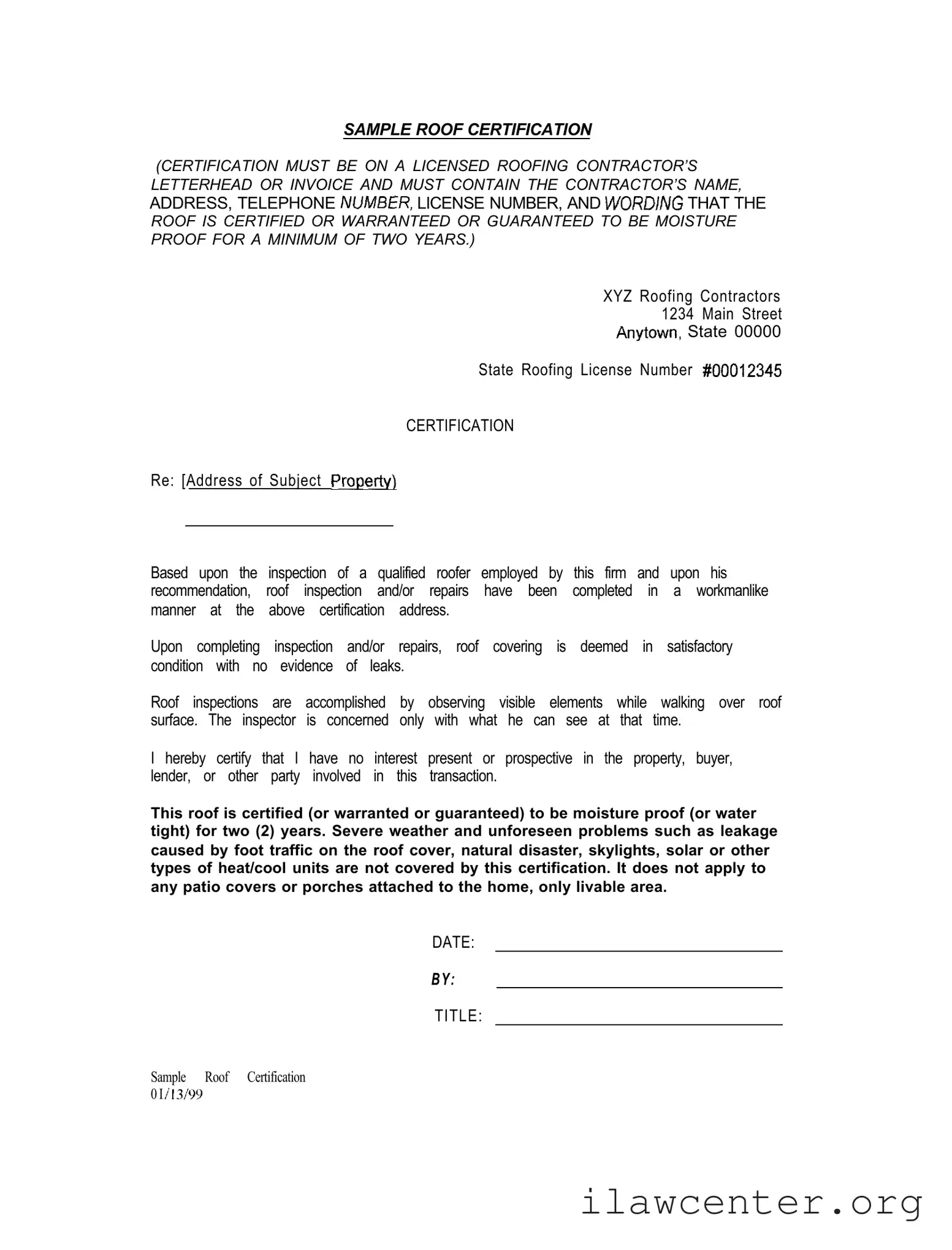
The Sample Roof Certification form serves as a crucial document in the roofing industry, providing essential assurances to property owners regarding the condition and reliability of their roofs. This certification must be presented on the letterhead or invoice of a licensed roofing contractor, ensuring that it includes the contractor's name, address, telephone number, and license number. The form explicitly states that the roof is certified, warranted, or guaranteed to be moisture-proof for a minimum of two years. It references the property address and confirms that a qualified roofer has conducted a thorough inspection, completing any necessary repairs in a workmanlike manner. The inspector evaluates visible elements of the roof while walking over its surface, focusing solely on what can be seen at that moment. Importantly, the certification asserts that the inspector has no financial interest in the property or any parties involved in the transaction. While the roof is deemed satisfactory with no evidence of leaks, the certification does not cover damages caused by severe weather, foot traffic, or other unforeseen issues. Additionally, it is limited to the livable area of the home, excluding any patio covers or porches. This document is vital for both buyers and sellers, as it provides peace of mind and clarity regarding the roof's integrity.

Sample Roof Certification Preview

SAMPLE ROOF CERTIFICATION
(CERTIFICATION MUST BE ON A LICENSED ROOFING CONTRACTOR’S
LETTERHEAD OR INVOICE AND MUST CONTAIN THE CONTRACTOR’S NAME,
ADDRESS, TELEPHONE
NUMSER,
LICENSE NUMBER, AND
WORDlNG
THAT THE
ROOF IS CERTIFIED OR WARRANTEED OR GUARANTEED TO BE MOISTURE
PROOF FOR A MINIMUM OF TWO YEARS.)
XYZ Roofing Contractors
1234 Main Street
Anytown,
State 00000
State Roofing License Number #00012345
CERTIFICATION
Re: [Address of Subject Property)
Based upon the inspection of a qualified roofer employed by this firm and upon his
recommendation, roof inspection and/or repairs have been completed in a workmanlike
manner at the above certification address.
Upon completing inspection and/or repairs, roof covering is deemed in satisfactory
condition with no evidence of leaks.
Roof inspections are accomplished by observing visible elements while walking over roof
surface. The inspector is concerned only with what he can see at that time.
I hereby certify that I have no interest present or prospective in the property, buyer,
lender, or other party involved in this transaction.
This roof is certified (or warranted or guaranteed) to be moisture proof (or water
tight) for two (2) years. Severe weather and unforeseen problems such as leakage
caused by foot traffic on the roof cover, natural disaster, skylights, solar or other
types of heat/cool units are not covered by this certification. It does not apply to
any patio covers or porches attached to the home, only livable area.
DATE:
BY:
TITLE:
Sample Roof Certification
0 I
/13/w

File Properties

Fact Name Details
Document Requirement The certification must be on a licensed roofing contractor’s letterhead or invoice.
Contractor Information Must include the contractor’s name, address, telephone number, and license number.
Certification Duration The roof is certified to be moisture proof for a minimum of two years.
Inspection Basis The certification is based on an inspection conducted by a qualified roofer.
Condition of Roof The roof must be deemed in satisfactory condition with no evidence of leaks.
Visible Elements Inspections involve observing visible elements while walking over the roof surface.
Conflict of Interest The certifier must declare no interest in the property or involved parties.
Exclusions Severe weather and issues like foot traffic or natural disasters are not covered.
Scope of Certification This certification applies only to livable areas, excluding patio covers or porches.
State-Specific Laws Refer to state regulations governing roofing certifications for compliance.

Instructions on Utilizing Sample Roof Certification

Filling out the Sample Roof Certification form requires careful attention to detail. Each section must be completed accurately to ensure the certification is valid. Follow these steps to complete the form correctly.

  1. Obtain the form on a licensed roofing contractor’s letterhead or invoice.
  2. Fill in the contractor’s name, address, and telephone number at the top of the form.
  3. Enter the contractor’s state roofing license number in the designated area.
  4. Specify the address of the property being certified in the "Re:" section.
  5. Include a statement confirming that inspections and/or repairs have been completed in a workmanlike manner.
  6. State that the roof covering is deemed in satisfactory condition with no evidence of leaks.
  7. Certify that the inspector has no interest in the property or parties involved in the transaction.
  8. Clearly state the certification that the roof is moisture proof (or water tight) for a minimum of two years.
  9. Note any exclusions, such as severe weather or issues caused by foot traffic, in the appropriate section.
  10. Sign and date the form at the bottom, including the title of the person signing.

Important Facts about Sample Roof Certification

What is a Sample Roof Certification form?

The Sample Roof Certification form is a document provided by licensed roofing contractors to certify that a roof has been inspected and is in satisfactory condition. It states that the roof is guaranteed to be moisture-proof for a minimum of two years, provided that the conditions outlined in the certification are met.

What information must be included in the certification?

The certification must be printed on the contractor's letterhead or invoice. It should include the contractor’s name, address, telephone number, and license number. Additionally, the wording must clearly state that the roof is certified, warranted, or guaranteed to be moisture-proof for at least two years.

How is the roof inspected for certification?

A qualified roofer conducts the inspection by walking over the roof surface and observing visible elements. The inspector assesses the condition of the roof based on what can be seen at that time. This process ensures that any apparent issues are noted, but it does not cover hidden problems that may exist.

What does the certification guarantee?

The certification guarantees that the roof is moisture-proof or water-tight for a period of two years. It assures property owners that the roof has been inspected and is free from leaks at the time of certification. However, it is important to note that certain conditions, such as severe weather or damage from foot traffic, are not covered by this guarantee.

Are there any exclusions in the certification?

Yes, the certification does not cover damages caused by natural disasters, foot traffic, or issues related to skylights and HVAC units. It also does not apply to any patio covers or porches attached to the home; it is strictly for the livable area of the property.

Who is responsible for the roof after certification?

Once the roof is certified, the contractor certifies that they have no interest in the property or the parties involved in the transaction. However, the property owner is responsible for maintaining the roof and addressing any issues that may arise during the certification period.

How long is the certification valid?

The certification is valid for two years from the date of issuance. Property owners should keep track of this timeframe and consider scheduling another inspection before the certification expires to ensure continued roof integrity.

Common mistakes

When individuals fill out the Sample Roof Certification form, several common mistakes can occur, potentially leading to complications in the certification process. One frequent error is the omission of essential contact information. The form requires the roofing contractor’s name, address, telephone number, and license number. If any of these details are missing, the certification may be deemed incomplete, which can create issues for both the contractor and the property owner.

Another mistake often made is failing to include the specific wording that certifies the roof's condition. The form explicitly states that the certification must contain phrases such as "certified," "warranted," or "guaranteed to be moisture proof." Neglecting to use this language can result in ambiguity regarding the certification’s intent and coverage. This lack of clarity may lead to misunderstandings about the roof's warranty and the contractor's obligations.

Additionally, individuals sometimes overlook the importance of the inspection process. The certification relies on an inspection conducted by a qualified roofer, and it is crucial that this inspection is thorough and documented. If the inspector does not adequately assess the roof or fails to provide a detailed account of their findings, the certification may not hold up if issues arise later. The inspector's observations must be clearly stated to ensure that the certification accurately reflects the roof's condition.

Lastly, a common oversight involves the failure to address the limitations of the certification. The form notes that certain conditions, such as severe weather or damage from foot traffic, are not covered by the certification. It is important for both the contractor and the property owner to understand these limitations to avoid future disputes. Clearly outlining these exclusions in the certification can help manage expectations and provide a more comprehensive understanding of the roof's warranty.

Documents used along the form

When dealing with roofing projects, several important forms and documents often accompany the Sample Roof Certification form. These documents help ensure that all parties are informed, protected, and compliant with local regulations. Below is a list of commonly used forms that may be relevant in the roofing industry.

  • Roof Inspection Report: This document provides a detailed analysis of the roof's condition before any work is done. It outlines any existing issues and offers recommendations for repairs or maintenance.
  • Contractor Agreement: A formal agreement between the homeowner and the roofing contractor. It outlines the scope of work, payment terms, and responsibilities of both parties.
  • Work Order: This document serves as a directive for the roofing contractor to begin work. It includes specific details about the job, such as materials to be used and timelines for completion.
  • Warranty Document: This provides information about the warranty for materials and workmanship. It details what is covered and for how long, giving homeowners peace of mind about their investment.
  • Permit Application: Before starting any roofing project, a permit may be required by local authorities. This application ensures that the work complies with building codes and regulations.
  • Change Order: If any modifications to the original contract are necessary, a change order documents those changes. It helps keep track of adjustments in scope, cost, or schedule.
  • Final Inspection Certificate: After the roofing work is completed, this certificate verifies that the job has been inspected and meets all local building codes and standards.
  • Insurance Certificate: This document proves that the roofing contractor has liability and workers' compensation insurance. It protects homeowners from potential liabilities during the project.
  • Payment Receipt: Once payment has been made, a receipt confirms the transaction. It serves as proof of payment for both the contractor and the homeowner.

Having these documents on hand can streamline the roofing process and protect everyone involved. By ensuring that all necessary paperwork is completed, homeowners can feel more confident in their roofing decisions and contractors can maintain clear communication and accountability.

Similar forms

The Sample Roof Certification form shares similarities with several other important documents in the construction and real estate industries. Each document serves a unique purpose but contains elements that overlap with the Sample Roof Certification. Here are eight documents that are similar:

  • Home Inspection Report: Like the roof certification, this report provides an assessment of a property's condition, focusing on visible issues. It is typically conducted by a qualified inspector and highlights any concerns that may affect the property's value.
  • Roof Warranty: This document guarantees the quality of roofing work for a specified period. Similar to the roof certification, it assures the property owner that the roof will remain leak-free for a defined duration.
  • Building Permit: A building permit is necessary for construction or renovation projects. It ensures that work complies with local codes, much like the roof certification confirms that roofing work meets specific standards.
  • Contractor’s Invoice: An invoice from a contractor outlines the services provided and their costs. It often accompanies certifications and includes essential details such as the contractor's information and the work performed.
  • Title Report: This report reveals any liens or claims against a property. While it focuses on legal ownership, it parallels the roof certification by confirming that the property is in good standing before a sale.
  • Insurance Policy: A homeowner's insurance policy protects against specific risks, including roof damage. Like the roof certification, it provides assurance to the homeowner regarding the condition and safety of the property.
  • Disclosure Statement: In real estate transactions, sellers often provide a disclosure statement detailing known issues with the property. This is similar to the roof certification, which informs buyers about the roof's condition.
  • Maintenance Agreement: A maintenance agreement outlines the services a contractor will provide over time to keep the roof in good condition. This document is similar in purpose, as it aims to ensure the longevity and reliability of the roofing system.

Dos and Don'ts

When filling out the Sample Roof Certification form, it’s important to follow certain guidelines to ensure accuracy and compliance. Here’s a list of things to do and avoid:

  • Do use a licensed roofing contractor’s letterhead or invoice.
  • Do include the contractor’s name, address, and telephone number.
  • Do provide the contractor’s license number.
  • Do clearly state that the roof is certified, warranted, or guaranteed to be moisture proof for a minimum of two years.
  • Do ensure the certification is based on a thorough inspection by a qualified roofer.
  • Don’t omit the address of the subject property.
  • Don’t include any personal interests in the property or transaction.
  • Don’t forget to mention that severe weather or unforeseen problems are not covered by the certification.
  • Don’t apply the certification to patio covers or porches; it only covers livable areas.

By adhering to these guidelines, you can ensure that the Sample Roof Certification form is filled out correctly, minimizing the risk of issues down the line.

Misconceptions

Misconceptions about the Sample Roof Certification form can lead to misunderstandings regarding its purpose and limitations. Here are nine common misconceptions:

  • 1. The certification guarantees a leak-free roof for two years. The certification states that the roof is moisture-proof for two years, but it does not cover issues arising from severe weather or unforeseen problems.
  • 2. Any roofing contractor can issue a certification. The certification must be on a licensed roofing contractor’s letterhead or invoice, ensuring that the contractor is qualified and recognized.
  • 3. The inspection is comprehensive. The inspection is limited to visible elements. Inspectors do not assess hidden issues that may exist beneath the roof surface.
  • 4. The certification covers all parts of the property. The certification specifically excludes patio covers or porches. It applies only to the livable area of the home.
  • 5. The contractor has a vested interest in the property. The form includes a statement certifying that the contractor has no present or prospective interest in the property or parties involved in the transaction.
  • 6. The certification is a warranty. While it mentions a warranty, it is important to understand that it does not cover damage from foot traffic, natural disasters, or specific installations like skylights.
  • 7. The certification is a guarantee against all roof problems. The certification is not a blanket guarantee. It only certifies the roof's condition at the time of inspection.
  • 8. The date on the certification is irrelevant. The date is crucial as it marks the start of the two-year certification period. Issues arising after this date are not covered.
  • 9. The certification can be transferred to a new owner. The certification is tied to the original property owner and may not automatically transfer to a new owner without proper documentation.

Key takeaways

Here are some key takeaways about filling out and using the Sample Roof Certification form:

  • Use Proper Letterhead: The certification must be printed on the letterhead or invoice of a licensed roofing contractor. This includes the contractor's name, address, telephone number, and license number.
  • Inspection Requirements: A qualified roofer must perform an inspection. The certification indicates that the roof has been inspected and any necessary repairs have been made in a professional manner.
  • Certification Validity: The roof is certified to be moisture-proof for a minimum of two years. This means that any issues related to leaks should be addressed within this time frame.
  • Limitations of Certification: The certification does not cover damage from severe weather, foot traffic, or natural disasters. It is also important to note that it applies only to the livable area of the home, excluding patio covers or porches.