Fillable Scholarship Recommendation Letter Document

Fillable Scholarship Recommendation Letter Document

The Scholarship Recommendation Letter form is a crucial document that helps students secure financial aid by providing insights into their character, achievements, and potential. This form is typically completed by teachers, mentors, or community leaders who can vouch for the applicant's qualifications. To get started, fill out the form by clicking the button below.

Article Guide

When applying for scholarships, a well-crafted recommendation letter can significantly enhance a candidate's chances of success. The Scholarship Recommendation Letter form serves as a structured guide for those writing these letters, ensuring that they cover essential aspects that highlight the applicant's qualifications and character. Typically, this form includes sections for the recommender's information, the applicant's details, and specific prompts that help the recommender articulate their insights. It may ask for examples of the applicant's achievements, leadership qualities, and personal attributes that make them a worthy candidate. Additionally, it often provides space for the recommender to discuss the applicant's potential contributions to their chosen field or community. By filling out this form, recommenders can present a comprehensive picture of the applicant, making it easier for scholarship committees to understand the individual behind the application.

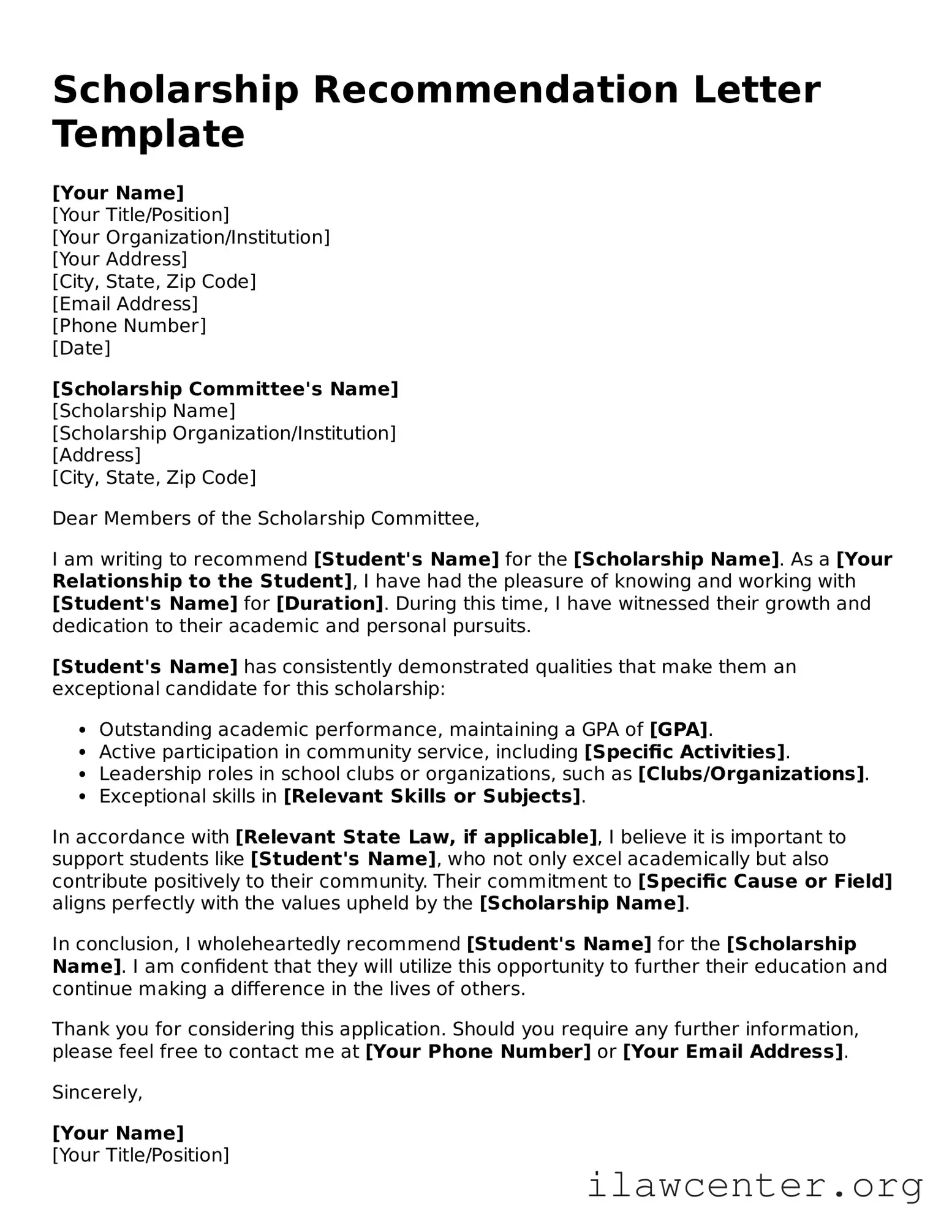
Scholarship Recommendation Letter Preview

Scholarship Recommendation Letter Template

[Your Name]
[Your Title/Position]
[Your Organization/Institution]
[Your Address]
[City, State, Zip Code]
[Email Address]
[Phone Number]
[Date]

[Scholarship Committee's Name]
[Scholarship Name]
[Scholarship Organization/Institution]
[Address]
[City, State, Zip Code]

Dear Members of the Scholarship Committee,

I am writing to recommend [Student's Name] for the [Scholarship Name]. As a [Your Relationship to the Student], I have had the pleasure of knowing and working with [Student's Name] for [Duration]. During this time, I have witnessed their growth and dedication to their academic and personal pursuits.

[Student's Name] has consistently demonstrated qualities that make them an exceptional candidate for this scholarship:

  • Outstanding academic performance, maintaining a GPA of [GPA].
  • Active participation in community service, including [Specific Activities].
  • Leadership roles in school clubs or organizations, such as [Clubs/Organizations].
  • Exceptional skills in [Relevant Skills or Subjects].

In accordance with [Relevant State Law, if applicable], I believe it is important to support students like [Student's Name], who not only excel academically but also contribute positively to their community. Their commitment to [Specific Cause or Field] aligns perfectly with the values upheld by the [Scholarship Name].

In conclusion, I wholeheartedly recommend [Student's Name] for the [Scholarship Name]. I am confident that they will utilize this opportunity to further their education and continue making a difference in the lives of others.

Thank you for considering this application. Should you require any further information, please feel free to contact me at [Your Phone Number] or [Your Email Address].

Sincerely,

[Your Name]
[Your Title/Position]

PDF Form Characteristics

Fact Name Description
Purpose The Scholarship Recommendation Letter form is used to provide insights about a candidate’s qualifications and character from a third party.
Eligibility Typically, the form is intended for students applying for scholarships, often requiring a recommendation from a teacher, employer, or community leader.
Content Requirements The letter should include specific examples of the candidate’s achievements, skills, and personal qualities that make them a suitable candidate for the scholarship.
Submission Process Most scholarship programs require the recommendation letter to be submitted along with the application, either electronically or by mail.
State-Specific Forms Some states may have specific forms or guidelines for scholarship recommendations, governed by local educational laws.
Confidentiality In many cases, the content of the recommendation letter is confidential and should not be shared with the applicant.
Length Recommendation letters typically range from one to two pages, allowing enough space for detailed insights without being overly lengthy.
Deadline It’s crucial for recommenders to be aware of submission deadlines, as late letters can jeopardize a candidate’s application.
Impact A well-written recommendation letter can significantly enhance a candidate’s chances of receiving a scholarship, highlighting their unique strengths.

Instructions on Utilizing Scholarship Recommendation Letter

Once you have the Scholarship Recommendation Letter form ready, you will need to complete it carefully. This form is crucial for the scholarship application process. Make sure to provide accurate information and express your genuine thoughts about the candidate.

  1. Begin by entering the date at the top of the form.
  2. Fill in your name in the designated section.
  3. Provide your title or position, along with the organization you represent.
  4. Enter your contact information, including your phone number and email address.
  5. In the next section, write the name of the candidate you are recommending.
  6. Describe your relationship with the candidate, including how long you have known them and in what capacity.
  7. Provide specific examples of the candidate's strengths, achievements, and qualities that make them a good fit for the scholarship.
  8. Conclude your recommendation with a strong endorsement of the candidate.
  9. Sign and date the form at the bottom.

After completing the form, review it for any errors or omissions. Ensure that all required sections are filled out clearly. Once you are satisfied, submit the form according to the instructions provided by the scholarship program.

Important Facts about Scholarship Recommendation Letter

What is a Scholarship Recommendation Letter form?

The Scholarship Recommendation Letter form is a document that allows individuals, such as teachers, employers, or mentors, to provide a written endorsement for a student applying for a scholarship. This letter highlights the student’s strengths, achievements, and character traits, helping scholarship committees assess their suitability for funding.

Who should write the recommendation letter?

The recommendation letter should be written by someone who knows the student well and can speak to their abilities and accomplishments. This may include teachers, school counselors, employers, or community leaders. It is important that the writer can provide specific examples of the student’s skills and contributions.

What information should be included in the letter?

The letter should include the writer's relationship to the student, an overview of the student’s academic and extracurricular achievements, and specific examples that demonstrate the student’s strengths. It is also helpful to mention any personal qualities that make the student a good candidate for the scholarship.

How long should the recommendation letter be?

A recommendation letter should typically be one page long. It should be concise while still providing enough detail to give the scholarship committee a clear picture of the student’s qualifications. A well-structured letter that is easy to read will be most effective.

Is there a specific format for the letter?

While there may not be a strict format required, it is advisable to use a professional tone. The letter should include the writer's contact information, the date, and a formal greeting. The body of the letter should clearly convey the writer’s endorsement of the student. A closing statement and signature are also important.

When is the recommendation letter due?

The due date for the recommendation letter varies depending on the scholarship program. It is essential for the writer to check the specific deadline set by the scholarship committee. To ensure timely submission, it is best to complete the letter well in advance of the deadline.

Common mistakes

Filling out a Scholarship Recommendation Letter form can be a crucial step in a student's journey toward securing funding for their education. However, there are common mistakes that can undermine the effectiveness of the recommendation. Recognizing these pitfalls can make a significant difference.

One frequent error is not providing specific examples. A recommendation that lacks detailed anecdotes about the student’s achievements or character can come across as generic. Specificity adds credibility and helps the selection committee understand the student's unique qualities.

Another mistake is failing to address the scholarship criteria. Each scholarship has its own set of values and requirements. Not tailoring the letter to highlight how the student meets these criteria can weaken the recommendation.

Some recommenders overlook the importance of a professional tone. While it’s essential to convey genuine feelings, the language should remain respectful and formal. A casual tone might detract from the seriousness of the recommendation.

Another common error is neglecting to proofread. Spelling and grammatical errors can create a negative impression. Taking the time to review the letter ensures that it reflects well on both the student and the recommender.

Additionally, some individuals forget to include their contact information. Providing a way for the scholarship committee to reach out for further clarification or additional information is important. Omitting this can limit the effectiveness of the recommendation.

Another mistake is writing a letter that is too long or too short. A concise letter that gets to the point while still providing enough detail is ideal. A lengthy letter may lose the reader's attention, while a brief one might not provide enough insight.

Sometimes, recommenders fail to highlight the student's growth. Emphasizing how the student has developed over time can add depth to the recommendation. This shows that the student is capable of continued growth and improvement.

Some people also forget to mention the relationship with the student. Clearly stating how long and in what capacity the recommender knows the student helps establish credibility. It allows the committee to understand the context of the recommendation.

Lastly, not submitting the letter on time can be a critical error. Meeting deadlines is essential in the scholarship application process. Late submissions can lead to disqualification, regardless of the quality of the recommendation.

Documents used along the form

When applying for scholarships, a variety of documents may be required to support your application. Each document plays a crucial role in presenting a complete picture of the applicant’s qualifications, achievements, and character. Below is a list of common forms and documents that often accompany a Scholarship Recommendation Letter.

  • Scholarship Application Form: This is the primary document where applicants provide personal information, academic history, and details about the scholarship for which they are applying.
  • Transcripts: Official academic records from high schools or colleges that showcase the applicant's grades and courses taken. These documents verify the applicant's academic performance.
  • Personal Statement: A written essay where the applicant shares their goals, experiences, and reasons for pursuing the scholarship. This statement helps to convey the applicant's voice and aspirations.
  • Resume: A summary of the applicant's educational background, work experience, extracurricular activities, and skills. This document highlights the applicant's qualifications and achievements.
  • Financial Aid Application: A form that provides details about the applicant's financial situation. This helps scholarship committees assess the need for financial assistance.
  • Letters of Recommendation: Additional letters from teachers, employers, or community leaders who can speak to the applicant’s character and accomplishments. These letters complement the scholarship recommendation letter.
  • Proof of Enrollment: Documentation confirming that the applicant is currently enrolled in an educational institution. This can include acceptance letters or enrollment verification forms.
  • Standardized Test Scores: Results from tests such as the SAT or ACT, which may be required by some scholarship programs to evaluate academic readiness.
  • Portfolio: A collection of work samples, particularly for applicants in creative fields, showcasing their skills and accomplishments in art, writing, or other areas.

Each of these documents serves to strengthen the scholarship application. Ensuring that all required materials are complete and submitted on time is essential for maximizing the chances of receiving financial support for education.

Similar forms

The Scholarship Recommendation Letter form shares similarities with several other documents. Here are four documents that are alike in purpose or structure:

  • Job Recommendation Letter: Like the scholarship letter, this document highlights an individual’s strengths and qualifications. It provides insight into the candidate's skills and character, helping potential employers make informed decisions.
  • College Admission Recommendation Letter: This letter supports a student's application to college. It focuses on the applicant’s academic achievements and personal qualities, much like the scholarship recommendation does for funding opportunities.
  • Character Reference Letter: This document emphasizes a person's character traits and personal qualities. It serves to vouch for an individual's integrity and reliability, similar to how a scholarship letter endorses a candidate's potential.
  • Professional Reference Letter: This letter is used in job applications to speak to a person's professional abilities and experiences. It mirrors the scholarship recommendation by providing a third-party perspective on the candidate’s qualifications.

Dos and Don'ts

When filling out a Scholarship Recommendation Letter form, there are several important practices to keep in mind. The following list outlines ten key dos and don'ts to help ensure that the letter is effective and meets the expectations of the scholarship committee.

  • Do provide specific examples of the candidate's achievements and strengths.
  • Do maintain a professional tone throughout the letter.
  • Do address the letter to the correct recipient or committee.
  • Do include your contact information for follow-up questions.
  • Do proofread the letter for spelling and grammatical errors.
  • Don't use generic phrases that do not add value to the recommendation.
  • Don't exaggerate the candidate's abilities or accomplishments.
  • Don't share personal opinions that are not relevant to the scholarship.
  • Don't forget to adhere to any specific guidelines provided by the scholarship organization.
  • Don't wait until the last minute to complete the letter.

By following these guidelines, you can help create a strong and impactful recommendation that truly reflects the candidate's potential and suitability for the scholarship opportunity.

Misconceptions

Misconceptions about the Scholarship Recommendation Letter form can lead to confusion and missed opportunities. Here are four common misunderstandings:

  1. All recommenders must be teachers.

    Many believe that only teachers can write recommendation letters. In reality, recommenders can include mentors, employers, or community leaders who know the applicant well. What matters most is the recommender's ability to speak to the applicant's strengths and potential.

  2. The letter must be lengthy to be effective.

    Some think that a longer letter equates to a better letter. However, a concise and focused recommendation often carries more weight. A well-articulated letter that highlights specific qualities and achievements can be more impactful than a lengthy one filled with general statements.

  3. All letters are the same for every scholarship.

    There is a misconception that a single letter can be used for all scholarship applications. Each scholarship may have different criteria and values. Tailoring the letter to reflect the specific scholarship's focus can enhance the applicant's chances of success.

  4. Recommenders should only focus on academic achievements.

    While academic performance is important, it is not the only factor. Recommenders should also highlight personal qualities, leadership skills, and community involvement. A well-rounded view of the applicant can provide a more comprehensive picture.

Key takeaways

When filling out and using a Scholarship Recommendation Letter form, consider the following key takeaways:

  1. Understand the purpose of the recommendation letter. It serves to highlight the strengths and qualifications of the applicant.
  2. Choose the right person to write the letter. Ideally, the recommender should know the applicant well and be able to speak to their abilities.
  3. Provide the recommender with relevant information. Share details about the scholarship, the applicant’s achievements, and specific qualities to highlight.
  4. Encourage the recommender to be specific. Concrete examples of the applicant’s skills and experiences can make a stronger impact.
  5. Keep the tone positive and professional. The letter should reflect enthusiasm and support for the applicant.
  6. Follow any specific guidelines provided by the scholarship. These may include formatting, length, and submission methods.
  7. Proofread the letter before submission. Spelling and grammar errors can detract from the message.
  8. Submit the letter on time. Adhering to deadlines is crucial for the applicant’s chances of receiving the scholarship.
  9. Confirm receipt of the letter. Following up ensures that it has been submitted correctly and on time.
  10. Understand that the letter is just one part of the application. It should complement other materials, like transcripts and essays.