Fillable School Letter of Intent Document

Fillable School Letter of Intent Document

The School Letter of Intent form is a document that expresses a student's intention to enroll in a specific educational institution. This form is essential for both the school and the student, as it helps to formalize the enrollment process and ensures that the institution can plan accordingly. For those ready to take the next step, consider filling out the form by clicking the button below.

Article Guide

The School Letter of Intent form serves as an important document for students and families navigating the educational landscape. This form outlines a student's intention to enroll in a specific school or program, signaling their commitment to that institution. It typically includes essential information such as the student's name, contact details, and the school or program they wish to attend. Additionally, the form may require details about the student's academic history, extracurricular activities, and any special considerations that could impact their enrollment. By submitting this letter, families not only express their interest but also initiate the enrollment process, allowing schools to prepare for incoming students. Understanding the nuances of this form can significantly enhance a family's experience as they transition into a new educational environment.

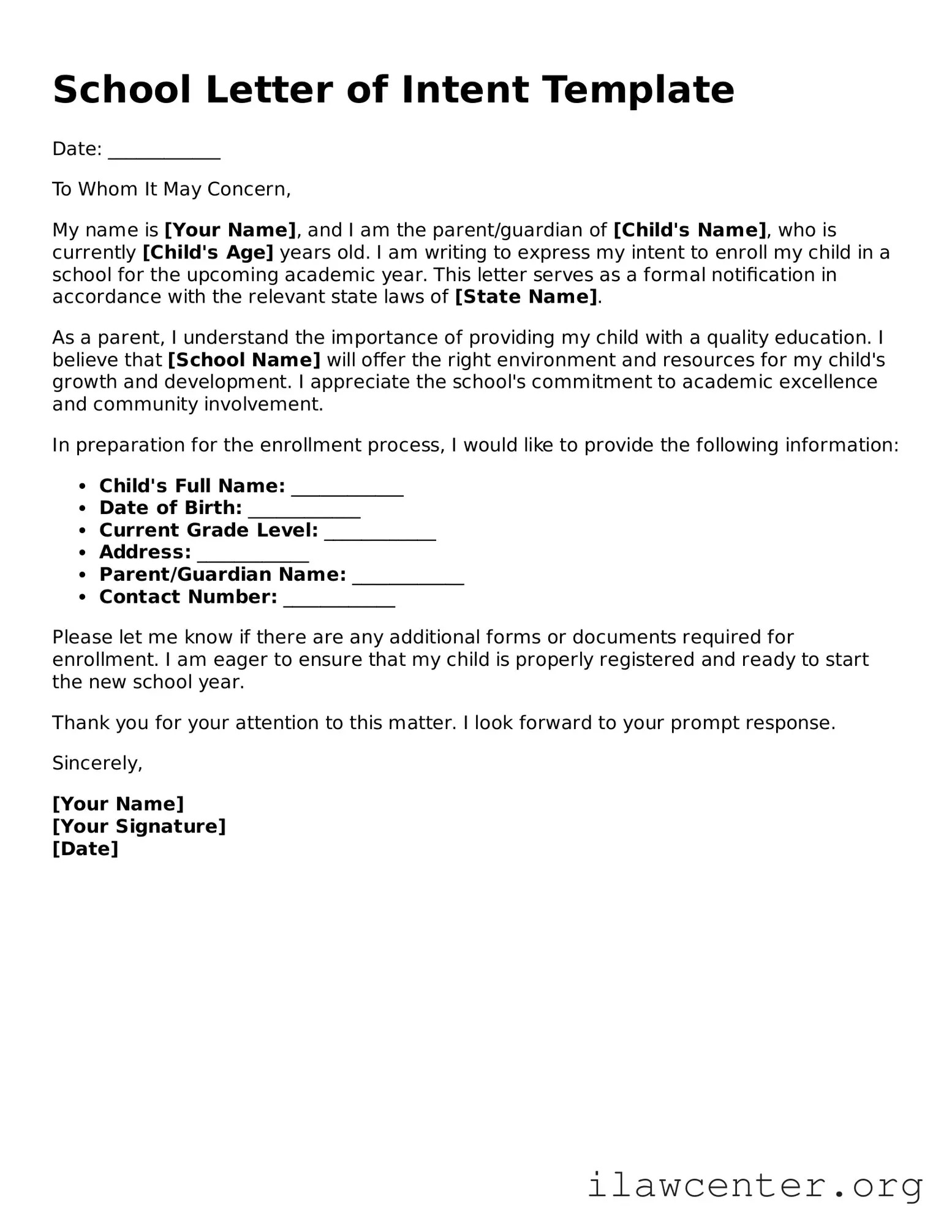
School Letter of Intent Preview

School Letter of Intent Template

Date: ____________

To Whom It May Concern,

My name is [Your Name], and I am the parent/guardian of [Child's Name], who is currently [Child's Age] years old. I am writing to express my intent to enroll my child in a school for the upcoming academic year. This letter serves as a formal notification in accordance with the relevant state laws of [State Name].

As a parent, I understand the importance of providing my child with a quality education. I believe that [School Name] will offer the right environment and resources for my child's growth and development. I appreciate the school's commitment to academic excellence and community involvement.

In preparation for the enrollment process, I would like to provide the following information:

  • Child's Full Name: ____________
  • Date of Birth: ____________
  • Current Grade Level: ____________
  • Address: ____________
  • Parent/Guardian Name: ____________
  • Contact Number: ____________

Please let me know if there are any additional forms or documents required for enrollment. I am eager to ensure that my child is properly registered and ready to start the new school year.

Thank you for your attention to this matter. I look forward to your prompt response.

Sincerely,

[Your Name]
[Your Signature]
[Date]

PDF Form Characteristics

Fact Name Description
Purpose The School Letter of Intent form is used to express a student's intention to enroll in a particular school or program.
State-Specific Forms Each state may have its own version of the form, tailored to meet local educational requirements.
Governing Laws In many states, the form is governed by specific education laws that outline enrollment processes and requirements.
Submission Timeline Schools often require the form to be submitted by a certain deadline to secure a spot for the upcoming academic year.
Importance of Accuracy Completing the form accurately is crucial, as errors can lead to delays or issues with enrollment.

Instructions on Utilizing School Letter of Intent

After obtaining the School Letter of Intent form, you will need to fill it out accurately. Once completed, the form will be submitted to the appropriate school authority. Ensure that all required information is provided to avoid any delays in processing.

  1. Begin by writing your full name at the top of the form.
  2. Next, enter your contact information, including your address, phone number, and email.
  3. Provide the name of the school you are intending to enroll in.
  4. Indicate the grade level you will be entering.
  5. Fill in the date of your intended enrollment.
  6. If applicable, list any siblings who are currently enrolled in the same school.
  7. Sign and date the form at the bottom.
  8. Review the form for accuracy and completeness.
  9. Submit the form to the designated school office or online portal as instructed.

Important Facts about School Letter of Intent

What is a School Letter of Intent?

A School Letter of Intent is a formal document that expresses a student's intention to enroll in a particular school. It serves as a commitment from the student and their family to the school, indicating that they plan to attend and may help the school with planning for enrollment numbers. This letter is often required by schools to finalize the admission process.

When should I submit the School Letter of Intent?

You should submit the School Letter of Intent as soon as you are certain about your decision to attend the school. Many schools have specific deadlines for submission, typically around the time of acceptance notifications. Check with the school for their exact timeline to ensure your letter is received on time.

What information should be included in the School Letter of Intent?

Your letter should include your full name, the name of the school you intend to enroll in, and any relevant details about your program of study. It’s also a good idea to express your enthusiasm for joining the school community. Additionally, you may want to mention any specific plans or goals you have while attending the school.

Is there a specific format I need to follow for the letter?

What happens after I submit the School Letter of Intent?

After you submit the letter, the school will typically acknowledge receipt. They may provide you with further instructions regarding enrollment, orientation, or registration. It’s important to stay in communication with the school to ensure you complete any additional requirements on time.

Common mistakes

Filling out a School Letter of Intent form can be straightforward, but many people make common mistakes that can lead to confusion or delays. One frequent error is not reading the instructions carefully. Each school may have specific requirements, and overlooking these can result in an incomplete or incorrect submission.

Another mistake is failing to provide all necessary information. Some individuals might skip sections they think are unimportant. However, every part of the form is typically designed to give the school a complete picture of the student. Omitting details can lead to misunderstandings.

Many people also forget to double-check their contact information. Providing an incorrect phone number or email address can hinder communication between the school and the family. It's crucial to ensure that this information is accurate and up-to-date.

Another common issue arises from not signing the form. Some might assume that a digital submission doesn't require a signature, but many schools still expect one. A missing signature can delay the processing of the application.

In addition, people often overlook the importance of deadlines. Submitting the form late can result in a loss of opportunities. Marking the due date on a calendar can help keep track of important timelines.

Using unclear or vague language can also be problematic. When describing the student's interests or goals, being specific can make a positive impression. Clear communication helps the school understand the student's needs better.

Some individuals fail to proofread their forms. Typos or grammatical errors can create a negative impression. Taking the time to review the document can help ensure it is polished and professional.

Another mistake is not providing supporting documents when required. Some schools may ask for additional materials, such as transcripts or recommendations. Failing to include these can weaken an application.

People sometimes neglect to follow up after submission. It's a good practice to confirm that the school received the form. This step can help avoid any surprises later on.

Lastly, many forget to keep a copy of the submitted form. Having a record can be helpful if there are questions or issues down the line. Keeping organized records ensures that you have all necessary information at your fingertips.
Documents used along the form

The School Letter of Intent form is an important document that outlines a student's intention to enroll in a particular school or program. However, it is often accompanied by other forms and documents that support the enrollment process. Below is a list of commonly used documents that may be required alongside the School Letter of Intent.

  • Application Form: This is the primary document that provides the school with essential information about the student, including personal details, academic history, and extracurricular activities.
  • Transcript: A transcript is an official record of a student's academic performance, detailing grades, courses taken, and credits earned. It helps schools assess a student's readiness for the program.
  • Recommendation Letters: These letters, typically written by teachers or counselors, provide insight into a student's character, work ethic, and suitability for the program.
  • Proof of Residency: This document verifies the student's home address and may include utility bills, lease agreements, or other official documents to confirm residency within the school's district.
  • Health Records: Schools often require documentation of a student's immunizations and general health information to ensure the safety and well-being of all students.
  • Financial Aid Application: For families seeking financial assistance, this application helps schools determine eligibility for scholarships, grants, or other financial support.
  • Enrollment Agreement: This document outlines the terms and conditions of enrollment, including tuition fees, school policies, and expectations from both the school and the family.

Submitting these documents along with the School Letter of Intent can facilitate a smoother enrollment process. Each document serves a specific purpose and contributes to a comprehensive understanding of the student’s background and needs. Ensuring that all required forms are completed accurately and submitted on time can greatly enhance the chances of a successful enrollment experience.

Similar forms

  • Memorandum of Understanding (MOU): Similar to a School Letter of Intent, an MOU outlines the intentions of parties to collaborate on a project. It establishes a framework for cooperation, though it is typically less formal and not legally binding.
  • Letter of Agreement: This document serves as a formal acknowledgment of the terms agreed upon by two parties. Like the School Letter of Intent, it details the scope of work and expectations but may include more binding commitments.
  • Term Sheet: A term sheet summarizes the key terms and conditions of a potential agreement. It shares similarities with the School Letter of Intent by providing a preliminary outline of the deal, although it is often used in financial transactions.
  • Proposal: A proposal presents a plan for a project or service, similar to a School Letter of Intent. Both documents aim to express interest and outline intentions, but a proposal usually includes detailed descriptions and justifications for the project.
  • Contract: While a contract is a legally binding agreement, it shares the purpose of the School Letter of Intent in that both documents clarify the intentions of the parties involved. The contract, however, is more comprehensive and enforceable.

Dos and Don'ts

When filling out the School Letter of Intent form, it's essential to follow certain guidelines to ensure your submission is complete and accurate. Here are some dos and don'ts to keep in mind:

  • Do read the instructions carefully before starting.
  • Do provide accurate information about your child.
  • Do sign and date the form where required.
  • Do keep a copy of the completed form for your records.
  • Don't leave any required fields blank.
  • Don't use abbreviations or unclear language.
  • Don't submit the form late, as deadlines are important.

By adhering to these guidelines, you can help ensure a smooth process for your child's school enrollment.

Misconceptions

  • It is a binding contract. Many believe that signing a School Letter of Intent creates a legal obligation to attend that school. In reality, it expresses an intention but does not legally bind the student.
  • All schools require it. Some assume that every educational institution mandates a Letter of Intent. However, not all schools use this form; it varies by institution and program.
  • It guarantees admission. There is a misconception that submitting a Letter of Intent ensures acceptance into the school. Admission decisions are based on various factors beyond just this letter.
  • It must be submitted early in the application process. Some think the Letter of Intent should be submitted at the very beginning of the application process. In fact, it is often better to submit it after receiving an offer of admission.
  • It is the same as a personal statement. People often confuse the Letter of Intent with a personal statement. While both documents express interest, they serve different purposes and focus on different aspects of the applicant's qualifications.
  • It is only for undergraduate students. There is a belief that only undergraduate students need to submit a Letter of Intent. Graduate programs also use this document to gauge interest and commitment.
  • It can be submitted after acceptance. Some individuals think they can submit the Letter of Intent after they have accepted an offer. This is not advisable, as the letter should ideally be submitted promptly to show commitment.
  • It has no impact on financial aid. Many believe that a Letter of Intent does not influence financial aid decisions. In reality, expressing a strong commitment to a school can sometimes enhance financial aid opportunities.
  • It is a standard form with no personalization. Some assume that the Letter of Intent is a generic form. In truth, personalizing the letter can significantly strengthen the applicant's case and demonstrate genuine interest.

Key takeaways

When filling out and using the School Letter of Intent form, it is essential to consider several key points to ensure clarity and effectiveness. Below are important takeaways to keep in mind:

  1. Understand the Purpose: The School Letter of Intent serves as a formal declaration of a student's intention to enroll in a specific school.
  2. Check Requirements: Different schools may have varying requirements for the letter. Confirm what is needed for the specific institution.
  3. Provide Accurate Information: Ensure that all personal details, including name, address, and contact information, are accurate and up to date.
  4. Be Clear and Concise: Write the letter in a straightforward manner. Avoid unnecessary jargon and keep the message clear.
  5. Express Enthusiasm: Convey excitement about attending the school. This can positively influence the school's perception of the applicant.
  6. Include Relevant Details: Mention any specific programs, extracurricular activities, or features of the school that are appealing.
  7. Review and Edit: Before submission, carefully review the letter for any spelling or grammatical errors. A polished letter reflects professionalism.
  8. Submit on Time: Pay attention to deadlines. Late submissions may impact enrollment opportunities.
  9. Keep a Copy: Retain a copy of the letter for personal records. This can be useful for future reference.
  10. Follow Up: After submission, consider following up with the school to confirm receipt of the letter and express continued interest.

By adhering to these guidelines, individuals can effectively navigate the School Letter of Intent process and enhance their chances of a successful enrollment.