
Scrivener's Affidavit PDF Template

Scrivener's Affidavit PDF Template

The Scrivener's Affidavit is a legal document used to clarify or correct a mistake in a written instrument, such as a deed or a contract. This form serves as a declaration by a scrivener, who is often the person responsible for drafting the original document, affirming the intent of the parties involved. Understanding how to properly fill out this form is essential for ensuring that your legal documents accurately reflect your intentions.

To get started, click the button below to fill out the Scrivener's Affidavit form.

Article Guide

The Scrivener's Affidavit is a vital document in various legal proceedings, often serving as a tool to clarify and confirm the intentions behind certain written instruments. This form is typically utilized in situations where discrepancies arise in legal documents, such as deeds or contracts, due to clerical errors or misunderstandings. By providing a sworn statement, the affiant—often a notary or attorney—attests to the accuracy of the information contained in the original document, thus helping to rectify any ambiguities. The Scrivener's Affidavit not only enhances the integrity of legal records but also aids in protecting the interests of all parties involved. With its straightforward format, the affidavit includes essential details such as the affiant's identification, the nature of the error, and the corrections made. This form plays a crucial role in ensuring that the original intent of the parties is preserved and upheld in the eyes of the law.

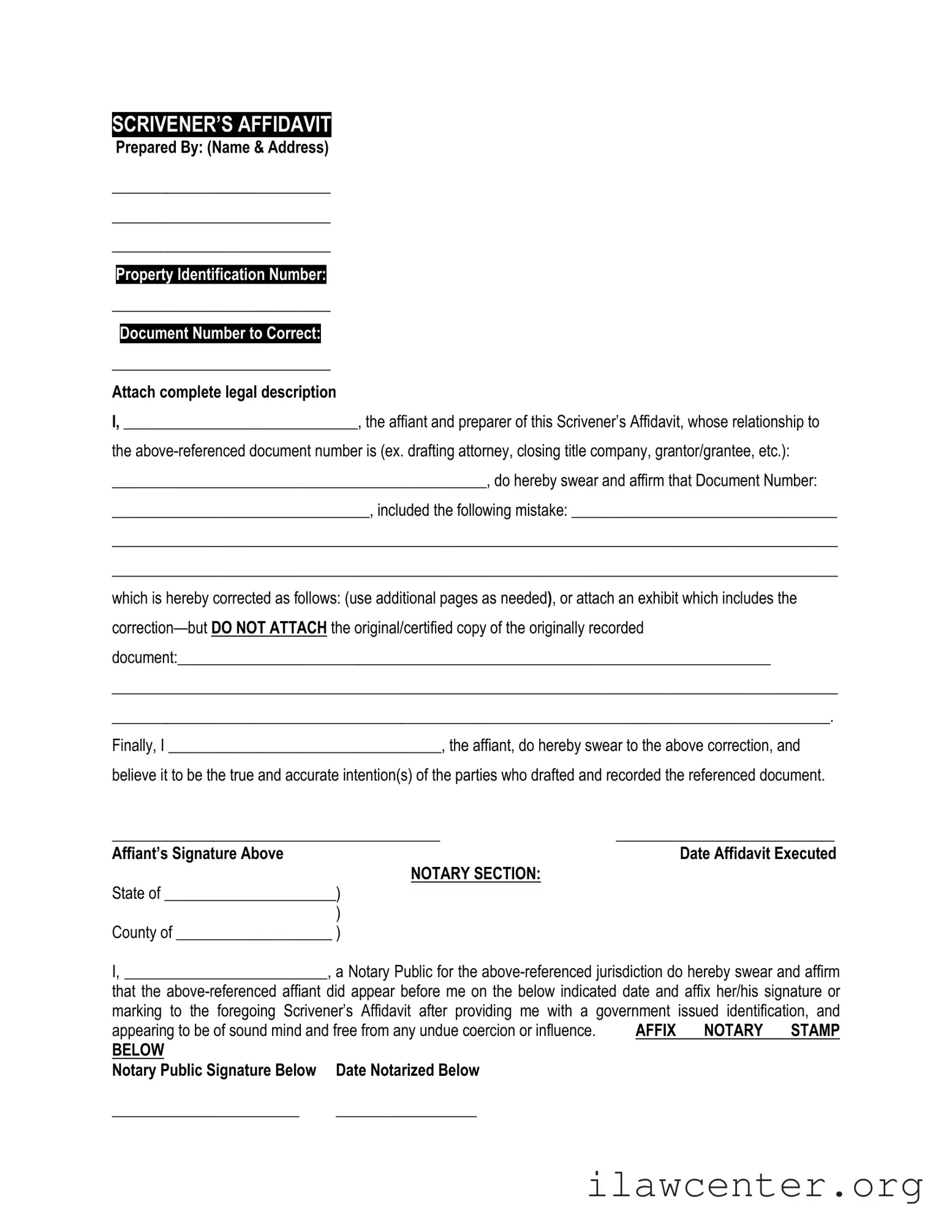
Scrivener's Affidavit Preview

SCRIVENER’S AFFIDAVIT
Prepared By: (Name & Address)
____________________________
____________________________
____________________________
Property Identification Number:
____________________________
Document Number to Correct:
____________________________
Attach complete legal description
I, ______________________________, the affiant and preparer of this Scrivener’s Affidavit, whose relationship to
the above-referenced document number is (ex. drafting attorney, closing title company, grantor/grantee, etc.):
________________________________________________, do hereby swear and affirm that Document Number:
_________________________________, included the following mistake: __________________________________
_____________________________________________________________________________________________
_____________________________________________________________________________________________
which is hereby corrected as follows: (use additional pages as needed), or attach an exhibit which includes the
correctionbut DO NOT ATTACH the original/certified copy of the originally recorded
document:____________________________________________________________________________
_____________________________________________________________________________________________
____________________________________________________________________________________________.
Finally, I ___________________________________, the affiant, do hereby swear to the above correction, and
believe it to be the true and accurate intention(s) of the parties who drafted and recorded the referenced document.
__________________________________________ ____________________________
Affiant’s Signature Above Date Affidavit Executed
NOTARY SECTION:
State of ______________________)
)
County of ____________________ )
I, __________________________
, a Notary Public for the above-referenced jurisdiction do hereby swear and affirm
that the above-referenced affiant did appear before me on the below indicated date and affix her/his signature or
marking to the foregoing Scrivener’s Affidavit after providing me with a government issued identification, and
appearing to be of sound mind and free from any undue coercion or influence. AFFIX NOTARY STAMP
BELOW
Notary Public Signature Below Date Notarized Below
________________________ __________________

File Properties

Fact Name Description
Definition A Scrivener's Affidavit is a legal document used to correct or clarify errors in a recorded document, such as a deed or mortgage.
Purpose This form is typically used to confirm that the original document reflects the true intent of the parties involved.
Governing Law In many states, including California, the governing law for Scrivener's Affidavits falls under the California Civil Code Section 1180.
Filing Requirements Most jurisdictions require the Scrivener's Affidavit to be notarized and filed with the appropriate county recorder's office.
Impact on Title Filing this affidavit can help clear up title issues that may arise from discrepancies in recorded documents.

Instructions on Utilizing Scrivener's Affidavit

Once you have the Scrivener's Affidavit form in front of you, it’s important to fill it out accurately to ensure that your legal needs are met. This form typically serves as a declaration made under oath, and it will require specific information to be provided. Follow these steps carefully to complete the form correctly.

  1. Read the Form: Begin by reviewing the entire form to understand what information is required.
  2. Provide Your Name: In the designated area, write your full legal name as it appears on your identification.
  3. Include Your Address: Fill in your current residential address, ensuring it is complete and accurate.
  4. State the Date: Enter the date when you are completing the affidavit.
  5. Describe the Matter: In the section provided, clearly explain the matter or issue that the affidavit pertains to. Be concise but thorough.
  6. Sign the Affidavit: Once you have filled out the necessary information, sign the form where indicated. Your signature must be in ink.
  7. Notarization: Take the form to a notary public. They will witness your signature and affix their seal, confirming that you signed the document in their presence.
  8. Make Copies: After notarization, make copies of the signed affidavit for your records and for any parties that may require it.

Important Facts about Scrivener's Affidavit

What is a Scrivener's Affidavit?

A Scrivener's Affidavit is a legal document used to correct or clarify a mistake in a written instrument, such as a deed or contract. It is typically prepared by a scrivener, or a person who writes or drafts documents, to affirm that the original document does not accurately reflect the intentions of the parties involved. This affidavit serves to provide clarity and ensure that the true intent is recorded officially.

When should I use a Scrivener's Affidavit?

You should consider using a Scrivener's Affidavit when you discover an error in a legal document that needs correction. Common scenarios include typographical errors, incorrect names, or misstatements of facts. If these mistakes could affect the rights or obligations of the parties, an affidavit can help rectify the situation without needing to create an entirely new document.

Who can prepare a Scrivener's Affidavit?

What information should be included in a Scrivener's Affidavit?

A Scrivener's Affidavit should include the following information: a clear statement of the error, the original document's details (such as date and parties involved), and a description of the intended correction. Additionally, the affiant must provide their signature and, if applicable, notarization to validate the document.

Is a Scrivener's Affidavit legally binding?

Do I need to file a Scrivener's Affidavit with the court?

Can a Scrivener's Affidavit be used for any type of document?

What happens if the original error is not corrected?

Can I contest a Scrivener's Affidavit?

Common mistakes

Filling out the Scrivener's Affidavit form can be a straightforward process, but many people make common mistakes that can lead to delays or complications. One frequent error is failing to provide accurate personal information. It’s crucial to double-check your name, address, and contact details. Any discrepancies can cause significant issues down the line.

Another mistake often made is not signing the affidavit in the correct place. Some individuals overlook this step or forget to sign altogether. Remember, your signature validates the document. Without it, the affidavit may not be accepted.

People also sometimes neglect to date the affidavit. This date is important as it establishes when the affidavit was executed. An undated affidavit may raise questions about its validity, leading to unnecessary complications.

In addition, many individuals fail to provide all required supporting documents. The Scrivener's Affidavit may require attachments or additional paperwork to substantiate the claims made. Omitting these documents can result in rejection or requests for further information.

Another common issue is the use of vague or unclear language. The affidavit should be straightforward and precise. Ambiguities can lead to misunderstandings and may even invalidate the document.

People often forget to review the entire form before submission. This oversight can result in minor errors that may seem insignificant but can have serious implications. Taking the time to carefully review your submission can save you from future headaches.

Lastly, some individuals fail to keep a copy of the completed affidavit for their records. It’s essential to retain a copy for future reference. This can be invaluable if any questions arise about the affidavit later on.

Documents used along the form

The Scrivener's Affidavit is a document that serves to clarify and correct errors in other legal documents. It is often used in conjunction with various other forms and documents to ensure that the intended meaning and accuracy of legal instruments are preserved. Below is a list of other commonly associated documents that may be utilized alongside the Scrivener's Affidavit.

  • Deed: A legal document that conveys property ownership from one party to another. It typically includes a description of the property and the parties involved.
  • Will: A legal document that outlines how a person's assets and affairs should be handled after their death. It may require clarification through a Scrivener's Affidavit if there are discrepancies.
  • Power of Attorney: This document grants one person the authority to act on behalf of another in legal or financial matters. Errors in the document may necessitate a Scrivener's Affidavit for correction.
  • Trust Agreement: A legal arrangement where one party holds property for the benefit of another. Any mistakes in the trust terms can be addressed with a Scrivener's Affidavit.
  • Contract: A legally binding agreement between two or more parties. If there are errors in the contract language, a Scrivener's Affidavit may help clarify the parties' intentions.
  • Mortgage Document: This is a legal agreement between a borrower and a lender regarding the loan used to purchase real estate. Errors in the mortgage terms may be corrected with a Scrivener's Affidavit.
  • Affidavit of Identity: A document used to verify an individual's identity. It may be necessary to correct any discrepancies in identity documentation.
  • Certificate of Incorporation: This document establishes a corporation and outlines its basic structure. If there are inaccuracies, a Scrivener's Affidavit can clarify the intended details.

Using these documents in conjunction with the Scrivener's Affidavit can help ensure that all legal instruments reflect the true intentions of the parties involved. This process is crucial for maintaining clarity and preventing future disputes.

Similar forms

The Scrivener's Affidavit is a useful legal document, but it shares similarities with several other forms. Here are seven documents that are comparable:

  • Affidavit of Support: This document is used to confirm that an individual has the financial means to support another person, often in immigration cases. Like the Scrivener's Affidavit, it requires a sworn statement and can support claims made in legal proceedings.
  • Power of Attorney: This form allows one person to act on behalf of another in legal matters. Both documents require clear intent and a signature, affirming the authority granted or the facts stated.
  • Declaration: A declaration is a written statement that is confirmed to be true. Similar to a Scrivener's Affidavit, it is often used to provide evidence in legal situations, although it may not always require notarization.
  • Notarized Statement: This document is a written statement that has been verified by a notary public. Both the notarized statement and the Scrivener's Affidavit provide a level of authenticity and credibility to the information presented.
  • Certificate of Authenticity: This document verifies the legitimacy of an item or document. Like the Scrivener's Affidavit, it serves to confirm facts and can be crucial in legal contexts.
  • Witness Affidavit: This is a sworn statement from a witness about what they observed. Both forms are used to provide testimony in legal cases, supporting the claims made by parties involved.
  • Verification of Facts: This document confirms specific facts or statements are true. Similar to the Scrivener's Affidavit, it often accompanies legal filings to bolster claims made in court.

Dos and Don'ts

When filling out the Scrivener's Affidavit form, it is important to follow certain guidelines to ensure accuracy and compliance. Here are some things you should and shouldn't do:

  • Do read the instructions carefully before starting.
  • Do provide clear and legible information.
  • Do double-check all entries for accuracy.
  • Do sign and date the affidavit where required.
  • Don't leave any required fields blank.
  • Don't use correction fluid or tape on the form.

Following these guidelines will help ensure that your Scrivener's Affidavit is completed correctly and accepted without issues.

Misconceptions

The Scrivener's Affidavit is often misunderstood. Here are nine common misconceptions about this important legal document:

  1. It is only used in real estate transactions. Many believe the Scrivener's Affidavit is exclusive to real estate. In reality, it can be used in various legal contexts, including estate planning and contract disputes.
  2. It must be notarized. While notarization is common, it is not always a requirement. The need for notarization depends on the specific jurisdiction and the context in which the affidavit is used.
  3. Anyone can fill it out. Some think that any individual can complete the form. However, it is typically best prepared by a legal professional who understands the nuances of the law.
  4. It serves as a substitute for a will. This misconception can be dangerous. The Scrivener's Affidavit does not replace a will; it serves a different purpose in clarifying intentions or correcting documents.
  5. It only addresses errors in legal documents. While it is often used to correct mistakes, it can also clarify intentions, provide context, or affirm facts related to a legal matter.
  6. It is a binding legal document. The affidavit is not automatically binding. Its enforceability can depend on the circumstances and how it is presented in court.
  7. It can be used to change the terms of a contract. This is a common misunderstanding. A Scrivener's Affidavit cannot modify a contract; it can only clarify or confirm existing terms.
  8. It is the same as an affidavit of support. These documents serve different purposes. An affidavit of support is specifically related to immigration, while a Scrivener's Affidavit deals with clarifying legal documents.
  9. Once filed, it cannot be amended. This is incorrect. A Scrivener's Affidavit can be amended or replaced if necessary, provided the proper legal procedures are followed.

Understanding these misconceptions can help individuals navigate legal processes more effectively and make informed decisions regarding the use of a Scrivener's Affidavit.

Key takeaways

When filling out and using the Scrivener's Affidavit form, keep these key takeaways in mind:

  • Accuracy is crucial. Ensure that all information provided is correct and complete. Mistakes can lead to delays or complications.
  • Signature requirements. The affidavit must be signed in the presence of a notary public to be considered valid.
  • Purpose of the affidavit. Understand that this form serves to affirm the truthfulness of the statements made, often in legal or official contexts.
  • Keep copies. Always retain a copy of the completed affidavit for your records, as it may be needed for future reference.