Security Deposit Deductions PDF Template

Security Deposit Deductions PDF Template

The Security Deposit Deductions form is a document used by landlords to outline the deductions made from a tenant's security deposit. It provides a clear summary of charges related to repairs, cleaning, and other expenses incurred during the tenancy. Ensure you fill out the form accurately to facilitate a smooth refund process by clicking the button below.

Article Guide

When moving out of a rental property, understanding the Security Deposit Deductions form is essential for both tenants and landlords. This form serves as a crucial document that outlines how a tenant's security deposit will be handled after they vacate the premises. It includes important details such as the tenant's name and address, the dates the tenancy began and keys were returned, and a breakdown of all deposits paid. One of the key features of the form is the itemized statement of deductions, which lists various costs that may be deducted from the security deposit, such as repairs, cleaning, and unpaid rent. If the total deductions do not exceed $125, tenants are not required to provide supporting documents for repairs or cleaning. Furthermore, the form specifies the amount of the refund check that will be issued to the tenant and provides instructions on how to make the check payable. It also includes a legal notice regarding the potential impact on credit history if obligations are not met. Understanding these elements can help ensure a smoother transition and clarify expectations for both parties involved.

Security Deposit Deductions Preview

UNAUTHORIZED USE PROHIBITED
For Members Only
Approved Form #22.0
Rev. 05-2011
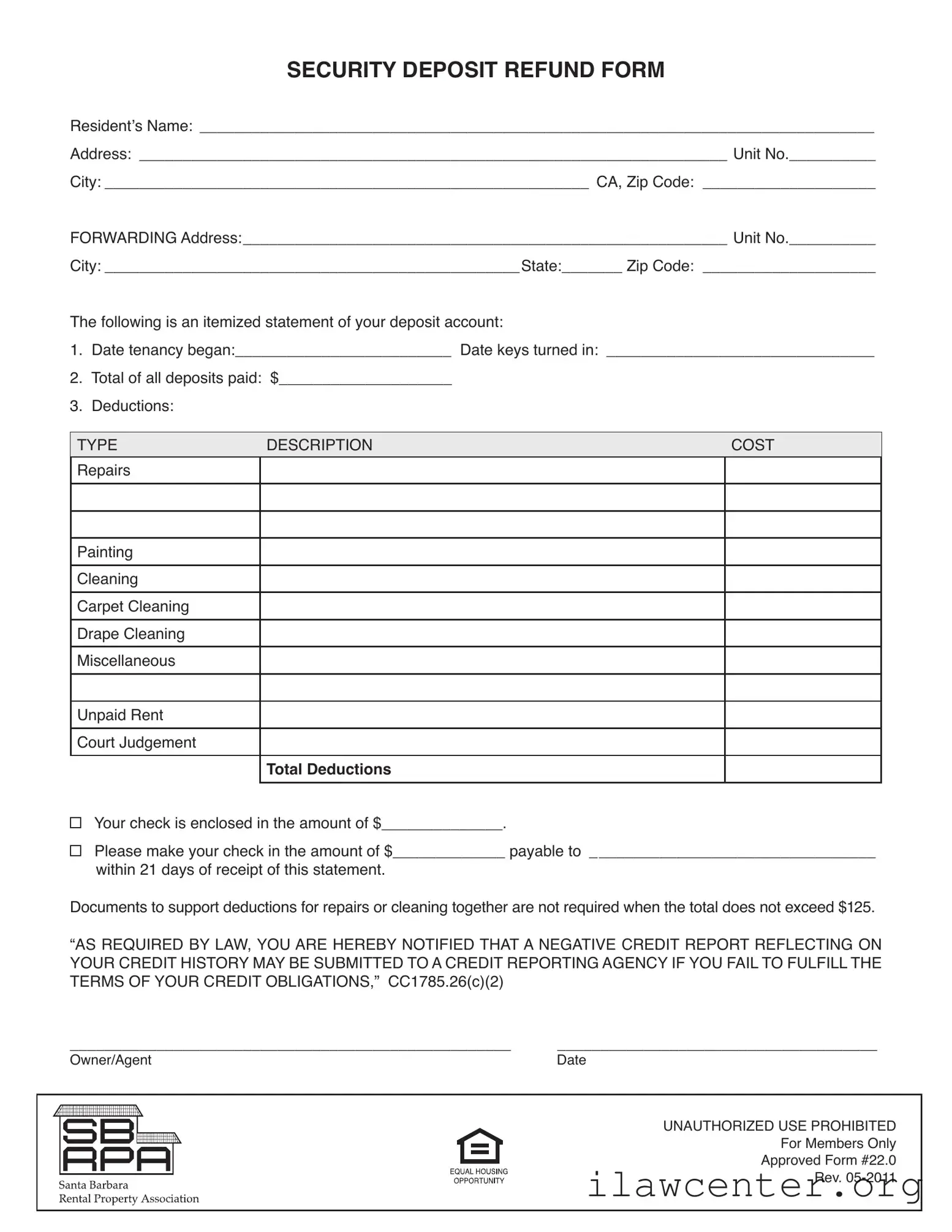
SECURITY DEPOSIT REFUND FORM
Resident’s Name: ______________________________________________________________________________
Address: ____________________________________________________________________ Unit No.__________
City: ________________________________________________________ CA, Zip Code: ____________________
FORWARDING Address: ________________________________________________________ Unit No.__________
City: ________________________________________________State:_______ Zip Code: ____________________
The following is an itemized statement of your deposit account:
1. Date tenancy began:_________________________ Date keys turned in: _______________________________
2. Total of all deposits paid: $____________________
3. Deductions:
TYPE DESCRIPTION COST
Repairs
Painting
Cleaning
Carpet Cleaning
Drape Cleaning
Miscellaneous
Unpaid Rent
Court Judgement
Total Deductions
Your check is enclosed in the amount of $______________.
Please make your check in the amount of $_____________ payable to _________________________________
within 21 days of receipt of this statement.
Documents to support deductions for repairs or cleaning together are not required when the total does not exceed $125.
“AS REQUIRED BY LAW, YOU ARE HEREBY NOTIFIED THAT A NEGATIVE CREDIT REPORT REFLECTING ON
YOUR CREDIT HISTORY MAY BE SUBMITTED TO A CREDIT REPORTING AGENCY IF YOU FAIL TO FULFILL THE
TERMS OF YOUR CREDIT OBLIGATIONS,” CC1785.26(c)(2)
___________________________________________________ _____________________________________
Owner/Agent Date

File Properties

Fact Name Details
Purpose of the Form This form is used by landlords to provide tenants with an itemized statement of security deposit deductions after the end of a tenancy.
Tenant Information It requires the resident’s name, address, and forwarding address to ensure accurate communication regarding the security deposit refund.
Itemized Deductions The form includes a section for detailing various types of deductions, such as repairs, cleaning, and unpaid rent, ensuring transparency in the process.
California Governing Law In California, the handling of security deposits is governed by California Civil Code Section 1950.5, which outlines the rights and responsibilities of both landlords and tenants.
Documentation Requirements Landlords are not required to provide supporting documents for deductions under $125, simplifying the process for minor repairs or cleaning.
Refund Timeline Landlords must issue the refund check within 21 days of providing this statement to the tenant, ensuring timely reimbursement.
Credit Reporting Notification The form includes a legal notice regarding the potential for negative credit reporting if tenants fail to meet their financial obligations, highlighting the importance of compliance.

Instructions on Utilizing Security Deposit Deductions

Completing the Security Deposit Deductions form is essential for ensuring that your security deposit is processed correctly. After filling out the form, you will submit it to the appropriate party for review. Make sure to double-check all entries for accuracy to avoid any delays in receiving your refund.

  1. Begin by entering your Resident’s Name in the designated space.
  2. Fill in your Address, including the unit number, city, state, and zip code.
  3. Provide your Forwarding Address, including the unit number, city, state, and zip code.
  4. Record the Date tenancy began and the Date keys turned in.
  5. Indicate the Total of all deposits paid in the specified field.
  6. List any Deductions in the appropriate sections. Include the type, description, and cost for each deduction. Types may include repairs, painting, cleaning, and unpaid rent.
  7. Calculate the TOTAL DEDUCTIONS and enter the amount.
  8. Enter the amount of your enclosed check in the space provided.
  9. Make the check payable to the specified name.
  10. Sign and date the form at the bottom.

Important Facts about Security Deposit Deductions

What is the purpose of the Security Deposit Deductions form?

The Security Deposit Deductions form is designed to provide tenants with a clear breakdown of any deductions made from their security deposit upon the termination of their lease. It outlines the amounts withheld for repairs, cleaning, and other costs, ensuring transparency in the refund process.

How do I fill out the Security Deposit Deductions form?

To complete the form, start by entering your name, address, and unit number. Next, provide the dates your tenancy began and when you returned the keys. Then, list the total amount of your security deposit and detail any deductions. This includes specifying the type of deduction, a brief description, and the associated cost. Finally, ensure that the form is signed and dated by the owner or agent.

What types of deductions can be made from my security deposit?

Deductions may include costs for repairs, painting, cleaning, carpet cleaning, drape cleaning, unpaid rent, and court judgments. Each type of deduction should be clearly described on the form, with the corresponding cost listed next to it.

Is there a limit on the amount of deductions that require supporting documents?

Yes, if the total deductions do not exceed $125, supporting documents for repairs or cleaning are not required. This helps streamline the process for minor deductions, making it easier for both tenants and property owners.

How long does the landlord have to return my security deposit?

Landlords are required to return your security deposit, along with an itemized statement of deductions, within 21 days of receiving the completed Security Deposit Deductions form. This timeframe ensures that tenants receive their funds promptly after moving out.

What should I do if I believe the deductions are unfair?

If you feel that the deductions listed on the form are unjustified, you have the right to dispute them. Start by discussing your concerns with your landlord. If the issue remains unresolved, you may consider seeking mediation or legal advice to explore your options further.

What happens if I do not receive my security deposit back?

If you do not receive your security deposit or an itemized statement of deductions within the required timeframe, you should contact your landlord to inquire about the delay. If necessary, you may need to escalate the matter by filing a complaint with your local housing authority or pursuing legal action.

Will a negative credit report affect my credit history?

Yes, as noted in the form, if you fail to fulfill the terms related to your security deposit obligations, a negative credit report may be submitted to a credit reporting agency. This can impact your credit score and future rental opportunities, so it’s essential to address any issues promptly.

Who should I contact if I have questions about the Security Deposit Deductions form?

If you have questions regarding the form or the deductions, it’s best to reach out directly to your landlord or property management company. They can provide clarification and assist you in understanding the details of your security deposit account.
Common mistakes

Filling out the Security Deposit Deductions form can be a straightforward process, but many people make common mistakes that can lead to delays or issues with their refunds. One frequent error is incomplete information. Residents often forget to fill in crucial details such as their name, address, or unit number. Omitting this information can result in the form being processed incorrectly or not at all.

Another common mistake is failing to provide an accurate total for all deposits paid. This figure is essential for calculating the refund amount. If residents do not double-check this number, they risk receiving less than they are entitled to. Similarly, when listing deductions, some individuals do not provide a clear description of each item. Vague descriptions can lead to confusion and disputes over what the deductions were for.

Additionally, residents sometimes overlook the requirement to include supporting documents for repairs or cleaning. While the form states that documents are not needed if the total does not exceed $125, many still forget to attach any necessary paperwork when their deductions exceed this amount. This can delay the processing of their refund.

Another mistake is miscalculating the total deductions. Residents may add up their deductions incorrectly, which can lead to an inaccurate refund amount. It's crucial to carefully review the math before submitting the form. Furthermore, some people neglect to sign and date the form. An unsigned form may be deemed invalid, causing further complications.

Lastly, failing to provide a valid forwarding address can create issues for receiving the refund check. Residents should ensure that the address listed is accurate and current. If the check is sent to the wrong address, it could be lost or delayed, leaving the resident without their funds for an extended period.

Documents used along the form

The Security Deposit Deductions form is an important document for both landlords and tenants. It outlines the deductions made from a tenant's security deposit and provides a clear statement of charges. Several other forms and documents are often used in conjunction with this form to ensure transparency and compliance with housing regulations. Here is a list of those documents:

  • Lease Agreement: This document outlines the terms of the rental arrangement, including rent amount, duration, and responsibilities of both the landlord and tenant.
  • Move-In Inspection Checklist: A record of the condition of the rental unit at the start of the tenancy. It helps to document any existing damages or issues.
  • Move-Out Inspection Checklist: Similar to the move-in checklist, this document records the condition of the unit when the tenant vacates. It is used to assess damages and determine deductions.
  • Repair Receipts: These are documents that provide proof of any repairs made to the rental unit. They support the deductions claimed for damages.
  • Cleaning Receipts: Receipts from professional cleaning services can justify charges for cleaning the unit after a tenant moves out.
  • Notice to Vacate: A formal notification from the tenant to the landlord indicating their intention to leave the rental property. This document often includes the intended move-out date.
  • Security Deposit Agreement: This document outlines the terms regarding the security deposit, including how it can be used and the conditions for its return.
  • Final Rent Statement: A summary of the tenant’s rental payments, including any outstanding balances that may affect the security deposit return.

Using these forms and documents together can help both landlords and tenants navigate the security deposit process more effectively. They provide clarity and support for any deductions made, ensuring that both parties are aware of their rights and responsibilities.

Similar forms

The Security Deposit Deductions form shares similarities with several other documents commonly used in rental agreements and tenant-landlord interactions. Each of these documents serves a specific purpose in managing the financial aspects of a rental agreement. Below are six documents that are similar to the Security Deposit Deductions form:

  • Lease Agreement: This document outlines the terms and conditions of the rental arrangement. It includes details about the security deposit, payment terms, and the responsibilities of both the tenant and landlord. Like the Security Deposit Deductions form, it is essential for establishing financial expectations.
  • Move-In Inspection Checklist: This checklist documents the condition of the rental unit at the beginning of the tenancy. It helps both parties understand any pre-existing damages. Similar to the deductions form, it plays a critical role in determining what may be deducted from the security deposit upon move-out.
  • Move-Out Inspection Report: Conducted at the end of the lease, this report assesses the condition of the unit before the tenant vacates. It provides a basis for any deductions from the security deposit, paralleling the itemized deductions outlined in the Security Deposit Deductions form.
  • Notice of Non-Renewal: This document informs the tenant that the lease will not be renewed. It often includes details about the return of the security deposit and any potential deductions, similar to the transparency provided in the deductions form.
  • Tenant Ledger: A record of all financial transactions between the landlord and tenant, including rent payments and any charges. This ledger can support the deductions made on the Security Deposit Deductions form, ensuring clarity on what has been paid and owed.
  • Final Account Statement: This statement summarizes the financial transactions at the end of the lease. It outlines the total deposits, deductions, and the final amount returned to the tenant. Like the Security Deposit Deductions form, it aims to provide a clear financial summary for both parties.

Dos and Don'ts

When filling out the Security Deposit Deductions form, follow these guidelines to ensure accuracy and compliance.

  • Do provide your full name and current address clearly.
  • Do list the exact dates for when your tenancy began and when you returned the keys.
  • Do itemize all deductions clearly, including descriptions and costs.
  • Do keep a copy of the completed form for your records.
  • Don't leave any sections blank; fill out all required fields.
  • Don't forget to sign and date the form before submission.

Misconceptions

Understanding the Security Deposit Deductions form can be tricky. Here are some common misconceptions that many people have:

  • All deductions require receipts. Many believe that every deduction must have supporting documents. However, if the total deductions are less than $125, receipts are not needed.
  • Landlords can keep the entire deposit. Some think landlords can keep all of the security deposit. In reality, landlords must return any unused portion after legitimate deductions.
  • Only major damages can be deducted. Many assume that only significant damages can lead to deductions. However, normal wear and tear is not a valid reason for deductions, but minor issues like cleaning can be.
  • Tenants have no say in deductions. Some believe they cannot dispute deductions. Tenants have the right to question any deductions they think are unfair.
  • Security deposits are always fully refundable. While many expect to get their full deposit back, deductions can occur for damages or unpaid rent.
  • The landlord must provide a detailed breakdown of all deductions. It is a misconception that landlords must itemize every single deduction. They only need to provide a general statement of deductions.
  • Refund checks are issued immediately. Some think landlords must send the refund right away. In fact, landlords have up to 21 days to send the refund after the tenant vacates.
  • All tenants receive the same treatment. Many believe that all tenants are treated equally regarding deductions. Each case can vary based on the condition of the unit and the lease agreement.
  • Legal action is the only way to resolve disputes. Some think they must go to court to resolve security deposit issues. In many cases, communication with the landlord can lead to a resolution without legal action.

By understanding these misconceptions, tenants can navigate the security deposit process more effectively. It’s important to know your rights and responsibilities when it comes to security deposits.

Key takeaways

When filling out and using the Security Deposit Deductions form, there are several important points to keep in mind.

  • Complete Information: Ensure that all sections of the form are filled out accurately. This includes your name, address, and the dates related to your tenancy.
  • Itemized Deductions: Clearly list all deductions with corresponding descriptions and costs. This transparency helps in understanding how your deposit was utilized.
  • Documentation Requirements: Keep in mind that if the total deductions do not exceed $125, supporting documents for repairs or cleaning are not required. This can simplify the process for smaller amounts.
  • Timely Payment: The landlord or agent must send your refund check within 21 days of providing the statement. Make sure to follow up if you do not receive it within that timeframe.

Understanding these key takeaways can help you navigate the process more smoothly and ensure that your rights are protected.