Self Employment Ledger PDF Template

Self Employment Ledger PDF Template

The Self Employment Ledger form is a document used by the Iowa Department of Human Services to track income and expenses for individuals who are self-employed. This form helps ensure that all financial information is organized and available when requested by the DHS. For assistance in filling out the form, please click the button below.

Article Guide

The Self Employment Ledger form is an essential tool for individuals managing their self-employment income and expenses, particularly when interacting with the Iowa Department of Human Services. This form serves as a record-keeping mechanism, ensuring that all financial activities related to self-employment are documented clearly and accurately. Key components of the ledger include the case name, Social Security Number (SSN), worker information, and case number, all of which help to identify the individual and their specific case. Each month, users are required to fill out the form with detailed entries for both income and expenses, allowing for comprehensive tracking of financial performance. Additionally, it is important to note that information must be submitted upon request from the Department of Human Services, reinforcing the need for diligent record-keeping. The form, identified by its unique code 470-3784, is structured to facilitate easy updates and reviews, making it a vital resource for self-employed individuals seeking assistance or benefits.

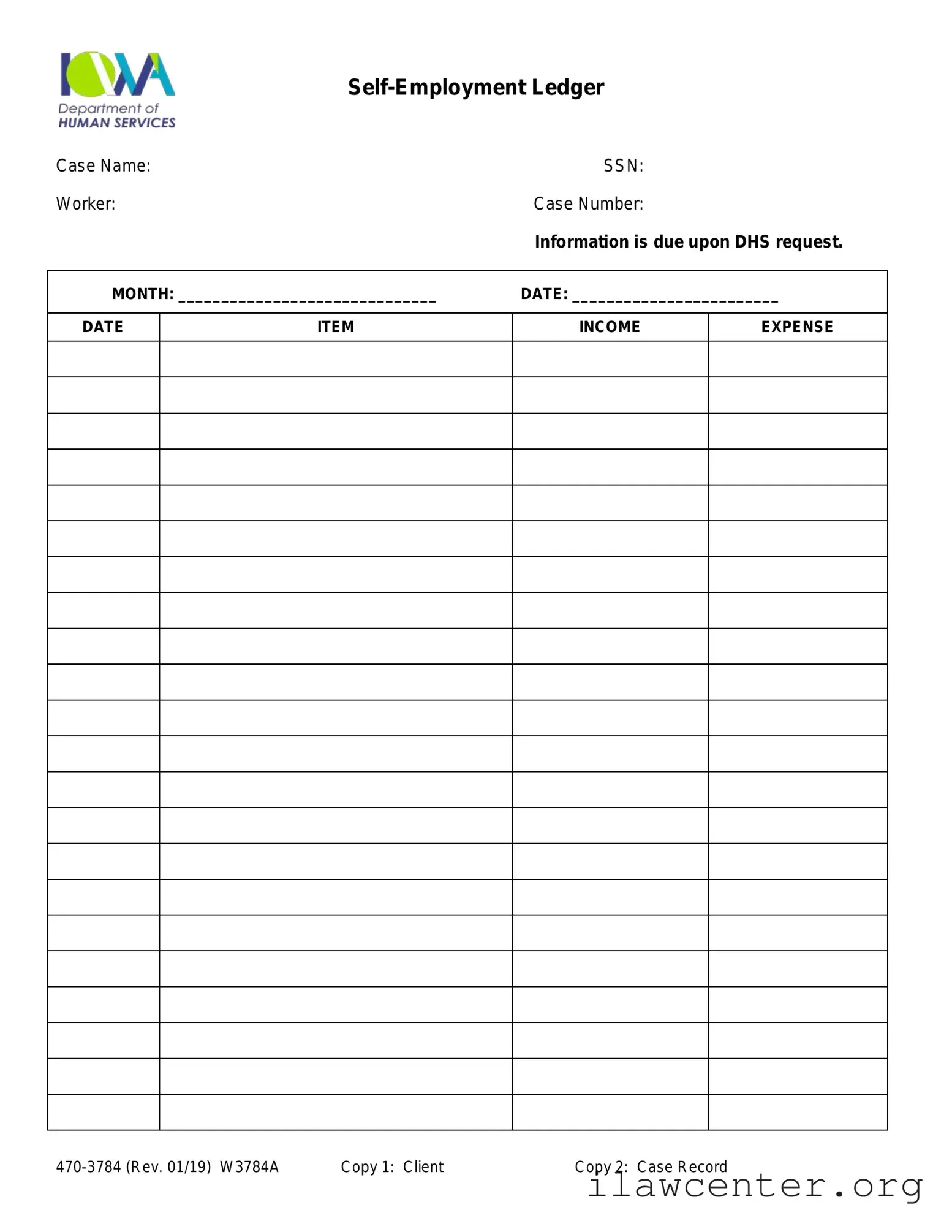
Self Employment Ledger Preview

470-3784 (Rev. 01/19) W3784A Copy 1: Client Copy 2: Case Record
Self-Employment Ledger
Case Name: SSN:
Worker: Case Number:
Information is due upon DHS request.
MONTH: ______________________________ DATE: ________________________
DATE ITEM INCOME EXPENSE

File Properties

Fact Name Description
Purpose The Self-Employment Ledger form is used to track income and expenses for individuals who are self-employed, ensuring accurate reporting to the Iowa Department of Human Services.
Governing Law This form is governed by Iowa state laws and regulations pertaining to self-employment and public assistance programs.
Required Information Individuals must provide their case name, Social Security Number (SSN), worker information, and case number on the form.
Monthly Reporting The form requires monthly reporting of income and expenses, with specific dates to be filled out by the user.
Submission Information must be submitted upon request by the Iowa Department of Human Services, ensuring compliance with program requirements.
Form Revision The current version of the form is 470-3784, revised in March 2012, reflecting updates in state requirements.

Instructions on Utilizing Self Employment Ledger

Filling out the Self Employment Ledger form is an important step in documenting your income and expenses as a self-employed individual. Once you complete this form, you will have a clear record that can assist you in various aspects of your financial reporting and obligations.

  1. Begin by writing your Case Name at the top of the form.
  2. Next, enter your Social Security Number (SSN).
  3. Fill in the name of the Worker assigned to your case.
  4. Provide your Case Number in the designated space.
  5. Indicate the MONTH for which you are reporting income and expenses.
  6. Write the DATE you are filling out the form.
  7. In the INCOME section, list all sources of income you received during the month.
  8. In the EXPENSE section, detail all expenses incurred during the same month.
  9. Double-check all entries for accuracy before submitting the form.

Once you have completed the form, keep a copy for your records and submit it as required by the Iowa Department of Human Services.

Important Facts about Self Employment Ledger

What is the purpose of the Self Employment Ledger form?

The Self Employment Ledger form is used to document income and expenses related to self-employment. It helps the Iowa Department of Human Services (DHS) track financial information necessary for determining eligibility for various assistance programs.

Who needs to fill out the Self Employment Ledger form?

This form is required for individuals who are self-employed and receiving assistance from DHS. If you have a business or freelance work that generates income, you will need to complete this ledger to report your financial activities.

What information is required on the form?

The form requires basic information such as your case name, Social Security Number (SSN), worker name, and case number. Additionally, you will need to fill in details about your income and expenses for each month, including specific dates and amounts.

How often should I submit the Self Employment Ledger form?

You must submit the Self Employment Ledger form upon request from DHS. It is important to keep your records updated and accurate, as this information is essential for ongoing eligibility assessments.

Where can I obtain the Self Employment Ledger form?

The Self Employment Ledger form can be obtained from the Iowa Department of Human Services website or through your case worker. Ensure you have the most recent version of the form to avoid any issues.

What should I do if I have questions while filling out the form?

If you have questions while completing the Self Employment Ledger form, reach out to your case worker for assistance. They can provide guidance and clarify any uncertainties regarding the information needed.

What happens if I do not submit the Self Employment Ledger form?

Failure to submit the Self Employment Ledger form when requested may affect your eligibility for assistance programs. It is crucial to comply with DHS requests to ensure continued support.

Common mistakes

Filling out the Self Employment Ledger form can be straightforward, but many people make common mistakes that can lead to issues later on. One frequent error is not including the case name. This information is essential for identifying the correct file and ensuring that the form is processed accurately.

Another mistake is failing to provide the Social Security Number (SSN). Omitting this number can delay processing and create complications in verifying identity. Always double-check that the SSN is entered correctly to avoid these issues.

Many individuals also overlook the worker's name and case number. These details help the Department of Human Services (DHS) track the case effectively. If these sections are left blank, it can result in unnecessary delays.

When it comes to the income and expense sections, people often forget to include all sources of income. This can lead to an inaccurate representation of financial status. Similarly, failing to document all expenses can skew the results and affect eligibility for assistance.

Some individuals do not update the month and date fields correctly. Providing outdated information can lead to confusion and may require resubmission of the form. Always ensure that the dates reflect the current reporting period.

Another common error is not signing or dating the form. A signature confirms that the information provided is accurate and complete. Without it, the form may be considered invalid.

People sometimes neglect to keep a copy of the completed form for their records. This can create problems if there are questions or discrepancies later. Retaining a copy ensures that individuals have a reference point for future communications.

Finally, individuals may not respond promptly to any requests for additional information from DHS. Timely communication is crucial to avoid interruptions in services. Always be prepared to provide any necessary documentation when requested.

Documents used along the form

The Self Employment Ledger form is an important document for individuals who are self-employed and need to track their income and expenses for reporting purposes. Along with this form, there are several other documents that may be necessary to support self-employment claims or applications. Below is a list of these commonly used forms and documents.

  • Profit and Loss Statement: This document summarizes the income and expenses of a business over a specific period. It provides a clear picture of profitability and is often required for tax purposes.
  • Tax Returns: Personal and business tax returns are essential for verifying income. They provide a comprehensive overview of earnings and deductions, which can help in assessing financial stability.
  • Business License: A business license is proof that an individual is legally allowed to operate a business in their locality. It may be requested to validate the legitimacy of the self-employment.
  • Invoices: Invoices document sales transactions between a business and its clients. They serve as evidence of income received and can be used to support claims of earnings.
  • Bank Statements: These statements show the financial activity of a business's bank account. They can help verify income and expenses reported on the Self Employment Ledger.
  • Receipts: Receipts provide proof of purchases and expenses incurred in the course of business operations. They are crucial for accurate expense reporting.
  • Client Contracts: Contracts with clients outline the terms of service and payment. They can be used to demonstrate ongoing business relationships and expected income.

These documents collectively support the information provided on the Self Employment Ledger form. Keeping them organized and accessible can simplify the process of reporting income and expenses, ensuring compliance with relevant regulations.

Similar forms

The Self Employment Ledger form is a crucial document for individuals reporting their income and expenses related to self-employment. Several other documents serve similar purposes in tracking income, expenses, and financial reporting. Here are eight documents that share similarities with the Self Employment Ledger:

  • Profit and Loss Statement: This document summarizes revenues, costs, and expenses over a specific period, helping self-employed individuals understand their financial performance.
  • Schedule C (Form 1040): Used by sole proprietors to report income and expenses from their business on their personal tax return, it provides a detailed breakdown similar to the ledger.
  • Income Statement: Often prepared for businesses, this statement outlines revenues and expenses, showing net profit or loss, much like the Self Employment Ledger.
  • Expense Report: This document records business-related expenses incurred over a specific time, which aligns with the expense tracking aspect of the Self Employment Ledger.
  • Cash Flow Statement: This statement provides an overview of cash inflows and outflows, similar to the income tracking in the Self Employment Ledger.
  • Bank Statements: These documents can be used to track income and expenses, offering a financial snapshot that complements the Self Employment Ledger.
  • Business Activity Report: This report details the operations of a business over a given period, including income and expenses, akin to the Self Employment Ledger.
  • Quarterly Tax Estimate Worksheet: This document helps self-employed individuals estimate their tax obligations based on their income and expenses, similar to the reporting function of the Self Employment Ledger.

Dos and Don'ts

When filling out the Self Employment Ledger form, it is essential to approach the task with care and attention to detail. Here are four important do's and don'ts to consider:

  • Do ensure that all sections of the form are completed accurately.
  • Do keep a copy of the filled-out form for your records.
  • Don't leave any fields blank; incomplete forms may delay processing.
  • Don't use abbreviations or unclear language that could lead to misunderstandings.

Misconceptions

Misconceptions about the Self Employment Ledger form can lead to confusion for individuals navigating self-employment reporting. Here are nine common misconceptions:

  1. The Self Employment Ledger is only for business owners. Many believe that only those who run their own businesses need to use this form. In reality, anyone earning income through self-employment, including freelancers and independent contractors, should complete it.
  2. It's optional to submit the Self Employment Ledger. Some think that they can choose whether or not to submit this form. However, it is required when the Department of Human Services requests it for income verification.
  3. All income must be reported on a monthly basis. A misconception exists that income should be reported monthly, regardless of the frequency of actual earnings. In fact, individuals should report income based on the time period in which it was earned.
  4. Expenses do not need to be documented. Some individuals assume that they can simply report income without providing evidence of expenses. However, accurate reporting of expenses is crucial for determining net income.
  5. The form is the same for every state. Many people think that the Self Employment Ledger is a standard form used nationwide. In truth, each state may have its own version or specific requirements, so it’s important to refer to the local guidelines.
  6. Once submitted, the information cannot be changed. There is a belief that any errors made on the form are permanent. In reality, individuals can correct mistakes by contacting the appropriate agency and submitting a revised form.
  7. The Self Employment Ledger is only for tax purposes. While some may think this form is solely for tax reporting, it also serves as a tool for social service agencies to assess eligibility for assistance programs.
  8. Only profits need to be reported. Some individuals believe they only need to report their profits, ignoring the importance of reporting both income and expenses. Accurate reporting of both is necessary for a complete financial picture.
  9. Filling out the form is straightforward and doesn’t require any help. Many assume they can easily complete the form without assistance. However, guidance may be beneficial, especially for those unfamiliar with self-employment reporting.

Key takeaways

Filling out the Self Employment Ledger form is an important process for individuals engaged in self-employment. Here are key takeaways to consider:

  • Accurate Information: Ensure that all entries are filled out accurately. This includes your case name, social security number, and case number.
  • Monthly Tracking: The form requires you to track income and expenses on a monthly basis. Consistent updates are essential.
  • Documentation: Keep all relevant documents, such as receipts and invoices, to support the entries made in the ledger.
  • Submission Requirements: Be aware that the information is due upon request from the Department of Human Services (DHS).
  • Income and Expense Categories: Clearly categorize your income and expenses to provide a clear financial picture.
  • Review Regularly: Regularly review your entries to ensure accuracy and to help identify trends in your business finances.
  • Client Copies: Retain a copy of the completed ledger for your records, as well as provide a copy for the case record.