Fillable Single-Member Operating Agreement Document

Fillable Single-Member Operating Agreement Document

A Single-Member Operating Agreement is a legal document that outlines the management structure and operating procedures for a single-member limited liability company (LLC). This agreement is essential for establishing clear guidelines, protecting personal assets, and ensuring compliance with state laws. To get started, fill out the form by clicking the button below.

Article Guide

For individuals looking to establish a single-member limited liability company (LLC), the Single-Member Operating Agreement form serves as a crucial document that outlines the internal workings and management structure of the business. This agreement not only clarifies the owner’s rights and responsibilities but also helps in delineating the separation between personal and business assets, providing essential liability protection. It typically includes key components such as the purpose of the LLC, the ownership structure, and the decision-making processes. Furthermore, it often addresses how profits and losses will be handled, the process for transferring ownership, and the procedures for dissolving the LLC if necessary. By creating this agreement, a single-member LLC owner can ensure that their business operates smoothly and in accordance with their intentions, while also adhering to state regulations. This document is not merely a formality; it is a foundational element that can protect the owner’s interests and enhance the credibility of the business in the eyes of clients, vendors, and potential investors.

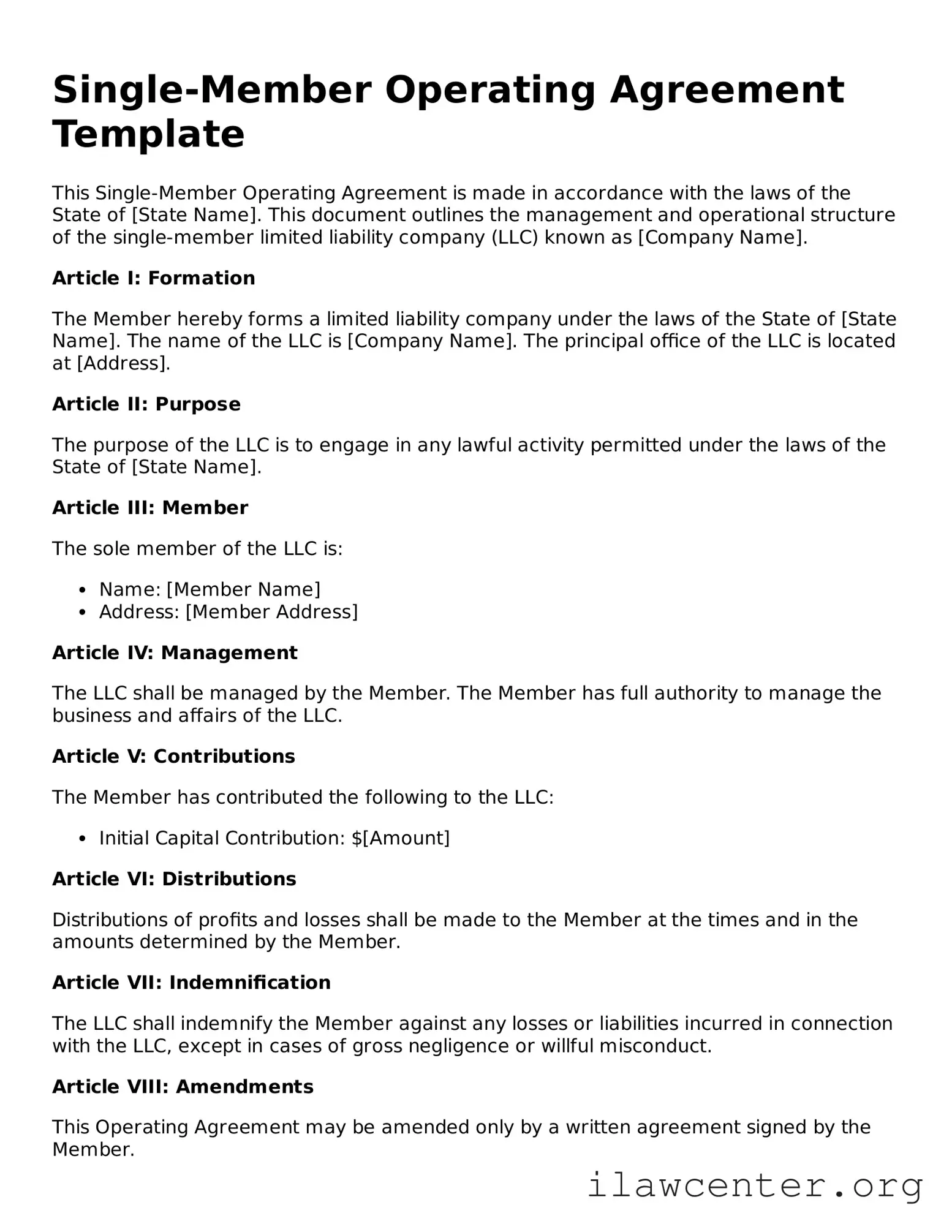
Single-Member Operating Agreement Preview

Single-Member Operating Agreement Template

This Single-Member Operating Agreement is made in accordance with the laws of the State of [State Name]. This document outlines the management and operational structure of the single-member limited liability company (LLC) known as [Company Name].

Article I: Formation

The Member hereby forms a limited liability company under the laws of the State of [State Name]. The name of the LLC is [Company Name]. The principal office of the LLC is located at [Address].

Article II: Purpose

The purpose of the LLC is to engage in any lawful activity permitted under the laws of the State of [State Name].

Article III: Member

The sole member of the LLC is:

  • Name: [Member Name]
  • Address: [Member Address]

Article IV: Management

The LLC shall be managed by the Member. The Member has full authority to manage the business and affairs of the LLC.

Article V: Contributions

The Member has contributed the following to the LLC:

  • Initial Capital Contribution: $[Amount]

Article VI: Distributions

Distributions of profits and losses shall be made to the Member at the times and in the amounts determined by the Member.

Article VII: Indemnification

The LLC shall indemnify the Member against any losses or liabilities incurred in connection with the LLC, except in cases of gross negligence or willful misconduct.

Article VIII: Amendments

This Operating Agreement may be amended only by a written agreement signed by the Member.

Article IX: Governing Law

This Agreement shall be governed by and construed in accordance with the laws of the State of [State Name].

IN WITNESS WHEREOF, the Member has executed this Single-Member Operating Agreement as of the [Date].

______________________________

[Member Name]

PDF Form Characteristics

Fact Name Description
Definition A Single-Member Operating Agreement is a document that outlines the management structure and operational procedures for a single-member limited liability company (LLC).
Purpose This agreement serves to clarify the rights and responsibilities of the sole member, ensuring that the member's intentions are documented and legally recognized.
Governing Law The laws governing Single-Member Operating Agreements vary by state. For example, in California, the relevant statutes are found in the California Corporations Code.
Flexibility The agreement allows the sole member to customize the management structure, including decision-making processes and profit distribution.
Legal Protection Having a formal operating agreement can help protect the member's personal assets from liabilities incurred by the LLC.
Not Mandatory While not required by law in many states, it is highly recommended to have an operating agreement to establish clear guidelines for the business.

Instructions on Utilizing Single-Member Operating Agreement

Completing the Single-Member Operating Agreement form requires careful attention to detail. This document serves as a foundational element for your business structure and outlines important information regarding the management and operation of your single-member LLC.

  1. Begin by entering the name of your LLC at the top of the form. Ensure that the name matches the name registered with your state.
  2. Next, provide the principal business address of your LLC. This should be a physical address, not a P.O. Box.
  3. Indicate the name and address of the sole member. This individual is the owner of the LLC.
  4. Fill in the date of formation of your LLC. This is the date when the LLC was officially registered with the state.
  5. Specify the purpose of the LLC. Clearly outline the business activities that the LLC will engage in.
  6. Include the initial capital contribution made by the sole member. This amount represents the financial investment in the LLC.
  7. State the management structure of the LLC. Indicate that the single member will manage the LLC.
  8. Review the document for accuracy. Ensure that all information is correct and complete.
  9. Sign and date the form. The signature must be from the sole member, confirming the information provided.
  10. Make copies of the completed form for your records and any necessary filings.

Important Facts about Single-Member Operating Agreement

What is a Single-Member Operating Agreement?

A Single-Member Operating Agreement is a legal document that outlines the management structure and operating procedures of a single-member limited liability company (LLC). This agreement serves as a foundational document, detailing the rights and responsibilities of the sole owner, as well as the operational guidelines of the business. While it is not required by law in all states, having one can help clarify the owner’s intentions and protect personal assets from business liabilities.

Why should I create a Single-Member Operating Agreement?

Creating a Single-Member Operating Agreement is beneficial for several reasons. It provides a clear structure for your business operations, which can help avoid misunderstandings in the future. Additionally, it reinforces the separation between your personal and business assets, which is crucial for liability protection. Furthermore, if you ever decide to add members to your LLC, having an operating agreement in place can simplify the transition and integration process.

What key elements should be included in the agreement?

While each Single-Member Operating Agreement can be tailored to fit specific needs, some essential elements should typically be included. These include the name of the LLC, the purpose of the business, the owner's information, management structure, and procedures for handling profits and losses. Additionally, provisions regarding amendments to the agreement and the dissolution process should also be outlined to ensure clarity and guidance for future scenarios.

Is a Single-Member Operating Agreement legally binding?

Yes, a Single-Member Operating Agreement is legally binding, provided it is properly executed according to state laws. Once signed, it serves as a contract between the member and the LLC. This means that both parties are expected to adhere to the terms laid out in the agreement. However, it is important to ensure that the agreement complies with state regulations to maintain its enforceability.

Do I need to file the agreement with the state?

In most cases, you do not need to file your Single-Member Operating Agreement with the state. This document is typically kept on file for your records and may be requested by banks or other financial institutions when opening accounts or applying for loans. However, it is advisable to check your specific state’s requirements, as some jurisdictions may have different regulations regarding the documentation of LLCs.

Can I change my Single-Member Operating Agreement after it is created?

Yes, you can modify your Single-Member Operating Agreement at any time. Life circumstances, business goals, or changes in the law may necessitate updates to the agreement. It is important to document any amendments clearly, noting the date of the changes and ensuring that you sign the revised document. This helps maintain an accurate record of your business’s operational guidelines.

What happens if I do not have a Single-Member Operating Agreement?

Operating without a Single-Member Operating Agreement can lead to potential complications. Without this document, you may face challenges in proving the separation between your personal and business assets, which could expose you to personal liability for business debts. Additionally, the lack of a formal agreement may result in ambiguity regarding business operations, which can lead to disputes or misunderstandings in the future.

Can I use a template for my Single-Member Operating Agreement?

Using a template for your Single-Member Operating Agreement can be a practical starting point. Many templates are available online and can help ensure that you include all necessary elements. However, it is crucial to customize the template to reflect your unique business needs and comply with state laws. Consider consulting with a legal professional to ensure that your agreement is comprehensive and tailored to your specific situation.

How does a Single-Member Operating Agreement affect taxes?

A Single-Member Operating Agreement can have implications for how your business is taxed. By default, a single-member LLC is treated as a disregarded entity for tax purposes, meaning that income and expenses are reported on the owner's personal tax return. However, having an operating agreement can help clarify how profits and losses are handled, which may be beneficial for record-keeping and tax reporting. It is advisable to consult with a tax professional to understand the specific tax implications for your business.

Where can I find assistance in drafting my Single-Member Operating Agreement?

Assistance in drafting a Single-Member Operating Agreement can be found through various sources. Online legal services often provide templates and guidance for creating your agreement. Additionally, local attorneys who specialize in business law can offer personalized assistance to ensure that your agreement meets legal requirements and reflects your business goals. Seeking professional help can provide peace of mind and ensure that your agreement is comprehensive and enforceable.
Common mistakes

When completing the Single-Member Operating Agreement form, individuals often overlook essential details that can lead to complications in the future. One common mistake is failing to provide accurate information about the member. This includes the member's full legal name and address. Omitting or misspelling this information can create issues with identification and legal recognition.

Another frequent error involves neglecting to specify the purpose of the business. The agreement should clearly outline the business's intended activities. Without this clarity, misunderstandings may arise regarding the scope of operations, potentially leading to disputes or regulatory challenges.

People also tend to forget to include provisions for the management structure. Even as a single-member entity, it is crucial to define how decisions will be made and what authority the member has. This lack of detail can lead to confusion and hinder effective management.

Additionally, many individuals fail to address the financial aspects of the business in the agreement. It is important to outline how profits and losses will be handled. Not including this information can result in unexpected tax implications or disagreements down the line.

Another mistake is not considering the process for amending the agreement. Life circumstances can change, and the operating agreement should include a method for making adjustments. This oversight can complicate future changes and create unnecessary obstacles.

Lastly, individuals may neglect to sign and date the agreement properly. A signature is vital for validating the document. Without it, the agreement may not hold up in legal situations, rendering the entire document ineffective.

Documents used along the form

A Single-Member Operating Agreement is an essential document for a single-member limited liability company (LLC). It outlines the management structure and operational guidelines for the business. Along with this agreement, several other forms and documents can be beneficial for establishing and maintaining your LLC. Here are some commonly used documents:

  • Articles of Organization: This is the official document filed with the state to create your LLC. It includes basic information such as the company name, address, and the name of the registered agent.
  • Employer Identification Number (EIN): An EIN is a unique number assigned by the IRS for tax purposes. It’s essential for opening a business bank account and filing taxes.
  • Initial Resolution: This document records the initial decisions made by the owner, such as opening a bank account or designating a registered agent. It serves as a formal record of the owner's intentions.
  • Membership Certificate: Although not always required, this certificate can be issued to document ownership of the LLC. It can help clarify ownership stakes and facilitate transfers in the future.
  • Bylaws: While not mandatory for single-member LLCs, bylaws can provide additional structure. They outline the rules for operating the business, including meeting procedures and decision-making processes.
  • Annual Report: Some states require LLCs to file an annual report. This document updates the state on your business's status and any changes in ownership or management.

Having these documents in place can help ensure your LLC operates smoothly and remains compliant with state regulations. It's always a good idea to consult with a legal professional to tailor these documents to your specific needs.

Similar forms

A Single-Member Operating Agreement is a key document for individuals who own a limited liability company (LLC) on their own. It outlines how the business will be run and clarifies the owner's rights and responsibilities. Here are four other documents that share similarities with the Single-Member Operating Agreement:

  • Partnership Agreement: Like the operating agreement, a partnership agreement outlines the roles, responsibilities, and profit-sharing arrangements among partners. It helps prevent disputes by clearly defining expectations and procedures.
  • Bylaws: Nonprofit organizations often use bylaws, which serve a similar purpose to an operating agreement. They establish the rules for governance, including how decisions are made and how meetings are conducted.
  • Shareholder Agreement: For corporations, a shareholder agreement functions similarly by detailing the rights and obligations of shareholders. It covers aspects like voting rights and transfer of shares, ensuring that all parties understand their roles.
  • Business Plan: While primarily a roadmap for business goals, a business plan can resemble an operating agreement in that it outlines the vision, mission, and operational strategies of the business. Both documents provide clarity on how the business will function and grow.

Understanding these documents can help business owners navigate their responsibilities and relationships more effectively. Each serves a unique purpose, but they all contribute to the overall structure and governance of a business.

Dos and Don'ts

When filling out the Single-Member Operating Agreement form, it is crucial to approach the task with care. Here are six important considerations to keep in mind.

  • Do ensure that all information is accurate and up-to-date.
  • Do clearly state the purpose of the business in the agreement.
  • Do include your name as the sole member to avoid any confusion.
  • Do review the agreement for completeness before submission.
  • Don't leave any sections blank; every part of the form should be filled out.
  • Don't use vague language; be specific about your business operations and responsibilities.

Following these guidelines can help ensure that your Single-Member Operating Agreement is properly completed and serves its intended purpose effectively.

Misconceptions

Understanding the Single-Member Operating Agreement is essential for anyone running a single-member LLC. However, several misconceptions can lead to confusion. Here are ten common misconceptions:

  1. It’s not necessary for a single-member LLC. Many believe that an operating agreement is optional for single-member LLCs. In reality, it helps establish the entity's legitimacy and outlines how the business will operate.
  2. It must be filed with the state. Some think the operating agreement needs to be submitted to the state. This is incorrect; it is an internal document and does not require filing.
  3. It’s only for legal protection. While it does offer legal protection, the agreement also clarifies management roles and operational procedures, which can prevent misunderstandings.
  4. It doesn’t need to be updated. People often assume that once the agreement is created, it can be forgotten. However, changes in business structure or operations may require updates to the document.
  5. It must be complex and lengthy. Some believe that a valid operating agreement must be complicated. In truth, it can be straightforward and still serve its purpose effectively.
  6. It’s the same as a business plan. Many confuse an operating agreement with a business plan. While both are important, they serve different functions. A business plan outlines goals, while an operating agreement details operational procedures.
  7. It can be verbal. Some think a verbal agreement is sufficient. However, having a written document is crucial for clarity and legal protection.
  8. Only lawyers can draft it. While legal assistance can be helpful, individuals can create their own operating agreements using templates or resources available online.
  9. It only benefits the owner. A well-crafted operating agreement can also benefit any potential investors or partners by providing clear guidelines on operations and expectations.
  10. It’s only important during disputes. Many believe that an operating agreement is only necessary when issues arise. In reality, it serves as a preventative measure by clearly defining roles and responsibilities from the start.

By dispelling these misconceptions, individuals can better understand the importance of a Single-Member Operating Agreement and ensure their business operates smoothly.

Key takeaways

When filling out and utilizing a Single-Member Operating Agreement, several important points should be considered to ensure clarity and legal compliance. Here are some key takeaways:

  • Purpose of the Agreement: This document serves as a foundational blueprint for your business. It outlines how the business will be run, even if you are the sole owner.
  • Clarity on Management: Clearly define your role and responsibilities as the sole member. This helps in understanding decision-making processes and operational procedures.
  • Asset Protection: The agreement can help protect your personal assets from business liabilities. Ensure that the document is properly executed to maintain this protection.
  • State Requirements: Familiarize yourself with your state’s specific requirements for operating agreements. Some states may not mandate an agreement, but having one can provide legal advantages.

By paying attention to these aspects, you can create a comprehensive and effective Single-Member Operating Agreement that supports your business goals.