Fillable Sorority Recommendation Letter Document

Fillable Sorority Recommendation Letter Document

The Sorority Recommendation Letter form is a crucial document that assists potential new members in securing a place within a sorority. This form typically includes insights and endorsements from current members, highlighting the candidate's qualities and fit for the organization. To take the next step in your sorority journey, consider filling out the form by clicking the button below.

Article Guide

For many young women aspiring to join a sorority, the recommendation letter plays a crucial role in the recruitment process. This letter serves as a personal endorsement, highlighting the candidate's character, achievements, and potential contributions to the sorority community. Typically, the recommendation letter is written by a current member or alumna of the sorority, who can provide insights into the applicant's qualities and experiences. It is essential for the letter to convey a genuine and positive impression of the candidate, as it can significantly influence the decision-making process of the sorority's selection committee. The form itself often includes specific sections that guide the writer in providing relevant information, such as the candidate's leadership skills, academic performance, and involvement in extracurricular activities. Additionally, it may require details about the relationship between the writer and the applicant, adding a personal touch to the recommendation. Understanding the importance of this form can empower candidates to seek out strong advocates who can effectively represent them in the competitive sorority recruitment landscape.

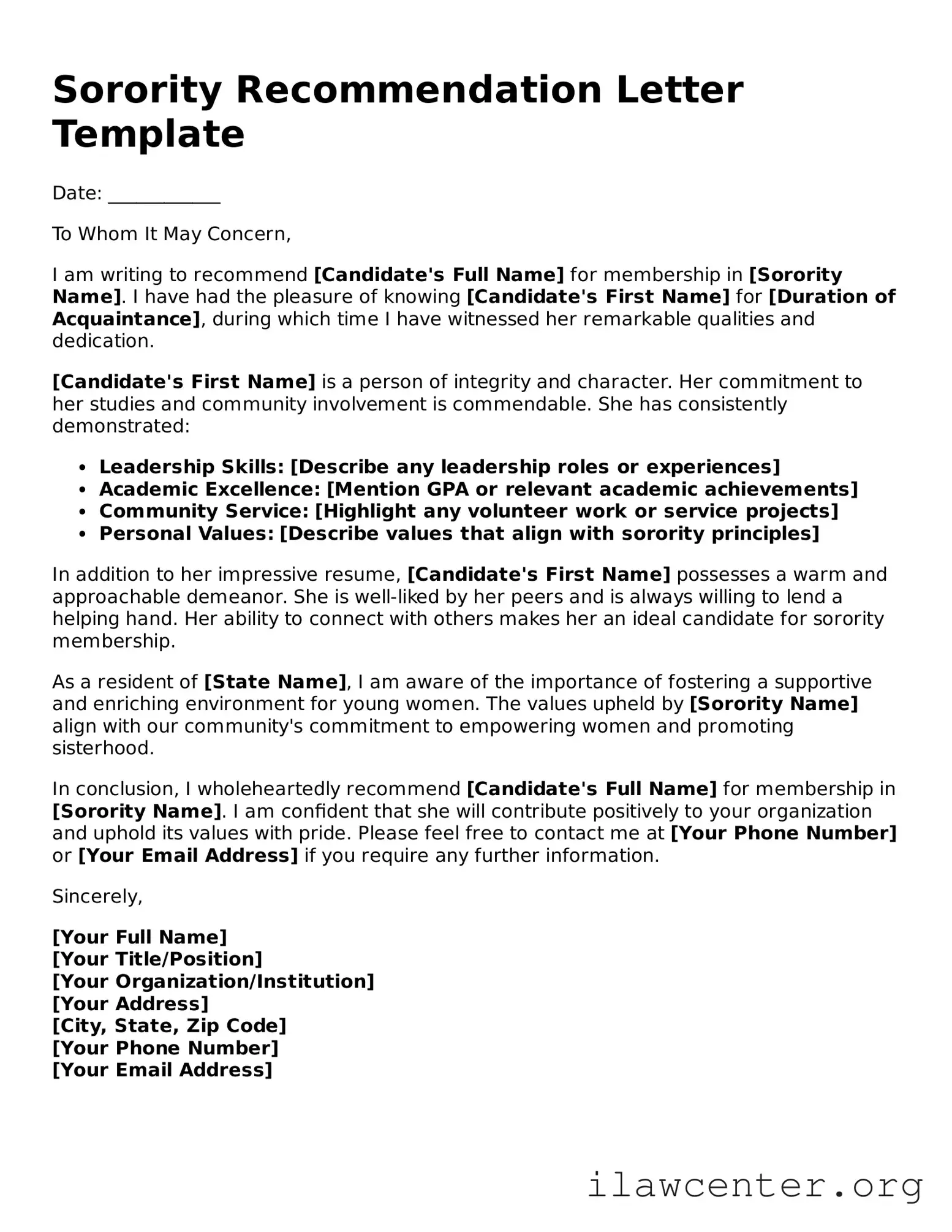
Sorority Recommendation Letter Preview

Sorority Recommendation Letter Template

Date: ____________

To Whom It May Concern,

I am writing to recommend [Candidate's Full Name] for membership in [Sorority Name]. I have had the pleasure of knowing [Candidate's First Name] for [Duration of Acquaintance], during which time I have witnessed her remarkable qualities and dedication.

[Candidate's First Name] is a person of integrity and character. Her commitment to her studies and community involvement is commendable. She has consistently demonstrated:

  • Leadership Skills: [Describe any leadership roles or experiences]
  • Academic Excellence: [Mention GPA or relevant academic achievements]
  • Community Service: [Highlight any volunteer work or service projects]
  • Personal Values: [Describe values that align with sorority principles]

In addition to her impressive resume, [Candidate's First Name] possesses a warm and approachable demeanor. She is well-liked by her peers and is always willing to lend a helping hand. Her ability to connect with others makes her an ideal candidate for sorority membership.

As a resident of [State Name], I am aware of the importance of fostering a supportive and enriching environment for young women. The values upheld by [Sorority Name] align with our community's commitment to empowering women and promoting sisterhood.

In conclusion, I wholeheartedly recommend [Candidate's Full Name] for membership in [Sorority Name]. I am confident that she will contribute positively to your organization and uphold its values with pride. Please feel free to contact me at [Your Phone Number] or [Your Email Address] if you require any further information.

Sincerely,

[Your Full Name]
[Your Title/Position]
[Your Organization/Institution]
[Your Address]
[City, State, Zip Code]
[Your Phone Number]
[Your Email Address]

PDF Form Characteristics

Fact Name Description
Purpose A Sorority Recommendation Letter is used to support a potential new member's application to a sorority.
Content The letter typically includes information about the candidate's character, achievements, and reasons for joining the sorority.
Submission Process Recommendation letters are usually submitted directly to the sorority chapter or through a designated online platform.
Eligibility Most sororities require recommendations from alumnae members or current members of the sorority.
State Variations Some states may have specific guidelines for recommendation letters, influenced by local sorority customs.
Confidentiality Many sororities consider recommendation letters confidential, meaning the candidate may not see the content.
Length There is no strict length requirement, but letters are typically one to two pages long.
Format Recommendation letters should be typed and formatted professionally, including the writer's contact information.
Deadline Each sorority has its own deadline for submission, often aligned with recruitment events.
Legal Considerations In some states, anti-discrimination laws may influence the content and requirements of recommendation letters.

Instructions on Utilizing Sorority Recommendation Letter

Filling out the Sorority Recommendation Letter form is an important step in the sorority recruitment process. This form helps potential members connect with sororities and provides a way for current members to share their insights about candidates. After completing the form, it will be submitted to the appropriate sorority for consideration.

  1. Begin by gathering all necessary information about the candidate. This includes their full name, contact information, and any relevant academic details.
  2. Next, locate the section of the form that asks for personal insights. Think about the candidate's strengths, character traits, and any experiences that make them a good fit for the sorority.
  3. Fill in the candidate's academic achievements and extracurricular activities. Be specific and provide examples that highlight their skills and involvement.
  4. In the section dedicated to your relationship with the candidate, describe how you know them and the length of your relationship. This adds credibility to your recommendation.
  5. Review the form for any additional questions or prompts that may require your input. Make sure to answer each question thoughtfully.
  6. After completing all sections, double-check your entries for accuracy and clarity. Ensure that all information is up-to-date and reflects the candidate positively.
  7. Finally, submit the form as instructed, whether that’s electronically or by mailing a hard copy. Be mindful of any deadlines to ensure the recommendation is received on time.

Important Facts about Sorority Recommendation Letter

What is a Sorority Recommendation Letter?

A Sorority Recommendation Letter is a written endorsement provided by a member of a sorority, recommending a potential new member for membership. This letter highlights the candidate's qualities, achievements, and character, providing insight into why they would be a good fit for the sorority.

Who should write a Sorority Recommendation Letter?

Typically, a current or alumna member of the sorority should write the recommendation. This person should know the candidate well and be able to speak positively about their personality, values, and potential contributions to the sorority.

What information is typically included in the letter?

The letter should include details about the candidate's academic achievements, leadership skills, community involvement, and personal attributes. It may also mention how the candidate aligns with the sorority's values and mission.

How do I obtain a Sorority Recommendation Letter?

To obtain a recommendation letter, reach out to sorority members or alumnae in your network. You can also contact the sorority's recruitment chair or advisor for guidance on who to approach. Be sure to ask well in advance to give them ample time to write a thoughtful letter.

Is there a specific format for the letter?

While there is no strict format, the letter should be typed, professionally written, and signed. It typically starts with a formal greeting, followed by the body of the letter detailing the recommendation, and ends with a closing statement and the writer's signature.

When should I submit the Sorority Recommendation Letter?

It is advisable to submit the recommendation letter as early as possible, ideally before the recruitment process begins. Each sorority may have different deadlines, so check with the specific sorority for their requirements.

Can I submit more than one Sorority Recommendation Letter?

Yes, you can submit multiple recommendation letters. Having more than one letter can strengthen your application, as it provides different perspectives on your qualifications and character. However, ensure that each letter comes from a different member to avoid redundancy.

Common mistakes

Filling out a Sorority Recommendation Letter form can be a crucial step in the sorority recruitment process. However, many individuals make common mistakes that can hinder their chances of receiving a positive recommendation. Understanding these pitfalls can help applicants present themselves in the best light possible.

One frequent mistake is providing incomplete information. When filling out the form, it is essential to ensure that all sections are filled out thoroughly. Leaving blank spaces or failing to provide necessary details can create a negative impression. Sorority members reviewing the forms may interpret gaps as a lack of interest or commitment.

Another common error is using vague language. When describing the candidate's qualities or experiences, specificity is key. Instead of general statements, it is more effective to provide concrete examples that illustrate the candidate's strengths. This helps the reader form a clearer picture of who the applicant is.

Additionally, some people overlook the importance of proofreading. Spelling and grammatical errors can detract from the professionalism of the recommendation. A letter filled with mistakes may lead the reader to question the credibility of the recommendation. Taking the time to review the form can make a significant difference.

Moreover, failing to follow the specific guidelines set by the sorority can be detrimental. Each sorority may have its own requirements regarding the format or content of the recommendation letter. Ignoring these guidelines can result in the form being disregarded entirely. It is crucial to read and adhere to the instructions provided.

Another mistake is not personalizing the recommendation. A generic letter that could apply to any candidate lacks impact. Tailoring the recommendation to reflect the unique qualities and experiences of the individual can make a stronger case for their candidacy. Personal anecdotes can enhance the letter’s effectiveness.

Some individuals also forget to include contact information. Providing a way for the sorority to reach out for further questions or clarifications is important. Omitting this information can hinder the process and may leave the reader with unanswered questions about the candidate.

In addition, being overly formal or too casual can be problematic. Striking the right balance in tone is essential. A recommendation should be respectful and professional, yet still convey warmth and personality. Finding this balance can help create a more engaging and relatable letter.

Another mistake is not addressing the letter to the appropriate audience. Some individuals may neglect to find out the name of the person or committee receiving the recommendation. Using a generic greeting can come off as impersonal. Taking the time to address the letter correctly shows attention to detail.

Lastly, failing to submit the recommendation on time can be a significant setback. Each sorority has its own deadlines, and missing them can result in the candidate being overlooked. Keeping track of submission dates is essential to ensure that the recommendation is considered.

By avoiding these common mistakes, individuals can enhance their Sorority Recommendation Letter and improve their chances of making a positive impression during the recruitment process. Thoughtfulness and attention to detail can go a long way in this important endeavor.

Documents used along the form

When seeking membership in a sorority, several documents are commonly utilized alongside the Sorority Recommendation Letter form. Each document serves a unique purpose in the application process, helping to present a well-rounded view of the candidate. Below is a list of these documents, along with a brief description of each.

  • Personal Statement: A written essay where the candidate expresses her motivations for joining the sorority, personal values, and goals.
  • Resume: A summary of the candidate's academic achievements, extracurricular activities, work experience, and community service.
  • Transcripts: Official academic records that provide insight into the candidate's educational background and performance.
  • Letters of Recommendation: Additional letters from teachers, employers, or community leaders who can attest to the candidate's character and qualifications.
  • Membership Application: A formal document that collects personal information and details about the candidate's interests and affiliations.
  • Financial Agreement: A document outlining the financial obligations associated with membership, including dues and fees.
  • Interview Evaluation Form: A form used by sorority members to assess the candidate during an interview, noting strengths and areas for improvement.
  • Social Media Guidelines: A set of rules regarding online conduct and representation of the sorority, which candidates must agree to follow.
  • Chapter Information Sheet: A document that provides details about the sorority, including its values, history, and community involvement.

Each of these documents plays a crucial role in the sorority recruitment process. Together, they help sororities evaluate candidates thoroughly and ensure a good fit for both the organization and the individual.

Similar forms

The Sorority Recommendation Letter form serves a specific purpose in the sorority recruitment process. However, it shares similarities with several other documents that also aim to provide insights about a candidate. Here are four such documents:

  • College Recommendation Letter: Similar to a sorority recommendation, this letter is written by someone who knows the student well, such as a teacher or counselor. It highlights the student’s academic achievements, character, and potential, helping colleges make informed decisions about admissions.
  • Job Reference Letter: This document is provided by a former employer or colleague. It outlines the candidate's work ethic, skills, and contributions in a professional setting. Like the sorority recommendation, it aims to give insight into the individual’s suitability for a particular role or organization.
  • Character Reference Letter: Often used in various situations, this letter is written by someone who can vouch for an individual’s character and personal qualities. It shares anecdotes and observations, similar to how a sorority recommendation highlights personal traits that align with the values of the sorority.
  • Scholarship Recommendation Letter: This type of letter is written to support a candidate’s application for a scholarship. It focuses on the applicant’s achievements, community involvement, and future goals, akin to how a sorority recommendation emphasizes a candidate's fit and contributions to the sorority.

Dos and Don'ts

When filling out a Sorority Recommendation Letter form, it's important to follow certain guidelines to ensure your submission is effective and well-received. Here are some dos and don'ts to consider:

  • Do provide accurate and complete information.
  • Do use clear and concise language.
  • Do highlight the candidate's strengths and accomplishments.
  • Do include specific examples to support your statements.
  • Do proofread your letter for spelling and grammar errors.
  • Don't use vague or generic statements.
  • Don't include irrelevant personal information.
  • Don't write in a negative tone or criticize the candidate.
  • Don't exceed the word limit if one is provided.

By following these guidelines, you can create a strong recommendation that effectively supports the candidate's application.

Misconceptions

Understanding the Sorority Recommendation Letter form can be challenging. Here are some common misconceptions that people often have:

  • It is only for potential new members. Many believe that recommendation letters are only necessary for those looking to join a sorority. However, alumni can also submit letters to support current members in leadership roles or scholarships.
  • All sororities require a recommendation letter. While many sororities appreciate recommendation letters, not all require them for membership. It's essential to check the specific requirements of each organization.
  • The letter must be written by a sorority member. Some think that only current sorority members can write recommendation letters. In reality, anyone who knows the potential member well and can speak to their character can write a letter.
  • The letter needs to be lengthy and formal. Many assume that a lengthy, formal letter is necessary. A concise, heartfelt letter that highlights key qualities and experiences can be just as effective.
  • Submitting a letter guarantees membership. Some individuals believe that having a recommendation letter will automatically secure a spot in the sorority. Membership decisions are based on various factors, and the letter is just one part of the process.
  • Letters are only considered during recruitment. There is a misconception that recommendation letters are only relevant during the recruitment process. In fact, they can be valuable throughout a member's time in the sorority, especially for leadership roles or awards.

Key takeaways

Filling out a Sorority Recommendation Letter form can be an important step in the sorority recruitment process. Here are some key takeaways to keep in mind:

  • Understand the Purpose: The recommendation letter serves as a personal endorsement, highlighting your strengths and suitability for membership.
  • Choose the Right Recommender: Select someone who knows you well, such as a teacher, coach, or family friend, and can provide a genuine perspective on your character.
  • Be Honest and Authentic: Share your true self in the form. Authenticity resonates more than trying to fit a mold.
  • Follow Guidelines: Each sorority may have specific requirements for the recommendation letter. Ensure you adhere to these instructions carefully.
  • Proofread Carefully: Spelling and grammatical errors can detract from your message. Review your form multiple times to ensure clarity and professionalism.
  • Submit on Time: Timeliness is crucial. Ensure that your recommendation letter is submitted by the deadline to avoid missing out on opportunities.

By keeping these points in mind, you can enhance your chances of making a positive impression during the recruitment process.