
St 108 PDF Template

St 108 PDF Template

Form ST-108 is a certificate used in Indiana to confirm that the gross retail or use tax has been paid on the purchase of a motor vehicle or watercraft. This form is essential for titling the vehicle or watercraft, as it provides necessary tax documentation to the Bureau of Motor Vehicles. Completing this form accurately ensures compliance with state tax laws and facilitates the licensing process.

Fill out the ST-108 form by clicking the button below.

Article Guide

The ST-108 form is an essential document for anyone involved in the purchase of a motor vehicle or watercraft in Indiana. This certificate verifies that the gross retail or use tax has been paid, which is a requirement when titling these vehicles. It captures crucial information, such as the dealer's name, registration details, and the purchaser's information. The form also includes sections for vehicle identification, allowing for the input of the Vehicle Identification Number (VIN) or Hull Identification Number (HIN). Calculating the sales or use tax is straightforward; it requires the total selling price, any trade-in allowances, and applies a tax rate of 7%. The seller must sign the form, certifying that the tax has been collected and will be submitted to the Indiana Department of Revenue. If a buyer claims an exemption, a separate form, ST-108E, must be completed. Understanding the ST-108 is crucial for both dealers and purchasers to ensure compliance with Indiana tax regulations and to avoid any potential issues during the titling process.

St 108 Preview

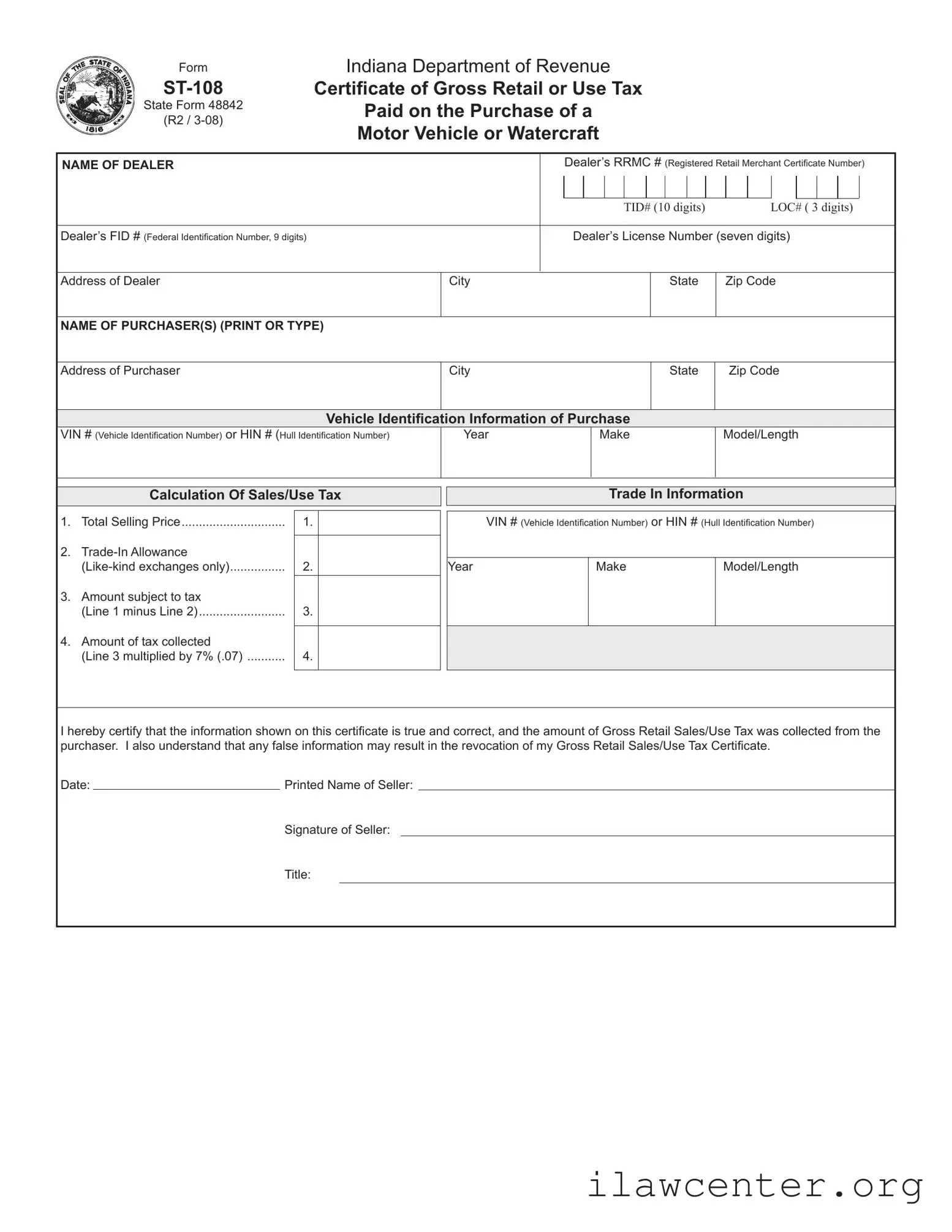
Calculation Of Sales/Use Tax
Form
ST-108
State Form 48842
(R2 / 3-08)
NAME OF DEALER
Trade In Information
Dealer’s RRMC # (Registered Retail Merchant Certicate Number)
TID# (10 digits) LOC# ( 3 digits)
Indiana Department of Revenue
Certicate of Gross Retail or Use Tax
Paid on the Purchase of a
Motor Vehicle or Watercraft
Dealer’s FID # (Federal Identication Number, 9 digits) Dealer’s License Number (seven digits)
Address of Dealer City State Zip Code
NAME OF PURCHASER(S) (PRINT OR TYPE)
Address of Purchaser City State Zip Code
Vehicle Identication Information of Purchase
VIN # (Vehicle Identication Number) or HIN # (Hull Identication Number) Year Make Model/Length
1. Total Selling Price .............................. 1. VIN # (Vehicle Identication Number) or HIN # (Hull Identication Number)
2. Trade-In Allowance
(Like-kind exchanges only) ................ 2. Year Make Model/Length
3. Amount subject to tax
(Line 1 minus Line 2) ......................... 3.
4. Amount of tax collected
(Line 3 multiplied by 7% (.07) ........... 4.
I hereby certify that the information shown on this certicate is true and correct, and the amount of Gross Retail Sales/Use Tax was collected from the
purchaser. I also understand that any false information may result in the revocation of my Gross Retail Sales/Use Tax Certicate.
Date: Printed Name of Seller:
Signature of Seller:
Title:
Instructions for Completing Form ST-108, Certicate of Gross Retail
or Use Tax on the Purchase of a Motor Vehicle or Watercraft.
INDIANA CODE 6-2.5-9-6 requires that a person titling a vehicle or watercraft present certication indicating the state
gross sales and use tax has been paid; otherwise the payment of the tax must be made directly to a Bureau of Motor
Vehicles license branch.
The ST-108 allows the dealer to indicate the amount of tax collected from the purchaser. The dealer is then required
to submit the sales/use tax to the Department of Revenue on a sales and use tax report.
If an exemption from the tax is claimed, the purchaser and the dealer must complete Form ST-108E and submit it to
the license branch at the time of licensing. ST-108E serves as an afdavit of exemption by the purchaser and lists the
exemptions available to qualied purchases.
Seller Information
NAME OF DEALER: Indicate the name of the dealer as it appears on the Registered Retail Merchant Certicate
(RRMC).
FID # (Federal Identication Number): Indicate the Federal Identication Number of the dealer, if applicable.
DEALER’S LICENSE #: Indicate the Dealer’s License Number(seven digits) as it appears on the Dealer’s License
Certicate.
RRMC # (same as TID # - 10 Digits + LOC # - 3 Digits): Indicate the Indiana Taxpayer Identication Number and
Location Number as it appears on the Registered Retail Merchant Certicate. This number must be in the following
format: 0001234567-001. If this number is not present or not in this format the ST-108 WILL BE REJECTED by the
license branch and the purchaser will have to return to the seller to obtain the valid number.
ADDRESS OF DEALER: Indicate the address of the dealer as it appears on the Registered Retail Merchant Certi-
cate.
Vehicle Identication Information
VIN or HIN ID #: Enter the Vehicle ID # (VIN) or the Hull ID # (HIN).
YEAR: Indicate the year the motor vehicle or watercraft was manufactured.
MODEL # OR WATERCRAFT LENGTH: If a motor vehicle is being sold indicate the model name for the vehicle. If a
watercraft is being sold indicate the length of the craft.
Calculation of Sales/Use Tax
TOTAL SELLING PRICE: When determining the total selling price include all delivery, make ready, repair, or other
costs incurred prior to transfer to the buyer. Federal excise tax is NOT included.
TRADE-IN ALLOWANCE: The trade-in allowance exemption is for like-kind vehicles or watercraft only. (i.e. A boat may
be traded for a car; however, the value of the non like-kind items do not reduce the taxable selling price).
You must also indicate the make, model, year, and ID # of the trade-in vehicle or watercraft.
AMOUNT SUBJECT TO TAX: Line 1 minus Line 2 results in the amount on which the sales/use tax will be calcu-
lated.
AMOUNT OF TAX COLLECTED: Line 3 multiplied by 7% or .07 equals the amount to be collected by the seller.
SIGNATURE SECTION: The Seller must sign the ST-108 certifying seller has collected the sales/use tax and will forward
it to the Department of Revenue with the Sales/Use Tax Return. Failure to sign the ST-108 will result in the rejection of
the form by the license branch and the purchaser will have to return to the seller for the signature.

File Properties

Fact Name Details
Form Purpose The ST-108 certifies that gross retail or use tax has been paid on a motor vehicle or watercraft purchase.
Governing Law Indiana Code 6-2.5-9-6 requires this certification for titling vehicles or watercraft.
Dealer Information Dealers must provide their Registered Retail Merchant Certificate Number (RRMC #) and Federal Identification Number (FID #).
Tax Calculation The tax is calculated at a rate of 7% on the amount subject to tax after deducting any trade-in allowance.
Trade-In Allowance Only like-kind exchanges qualify for a trade-in allowance, reducing the taxable amount.
Seller Certification Sellers must sign the ST-108 to confirm the tax has been collected and will be forwarded to the Department of Revenue.
Rejection Risk If the RRMC # is missing or incorrectly formatted, the form will be rejected by the license branch.
Exemption Process For tax exemptions, both the purchaser and dealer must complete Form ST-108E at the time of licensing.

Instructions on Utilizing St 108

Filling out the ST-108 form is an important step in the process of purchasing a motor vehicle or watercraft in Indiana. This form certifies that the sales or use tax has been paid, which is necessary for titling the vehicle or watercraft. Completing this form accurately ensures that both the dealer and the purchaser comply with state regulations.

  1. Gather Required Information: Collect all necessary details about the dealer and the vehicle or watercraft.
  2. Dealer Information: Enter the name of the dealer as it appears on the Registered Retail Merchant Certificate.
  3. Dealer’s RRMC #: Input the Indiana Taxpayer Identification Number and Location Number in the format 0001234567-001.
  4. Dealer’s FID #: Provide the Federal Identification Number of the dealer, if applicable.
  5. Dealer’s License Number: Fill in the seven-digit Dealer’s License Number as shown on the Dealer’s License Certificate.
  6. Address of Dealer: Write the complete address of the dealer as listed on the Registered Retail Merchant Certificate.
  7. Purchaser Information: Enter the name of the purchaser(s) in print or type format.
  8. Purchaser’s Address: Fill in the address of the purchaser, including city, state, and zip code.
  9. Vehicle Identification: Provide the VIN# (Vehicle Identification Number) or HIN# (Hull Identification Number).
  10. Year, Make, and Model/Length: Specify the year, make, and model of the vehicle or the length of the watercraft.
  11. Total Selling Price: Calculate the total selling price, including all associated costs, but excluding federal excise tax.
  12. Trade-In Allowance: If applicable, indicate the trade-in allowance for like-kind vehicles or watercraft, including their details.
  13. Amount Subject to Tax: Calculate this by subtracting the trade-in allowance from the total selling price.
  14. Amount of Tax Collected: Multiply the amount subject to tax by 7% (0.07) to find the total tax to be collected.
  15. Signature Section: The seller must sign the form, certifying that the sales/use tax has been collected and will be forwarded to the Department of Revenue.
  16. Date: Enter the date of signing the form.
  17. Printed Name of Seller: Provide the printed name of the seller.
  18. Title: Indicate the title of the seller.

Important Facts about St 108

What is the purpose of the ST-108 form?

The ST-108 form serves as a Certificate of Gross Retail or Use Tax Paid on the Purchase of a Motor Vehicle or Watercraft in Indiana. It is required by law for individuals titling a vehicle or watercraft to provide proof that the state gross sales and use tax has been paid. Without this certification, the tax must be paid directly to a Bureau of Motor Vehicles license branch. The form allows the dealer to indicate the amount of tax collected from the purchaser, ensuring compliance with Indiana tax regulations.

Who needs to complete the ST-108 form?

The ST-108 form must be completed by both the dealer and the purchaser involved in the sale of a motor vehicle or watercraft. The dealer fills out the form to indicate the sales price, trade-in allowance, and the amount of tax collected. The purchaser must provide their information and present the completed form when titling the vehicle or watercraft. If the purchaser claims an exemption from the tax, both parties must complete an additional form, ST-108E, at the time of licensing.

What information is required on the ST-108 form?

Several key pieces of information must be provided on the ST-108 form. The dealer’s name, address, and identification numbers (including the Registered Retail Merchant Certificate Number and Federal Identification Number) are essential. The purchaser’s name and address are also required. Additionally, the form must include details about the vehicle or watercraft, such as the Vehicle Identification Number (VIN) or Hull Identification Number (HIN), year, make, and model or length. Finally, the form includes a calculation section where the total selling price, trade-in allowance, amount subject to tax, and amount of tax collected must be clearly indicated.

What happens if the ST-108 form is not completed correctly?

If the ST-108 form is not filled out correctly, it may be rejected by the license branch. Common issues include missing information, incorrect formats for identification numbers, or lack of the seller's signature. If the form is rejected, the purchaser will need to return to the seller to obtain a valid form. This can cause delays in the titling process, so it is crucial to ensure all information is accurate and complete before submission.

Common mistakes

Completing the ST-108 form accurately is crucial for both dealers and purchasers in Indiana. However, many individuals make common mistakes that can lead to complications. Here are ten frequent errors to avoid when filling out this important document.

One of the most prevalent mistakes is failing to provide the correct dealer identification numbers. The ST-108 requires the Registered Retail Merchant Certificate Number, Taxpayer Identification Number, and Dealer’s License Number to be entered in a specific format. If these numbers are incorrect or not formatted properly, the form will be rejected, causing delays in the titling process.

Another common error is neglecting to include all necessary information about the vehicle or watercraft. This includes the Vehicle Identification Number (VIN) or Hull Identification Number (HIN), year, make, and model. Incomplete vehicle identification can lead to issues when the purchaser attempts to register the vehicle.

Many people also miscalculate the total selling price. It’s essential to include all costs associated with the sale, such as delivery and preparation fees. Excluding these costs can result in an inaccurate tax calculation, which may lead to underpayment or penalties.

Trade-in allowances often cause confusion. Some individuals mistakenly believe that any trade-in can reduce the taxable amount. However, only like-kind exchanges are eligible for this allowance. This means that if a boat is traded for a car, the trade-in value cannot be deducted from the selling price.

Additionally, individuals sometimes forget to calculate the amount of tax collected accurately. This figure is determined by multiplying the amount subject to tax by 7%. Errors in this calculation can lead to discrepancies that complicate the transaction.

Another mistake is failing to sign the form. The seller’s signature is mandatory for the ST-108 to be valid. Without it, the license branch will reject the form, forcing the purchaser to return to the dealer for the necessary signature.

Some purchasers overlook the importance of providing their complete address. The form requires the address of the purchaser, including city, state, and zip code. Incomplete address information can lead to issues with registration and tax records.

Another frequent oversight is not retaining a copy of the completed ST-108 form. Both the dealer and the purchaser should keep a copy for their records. This documentation can be crucial if there are any disputes or questions about the transaction in the future.

Moreover, individuals sometimes fail to understand the implications of providing false information. Any inaccuracies can result in serious consequences, including the revocation of the Gross Retail Sales/Use Tax Certificate. It is vital to ensure that all information is true and correct before submission.

Lastly, many people do not take the time to read the instructions thoroughly. The ST-108 comes with detailed guidelines that can help avoid these common pitfalls. Taking a moment to review these instructions can save time and prevent frustration down the line.

Documents used along the form

The ST-108 form is essential for certifying the payment of gross retail or use tax on the purchase of a motor vehicle or watercraft in Indiana. Several other forms accompany this document to ensure compliance with state tax regulations. Below is a brief overview of these forms.

  • Form ST-108E: This form serves as an affidavit of exemption for purchasers who qualify for certain tax exemptions. Both the purchaser and the dealer must complete it and submit it to the license branch during the licensing process.
  • Form ST-109: This form is used by dealers to report sales and use tax collected from purchasers. It provides a summary of all sales transactions and ensures that the tax is properly remitted to the Indiana Department of Revenue.
  • Form ST-130: This form allows for the application of a refund for overpaid sales or use tax. It requires detailed information about the transaction and the reason for the refund request.
  • Form ST-105: This is a resale certificate used by purchasers who intend to resell the vehicle or watercraft. It certifies that the buyer will not pay sales tax on the purchase, as it will be collected when the item is sold to the end consumer.

These forms play a crucial role in the tax compliance process for vehicle and watercraft purchases. Understanding their purpose can help ensure a smoother transaction for both dealers and purchasers.

Similar forms

  • Form ST-108E: This form serves as an affidavit of exemption for purchasers claiming a tax exemption. Similar to the ST-108, it requires detailed information about the vehicle or watercraft and the purchaser, ensuring that the proper documentation is in place for tax purposes.
  • Form ST-109: This form is used for reporting sales tax collected on sales of tangible personal property. Like the ST-108, it captures the seller's information and the details of the sale, ensuring compliance with tax regulations.
  • Form ST-105: Known as the General Sales Tax Exemption Certificate, this document allows certain purchases to be exempt from sales tax. Similar to the ST-108, it requires the seller and purchaser to provide their information, ensuring that the exemption is valid and properly documented.
  • Form ST-200: This is a sales tax return form that businesses use to report and remit sales tax. Like the ST-108, it requires accurate reporting of sales and tax collected, ensuring that businesses comply with state tax laws.

Dos and Don'ts

When filling out the ST-108 form, it's important to follow specific guidelines to ensure accuracy and compliance. Here are four things you should and shouldn't do:

  • Do: Ensure all information is printed clearly.
  • Do: Include the correct Federal Identification Number for the dealer.
  • Don't: Leave any required fields blank.
  • Don't: Use incorrect formatting for the Indiana Taxpayer Identification Number.

By adhering to these guidelines, you can help ensure that the ST-108 form is completed correctly and submitted without issues.

Misconceptions

Here are ten common misconceptions about the ST-108 form, which is used in Indiana for certifying the payment of gross retail or use tax on the purchase of a motor vehicle or watercraft.

  1. Only new vehicles require the ST-108 form. This is incorrect. The ST-108 form is needed for both new and used vehicles or watercraft.
  2. The ST-108 form is optional. In reality, presenting this form is mandatory when titling a vehicle or watercraft in Indiana.
  3. All dealers automatically fill out the ST-108 form correctly. Mistakes can happen. Dealers must ensure all information is accurate to avoid rejection.
  4. Trade-ins reduce the taxable amount for any vehicle. This is misleading. Only like-kind trade-ins qualify for a tax reduction.
  5. There is no need for a seller's signature on the ST-108. This is false. The seller's signature is required for the form to be valid.
  6. The ST-108 form is the same as the ST-108E form. These forms serve different purposes. The ST-108 is for tax certification, while the ST-108E is for claiming exemptions.
  7. Incorrect dealer information will not affect the transaction. If the dealer's information is incorrect, the form may be rejected, causing delays.
  8. Only the buyer needs to keep a copy of the ST-108 form. Both the buyer and the dealer should retain copies for their records.
  9. The ST-108 form can be submitted at any time. It must be presented at the time of licensing to avoid additional tax payments.
  10. Completing the ST-108 form is straightforward and error-proof. While it may seem simple, attention to detail is crucial to ensure compliance with tax regulations.

Key takeaways

When filling out and using the ST-108 form, there are several important points to keep in mind. This form is essential for certifying that the gross retail or use tax has been paid on the purchase of a motor vehicle or watercraft in Indiana.

  • Accurate Dealer Information: Ensure that the dealer's name, RRMC number, and Federal Identification Number are entered correctly. This information must match what is on the Registered Retail Merchant Certificate.
  • Correct Formatting: The RRMC number must be in the format of 10 digits followed by 3 digits (e.g., 0001234567-001). If not formatted correctly, the form will be rejected.
  • Vehicle Identification: Provide the Vehicle Identification Number (VIN) or Hull Identification Number (HIN) accurately. This is crucial for identifying the specific vehicle or watercraft being purchased.
  • Tax Calculation: Calculate the sales/use tax by subtracting any trade-in allowance from the total selling price and then multiplying by 7%. Ensure all costs related to the sale are included in the total selling price.
  • Trade-In Allowance: Only like-kind exchanges qualify for a trade-in allowance. For example, a boat traded for a car does not qualify. Be sure to list the details of the trade-in vehicle or watercraft.
  • Signature Requirement: The seller must sign the ST-108 to certify that the sales/use tax has been collected. Without a signature, the form will be rejected.
  • Exemption Procedures: If an exemption is claimed, both the purchaser and dealer must complete Form ST-108E and submit it at the time of licensing.
  • Submission to Revenue Department: The dealer is responsible for submitting the collected sales/use tax to the Indiana Department of Revenue through a sales/use tax report.

By keeping these key points in mind, you can ensure that the ST-108 form is filled out correctly and used effectively, making the process smoother for both the dealer and the purchaser.