Statement of Intent to Employ Minor and Request for Work Permit PDF Template

Statement of Intent to Employ Minor and Request for Work Permit PDF Template

The Statement of Intent to Employ Minor and Request for Work Permit form is a crucial document that allows employers to legally hire minors while ensuring compliance with labor laws. This form outlines the employer's intention to employ a minor and requests the necessary work permit from the appropriate authorities. To ensure a smooth hiring process, fill out the form by clicking the button below.

Article Guide

The Statement of Intent to Employ Minor and Request for Work Permit form is a crucial document for employers seeking to hire minors. This form ensures compliance with labor laws designed to protect young workers while allowing them to gain valuable work experience. It outlines the employer's commitment to providing a safe work environment and specifies the nature of the job, including hours and duties. Additionally, it requires parental consent, emphasizing the importance of family involvement in the decision-making process. By submitting this form, employers not only fulfill legal obligations but also demonstrate their dedication to the well-being of their young employees. Understanding the components and requirements of this form is essential for both employers and parents, as it helps facilitate a smooth hiring process while safeguarding the rights of minors in the workforce.

Statement of Intent to Employ Minor and Request for Work Permit Preview

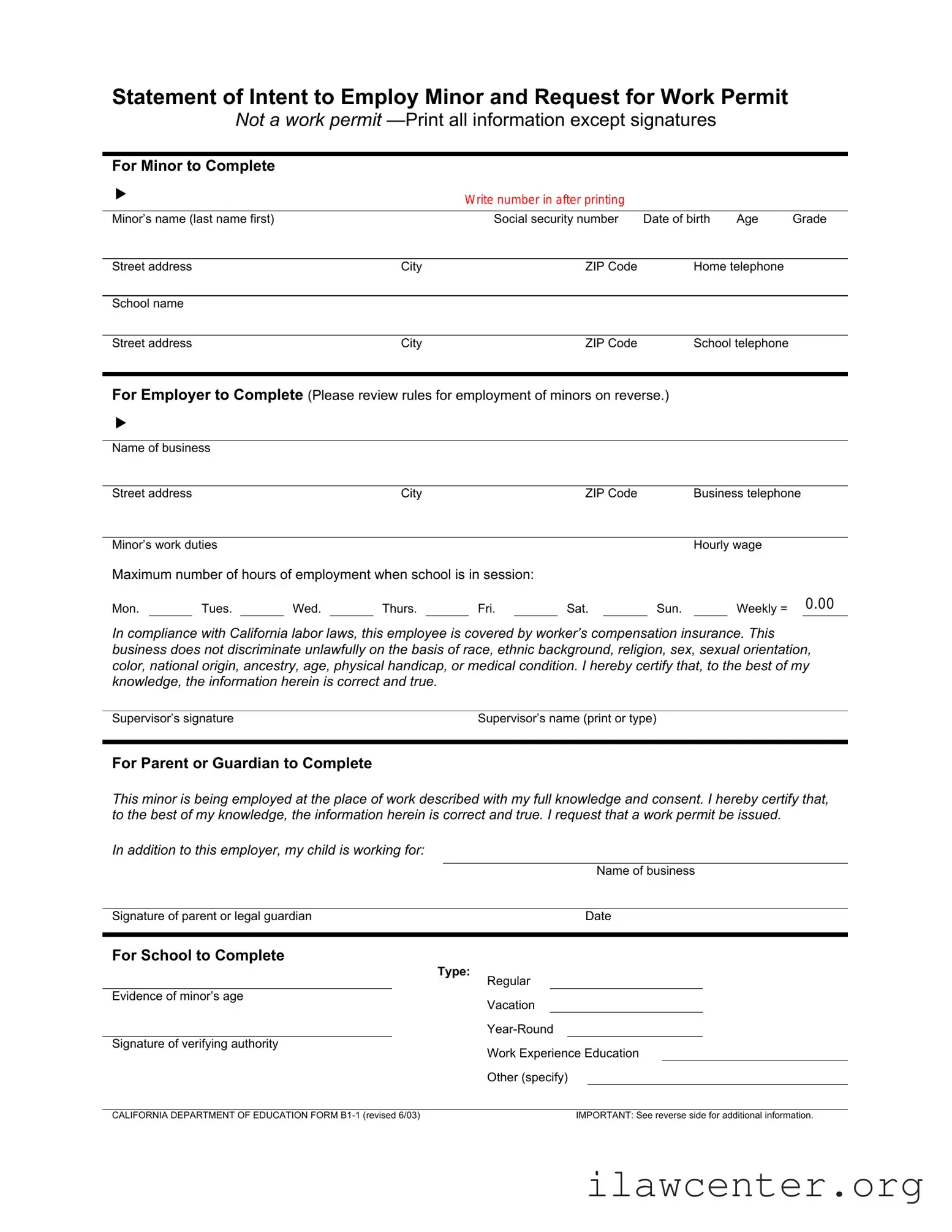
Statement of Intent to Employ Minor and Request for Work Permit
Not a work permit —Print all information except signatures
For Minor to Complete
Minor’s name (last name first)
Social security number
Date of birth
Age
Grade
Street address
ZIP Code
Home telephone
School name
Street address
ZIP Code
School telephone
For Employer to Complete (Please review rules for employment of minors on reverse.)
Name of business
Street address
ZIP Code
Business telephone
Minor’s work duties
Hourly wage
Maximum number of hours of employment when school is in session:
Mon.
Tues.
Wed.
Thurs.
Fri.
Sat.
Sun.
Weekly =
In compliance with California labor laws, this employee is covered by worker’s compensation insurance. This
business does not discriminate unlawfully on the basis of race, ethnic background, religion, sex, sexual orientation,
color, national origin, ancestry, age, physical handicap, or medical condition. I hereby certify that, to the best of my
knowledge, the information herein is correct and true.
Supervisor’s signature
Supervisor’s name (print or type)
For Parent or Guardian to Complete
This minor is being employed at the place of work described with my full knowledge and consent. I hereby certify that,
to the best of my knowledge, the information herein is correct and true. I request that a work permit be issued.
In addition to this employer, my child is working for:
Name of business
Signature of parent or legal guardian
Date
For School to Complete
Type:
Regular
Evidence of minor’s age
Vacation
Year-Round
Signature of verifying authority
Other (specify)
CALIFORNIA DEPARTMENT OF EDUCATION FORM B1-1 (revised 6/03)
IMPORTANT: See reverse side for additional information.
Write number in after printing
0.00
General Summary of Minors’ Work Regulations
If federal laws, state laws and school district policies
conflict, the more restrictive law (the one most
protective of the employee) prevails.
Generally, minors must attend school until age 18 unless
they are 16 years or older and have graduated from high
school or received a state Certificate of Proficiency.
Employers of minors required to attend school must
complete a “Statement of Intent to Employ Minor and
Request for Work Permit” (form B1-1) for the school
district of attendance for each such minor.
Employers must retain a “Permit to Employ and Work”
(form B1-4) for each such minor.
Work permits (B1-4) must be retained for three years and
be available for inspection by sanctioned authorities at all
times.
A work permit (B1-4) must be revoked whenever the
issuing authority determines the employment is illegal or
is impairing the health or education of the minor.
Minors under the age of 18 may not work in environments
declared hazardous or dangerous for young workers as
listed below:
1. Explosive exposure
2. Motor vehicle driving/outside helper
3. Coal mining
4. Logging and sawmilling
5. Power-driven woodworking machines
6. Radiation exposure
7. Power-driven hoists/forklifts
8. Power-driven metal forming, punching, and shearing
machines
9. Other mining
10. Power-driven meat slicing/processing machines
11. Power-baking machines
12. Power-driven paper products/paper bailing machines
13. Manufacturing brick, tile products
14. Power saws and shears
15. Wrecking, demolition
16. Roofing
17. Excavation operation
For more complete information about hazardous occupations,
contact the U.S. Department of Labor (Child Labor Bulletins
101 and 102) and the California Department of Industrial
Relations, Division of Labor Standards Enforcement. Regional
offices are located in several California cities. They are listed
in the “Government Listings” sections of telephone
directories.
Minors younger than 16 years are allowed to work only in
limited, specified occupations that exclude baking,
manufacturing, processing, construction, warehouse, and
transportation occupations.
In addition to safety regulations, labor laws applicable to
adult employees also generally apply to minor employees,
including workers’ compensation insurance requirements.
Child labor laws do not generally apply to minors who
deliver newspapers or work at odd jobs, such as yard
work and baby-sitting, or in private homes where the
minor is not regularly employed.
A day of rest from work is required if the total hours
worked per week exceed 30 or if more than 6 hours are
worked on any one day during the week.
Ages Hours of Work
16 – 17 When school is in session: Daily maximum of 4
hours, Monday through Thursday. May work up
to 8 hours on any non-school day or on any day
that precedes a non-school day. May be
permitted to work up to 48 hours per week.
Students in Work Experience Education or
cooperative vocational education programs may
be permitted to work a maximum of 8 hours on a
school day.
When school not in session: May work up to 48
hours per week but no more than 8 hours in any
one day.
Work must be performed no earlier than 5 a.m.
or later than 10 p.m. except that work may
extend to 12:30 a.m. on nights preceding non
-
school days. Students in Work Experience
Education or cooperative vocational education
programs may be authorized to work until 12:30
a.m. on nights preceding school days with
specified written permission.
14 – 15 When school is in session: On school days daily
maximum 3 hours. On non-school days may
work 8 hours. Weekly maximum of 18 hours.
Students in Work Experience Education and
career exploration programs may work up to 23
hours per week.
When school is not in session: Daily maximum 8
hours and weekly maximum 40 hours.
May not work during public school hours except
students in Work Experience Education or career
exploration programs.
Work must be performed no earlier than 7 a.m.
nor later than 7 p.m. any day of the week. From
June 1 to Labor Day work hours may be
extended to 9 p.m.
Younger Labor laws generally prohibit nonfarm
than 14 employment of children younger than 14.
Special rules apply to agricultural work,
domestic work and the entertainment industry.
File Properties

Fact Name Description
Purpose The Statement of Intent to Employ Minor and Request for Work Permit form is used to ensure that minors are legally allowed to work and that their employment complies with state labor laws.
Eligibility This form is applicable to minors, typically those under the age of 18, who seek employment in various sectors, including entertainment, retail, and service industries.
Parental Consent In most states, the form requires parental or guardian consent, affirming that the minor has permission to work.
State-Specific Requirements Each state has its own specific requirements regarding the form. For example, in California, the governing law is the California Labor Code Section 1286.
Work Hour Restrictions The form also outlines restrictions on the number of hours minors can work, which vary by age and type of employment.
Submission Process Once completed, the form must be submitted to the appropriate state labor department or local authority for approval before the minor can begin working.
Consequences of Non-Compliance Failure to obtain the necessary work permit can result in penalties for both the employer and the minor, including fines and restrictions on future employment opportunities.

Instructions on Utilizing Statement of Intent to Employ Minor and Request for Work Permit

After gathering the necessary information, you can proceed to complete the Statement of Intent to Employ Minor and Request for Work Permit form. Follow these steps to ensure accurate submission.

  1. Begin by entering the minor's full name in the designated field.
  2. Provide the minor's date of birth. This information is crucial for verifying eligibility.
  3. Fill in the name of the employer or business that intends to hire the minor.
  4. Include the employer's address, ensuring it is complete and accurate.
  5. State the job title or position that the minor will hold.
  6. Indicate the hours and days the minor will work. Be specific about the schedule.
  7. Sign and date the form at the bottom. This confirms the information provided is true and complete.

Once the form is completed, it will need to be submitted to the appropriate authority for processing. Be sure to keep a copy for your records.

Important Facts about Statement of Intent to Employ Minor and Request for Work Permit

What is the Statement of Intent to Employ Minor and Request for Work Permit form?

This form is a legal document that employers must complete when they intend to hire a minor. It serves as a formal request for a work permit, which is required in many states before a minor can begin working. The form ensures that the employment complies with labor laws designed to protect young workers.

Who needs to fill out this form?

Employers who wish to hire individuals under the age of 18 must complete this form. Additionally, the minor's parent or guardian may also need to provide consent, depending on the state’s regulations. It’s essential to ensure that both parties understand the terms of employment and the minor's rights.

What information is required on the form?

The form typically requires information about the employer, the minor, and the job position. This includes the employer's name and address, the minor's name and date of birth, the nature of the work, and the hours the minor will be working. Some states may ask for additional details, such as the minor's school information and parental consent.

How do I submit the form?

How long does it take to receive a work permit?

The processing time for a work permit can differ based on the state and the volume of applications being processed. In many cases, employers may receive the permit within a few days to a couple of weeks. However, it is advisable to submit the form well in advance of the intended start date to avoid any delays.

Are there any restrictions on the type of work a minor can do?

Yes, there are specific restrictions regarding the types of jobs minors can hold. Generally, minors are prohibited from working in hazardous occupations or jobs that may interfere with their education. Each state has its own list of permissible and prohibited occupations, so it’s crucial to review these regulations before hiring a minor.

What are the consequences of not completing this form?

Failing to complete the Statement of Intent to Employ Minor and Request for Work Permit form can lead to serious consequences for both the employer and the minor. Employers may face fines or penalties for violating labor laws, and the minor may be prohibited from working until the proper documentation is in place. Compliance is essential to ensure a safe and legal working environment.

Can the work permit be revoked?

Yes, work permits can be revoked under certain circumstances. If it is determined that the minor is working in violation of labor laws or if the job negatively impacts their education, the permit may be rescinded. Employers and guardians should monitor the minor’s work conditions to ensure compliance with all regulations.

Where can I find more information about hiring minors?

For more information, you can visit your state’s labor department website. These resources often provide detailed guidelines on the employment of minors, including required forms, restrictions, and best practices. Additionally, local chambers of commerce or legal advisors can offer support and clarification on the hiring process.

Common mistakes

When filling out the Statement of Intent to Employ Minor and Request for Work Permit form, individuals often overlook critical details that can lead to delays or even denials of work permits. One common mistake is failing to provide accurate personal information. This includes the minor’s full name, date of birth, and address. Inaccuracies can create confusion and may result in the application being rejected.

Another frequent error is neglecting to obtain the necessary signatures. Both the employer and the minor’s parent or guardian must sign the form. Without these signatures, the application is incomplete. It’s essential to ensure that all required parties have reviewed and agreed to the information presented.

Many applicants also misjudge the importance of including the correct employer information. This means not just the name of the business but also the employer's address and contact details. Providing incorrect or outdated information can hinder communication and slow down the processing of the work permit.

Additionally, people sometimes forget to specify the type of work the minor will be doing. Clearly outlining the job responsibilities helps authorities assess whether the work is appropriate for a minor. Failing to do so can lead to misunderstandings about the nature of the employment.

Another mistake is not checking the specific age restrictions and regulations that apply to the type of work. Each state has its own laws regarding the employment of minors, and failing to comply with these can result in legal issues for both the employer and the minor.

Moreover, individuals often overlook the required documentation that must accompany the form. This may include proof of age, such as a birth certificate or school identification. Missing documents can stall the application process significantly.

People also tend to underestimate the importance of double-checking the form for errors. Simple typos or omissions can lead to unnecessary delays. Taking the time to review the application thoroughly can save time and frustration down the road.

Lastly, applicants sometimes submit the form without understanding the processing times. Being unaware of how long it takes to receive a work permit can lead to confusion and disappointment. It’s wise to plan ahead and factor in these timelines when considering employment for a minor.

Documents used along the form

The Statement of Intent to Employ Minor and Request for Work Permit form is an essential document for employers looking to hire minors. Alongside this form, several other documents are often required to ensure compliance with labor laws and regulations. Below is a list of related forms and documents that may be necessary in the employment process for minors.

  • Parental Consent Form: This document is signed by a parent or guardian, granting permission for the minor to work. It typically includes details about the job, hours, and any restrictions.
  • Minor's Work Permit: Issued by the appropriate state authority, this permit allows a minor to work legally. It includes specific information about the minor, the employer, and the nature of the work.
  • Job Description: A detailed description of the job responsibilities and duties. This document helps clarify the nature of the work and ensures it complies with regulations regarding minor employment.
  • Employer's Statement of Compliance: A statement from the employer affirming adherence to all applicable labor laws and regulations concerning the employment of minors.
  • Hours of Work Agreement: This agreement outlines the specific hours and days the minor will work. It ensures that the work schedule complies with legal restrictions on minors’ working hours.
  • Health and Safety Guidelines: A document that provides information on workplace safety and health regulations. It is crucial for ensuring that the minor understands safety protocols in the workplace.

These documents work together to create a comprehensive framework for employing minors. Ensuring all necessary paperwork is completed and submitted helps protect both the minor and the employer, fostering a safe and compliant work environment.

Similar forms

The Statement of Intent to Employ Minor and Request for Work Permit form is an important document for employers wishing to hire minors. It ensures that the employment complies with labor laws designed to protect young workers. Several other documents serve similar purposes in various contexts. Here are six documents that share similarities with the Statement of Intent to Employ Minor and Request for Work Permit form:

  • Parental Consent Form: This document requires a parent or guardian's approval for a minor to work, similar to how the Statement of Intent seeks to ensure that the minor's employment is authorized and monitored.
  • Employment Application: An employment application gathers essential information about a potential employee. Like the Statement of Intent, it verifies the applicant's eligibility to work, including age and necessary permits.
  • Work Experience Agreement: This document outlines the terms of a minor's work experience, ensuring that the job aligns with educational goals. It parallels the Statement of Intent by emphasizing the importance of the minor's development and safety in the workplace.
  • Job Offer Letter: A job offer letter formally extends employment to a candidate. It often includes conditions related to age and work permits, mirroring the Statement of Intent's focus on compliance with labor regulations.
  • Health and Safety Training Certificate: This certificate confirms that a minor has completed required training on workplace safety. Similar to the Statement of Intent, it ensures that the minor is prepared and protected in their work environment.
  • Child Labor Law Compliance Document: This document outlines the specific regulations regarding the employment of minors. It serves a similar purpose to the Statement of Intent by ensuring that both the employer and minor understand and adhere to the legal requirements surrounding youth employment.

Dos and Don'ts

When filling out the Statement of Intent to Employ Minor and Request for Work Permit form, it is essential to follow certain guidelines to ensure accuracy and compliance. Below is a list of things you should and shouldn't do during this process.

  • Do: Read the instructions carefully before starting the form.
  • Do: Provide accurate information about the minor's personal details.
  • Do: Ensure that the employer's information is complete and correct.
  • Do: Sign and date the form where required.
  • Do: Submit the form to the appropriate authority in a timely manner.
  • Don't: Leave any sections blank; fill in all required fields.
  • Don't: Use incorrect or outdated information when completing the form.

Following these guidelines will help facilitate the process of obtaining the necessary work permit for minors. It is crucial to take your time and ensure everything is in order to avoid delays.

Misconceptions

  • Misconception 1: The form is only necessary for certain types of jobs.

    Many people believe that the Statement of Intent to Employ Minor and Request for Work Permit form is only required for specific job categories, like entertainment or modeling. In reality, any employment involving a minor requires this form, regardless of the job type.

  • Misconception 2: Employers can hire minors without any paperwork.

    Some assume that employers can simply hire minors without any formalities. This is not true. Proper documentation, including this form, is essential to ensure compliance with labor laws that protect young workers.

  • Misconception 3: The process is overly complicated and time-consuming.

    While some may think that completing the form is a daunting task, it is designed to be straightforward. With the right information, the process can be completed efficiently, often in just a few minutes.

  • Misconception 4: Only the employer needs to fill out the form.

    It’s a common belief that the employer is solely responsible for the paperwork. However, both the employer and the minor's parent or guardian must provide their input and signatures, making it a collaborative process.

  • Misconception 5: The form guarantees that the minor can start working immediately.

    Some might think that submitting the form automatically allows the minor to begin work. In fact, approval from the relevant authorities is required before employment can commence, ensuring that all legal requirements are met.

  • Misconception 6: The work permit is valid indefinitely.

    There’s a misconception that once a work permit is issued, it remains valid for all future employment. In reality, work permits are typically issued for a specific job and may need to be renewed or re-applied for new positions.

  • Misconception 7: All states have the same requirements for employing minors.

    Many people assume that the rules governing the employment of minors are uniform across the United States. However, each state has its own regulations and requirements, which can vary significantly. It’s crucial to check local laws to ensure compliance.

Key takeaways

When filling out and using the Statement of Intent to Employ Minor and Request for Work Permit form, it is essential to keep several key points in mind. Understanding these can help ensure compliance with regulations and facilitate a smooth process for employing minors.

  • Complete Information: Ensure all sections of the form are filled out accurately. Missing or incorrect information can lead to delays in processing.
  • Parental Consent: Obtain necessary signatures from a parent or guardian. This step is crucial for the validity of the work permit.
  • Age Verification: Provide proof of the minor's age. Acceptable documents include a birth certificate or school identification.
  • Job Description: Clearly outline the nature of the work. Include details about job duties, hours, and working conditions to ensure they comply with labor laws.
  • Submission Guidelines: Follow the specific submission procedures outlined by your state. Different jurisdictions may have unique requirements for submitting the form.

By keeping these takeaways in mind, employers can navigate the process more effectively and ensure a positive experience for both the minor and the organization.