Fillable Stock Purchase Agreement  Document

Fillable Stock Purchase Agreement Document

A Stock Purchase Agreement is a legal document that outlines the terms and conditions under which one party agrees to buy shares of stock from another party. This agreement protects both the buyer and the seller by clearly defining the rights and obligations involved in the transaction. Ready to get started? Fill out the form by clicking the button below.

Article Guide

When engaging in the buying or selling of shares in a company, a Stock Purchase Agreement (SPA) serves as a critical document that outlines the terms of the transaction. This form typically includes essential details such as the purchase price, the number of shares being sold, and the identities of both the buyer and the seller. Additionally, it often addresses representations and warranties made by the seller regarding the shares, ensuring that the buyer is fully informed about what they are acquiring. The agreement may also stipulate conditions that must be met before the transaction can be finalized, such as regulatory approvals or the completion of due diligence. By clearly delineating the rights and obligations of both parties, the SPA helps to mitigate risks and prevent misunderstandings, providing a structured framework for the transfer of ownership. Understanding the nuances of this document is vital for anyone involved in stock transactions, as it lays the groundwork for a successful and legally sound transfer of shares.

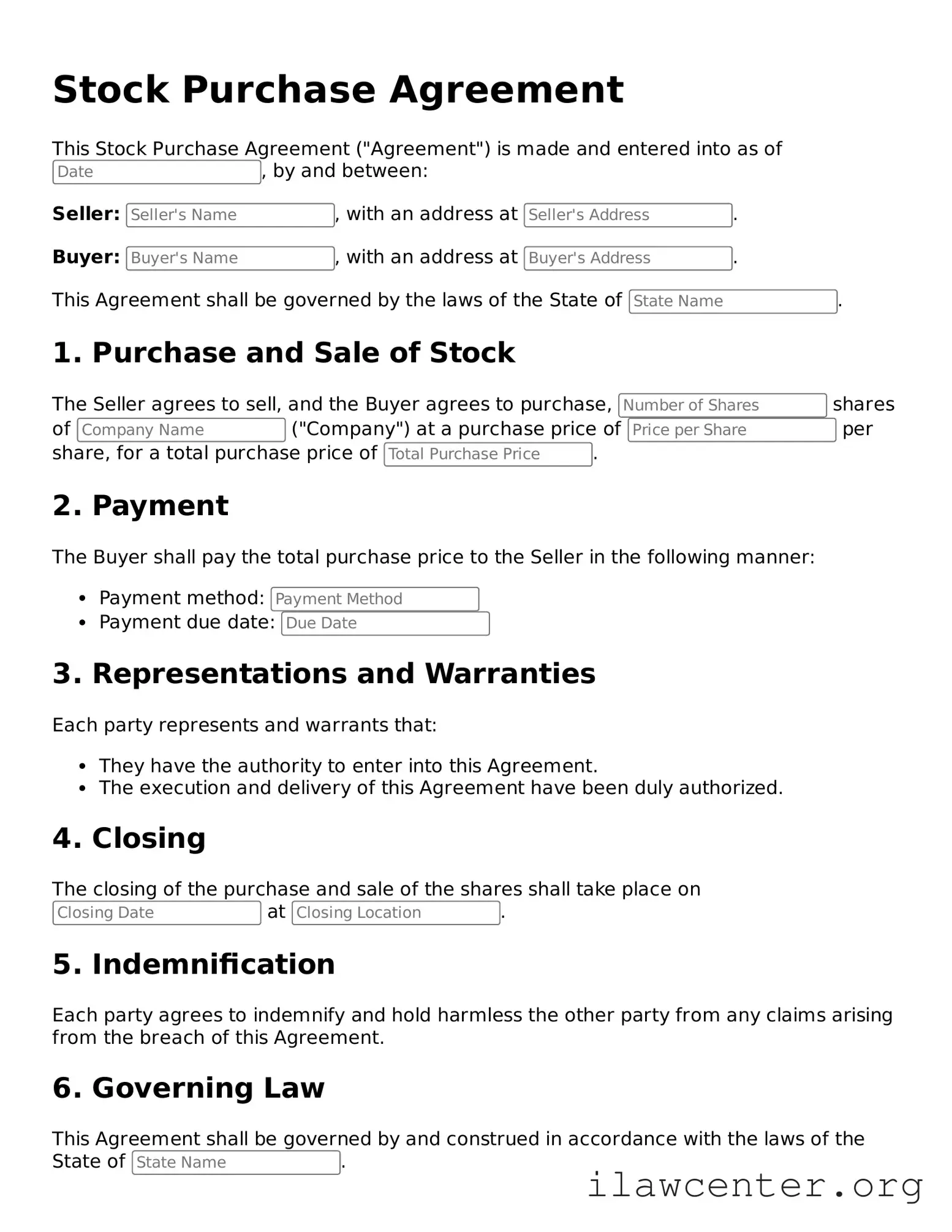
Stock Purchase Agreement Preview

Stock Purchase Agreement

This Stock Purchase Agreement ("Agreement") is made and entered into as of , by and between:

Seller: , with an address at .

Buyer: , with an address at .

This Agreement shall be governed by the laws of the State of .

1. Purchase and Sale of Stock

The Seller agrees to sell, and the Buyer agrees to purchase, shares of ("Company") at a purchase price of per share, for a total purchase price of .

2. Payment

The Buyer shall pay the total purchase price to the Seller in the following manner:

  • Payment method:
  • Payment due date:

3. Representations and Warranties

Each party represents and warrants that:

  • They have the authority to enter into this Agreement.
  • The execution and delivery of this Agreement have been duly authorized.

4. Closing

The closing of the purchase and sale of the shares shall take place on at .

5. Indemnification

Each party agrees to indemnify and hold harmless the other party from any claims arising from the breach of this Agreement.

6. Governing Law

This Agreement shall be governed by and construed in accordance with the laws of the State of .

7. Entire Agreement

This Agreement constitutes the entire agreement between the parties and supersedes all prior agreements and understandings.

8. Signatures

IN WITNESS WHEREOF, the parties hereto have executed this Stock Purchase Agreement as of the date first above written.

Seller Signature: ___________________________

Buyer Signature: ___________________________

PDF Form Characteristics

Fact Name Description
Definition A Stock Purchase Agreement is a legal document that outlines the terms and conditions of the sale of stock between a buyer and a seller.
Purpose This agreement serves to protect both parties by clearly stating the rights and obligations involved in the transaction.
Key Components It typically includes details about the purchase price, payment method, and any representations and warranties made by the seller.
Governing Law The governing law may vary by state. For example, California law often governs such agreements in transactions occurring there.
Confidentiality Many agreements include confidentiality clauses to protect sensitive information shared during the transaction.
Conditions Precedent These agreements often outline specific conditions that must be met before the sale can be finalized.
Dispute Resolution Provisions for dispute resolution, such as mediation or arbitration, may also be included to handle any conflicts that arise.
Closing Date The agreement specifies a closing date, which is when the actual transfer of stock ownership occurs.
Amendments Any changes to the agreement must be made in writing and signed by both parties to be valid.

Instructions on Utilizing Stock Purchase Agreement

Filling out the Stock Purchase Agreement form is an important step in the stock transaction process. Ensure you have all necessary information ready before starting. Below are the steps to complete the form accurately.

  1. Begin by entering the date at the top of the form.
  2. Provide the names and addresses of both the buyer and the seller.
  3. Specify the number of shares being purchased.
  4. Indicate the purchase price per share.
  5. Include the total purchase price, which is the number of shares multiplied by the price per share.
  6. State the payment method (e.g., cash, check, wire transfer).
  7. List any conditions that must be met before the sale is finalized.
  8. Sign and date the agreement at the bottom of the form.

After completing the form, review all entries for accuracy. Ensure both parties have signed the agreement to validate the transaction.

Important Facts about Stock Purchase Agreement

What is a Stock Purchase Agreement?

A Stock Purchase Agreement (SPA) is a legal document that outlines the terms and conditions under which shares of stock are bought and sold. It serves to protect both the buyer and the seller by clearly defining the rights and obligations of each party involved in the transaction.

Why is a Stock Purchase Agreement important?

This agreement is crucial because it helps to prevent misunderstandings and disputes. By detailing the purchase price, payment terms, and any representations or warranties made by the seller, the SPA provides a clear framework for the transaction. This clarity can be vital in ensuring that both parties are on the same page and that the deal proceeds smoothly.

What key elements should be included in a Stock Purchase Agreement?

An effective Stock Purchase Agreement should include several key components: the names of the buyer and seller, a description of the shares being sold, the purchase price, payment terms, and any conditions that must be met before the sale can be finalized. Additionally, representations and warranties from both parties, as well as any covenants or agreements regarding future actions, should be outlined.

Who typically uses a Stock Purchase Agreement?

Businesses and investors commonly use Stock Purchase Agreements. Companies looking to raise capital may sell shares to investors, while individuals or entities seeking to acquire ownership in a company will also utilize this agreement. It is a standard practice in both private and public transactions.

What are representations and warranties in the context of a Stock Purchase Agreement?

Representations and warranties are statements made by the seller regarding the condition of the company and the shares being sold. These may include assertions about the company’s financial status, legal compliance, and ownership of the shares. They serve to provide the buyer with assurances and can be a basis for legal recourse if the statements prove to be false.

Can a Stock Purchase Agreement be modified after it is signed?

Yes, a Stock Purchase Agreement can be modified after it is signed, but this typically requires the consent of both parties. Any amendments should be documented in writing and signed by both the buyer and the seller to ensure that they are legally enforceable.

What happens if one party breaches the Stock Purchase Agreement?

If one party breaches the agreement, the other party may have several options. These can include seeking damages, requesting specific performance (which means asking the court to enforce the terms of the agreement), or terminating the agreement altogether. The specific remedies available will depend on the terms outlined in the SPA and the nature of the breach.

Is it necessary to have a lawyer review a Stock Purchase Agreement?

While it is not legally required, having a lawyer review the Stock Purchase Agreement is highly recommended. A legal professional can help ensure that the agreement is comprehensive, compliant with relevant laws, and tailored to the specific needs of the transaction. This can provide peace of mind and protect against potential legal issues down the line.

How long does it take to finalize a Stock Purchase Agreement?

The time it takes to finalize a Stock Purchase Agreement can vary widely depending on the complexity of the deal and the responsiveness of the parties involved. Some agreements can be completed in a matter of days, while others may take weeks or longer, especially if negotiations are involved or if there are regulatory approvals required.
Common mistakes

When filling out a Stock Purchase Agreement form, individuals often overlook critical details that can lead to significant issues later. One common mistake is failing to provide accurate information about the parties involved. This includes not only the names but also the addresses and contact information. Inaccuracies can cause delays and complications in the transaction process.

Another frequent error is neglecting to specify the number of shares being purchased. This detail is crucial, as it directly impacts the valuation of the transaction. Without clear information on the quantity of shares, both parties may have differing expectations, leading to disputes.

Many individuals also forget to include the purchase price per share. This omission can create confusion and may result in legal challenges if the terms are not clearly defined. Clearly stating the purchase price helps to ensure that all parties are aligned on the financial aspects of the agreement.

Additionally, some people fail to address the conditions of the sale. This includes outlining any contingencies that must be met for the sale to proceed. Not specifying these conditions can lead to misunderstandings and may jeopardize the transaction.

Another mistake is not including a section for signatures and dates. A Stock Purchase Agreement is not legally binding without the signatures of all parties involved. Leaving this section incomplete can render the agreement ineffective.

Lastly, individuals often overlook the importance of consulting with a legal professional before finalizing the agreement. Legal advice can help identify potential pitfalls and ensure that the document meets all legal requirements. Skipping this step may lead to complications that could have been easily avoided.

Documents used along the form

A Stock Purchase Agreement is a crucial document in the process of buying or selling shares in a company. However, it is often accompanied by several other forms and documents that help clarify the terms of the transaction and protect the interests of all parties involved. Below is a list of common documents that may be used alongside a Stock Purchase Agreement.

  • Confidentiality Agreement: This document ensures that sensitive information shared during negotiations remains private. It protects both parties from unauthorized disclosure of proprietary information.
  • Due Diligence Checklist: A comprehensive list of items that the buyer should review before finalizing the purchase. This may include financial statements, legal documents, and operational details to assess the company's value and risks.
  • Disclosure Schedule: Attached to the Stock Purchase Agreement, this schedule outlines any exceptions to the representations and warranties made by the seller. It provides transparency regarding potential liabilities or issues.
  • Shareholder Agreement: If the buyer becomes a shareholder, this document outlines the rights and obligations of shareholders, including voting rights and profit distribution, ensuring smooth governance of the company.
  • Escrow Agreement: This agreement involves a third party holding funds or shares until certain conditions are met. It provides security for both the buyer and seller during the transaction process.
  • Board Resolutions: These documents record the decisions made by a company's board of directors regarding the sale of shares. They demonstrate that the transaction has been approved by the necessary governing body.
  • Opinion of Counsel: A letter from a legal advisor confirming that the transaction complies with applicable laws and regulations. This document adds an extra layer of assurance for the buyer.
  • Closing Statement: This document summarizes the final terms of the transaction, including the purchase price and any adjustments. It serves as a record of what was agreed upon at the closing of the sale.

These documents play an essential role in facilitating a smooth and legally sound transaction. Each one contributes to a clearer understanding of the terms and responsibilities involved, ensuring that both buyers and sellers are well-informed and protected throughout the process.

Similar forms

  • Asset Purchase Agreement: Similar to a Stock Purchase Agreement, this document outlines the terms under which a buyer acquires specific assets of a company rather than its stock. Both agreements detail the purchase price, representations, and warranties of the seller, but focus on different aspects of the transaction.

  • Shareholders' Agreement: This document complements a Stock Purchase Agreement by establishing the rights and obligations of shareholders in a corporation. While the Stock Purchase Agreement focuses on the transaction itself, the Shareholders' Agreement governs the ongoing relationship between the shareholders after the purchase.

  • Merger Agreement: In a merger, two companies combine into one entity. Like a Stock Purchase Agreement, a Merger Agreement specifies the terms of the transaction, including the exchange of stock and the valuation of the companies involved. However, it encompasses a broader scope, as it involves the entire business rather than just the stock.

  • Letter of Intent: Often a precursor to a Stock Purchase Agreement, this document outlines the preliminary understanding between parties regarding a potential transaction. It includes key terms and conditions that will be further detailed in the final Stock Purchase Agreement, helping to set the stage for negotiations.

Dos and Don'ts

Filling out a Stock Purchase Agreement (SPA) can be a crucial step in a business transaction. To help you navigate this process, here’s a list of what you should and shouldn’t do.

  • Do read the entire agreement carefully before signing.
  • Do ensure all parties involved are clearly identified.
  • Do specify the number of shares being purchased.
  • Do include the purchase price and payment terms.
  • Do seek legal advice if you have questions or concerns.
  • Don't rush through the form; take your time to understand each section.
  • Don't leave any sections blank unless instructed to do so.
  • Don't assume that verbal agreements are sufficient; everything should be in writing.
  • Don't overlook the importance of signatures; ensure all parties sign and date the agreement.

By following these guidelines, you can help ensure that your Stock Purchase Agreement is completed accurately and effectively, paving the way for a smooth transaction.

Misconceptions

Understanding a Stock Purchase Agreement (SPA) is crucial for anyone involved in buying or selling stock. However, several misconceptions can lead to confusion. Here are five common misunderstandings about SPAs:

  • 1. SPAs are only for large companies. Many believe that only big corporations use SPAs. In reality, any business, regardless of size, can benefit from a well-drafted agreement to outline the terms of a stock sale.
  • 2. An SPA is the same as a purchase order. Some think these terms are interchangeable. However, an SPA is a legal document that details the terms of a stock transaction, while a purchase order is typically used for goods and services.
  • 3. SPAs are only necessary for public companies. This is a common myth. Private companies also need SPAs to protect the interests of both buyers and sellers, ensuring clarity in the transaction.
  • 4. Once signed, an SPA cannot be changed. Many assume that an SPA is set in stone after signing. In fact, parties can negotiate changes before finalizing the agreement, and amendments can be made later if both sides agree.
  • 5. SPAs are only about price. While price is a key element, SPAs cover much more. They include terms regarding warranties, representations, and other important conditions that can affect the sale.

By understanding these misconceptions, buyers and sellers can navigate the stock purchase process more effectively and ensure their interests are protected.

Key takeaways

When dealing with a Stock Purchase Agreement, it’s important to understand the key aspects to ensure a smooth transaction. Here are some essential takeaways:

  • Understand the Purpose: A Stock Purchase Agreement outlines the terms under which one party buys stock from another. This document protects both the buyer and seller.
  • Identify the Parties: Clearly state the names and addresses of both the buyer and the seller. This helps avoid confusion later on.
  • Detail the Stock: Specify the type and number of shares being purchased. This information is crucial for clarity.
  • Set the Purchase Price: Clearly outline the total price and any payment terms. This ensures both parties are on the same page financially.
  • Include Representations and Warranties: Both parties should provide assurances about their authority to enter into the agreement and the condition of the stock.
  • Outline Conditions Precedent: Specify any conditions that must be met before the sale can proceed. This could include regulatory approvals or financing requirements.
  • Address Confidentiality: Consider including a confidentiality clause to protect sensitive information shared during the transaction.
  • Include Governing Law: Indicate which state’s laws will govern the agreement. This is important for resolving any disputes.
  • Seek Legal Advice: While this document can be filled out independently, consulting a legal professional can provide peace of mind and ensure compliance.

By keeping these key points in mind, you can navigate the Stock Purchase Agreement process more effectively and with confidence.