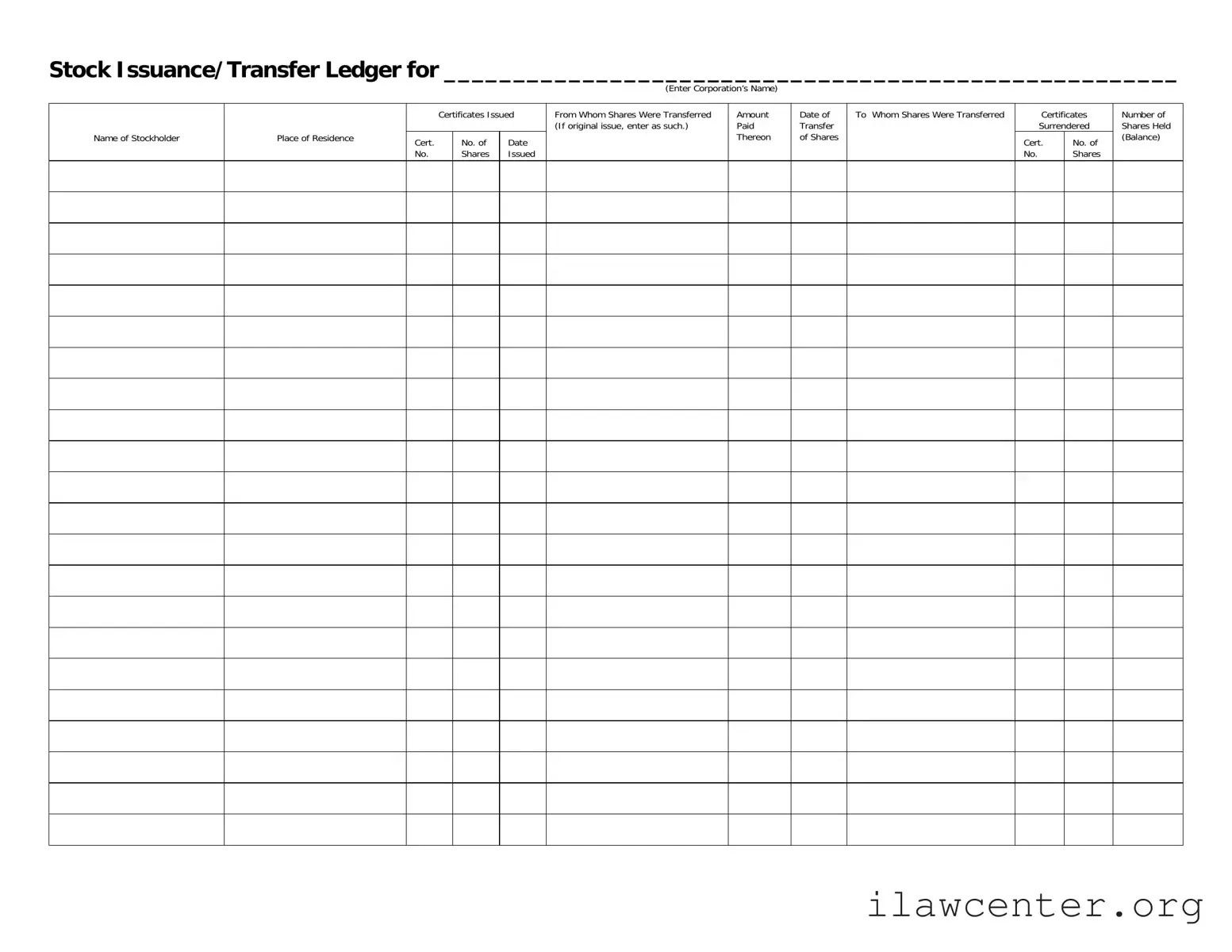

Stock Transfer Ledger PDF Template

Stock Transfer Ledger PDF Template

The Stock Transfer Ledger form is a crucial document used to track the issuance and transfer of shares within a corporation. It provides a clear record of stockholder details, certificates issued, and the history of share transfers. For accurate record-keeping and compliance, ensure you fill out the form by clicking the button below.

Article Guide

The Stock Transfer Ledger form is an essential document for any corporation managing its stock issuance and transfers. This form meticulously records key details such as the corporation's name and the stockholder's information, ensuring clarity in ownership. It includes sections for certificates issued, along with their corresponding certificate numbers and the dates on which shares were issued. The form also captures vital information about the transfer process, detailing from whom shares were transferred and to whom they are being transferred. If the shares are part of an original issue, this must be noted clearly. Additionally, the ledger tracks the amount paid for the shares, the date of transfer, and the certificates that have been surrendered. Lastly, it provides a space to indicate the number of shares held after the transfer, giving a complete picture of stock ownership at any point in time. This structured approach helps maintain accurate records and supports transparency in corporate stock transactions.

Stock Transfer Ledger Preview

Stock Issuance/Transfer Ledger for _____________________________________________________
(Enter Corporation’s Name)
Certificates Issued Certificates
Surrendered
Name of Stockholder Place of Residence
Cert.
No.
No. of
Shares
Date
Issued
From Whom Shares Were Transferred
(If original issue, enter as such.)
Amount
Paid
Thereon
Date of
Transfer
of Shares
To Whom Shares Were Transferred
Cert.
No.
No. of
Shares
Number of
Shares Held
(Balance)

File Properties

Fact Name Description
Purpose The Stock Transfer Ledger form tracks the issuance and transfer of shares in a corporation.
Required Information It requires details such as the corporation's name, stockholder's name, and certificates issued.
Transfer Details The form captures information about the transfer of shares, including the date and amount paid.
Original Issue If shares are originally issued, this must be clearly indicated on the form.
State-Specific Forms Different states may have specific requirements for Stock Transfer Ledgers governed by state corporate laws.
Balance Tracking The form helps maintain a record of the number of shares held after each transfer.

Instructions on Utilizing Stock Transfer Ledger

After completing the Stock Transfer Ledger form, you will be able to maintain an accurate record of stock transfers within your corporation. This documentation is essential for tracking ownership and ensuring compliance with corporate regulations.

  1. Enter the Corporation’s Name: Fill in the name of the corporation at the top of the form.
  2. Name of Stockholder: Write the name of the stockholder involved in the transfer.
  3. Place of Residence: Provide the stockholder’s residential address.
  4. Certificates Issued: Indicate the number of stock certificates that have been issued to the stockholder.
  5. Cert. No. of Shares Issued: Enter the certificate number for the shares that were issued.
  6. Date: Record the date when the shares were issued.
  7. From Whom Shares Were Transferred: If the shares are being transferred from another individual, write their name here. If this is the original issue, note that accordingly.
  8. Amount Paid Thereon: Specify the amount paid for the shares being transferred.
  9. Date of Transfer of Shares: Enter the date when the transfer of shares occurred.
  10. To Whom Shares Were Transferred: Write the name of the individual or entity receiving the shares.
  11. Certificates Surrendered: Indicate the certificate number of any shares that have been surrendered as part of the transfer.
  12. Cert. No. of Shares: Enter the certificate number for the shares being transferred.
  13. No. Shares: Specify the number of shares that are part of the transfer.
  14. Number of Shares Held (Balance): Finally, record the total number of shares held by the stockholder after the transfer.

Important Facts about Stock Transfer Ledger

What is the purpose of the Stock Transfer Ledger form?

The Stock Transfer Ledger form is used to record the issuance and transfer of stock shares within a corporation. It helps maintain an accurate account of who owns shares, the number of shares held, and any changes in ownership. This documentation is essential for corporate governance and compliance with legal requirements.

What information is required to complete the form?

To complete the Stock Transfer Ledger form, you need to provide the corporation's name, the stockholder's name, their place of residence, and details about the shares. This includes the certificate numbers, dates of issuance, the amount paid for the shares, and information about transfers, such as to whom the shares were transferred and the certificates surrendered.

Who is responsible for maintaining the Stock Transfer Ledger?

The corporation itself is responsible for maintaining the Stock Transfer Ledger. Typically, this task falls to the corporate secretary or another designated officer. It is crucial for ensuring that records are kept up to date and accurately reflect the ownership of shares.

How often should the Stock Transfer Ledger be updated?

The Stock Transfer Ledger should be updated each time there is a transfer of shares or when new shares are issued. This ensures that the records reflect the current ownership status and comply with regulatory requirements. Regular updates help prevent disputes over share ownership.

What happens if the Stock Transfer Ledger is not maintained properly?

If the Stock Transfer Ledger is not maintained properly, it can lead to legal issues, including disputes over ownership and potential regulatory penalties. Inaccurate records may also affect the corporation's ability to issue dividends or conduct shareholder meetings. Keeping accurate records is essential for the corporation's integrity and compliance.

Can the Stock Transfer Ledger be stored electronically?

Yes, the Stock Transfer Ledger can be stored electronically, provided that it meets legal requirements for record-keeping. Electronic records should be secure and backed up to prevent data loss. However, it is important to ensure that the electronic format is accessible and can be easily retrieved when necessary.

Common mistakes

Completing the Stock Transfer Ledger form requires attention to detail. One common mistake is failing to accurately enter the corporation’s name. This information must match the official documents of the corporation. Any discrepancies can lead to confusion and potential legal issues.

Another frequent error involves the incorrect entry of stockholder names. It is essential to ensure that the names are spelled correctly and reflect the official records. An error here can complicate the transfer process and may result in disputes over ownership.

Many individuals overlook the importance of documenting the certificates issued. The form requires specific certificate numbers, and omitting this information can create gaps in the transfer record. Each certificate number must be accurately listed to maintain a clear chain of ownership.

People often forget to indicate the amount paid for the shares. This detail is crucial for both tax purposes and for maintaining accurate financial records. Without this information, the transaction may not be recognized as valid, leading to potential complications.

Another mistake involves the date of transfer. It is vital to provide the correct date when the shares were transferred. Errors in this area can affect the timing of ownership and may have implications for dividends or other shareholder rights.

Finally, individuals sometimes neglect to indicate the number of shares held after the transfer. This final tally is necessary for both the corporation and the stockholder. It ensures that all parties have a clear understanding of ownership and can prevent future disputes regarding share distribution.

Documents used along the form

The Stock Transfer Ledger form is an essential document for tracking the ownership and transfer of shares in a corporation. Several other forms and documents complement this ledger, ensuring accurate record-keeping and compliance with regulations. Below is a list of related documents commonly used in conjunction with the Stock Transfer Ledger.

  • Stock Certificate: A physical document that represents ownership of shares in a corporation. It includes details such as the shareholder's name, the number of shares owned, and the corporation's name.
  • Stock Power: A legal document that allows a shareholder to transfer their shares to another party. It typically includes the name of the transferor, the transferee, and the number of shares being transferred.
  • Shareholder Agreement: A contract among shareholders that outlines the rights and responsibilities of each party. It often includes provisions for the transfer of shares and decision-making processes.
  • Bylaws: The rules governing the internal management of a corporation. Bylaws often include details on how shares can be issued and transferred, as well as the roles of shareholders.
  • Board Resolution: A formal decision made by a corporation's board of directors. This document may authorize the transfer of shares or the issuance of new shares, ensuring that such actions are legally valid.
  • Form 1099-DIV: A tax form used to report dividends and distributions to shareholders. It is important for shareholders to accurately report income received from their shares.
  • Transfer Agent Agreement: A contract between a corporation and a transfer agent, who manages the transfer of shares and maintains shareholder records. This agreement outlines the responsibilities of the transfer agent.
  • Notice of Shareholder Meeting: A document that informs shareholders about upcoming meetings. It often includes details about voting on significant issues, such as share transfers or corporate actions.
  • Certificate of Incorporation: The document that establishes a corporation's existence and outlines its basic structure. It may include provisions related to the issuance and transfer of shares.

These documents collectively support the effective management of share ownership and transfer within a corporation. Properly utilizing each form ensures compliance with legal requirements and promotes transparency among shareholders.

Similar forms

The Stock Transfer Ledger form serves a specific purpose in documenting the transfer of stock ownership. Several other documents share similarities with this form, each playing a crucial role in corporate governance and record-keeping. Here are five documents that resemble the Stock Transfer Ledger:

  • Shareholder Register: This document lists all shareholders of a corporation, including their contact information and the number of shares owned. Like the Stock Transfer Ledger, it tracks ownership and changes in stock ownership over time.
  • Stock Certificate: A stock certificate is a physical document that represents ownership of shares in a corporation. It includes details such as the shareholder's name and the number of shares, similar to the information recorded in the Stock Transfer Ledger.
  • Stock Option Agreement: This agreement outlines the terms under which an employee can purchase shares in a company. It provides details about the number of shares and the price, akin to the Stock Transfer Ledger's documentation of shares issued and transferred.
  • Annual Report: An annual report summarizes a corporation's financial performance and includes information about stock transactions. It may reference changes in stock ownership, paralleling the tracking function of the Stock Transfer Ledger.
  • Corporate Minutes: Minutes from board meetings often document decisions regarding stock issuance and transfers. They serve as an official record of actions taken, much like the Stock Transfer Ledger records the transfer of shares.

Dos and Don'ts

When filling out the Stock Transfer Ledger form, attention to detail is crucial. Here are some essential dos and don'ts to keep in mind:

  • Do enter the corporation’s name clearly at the top of the form.
  • Do ensure that the name of the stockholder is spelled correctly.
  • Do accurately fill in the place of residence for the stockholder.
  • Do list the correct certificate numbers and the corresponding number of shares issued.
  • Do specify the date of transfer for each transaction.
  • Don't leave any fields blank; every section must be completed.
  • Don't forget to indicate from whom the shares were transferred, especially if it's an original issue.
  • Don't use abbreviations that may confuse the reader.
  • Don't forget to surrender the certificates before transferring shares.

By following these guidelines, you can help ensure that the Stock Transfer Ledger form is filled out accurately and efficiently, minimizing the chances of errors that could lead to complications down the line.

Misconceptions

When dealing with the Stock Transfer Ledger form, several misconceptions often arise. Understanding these can help ensure proper use and compliance. Here are four common misconceptions:

  • It is only for large corporations. Many believe that only large companies need to maintain a Stock Transfer Ledger. In reality, any corporation that issues shares, regardless of size, should keep this record to track ownership and transfers.
  • It is not required by law. Some individuals think that maintaining a Stock Transfer Ledger is optional. However, many states require corporations to keep accurate records of stock ownership and transfers to comply with corporate governance laws.
  • It is the same as a stock certificate. There is a misconception that the Stock Transfer Ledger is equivalent to a stock certificate. In fact, the ledger serves as a record of transactions, while stock certificates are physical proof of ownership.
  • Only the secretary of the corporation needs to manage it. While the secretary often oversees the Stock Transfer Ledger, it is a shared responsibility. All corporate officers should be aware of its contents and updates to ensure accurate record-keeping.

By clarifying these misconceptions, individuals can better understand the importance of the Stock Transfer Ledger and its role in corporate governance.

Key takeaways

Filling out and using the Stock Transfer Ledger form is a critical task for maintaining accurate records of stock ownership. Here are key takeaways to consider:

  • Accurate Information: Ensure that all details entered, such as the corporation's name and stockholder information, are accurate and up to date.
  • Clear Documentation: Document each stock issuance and transfer clearly to avoid confusion in the future.
  • Certificate Numbers: Record the certificate numbers accurately to track the shares effectively.
  • Transfer Dates: Always include the date of transfer. This helps in maintaining a chronological record.
  • Amount Paid: Clearly indicate the amount paid for the shares to establish the financial details of the transaction.
  • Surrendered Certificates: Note any certificates that are surrendered during the transfer process.
  • Balance of Shares: Keep track of the number of shares held after each transaction to maintain an accurate balance.
  • Review Regularly: Regularly review the ledger to ensure all entries are complete and accurate, facilitating easier audits and compliance.