Straight Bill Of Lading PDF Template

Straight Bill Of Lading PDF Template

A Straight Bill of Lading is a legal document that serves as a receipt for goods and a contract for the transportation of those goods. This form is typically used when the shipment is consigned to a specific individual or organization, ensuring that only the designated recipient can claim the cargo. Understanding how to properly fill out this form is crucial for smooth shipping operations; start by clicking the button below to get started.

Article Guide

The Straight Bill of Lading form plays a crucial role in the shipping and transportation industry, serving as a vital document that facilitates the movement of goods from one location to another. This form acts as a receipt for the cargo, confirming that the carrier has received the goods as described. It outlines essential details, including the names and addresses of the shipper and consignee, a description of the goods being transported, and the terms of the shipment. Unlike other types of bills of lading, the Straight Bill of Lading is non-negotiable, meaning it cannot be transferred to another party. This characteristic provides a level of security for both the shipper and the consignee, ensuring that the goods are delivered directly to the intended recipient. Additionally, the form typically includes information about freight charges and any special instructions related to the shipment. Understanding the components and significance of the Straight Bill of Lading is essential for anyone involved in logistics, shipping, or supply chain management, as it ensures a smooth and efficient transfer of goods while minimizing the risk of disputes or misunderstandings.

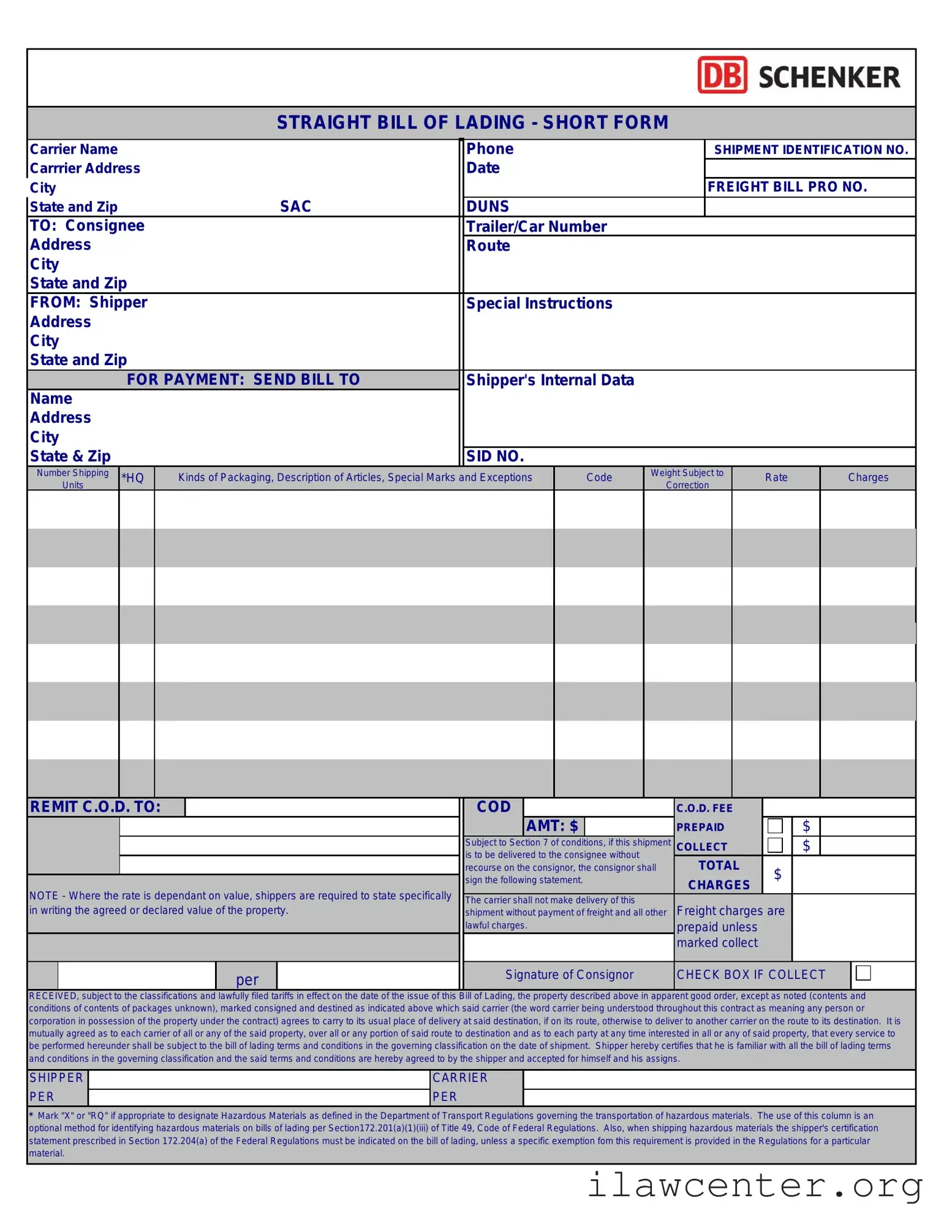
Straight Bill Of Lading Preview

Carrrier Address
*HQ
Number Shipping
Units
Kinds of Packaging, Description of Articles, Special Marks and Exceptions Code
Weight Subject to
Correction
Rate Charges
City
State & Zip SID NO.
FOR PAYMENT: SEND BILL TO
Shipper's Internal Data
Name
Address
City
State and Zip
FROM: Shipper
Special Instructions
Address
City
State and Zip
TO: Consignee
Trailer/Car Number
Address
Route
State and Zip SAC DUNS
Date
City
FREIGHT BILL PRO NO.
Carrier Name
Phone SHIPMENT IDENTIFICATION NO.
A
MT: $ $
$
State & Zip
$ per
Signature of Consignor CHECK BOX IF COLLECT
CHARGES
The carrier shall not make delivery of this
shipment without payment of freight and all other
lawful charges.
Freight charges are
prepaid unless
marked collect
The agreed or declared vlaue of the property is hereby specifically stated by the shipper t
o
be not exceeding
City
Subject to Section 7 of conditions, if this shipment
is to be delivered to the consignee without
recourse on the consignor, the consignor shall
sign the following statement.
COLLECT
TOTAL
$
in writing the agreed or declared value of the property.
COD
Address
PREPAID
REMIT C.O.D. TO:
RECEIVED, subject to the classifications and lawfully filed tariffs in effect on the date of the issue of this Bill of Lading, the property described above in apparent good order, except as noted (contents and
conditions of contents of packages unknown), marked consigned and destined as indicated above which said carrier (the word carrier being understood throughout this contract as meaning any person or
corporation in possession of the property under the contract) agrees to carry to its usual place of delivery at said destination, if on its route, otherwise to deliver to another carrier on the route to its destination. It is
mutually agreed as to each carrier of all or any of the said property, over all or any portion of said route to destination and as to each party at any time interested in all or any of said property, that every service to
be performed hereunder shall be subject to the bill of lading terms and conditions in the governing classification on the date of shipment. Shipper hereby certifies that he is familiar with all the bill of lading terms
and conditions in the governing classification and the said terms and conditions are hereby agreed to by the shipper and accepted for himself and his assigns.
NOTE - Where the rate is dependant on value, shippers are required to state specifically
C.O.D. FEE
STRAIGHT BILL OF LADING - SHORT FORM
SHIPPER CARRIER
PER PER
* Mark "X" or "RQ" if appropriate to designate Hazardous Materials as defined in the Department of Transport Regulations governing the transportation of hazardous materials. The use of this column is an
optional method for identifying hazardous materials on bills of lading per Section172.201(a)(1)(iii) of Title 49, Code of Federal Regulations. Also, when shipping hazardous materials the shipper's certification
statement prescribed in Section 172.204(a) of the Federal Regulations must be indicated on the bill of lading, unless a specific exemption fom this requirement is provided in the Regulations for a particular
material.
File Properties

Fact Name Description
Definition A Straight Bill of Lading is a document that serves as a receipt for goods and a contract for their transportation.
Non-Negotiable This type of bill of lading is non-negotiable, meaning it cannot be transferred to another party.
Consignee The goods are delivered only to the named consignee, who is specified in the document.
Governing Law In the United States, the Uniform Commercial Code (UCC) governs the use of bills of lading, including Straight Bills.
Usage Commonly used in domestic shipping, particularly for shipments where the consignee is known in advance.

Instructions on Utilizing Straight Bill Of Lading

Filling out the Straight Bill of Lading form is a crucial step in ensuring the proper transport of goods. This document serves as a receipt for the shipment and outlines the terms of the transportation agreement. Follow these steps to accurately complete the form.

  1. Shipper Information: Enter the name, address, and contact details of the shipper. This is the person or company sending the goods.
  2. Consignee Information: Fill in the name, address, and contact details of the consignee. This is the person or company receiving the goods.
  3. Carrier Information: Provide the name and contact details of the carrier responsible for transporting the goods.
  4. Shipment Details: Specify the date of shipment and any reference numbers related to the shipment.
  5. Goods Description: Clearly describe the items being shipped. Include quantity, weight, and any special handling instructions.
  6. Freight Charges: Indicate whether the freight charges are prepaid or collect. Provide the payment method if necessary.
  7. Signature: The shipper must sign and date the form to validate it. This signature confirms that all information is accurate.

After completing the form, make copies for your records and provide the necessary copies to the carrier and consignee. This ensures that all parties have the information needed for a smooth transaction.

Important Facts about Straight Bill Of Lading

What is a Straight Bill of Lading?

A Straight Bill of Lading is a shipping document that serves as a receipt for goods and a contract between the shipper and the carrier. It specifies the details of the shipment, including the type of goods, their destination, and the consignee. Unlike other types of bills of lading, a Straight Bill of Lading is non-negotiable, meaning it cannot be transferred to another party. The goods are delivered directly to the named consignee without the need for endorsement or further documentation.

What information is included in a Straight Bill of Lading?

The Straight Bill of Lading contains several key pieces of information. This includes the shipper's name and address, the consignee's name and address, a description of the goods being shipped, the shipping date, and any special instructions. Additionally, it may include the carrier's name, the freight charges, and the terms of transportation. All this information ensures clarity and accountability throughout the shipping process.

How does a Straight Bill of Lading differ from a Negotiable Bill of Lading?

The primary difference between a Straight Bill of Lading and a Negotiable Bill of Lading lies in their transferability. A Straight Bill of Lading is issued to a specific consignee and cannot be transferred to another party. In contrast, a Negotiable Bill of Lading can be endorsed and transferred, allowing the holder to claim the goods. This makes the Negotiable Bill of Lading more flexible for trade and financing purposes.

What are the advantages of using a Straight Bill of Lading?

Using a Straight Bill of Lading offers several advantages. First, it simplifies the shipping process by eliminating the need for endorsements. This can speed up the delivery of goods to the consignee. Second, it provides clear documentation of the shipment, which can help resolve disputes if they arise. Finally, since it is non-negotiable, it reduces the risk of fraud associated with transferring ownership of the goods during transit.

Is a Straight Bill of Lading legally binding?

Yes, a Straight Bill of Lading is a legally binding document. It establishes the terms of the contract between the shipper and the carrier. Both parties are obligated to adhere to the terms outlined in the document. If any issues arise, such as loss or damage to the goods, the Straight Bill of Lading serves as evidence in legal proceedings, helping to clarify responsibilities and liabilities.

Common mistakes

Filling out a Straight Bill of Lading form can be straightforward, but mistakes often occur. One common error is providing incomplete information. When the sender or receiver's details are missing, it can lead to delays or misdelivery of goods. Always double-check that all fields are filled out completely.

Another frequent mistake is incorrect descriptions of the goods. It is essential to accurately describe the items being shipped, including quantity and type. Misdescriptions can result in disputes or even legal issues down the line. Be specific and clear about what is being transported.

People sometimes fail to include the correct shipping instructions. This can cause confusion for the carrier and may lead to improper handling of the shipment. Clearly outline any special instructions or requirements to ensure the goods are treated appropriately.

Using the wrong unit of measurement is another mistake that can occur. For instance, mixing up pounds with kilograms can lead to significant discrepancies in shipping costs and logistics. Always verify the units of measurement to avoid complications.

Omitting the date is a common oversight. A date is crucial for tracking and accountability. Without it, issues may arise regarding the timeline of the shipment. Make sure to include the date when the bill of lading is completed.

Another error is not signing the form. A signature is often required to validate the document. Without it, the bill of lading may be considered invalid. Ensure that all necessary signatures are obtained before submitting the form.

Lastly, failing to keep a copy for personal records is a mistake that can lead to problems later. A copy of the Straight Bill of Lading serves as proof of shipment and can be vital in case of disputes. Always retain a copy for your records.

Documents used along the form

The Straight Bill of Lading is a critical document in the shipping and transportation industry, serving as a receipt for goods and a contract between the shipper and the carrier. Several other forms and documents often accompany it to ensure smooth operations and compliance with regulations. Below is a list of common documents used alongside the Straight Bill of Lading.

  • Commercial Invoice: This document details the transaction between the buyer and seller, including the price, quantity, and description of the goods being shipped.
  • Packing List: A packing list outlines the contents of each package, including dimensions and weight, helping carriers and recipients verify the shipment.
  • Certificate of Origin: This document certifies the country in which the goods were manufactured. It may be required for customs clearance in certain jurisdictions.
  • Import/Export Declaration: This form provides information to customs authorities about the goods being imported or exported, ensuring compliance with trade regulations.
  • Delivery Receipt: A delivery receipt is signed by the recipient upon receiving the goods, confirming that the shipment has been delivered in good condition.
  • Insurance Certificate: This document proves that the shipment is insured, providing financial protection against loss or damage during transit.
  • Dock Receipt: A dock receipt is issued by the carrier when the goods are received at the dock, serving as proof of receipt for the shipper.
  • Freight Bill: This document details the charges for transporting the goods, including any additional fees or surcharges applicable to the shipment.
  • Customs Bond: A customs bond is a contract ensuring that duties, taxes, and penalties owed to customs will be paid, often required for importing goods.

These documents collectively facilitate the shipping process, ensuring that all parties are informed and compliant with legal and regulatory requirements. Proper management of these forms helps prevent delays and disputes in the transportation of goods.

Similar forms

  • Uniform Commercial Code (UCC) Bill of Lading: Like the Straight Bill of Lading, this document serves as a receipt for goods and a contract for transportation. It is governed by the UCC, which standardizes commercial transactions across states.
  • Sea Waybill: Similar to the Straight Bill of Lading, the Sea Waybill acts as a receipt and contract for shipping goods by sea. However, it does not confer title to the goods, making it less formal than a traditional bill of lading.
  • Air Waybill: This document is used for air freight shipments. It serves as a receipt for the goods and a contract of carriage, similar to the Straight Bill of Lading, but specifically for air transport.
  • Warehouse Receipt: A Warehouse Receipt functions as proof of ownership for goods stored in a warehouse. It is similar in that it acts as a receipt, but it pertains to storage rather than transportation.
  • Freight Bill: This document outlines the charges for transporting goods. While it details payment terms, it also serves as a receipt for the shipment, akin to the Straight Bill of Lading.
  • Delivery Order: A Delivery Order instructs a carrier or warehouse to release goods to a specified party. It shares similarities with the Straight Bill of Lading in terms of facilitating the transfer of goods.
  • Consignment Note: This document is used in shipping to confirm that goods have been sent. Like the Straight Bill of Lading, it provides evidence of the shipment but may not always include a contract for transportation.
  • Transport Document: A generic term that encompasses various documents used in shipping. It serves a similar purpose to the Straight Bill of Lading by documenting the transport of goods.
  • Export Declaration: This document is required for goods being exported. While it focuses on compliance and customs, it is similar in that it tracks the movement of goods across borders.
  • Import Permit: An Import Permit is necessary for bringing goods into a country. It ensures compliance with regulations, similar to how the Straight Bill of Lading facilitates legal transport.

Dos and Don'ts

When filling out the Straight Bill of Lading form, attention to detail is crucial. This document serves as a receipt for the goods being transported and outlines the terms of the shipment. Here are some essential dos and don’ts to consider:

  • Do ensure all information is accurate and complete.
  • Do include the shipper's and consignee's full names and addresses.
  • Do describe the goods clearly, including quantity and type.
  • Do indicate the method of payment for shipping costs.
  • Do sign and date the form to validate it.
  • Don't leave any sections blank; incomplete forms can lead to delays.
  • Don't use vague terms when describing the goods.
  • Don't forget to keep a copy of the completed form for your records.
  • Don't ignore specific carrier requirements or regulations.

By following these guidelines, you can help ensure a smooth shipping process and minimize potential issues with your shipment.

Misconceptions

The Straight Bill of Lading is a crucial document in the shipping and freight industry, yet several misconceptions surround it. Understanding these misunderstandings can help individuals navigate logistics more effectively. Here are six common misconceptions:

  1. It is the same as a regular bill of lading. Many people believe that all bills of lading serve the same purpose. However, a Straight Bill of Lading is specifically non-negotiable, meaning it cannot be transferred to another party. In contrast, a negotiable bill of lading can be endorsed and transferred, allowing for more flexibility in ownership.

  2. It guarantees payment. Some assume that having a Straight Bill of Lading ensures that the shipper will receive payment for the goods. While it serves as a receipt and proof of shipment, it does not inherently guarantee payment. Payment terms should be established separately.

  3. It is only used for domestic shipments. A common belief is that the Straight Bill of Lading is limited to domestic shipping. In reality, it can be used for international shipments as well, provided that the parties involved agree to its terms.

  4. It is not legally binding. Some people think that a Straight Bill of Lading lacks legal weight. This is incorrect. It serves as a legally binding document between the shipper and the carrier, outlining the responsibilities and liabilities of each party.

  5. It can be altered after issuance. There is a misconception that changes can be made to a Straight Bill of Lading once it has been issued. In fact, alterations can lead to disputes and may invalidate the document. Any necessary changes should be made before the bill is finalized.

  6. It is only for large shipments. Many believe that only large shipments require a Straight Bill of Lading. However, this document can be utilized for shipments of any size, as long as the terms of the agreement are met.

By clarifying these misconceptions, individuals can better understand the role and function of the Straight Bill of Lading in the shipping process.

Key takeaways

When filling out and using the Straight Bill of Lading form, keep these key takeaways in mind:

  1. Understand the Purpose: The Straight Bill of Lading serves as a receipt for goods and a contract for transportation.
  2. Fill in Accurate Information: Ensure all details, such as sender, receiver, and shipment specifics, are correct to avoid issues.
  3. Use Clear Language: Write legibly and clearly to prevent misunderstandings about the shipment.
  4. Include Shipment Details: List the type, quantity, and condition of the goods being shipped.
  5. Sign the Document: Both the shipper and the carrier should sign the form to validate it.
  6. Keep Copies: Retain copies of the completed Bill of Lading for your records and future reference.
  7. Understand Liability: Know that the carrier's liability for loss or damage may be limited unless declared otherwise.
  8. Check for Additional Terms: Review any additional terms or conditions that may apply to your shipment.
  9. Use for Specific Shipments: The Straight Bill of Lading is typically used for shipments that are prepaid and not subject to change.
  10. Consult with Professionals: If unsure about any part of the form, consider seeking advice from a shipping or legal expert.