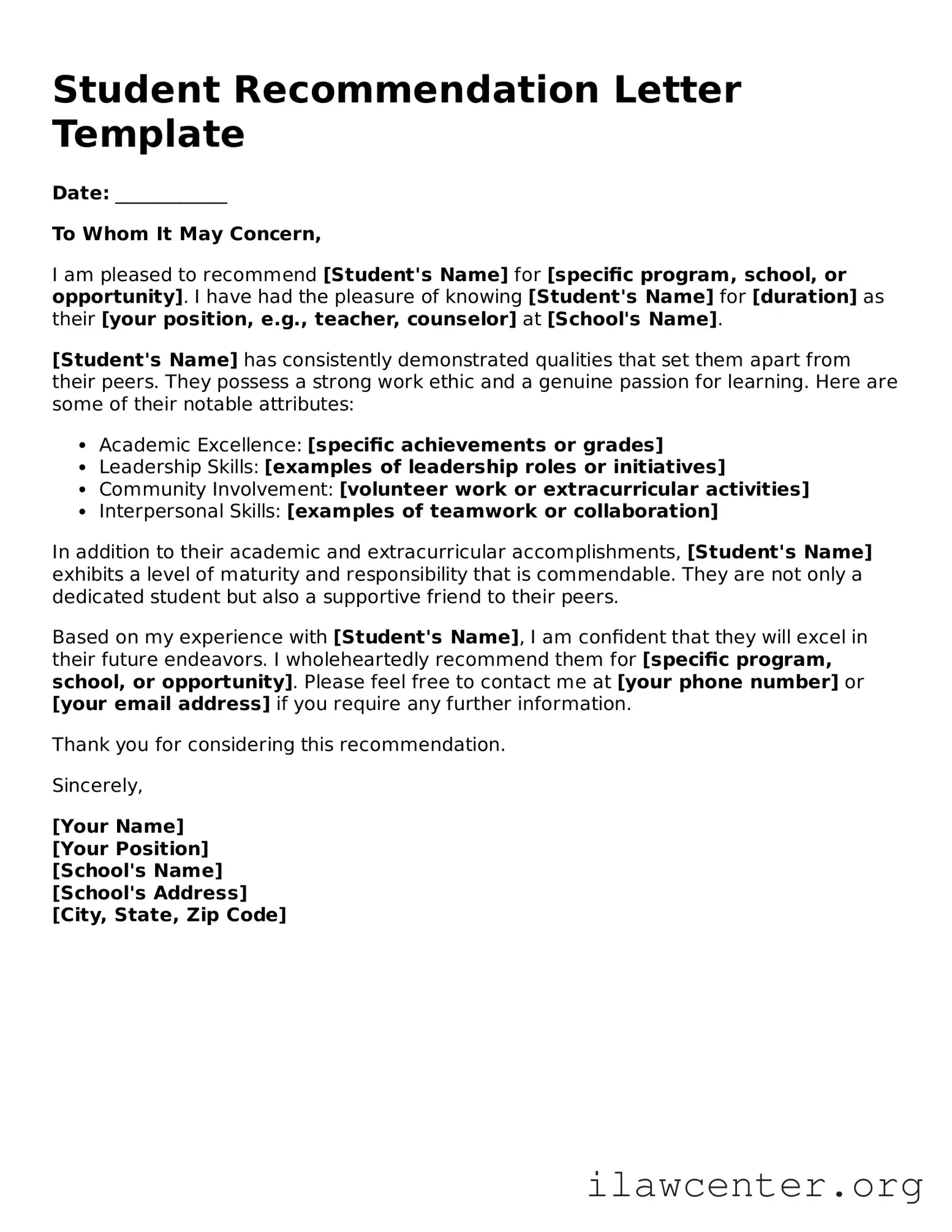
Fillable Student Recommendation Letter Document

Fillable Student Recommendation Letter Document

The Student Recommendation Letter form is a document used to request a letter of recommendation for a student from a teacher, counselor, or other qualified individual. This form helps streamline the process, ensuring that all necessary information is provided to support the student’s application. To get started, fill out the form by clicking the button below.

Article Guide

The Student Recommendation Letter form serves as a crucial tool in the academic and professional advancement of students. It is often utilized by educators, mentors, or supervisors to provide insights into a student's capabilities, character, and achievements. This form typically includes sections for the recommender's contact information, the relationship to the student, and specific qualities or experiences that highlight the student's strengths. Additionally, it may request the recommender to address particular skills or accomplishments relevant to the opportunity the student is pursuing, whether that be college admissions, scholarships, or internships. The overall purpose of the form is to present a well-rounded view of the student, allowing admissions committees or employers to make informed decisions based on the insights provided. Proper completion of this form can significantly impact a student's application, making it essential for recommenders to carefully consider their responses and provide detailed, honest evaluations.

Student Recommendation Letter Preview

Student Recommendation Letter Template

Date: ____________

To Whom It May Concern,

I am pleased to recommend [Student's Name] for [specific program, school, or opportunity]. I have had the pleasure of knowing [Student's Name] for [duration] as their [your position, e.g., teacher, counselor] at [School's Name].

[Student's Name] has consistently demonstrated qualities that set them apart from their peers. They possess a strong work ethic and a genuine passion for learning. Here are some of their notable attributes:

  • Academic Excellence: [specific achievements or grades]
  • Leadership Skills: [examples of leadership roles or initiatives]
  • Community Involvement: [volunteer work or extracurricular activities]
  • Interpersonal Skills: [examples of teamwork or collaboration]

In addition to their academic and extracurricular accomplishments, [Student's Name] exhibits a level of maturity and responsibility that is commendable. They are not only a dedicated student but also a supportive friend to their peers.

Based on my experience with [Student's Name], I am confident that they will excel in their future endeavors. I wholeheartedly recommend them for [specific program, school, or opportunity]. Please feel free to contact me at [your phone number] or [your email address] if you require any further information.

Thank you for considering this recommendation.

Sincerely,

[Your Name]
[Your Position]
[School's Name]
[School's Address]
[City, State, Zip Code]

PDF Form Characteristics

Fact Name Description
Purpose The Student Recommendation Letter form is used to provide insights into a student's character, achievements, and potential for future success.
Common Uses This form is often required for college applications, scholarship submissions, and job opportunities.
Who Can Write Teachers, counselors, coaches, and employers are typically qualified to write these letters.
Content Requirements A strong recommendation letter should include specific examples of the student's skills and accomplishments.
Length Most recommendation letters are one to two pages long, providing enough detail without being overly lengthy.
Confidentiality Some institutions allow students to waive their right to view the letter, which can enhance its credibility.
State-Specific Forms Some states may have specific guidelines or forms for recommendation letters, governed by educational laws.
Submission Process Letters can often be submitted online, mailed directly, or given to the student in a sealed envelope, depending on the institution's requirements.

Instructions on Utilizing Student Recommendation Letter

Completing the Student Recommendation Letter form is an important step in supporting a student’s application. By following the steps outlined below, you can ensure that the form is filled out accurately and effectively, providing a strong recommendation.

  1. Begin by reading the entire form carefully to understand what information is required.
  2. Gather relevant information about the student, including their academic achievements, extracurricular activities, and personal qualities.
  3. Fill in your personal details at the top of the form, including your name, title, and contact information.
  4. Provide the student's name and any identifying information requested on the form.
  5. In the designated section, write your recommendation. Focus on specific examples that highlight the student’s strengths and potential.
  6. Review your recommendation to ensure clarity and coherence. Make sure your points are well-organized.
  7. Sign and date the form where indicated. This adds authenticity to your recommendation.
  8. Submit the completed form as directed, whether electronically or in hard copy.

Important Facts about Student Recommendation Letter

What is a Student Recommendation Letter form?

The Student Recommendation Letter form is a document used to request a recommendation letter from a teacher, counselor, or other individual who can speak to a student's abilities and character. This letter is often required for college applications, scholarships, or other academic opportunities.

Who should I ask to write my recommendation letter?

It's best to ask someone who knows you well and can provide specific examples of your skills and achievements. This could be a teacher from a relevant subject, a school counselor, or even a coach. Choose someone who can highlight your strengths and contributions.

How do I fill out the Student Recommendation Letter form?

To fill out the form, provide your basic information, such as your name, contact details, and the purpose of the recommendation letter. Be clear about any deadlines and any specific points you would like the writer to address. Make sure to express gratitude for their time and effort.

When should I submit the Student Recommendation Letter form?

Submit the form well in advance of any deadlines. Ideally, give your recommender at least two to four weeks to write the letter. This allows them enough time to craft a thoughtful and detailed recommendation without feeling rushed.

Can I see the recommendation letter before it is submitted?

It is courteous to ask your recommender if you can review the letter. However, many recommenders prefer to keep their letters confidential to maintain their authenticity. Respect their choice, but do communicate any specific points you want them to include.

What should I do if my recommender does not submit the letter on time?

If the letter is not submitted by the deadline, reach out to your recommender politely to check on its status. Sometimes, a gentle reminder can help. If they are unable to complete it in time, consider asking someone else to write a recommendation letter for you.

Common mistakes

When it comes to filling out a Student Recommendation Letter form, many individuals inadvertently make mistakes that can undermine the effectiveness of the recommendation. One common error is failing to provide specific examples of the student's achievements and qualities. Generic statements may not capture the essence of the student, leaving the reader with a lack of understanding about their true capabilities.

Another frequent mistake is neglecting to follow the guidelines provided by the institution requesting the recommendation. Each school or program may have specific requirements regarding length, format, or content. Ignoring these details can result in a recommendation that does not meet the expectations of the admissions committee.

Additionally, some recommenders may overlook the importance of a personal touch. A recommendation that reads like a form letter can feel impersonal and may not resonate with the reader. Including anecdotes or personal insights about the student's character can make a significant difference in how the recommendation is perceived.

Another mistake involves failing to proofread the letter before submission. Spelling errors, grammatical mistakes, or awkward phrasing can detract from the overall professionalism of the recommendation. Taking the time to review the letter can help ensure that it reflects positively on both the student and the recommender.

Many recommenders also forget to address the specific qualities or skills that are relevant to the program the student is applying for. Tailoring the recommendation to highlight attributes that align with the desired traits for the program can strengthen the letter's impact.

Moreover, some individuals may not take the time to reflect on the student's growth over time. A recommendation that discusses the student's progress, challenges overcome, and how they have evolved can provide a more comprehensive view of their potential.

Finally, a lack of enthusiasm can hinder the effectiveness of a recommendation. If a recommender seems indifferent or fails to convey genuine support for the student, it may raise questions about the student's qualifications. A heartfelt endorsement can leave a lasting impression and bolster the student's application.

Documents used along the form

When applying for educational programs, students often need to submit various forms and documents alongside their Student Recommendation Letter. Each of these documents plays a crucial role in presenting a comprehensive view of the applicant's qualifications, character, and readiness for the desired program. Below is a list of commonly used forms and documents.

  • Application Form: This is the primary document that collects essential information about the student, including personal details, educational background, and program of interest.
  • Transcript: An official record of the student's academic performance, detailing courses taken, grades received, and overall GPA.
  • Personal Statement: A written essay where the student articulates their goals, motivations, and reasons for pursuing the program.
  • Resume or CV: A summary of the student's educational background, work experience, skills, and extracurricular activities.
  • Standardized Test Scores: Results from tests such as the SAT, ACT, GRE, or others, which may be required for admission to certain programs.
  • Financial Aid Application: A form that assesses the student's financial need and eligibility for scholarships or loans.
  • Portfolio: A collection of the student's work, often required for creative programs, showcasing skills and accomplishments in relevant areas.
  • Interview Evaluation: A document that summarizes the findings from an interview with the applicant, often used to assess fit and readiness for the program.
  • Supplemental Letters of Recommendation: Additional letters from other individuals who can speak to the student's qualifications and character.

Each of these documents contributes to a holistic understanding of the student, allowing admissions committees to make informed decisions. It is essential for students to prepare these materials carefully to enhance their chances of acceptance.

Similar forms

The Student Recommendation Letter form shares similarities with several other documents commonly used in academic and professional settings. Here are eight documents that are comparable:

  • Job Recommendation Letter: Like a student recommendation letter, this document highlights an individual's skills and experiences, often written by a supervisor or colleague to support a job application.
  • College Admission Essay: Both documents provide insights into a candidate's character and achievements, although the essay is typically more personal and reflective.
  • Scholarship Application Letter: Similar in purpose, this letter advocates for a student's qualifications for financial aid, emphasizing academic and extracurricular accomplishments.
  • Character Reference Letter: This document, often requested for personal matters, discusses a person's integrity and moral character, akin to how a recommendation letter addresses a student's qualities.
  • Internship Recommendation Letter: This letter serves to endorse a student's suitability for an internship, focusing on relevant skills and experiences, much like a student recommendation letter.
  • Graduate School Recommendation Letter: Written by professors or professionals, this letter evaluates a student's readiness for advanced study, paralleling the student recommendation letter's evaluative nature.
  • Professional Reference Letter: This document is used in job searches to vouch for a candidate's work ethic and skills, similar to how a student recommendation letter supports a student's application.
  • Personal Statement: While more introspective, a personal statement and a recommendation letter both aim to present the applicant in a favorable light, showcasing their strengths and aspirations.

Dos and Don'ts

When completing a Student Recommendation Letter form, certain practices can enhance the quality of the recommendation, while others may detract from it. Below is a list of things to do and avoid.

Things You Should Do:

  • Provide accurate and specific information about the student.
  • Highlight the student’s strengths and achievements.
  • Use clear and concise language.
  • Include examples that illustrate the student’s skills and character.
  • Follow any specific guidelines or requirements outlined in the form.

Things You Shouldn't Do:

  • Do not exaggerate the student’s abilities or accomplishments.
  • Avoid using vague or generic statements.
  • Do not include irrelevant personal opinions or anecdotes.
  • Refrain from making negative comments about the student.
  • Do not submit the form late or without proper signatures, if required.

Misconceptions

When it comes to the Student Recommendation Letter form, there are several misconceptions that can lead to confusion. Here are four common misunderstandings:

  • All recommenders must be teachers. Many believe that only teachers can write recommendation letters. In reality, anyone who knows the student well can provide a meaningful recommendation. This includes coaches, employers, or community leaders.
  • The letter must be lengthy to be effective. Some think that a longer letter is always better. However, a concise letter that highlights specific strengths and experiences can be just as powerful. Quality matters more than quantity.
  • Recommendation letters are only for college applications. While they are commonly used for college admissions, recommendation letters can also be important for scholarships, internships, and job applications. They play a role in various opportunities.
  • Students should not be involved in the letter writing process. It's a common belief that students should remain completely hands-off. In fact, students can help by providing recommenders with information about their achievements and goals. This can lead to a more personalized letter.

Key takeaways

When filling out and using the Student Recommendation Letter form, keep these key points in mind:

  1. Understand the purpose: This letter serves to highlight a student's strengths and qualifications for a specific opportunity.
  2. Choose the right recommender: Select someone who knows the student well and can provide specific examples of their abilities.
  3. Provide context: The recommender should understand the context of the recommendation, including the program or school the student is applying to.
  4. Be honest: Authenticity matters. The letter should reflect the true capabilities and character of the student.
  5. Use specific examples: Concrete instances of the student’s achievements or contributions can make the recommendation more compelling.
  6. Follow the guidelines: Adhere to any specific instructions provided by the institution regarding format and content.
  7. Proofread: Ensure the letter is free of grammatical errors and typos to maintain professionalism.
  8. Be timely: Submit the letter well before the deadline to avoid any last-minute issues.
  9. Maintain confidentiality: If possible, the student should not read the letter to keep it candid and trustworthy.
  10. Include contact information: The recommender should provide their contact details for any follow-up questions from the institution.

These takeaways will help ensure that the Student Recommendation Letter is effective and impactful.