Fillable Talent Release Document

Fillable Talent Release Document

A Talent Release form is a legal document that grants permission for the use of an individual's likeness, voice, or performance in various media projects. This form protects both the talent and the production team by clearly outlining the rights and responsibilities associated with the use of the talent's image and work. To ensure proper authorization, consider filling out the form by clicking the button below.

Article Guide

In the world of creative projects, whether in film, photography, or other media, the Talent Release form plays a crucial role in ensuring that all parties are protected and clear about their rights and responsibilities. This document serves as a legal agreement between the talent—such as actors, models, or musicians—and the production team or company. It typically outlines the scope of the project, detailing how the talent's likeness, voice, or performance may be used. By signing this form, individuals grant permission for their image or performance to be recorded and distributed, often in exchange for compensation or other benefits. Additionally, it may include clauses that address the duration of the rights granted, any limitations on usage, and the acknowledgment of the talent's rights to privacy and publicity. Understanding the importance of this form can help both talent and producers navigate the complexities of intellectual property and avoid potential disputes down the line.

Talent Release Preview

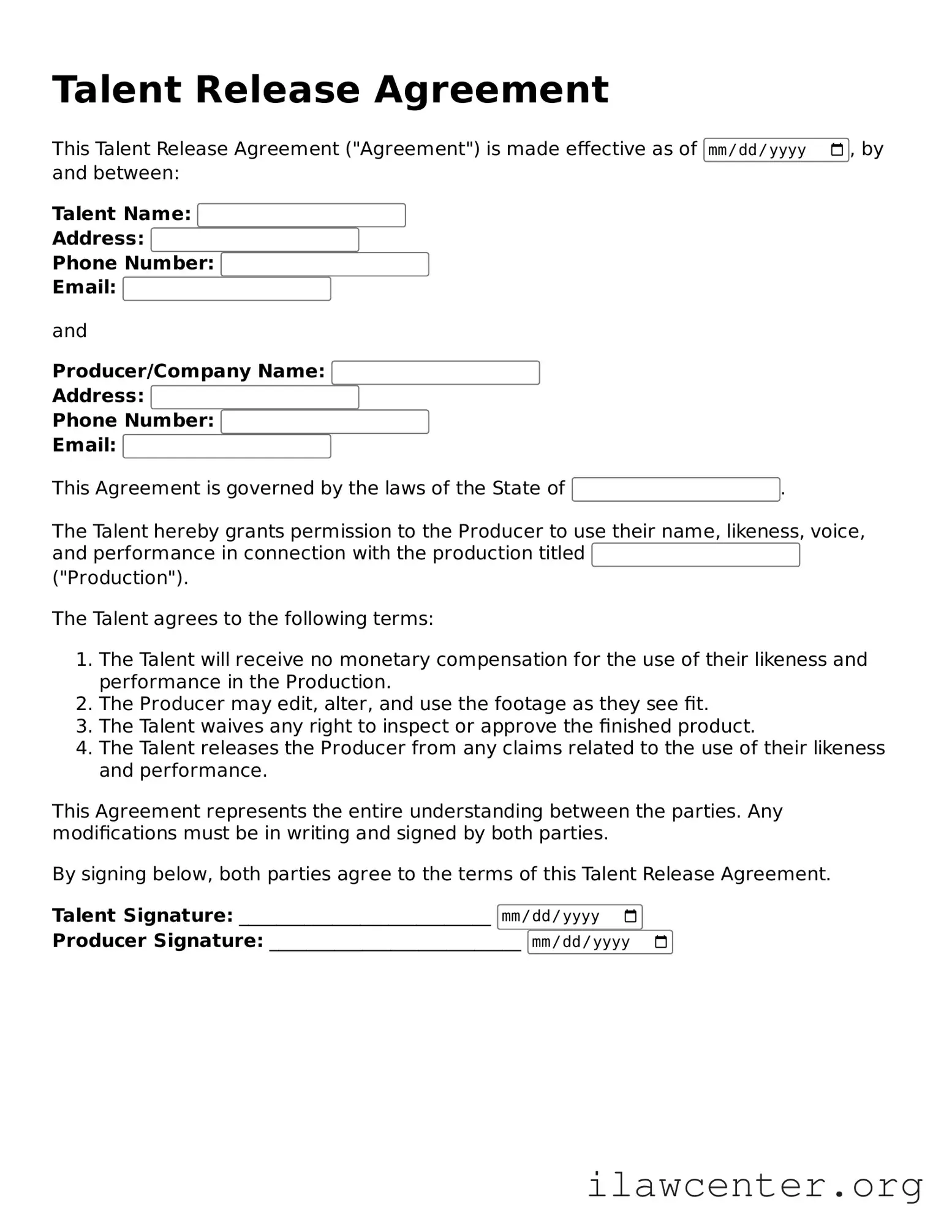
Talent Release Agreement

This Talent Release Agreement ("Agreement") is made effective as of , by and between:

Talent Name:
Address:
Phone Number:
Email:

and

Producer/Company Name:
Address:
Phone Number:
Email:

This Agreement is governed by the laws of the State of .

The Talent hereby grants permission to the Producer to use their name, likeness, voice, and performance in connection with the production titled ("Production").

The Talent agrees to the following terms:

  1. The Talent will receive no monetary compensation for the use of their likeness and performance in the Production.
  2. The Producer may edit, alter, and use the footage as they see fit.
  3. The Talent waives any right to inspect or approve the finished product.
  4. The Talent releases the Producer from any claims related to the use of their likeness and performance.

This Agreement represents the entire understanding between the parties. Any modifications must be in writing and signed by both parties.

By signing below, both parties agree to the terms of this Talent Release Agreement.

Talent Signature: ___________________________
Producer Signature: ___________________________

PDF Form Characteristics

Fact Name Description
Definition A Talent Release form is a legal document that grants permission to use an individual's likeness, voice, or performance in various media.
Purpose This form protects creators and organizations from potential legal disputes regarding the use of a person's image or performance.
Key Elements The form typically includes the individual's name, the scope of the release, and the types of media in which the likeness may be used.
State Variations Different states may have specific requirements or variations for Talent Release forms, reflecting local laws.
Governing Law - California In California, the right of publicity is governed by Civil Code Section 3344, which protects individuals from unauthorized commercial use of their likeness.
Governing Law - New York New York's Civil Rights Law Sections 50 and 51 provide protections against the unauthorized use of an individual's name or likeness for commercial purposes.
Importance of Clarity It is crucial that the form is clear and comprehensive to avoid misunderstandings and ensure all parties are aware of their rights and obligations.

Instructions on Utilizing Talent Release

Completing the Talent Release form is an important step in the process of securing rights for the use of an individual's likeness or performance. After filling out the form, it will be submitted for review and approval, ensuring that all necessary permissions are documented appropriately.

  1. Begin by entering the full name of the talent in the designated field.
  2. Provide the contact information, including phone number and email address, ensuring accuracy for future correspondence.
  3. Fill in the date of birth to confirm the talent's age and eligibility.
  4. Specify the project title for which the release is being granted, making sure it matches any official documentation.
  5. Indicate the date of the shoot or performance, if applicable, to establish a timeline for the release.
  6. Include any additional notes or special instructions in the provided section, if necessary.
  7. Sign and date the form at the bottom to validate the agreement.

Important Facts about Talent Release

What is a Talent Release form?

A Talent Release form is a legal document that grants permission for the use of an individual’s likeness, image, voice, or performance in various media. This form is typically used in film, television, photography, and other creative projects. By signing this document, the individual allows the producer or creator to use their contributions without further compensation or approval.

Why is a Talent Release form important?

This form is crucial for protecting both the talent and the producer. It ensures that the producer has the legal right to use the talent's image or performance, thereby avoiding potential disputes or claims in the future. For the talent, it clarifies how their likeness will be used and helps to establish their rights regarding compensation and credit.

Who needs to sign a Talent Release form?

Anyone who appears in a project and whose likeness or performance will be used commercially should sign a Talent Release form. This includes actors, models, musicians, and even individuals who may appear in background shots or be featured in promotional materials.

When should a Talent Release form be signed?

The form should be signed before any filming or recording takes place. Obtaining consent in advance helps to avoid any misunderstandings and ensures that the project can proceed smoothly. It is advisable to have the form signed as part of the pre-production process.

What happens if a Talent Release form is not signed?

If a Talent Release form is not signed, the producer may face legal challenges when attempting to use the talent's image or performance. The talent may assert their rights, potentially leading to lawsuits, demands for compensation, or the removal of the content from circulation.

Can a Talent Release form be revoked?

Generally, once a Talent Release form is signed, it cannot be revoked. However, the specific terms of the release may allow for certain conditions under which the talent can withdraw their consent. It is essential to read the document carefully to understand any limitations or stipulations regarding revocation.

What should be included in a Talent Release form?

A comprehensive Talent Release form should include the names of the parties involved, a description of the project, the scope of usage for the talent’s likeness, any compensation details, and the duration of the agreement. It should also clarify any rights the talent retains and any limitations on the use of their image or performance.

Is a Talent Release form necessary for non-commercial projects?

While a Talent Release form is often associated with commercial projects, it is still advisable to use one for non-commercial endeavors. Even in informal settings, having a signed release can help prevent misunderstandings and protect both parties' interests. It establishes clear expectations regarding the use of the talent's likeness.
Common mistakes

Filling out a Talent Release form can be straightforward, but many people make common mistakes that can lead to complications later. One frequent error is not providing complete personal information. It is crucial to include full names, contact details, and any relevant identification numbers. Missing this information can delay the approval process or even render the form invalid.

Another mistake is failing to read the terms carefully. Some individuals overlook important clauses regarding usage rights and compensation. Understanding these terms is essential to ensure that you are comfortable with how your image or performance will be used. Ignoring them can lead to misunderstandings down the line.

People often forget to sign and date the form. A signature is a legal acknowledgment of the agreement, and without it, the document holds no weight. Double-checking that the form is signed and dated before submission can save time and hassle.

In some cases, individuals do not provide the necessary parental or guardian consent when applicable. If a minor is involved, a parent or guardian must sign the form. Failing to do so can result in the form being rejected or invalidated.

Another common oversight is neglecting to specify the scope of the release. It is important to clarify how the content will be used, whether for promotional materials, social media, or other purposes. Without this clarity, there may be confusion about the extent of the release.

Some people assume that verbal agreements are sufficient. However, a Talent Release form is a written contract, and verbal agreements can be difficult to enforce. Always ensure that all agreements are documented in the form.

Individuals sometimes overlook the need for witnesses or notarization, depending on the requirements of the project. Not all Talent Release forms require this, but when they do, failing to include a witness can invalidate the agreement.

Another mistake is not keeping a copy of the completed form. Retaining a copy is essential for your records. It provides proof of the agreement and can be helpful if any disputes arise later.

Finally, people may not follow the submission guidelines. Each project may have specific requirements for how to submit the form, whether electronically or in hard copy. Ignoring these guidelines can lead to delays or rejection of the form.

Documents used along the form

When working with talent in creative projects, several key documents often accompany the Talent Release form. Each of these forms serves a specific purpose to ensure clarity and protect the rights of all parties involved. Below is a list of commonly used forms and documents.

  • Model Release Form: This document grants permission for the use of a model's likeness in photographs or videos. It ensures that the photographer or producer can legally use the images for commercial purposes.
  • Location Release Form: This form secures permission from property owners to film or photograph on their premises. It outlines the terms of use and protects against potential legal issues.
  • Production Agreement: This contract outlines the terms between the production company and the talent. It includes details about compensation, roles, and responsibilities, ensuring everyone is on the same page.
  • Non-Disclosure Agreement (NDA): An NDA protects sensitive information shared during the project. It prevents talent and crew from disclosing confidential details about the production.
  • Copyright Assignment Agreement: This document transfers ownership of creative work from the creator to another party. It clarifies who holds the rights to the content produced during the project.

Using these forms in conjunction with the Talent Release form helps create a smooth and legally sound production process. Each document plays a vital role in protecting the interests of everyone involved, ensuring a successful collaboration.

Similar forms

The Talent Release form is an essential document in the entertainment industry, particularly for anyone involved in film, television, or photography. It grants permission for the use of an individual's likeness, voice, or performance. Several other documents share similarities with the Talent Release form, each serving a unique purpose while providing legal protection and clarity. Here are nine documents that are comparable:

  • Model Release: This document allows photographers or artists to use images of a model for commercial purposes. Like the Talent Release, it secures permission for likeness usage.
  • Location Release: When filming on private property, this form ensures that the property owner permits the use of their location. It mirrors the Talent Release in that it formalizes consent for use.
  • Music License Agreement: This contract allows the use of a specific piece of music in a project. Similar to the Talent Release, it protects the rights of the original creator while granting permission for use.
  • Copyright Assignment: This document transfers ownership of a creative work from one party to another. It parallels the Talent Release by ensuring that rights are clearly defined and assigned.
  • Screenplay Option Agreement: This allows a producer to secure rights to a screenplay for a specified time. Like the Talent Release, it involves the granting of rights and permissions.
  • Voiceover Release: This form gives permission to use a voice actor's recording in a project. It is akin to the Talent Release as it outlines the terms of use for the performer’s voice.
  • Performance Release: Similar to the Talent Release, this document secures permission from performers to use their performance in various media formats.
  • Distribution Agreement: This contract outlines the terms under which a film or media project will be distributed. It shares similarities with the Talent Release in that it defines rights and permissions for distribution.
  • Collaboration Agreement: When multiple parties work together on a creative project, this document outlines the contributions and rights of each party. It resembles the Talent Release by clarifying permissions among collaborators.

Understanding these documents can help ensure that all parties involved in a project are protected and that their rights are respected. Each document plays a vital role in the creative process, just like the Talent Release.

Dos and Don'ts

When filling out a Talent Release form, it is essential to follow certain guidelines to ensure clarity and legality. Below is a list of things you should and shouldn't do.

Things You Should Do:

  • Read the entire form carefully before signing.
  • Provide accurate personal information, including your name and contact details.
  • Clearly specify the scope of the project for which the release is being granted.
  • Understand the rights you are granting by signing the form.
  • Consult with a legal professional if you have any questions or concerns.

Things You Shouldn't Do:

  • Do not rush through the form without understanding its contents.
  • Avoid leaving any sections blank; fill in all required fields.
  • Do not sign the form if you feel uncomfortable with any of the terms.
  • Refrain from providing false information or misrepresenting yourself.
  • Do not forget to keep a copy of the signed form for your records.

Misconceptions

Understanding the Talent Release form is important for anyone involved in creative projects. Here are some common misconceptions about this form:

  • It’s only for actors. Many people think Talent Release forms are only needed for actors. In reality, they are necessary for anyone who appears in a video, photo, or audio recording, including musicians, models, and everyday people.
  • It’s not legally binding. Some believe that a Talent Release form is just a formality. However, when signed, it becomes a legal document that protects the rights of both the creator and the talent.
  • It can be signed after the project is complete. Many think it’s okay to get the release signed after filming or recording. It’s best to have it signed before the project begins to avoid any issues later on.
  • All Talent Release forms are the same. Some assume that one form fits all situations. Each Talent Release can vary based on the project, so it’s important to tailor it to specific needs.
  • It only covers the use of images. A common misconception is that these forms only apply to photos. In fact, they cover video, audio, and any other media that features the talent.
  • Children don’t need a release. Some believe that minors are exempt from needing a release. However, a parent or guardian must sign a Talent Release for anyone under the age of 18.
  • Once signed, it can’t be changed. Many think that a signed Talent Release is set in stone. While it is legally binding, changes can be made if both parties agree and sign a new form.
  • It’s only necessary for big productions. Some people think only large companies need Talent Releases. In truth, any project, big or small, can benefit from having a release in place.
  • It’s only about payment. Many think Talent Releases are only about financial agreements. While payment can be a part of it, the main purpose is to clarify how the talent’s image and work can be used.

Clearing up these misconceptions can help ensure that all parties involved in a project understand their rights and responsibilities. Always consult with a professional if you have questions about Talent Release forms.

Key takeaways

When working with talent in any creative project, using a Talent Release form is essential. Here are some key takeaways to keep in mind:

  • Purpose: The Talent Release form grants permission to use an individual’s likeness, voice, or performance in a project.
  • Clarity: Ensure the form clearly outlines what content will be used and how it will be distributed.
  • Consent: All talent involved must sign the form to provide their consent for the use of their image or performance.
  • Age Considerations: If the talent is a minor, a parent or guardian must sign the release on their behalf.
  • Compensation: Clearly state any compensation or benefits the talent will receive for their participation.
  • Duration: Specify how long the rights to use the talent’s image or performance will last.
  • Limitations: Include any limitations on how the content can be used, such as geographic restrictions or specific platforms.
  • Revocation: Explain the process, if any, for the talent to revoke their consent after signing the release.
  • Legal Age: Ensure that the talent is legally able to enter into a contract when signing the form.
  • Record Keeping: Keep a copy of the signed Talent Release form for your records, as it may be needed for future reference.

By following these key points, you can ensure a smooth process when working with talent on your project.