Taste Test PDF Template

Taste Test PDF Template

The Taste Test Form is a simple tool designed to gather feedback on food items based on various sensory experiences. Participants rate aspects like appearance, taste, texture, and aroma on a scale from 1 to 6, allowing for a comprehensive assessment of the food's quality. To share your opinions and contribute to the evaluation process, please fill out the form by clicking the button below.

Article Guide

The Taste Test form serves as a vital tool for evaluating food products, providing a structured approach to gather feedback from tasters. Each section of the form addresses key sensory attributes, allowing participants to assess the visual appeal, flavor, texture, and aroma of the food. Respondents circle a number from 1 to 6 for each question, where 1 indicates the lowest rating and 6 signifies the highest. This straightforward rating system simplifies the process of quantifying opinions, making it easier for food developers to understand consumer preferences. Additionally, the form includes a space for office use, where panelist codes and dates can be recorded, ensuring organized data collection. By focusing on these essential aspects, the Taste Test form not only enhances the evaluation process but also fosters a deeper understanding of how food products resonate with consumers.

Taste Test Preview

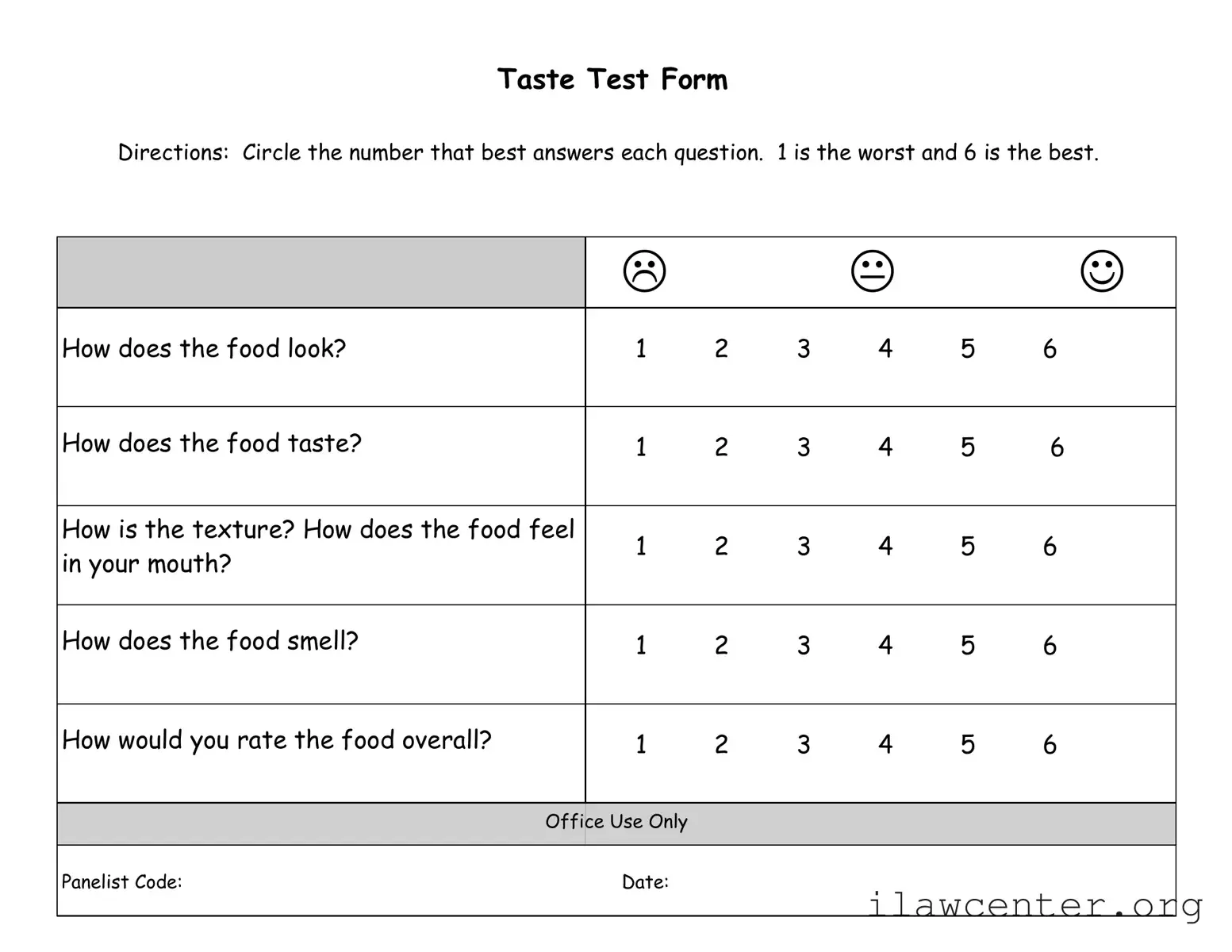
Taste Test Form
Directions: Circle the number that best answers each question. 1 is the worst and 6 is the best.
How does the food look?
1 2 3 4 5 6
How does the food taste?
1 2 3 4 5 6
How does the food smell?
1 2 3 4 5 6
How is the texture? How does the food feel
in your mouth?
1 2 3 4 5 6
How would you rate the food overall?
1 2 3 4 5 6
Panelist Code: Date:
Office Use Only

File Properties

Fact Name Description
Purpose The Taste Test form is designed to gather feedback on food items based on various sensory evaluations.
Rating Scale Respondents rate each aspect of the food on a scale from 1 to 6, with 1 being the worst and 6 being the best.
Visual Assessment Participants evaluate how the food looks, which is the first question on the form.
Taste Evaluation Respondents assess the taste of the food as the second question.
Texture Feedback The form includes a question about the texture of the food and how it feels in the mouth.
Smell Assessment Participants rate the aroma of the food, which is crucial for overall enjoyment.
Overall Rating The final question asks for an overall rating of the food, summarizing the participant's experience.
Panelist Code An Office Use Only section allows for the identification of the panelist through a unique code.
Date Tracking The form includes a space for the date, ensuring that feedback can be correlated with specific test sessions.
State-Specific Forms Some states may have specific regulations governing taste tests, such as food safety laws. Check local guidelines.

Instructions on Utilizing Taste Test

Once you have the Taste Test form in hand, it’s time to provide your feedback on the food you sampled. This process is straightforward and will help gather valuable insights about the food's quality. Follow the steps below to complete the form accurately.

  1. Begin by reviewing the Taste Test form carefully.
  2. For each question, you will see a scale from 1 to 6. 1 represents the worst rating, while 6 indicates the best.
  3. Circle the number that best reflects your opinion on how the food looks. Consider aspects such as color, presentation, and appeal.
  4. Next, circle a number for how the food tastes. Think about the flavor and whether it met your expectations.
  5. Assess the texture of the food. Circle a number based on how it feels in your mouth, whether it is crunchy, smooth, or chewy.
  6. Evaluate the smell of the food. Circle a number that represents your impression of its aroma.
  7. Finally, rate the food overall by circling a number that captures your overall experience.
  8. In the designated area for office use, write down your panelist code and the date of the taste test.

Important Facts about Taste Test

What is the purpose of the Taste Test form?

The Taste Test form is designed to gather feedback on food items. Participants rate various aspects of the food, including appearance, taste, texture, smell, and overall satisfaction. This feedback helps improve food products based on consumer preferences.

How do I fill out the Taste Test form?

To complete the form, you will circle a number from 1 to 6 for each question. A score of 1 indicates the worst experience, while a score of 6 represents the best. Each question focuses on a different characteristic of the food, allowing for a comprehensive evaluation.

What aspects of the food are evaluated?

The form evaluates five main aspects of the food: appearance, taste, texture, smell, and overall rating. Each of these categories is crucial for understanding how the food is perceived by consumers.

What do the numbers on the form represent?

The numbers range from 1 to 6, with 1 being the lowest score and 6 being the highest. This scoring system allows participants to express their opinions on the food's qualities in a straightforward manner.

Is there a specific way to rate the food?

Participants should consider their personal experiences with the food when rating it. Think about each aspect carefully and select the number that best reflects your opinion. Your honest feedback is valuable.

What should I do with the completed form?

Once you have filled out the Taste Test form, submit it according to the instructions provided by the testing organization. This may involve handing it to a staff member or placing it in a designated collection box.

Who will see my responses on the Taste Test form?

Your responses will typically be reviewed by the testing team to analyze feedback. Individual responses are usually kept confidential, ensuring that your opinions are used solely for improving the food product.

Can I participate in the Taste Test more than once?

Participation policies may vary by organization. Generally, if you are invited to taste test again, you can participate multiple times. Check with the organizing body for specific guidelines regarding repeat participation.

What is the significance of the Panelist Code and Date on the form?

The Panelist Code is used to identify participants without revealing their personal information. The date helps track when the taste test was conducted. Both pieces of information are important for organizing and analyzing the feedback effectively.
Common mistakes

When filling out the Taste Test form, many individuals make common mistakes that can affect the accuracy of their feedback. One frequent error is not circling a number for each question. Each question is designed to gather specific information, and leaving any question unanswered can lead to incomplete data.

Another mistake occurs when participants do not read the instructions carefully. The form clearly states to circle the number that best answers each question. Some people may write in their answers instead of circling them, which can create confusion during the review process.

Participants sometimes misinterpret the scale provided. The form uses a scale from 1 to 6, where 1 represents the worst experience and 6 represents the best. Some individuals may mistakenly think that a higher number indicates a negative response, leading to skewed results.

Inconsistent ratings can also be a problem. For example, if someone rates the appearance of the food as a 5 and then gives a 2 for taste without a clear reason, it may indicate a lack of attention or thoughtfulness in their responses. Each rating should reflect the individual's experience consistently across all questions.

Additionally, some people may forget to provide their panelist code or the date. This information is essential for tracking and organizing the feedback, and omitting it can complicate the data collection process.

Another common issue is the tendency to rush through the form. Taking time to consider each question can lead to more thoughtful and accurate responses. Rushed answers may not accurately reflect an individual's true feelings about the food.

Participants may also overlook the importance of describing the texture and smell of the food. These aspects are just as critical as appearance and taste. Neglecting to evaluate these elements can result in incomplete feedback.

Lastly, some individuals may not provide honest feedback. Whether out of politeness or fear of hurting someone's feelings, giving a higher rating than deserved can mislead those analyzing the results. Honest evaluations are crucial for improving food quality.

Documents used along the form

The Taste Test form is an essential tool for gathering feedback on food products. However, it is often accompanied by other documents that help streamline the testing process and ensure accurate data collection. Below is a list of related forms and documents commonly used alongside the Taste Test form.

  • Participant Consent Form: This document ensures that all participants understand the purpose of the taste test and agree to participate voluntarily. It outlines any potential risks and confirms that participants can withdraw at any time.
  • Demographic Survey: This survey collects basic information about participants, such as age, gender, and dietary preferences. This data helps analyze how different groups perceive the food being tested.
  • Product Information Sheet: This sheet provides details about the food product being tested, including ingredients, nutritional information, and any relevant background. It helps participants understand what they are tasting.
  • Observation Checklist: This checklist is used by moderators to note any behavioral cues or reactions from participants during the taste test. Observations can provide context to the ratings given on the Taste Test form.
  • Data Compilation Sheet: After the taste tests are completed, this sheet is used to compile and analyze the scores from all participants. It helps in identifying trends and overall preferences.
  • Feedback Summary Report: This report summarizes the findings from the taste tests, including average scores and key observations. It serves as a valuable resource for product development and marketing teams.

Using these documents together with the Taste Test form creates a comprehensive approach to gathering and analyzing feedback. This ensures that all aspects of the taste testing process are covered, leading to more informed decisions regarding food products.

Similar forms

The Taste Test form is a useful tool for gathering feedback on food products. It shares similarities with several other documents designed for evaluation and assessment. Here are seven documents that are comparable to the Taste Test form:

  • Customer Satisfaction Survey: This document collects feedback from customers about their overall experience with a product or service. Like the Taste Test form, it uses a rating scale to gauge satisfaction levels.
  • Product Review Form: Similar in purpose, this form allows consumers to provide detailed evaluations of a product's quality, functionality, and appeal, often using a numerical rating system.
  • Feedback Form: This general document invites users to share their thoughts on various aspects of a service or product. It often includes rating scales, much like the Taste Test form.
  • Quality Assurance Checklist: Used in manufacturing and food production, this checklist assesses the quality of products. It may include rating criteria to ensure standards are met, similar to how the Taste Test form evaluates food.
  • Focus Group Feedback Sheet: This document gathers insights from participants in a focus group. It often includes a rating system to evaluate different aspects of a product, mirroring the Taste Test form's structure.
  • Employee Evaluation Form: While focused on performance, this form often uses a rating scale to assess various competencies. The concept of rating performance shares a common thread with the Taste Test form.
  • Event Feedback Survey: Attendees use this survey to rate their experiences at events. Similar to the Taste Test form, it typically includes questions that require participants to assign numerical values to different aspects of the event.

Dos and Don'ts

When filling out the Taste Test form, it is important to follow certain guidelines to ensure clarity and accuracy. Here is a list of things you should and shouldn't do:

  • Do circle the number that accurately reflects your opinion for each question.
  • Do provide honest feedback based on your personal experience with the food.
  • Do take your time to consider each aspect of the food, including appearance, taste, texture, and smell.
  • Don't leave any questions unanswered; each question is important for the evaluation.
  • Don't use any symbols or marks other than the numbers to indicate your rating.
  • Don't discuss your ratings with other panelists until the process is complete.

By adhering to these guidelines, you contribute valuable insights that enhance the overall evaluation process.

Misconceptions

When it comes to the Taste Test form, several misconceptions can cloud understanding and lead to confusion. Here are eight common misunderstandings, clarified for better insight.

  • It’s only about taste. Many believe the Taste Test form focuses solely on how food tastes. However, it evaluates multiple sensory aspects, including appearance, texture, and aroma.
  • One number represents everything. Some think that circling a single number summarizes the entire experience. In reality, each question addresses a different sensory quality, requiring separate evaluations.
  • All scores are equally important. A misconception exists that each category carries the same weight. In practice, the significance of each aspect may vary depending on the food type being tested.
  • The form is only for professionals. Many assume that only trained panelists should use the Taste Test form. In truth, anyone can provide valuable feedback, whether they are experts or casual tasters.
  • Scores are absolute. Some individuals think that a score of 1 or 6 is definitive. However, taste is subjective, and personal preferences can greatly influence these ratings.
  • It’s a pass/fail test. There is a belief that the Taste Test form determines whether a food item is good or bad. Instead, it serves as a tool for gathering feedback, not a judgment of quality.
  • Panelist codes are for tracking individuals. Some worry that the panelist code identifies them. In reality, it’s used to organize responses while ensuring anonymity and confidentiality.
  • Feedback is not taken seriously. A common misconception is that responses on the form are ignored. On the contrary, this feedback is crucial for product development and improvement.

Understanding these misconceptions can enhance the experience of using the Taste Test form, making it a more effective tool for gathering insights about food products.

Key takeaways

When filling out and using the Taste Test form, consider the following key takeaways:

  1. Understand the Rating Scale: The form uses a scale from 1 to 6, where 1 indicates the worst experience and 6 represents the best. Familiarize yourself with this scale to provide accurate feedback.
  2. Focus on Each Aspect: The form asks for ratings on appearance, taste, texture, smell, and overall experience. Take time to evaluate each category thoughtfully.
  3. Be Honest and Constructive: Your feedback is valuable. Provide honest ratings that reflect your true experience, whether positive or negative.
  4. Use the Circling Method: Circle the number that best represents your opinion for each question. This method ensures clarity in your responses.
  5. Keep It Confidential: The form includes a panelist code for office use. This helps maintain anonymity and ensures that your feedback is treated confidentially.
  6. Record the Date: Always fill in the date on the form. This information can be crucial for tracking the tasting sessions and analyzing trends over time.