Tax POA dr 835 PDF Template

Tax POA dr 835 PDF Template

The Tax POA DR 835 form is a document that allows individuals to designate someone else to represent them in tax matters before the Colorado Department of Revenue. This form streamlines communication and ensures that your representative can handle your tax issues effectively. If you need assistance with your taxes, consider filling out this form by clicking the button below.

Article Guide

The Tax Power of Attorney (POA) DR 835 form serves as a crucial tool for individuals and businesses navigating their tax responsibilities. This form allows taxpayers to authorize another person, such as a tax professional or family member, to represent them before the Colorado Department of Revenue. By completing the DR 835, taxpayers can grant specific powers to their representatives, enabling them to handle various tax-related matters on their behalf. This includes the ability to receive confidential information, make inquiries, and even negotiate with tax authorities. Understanding the nuances of this form is essential for anyone looking to streamline their tax processes or ensure proper representation during audits or disputes. As tax laws can be complex and ever-changing, the DR 835 form provides a structured way to delegate authority while maintaining compliance with state regulations.

Tax POA dr 835 Preview

I
1111111111111111111111111111111111
L!;;;;;;;;;;;;;l
I
iiiiiiiiiiiiiiiiiiiiiiiiiiiiii~I
I
______________________________________________________________________________________________________________________________________
______________________________________________________________________________________________________________________________________
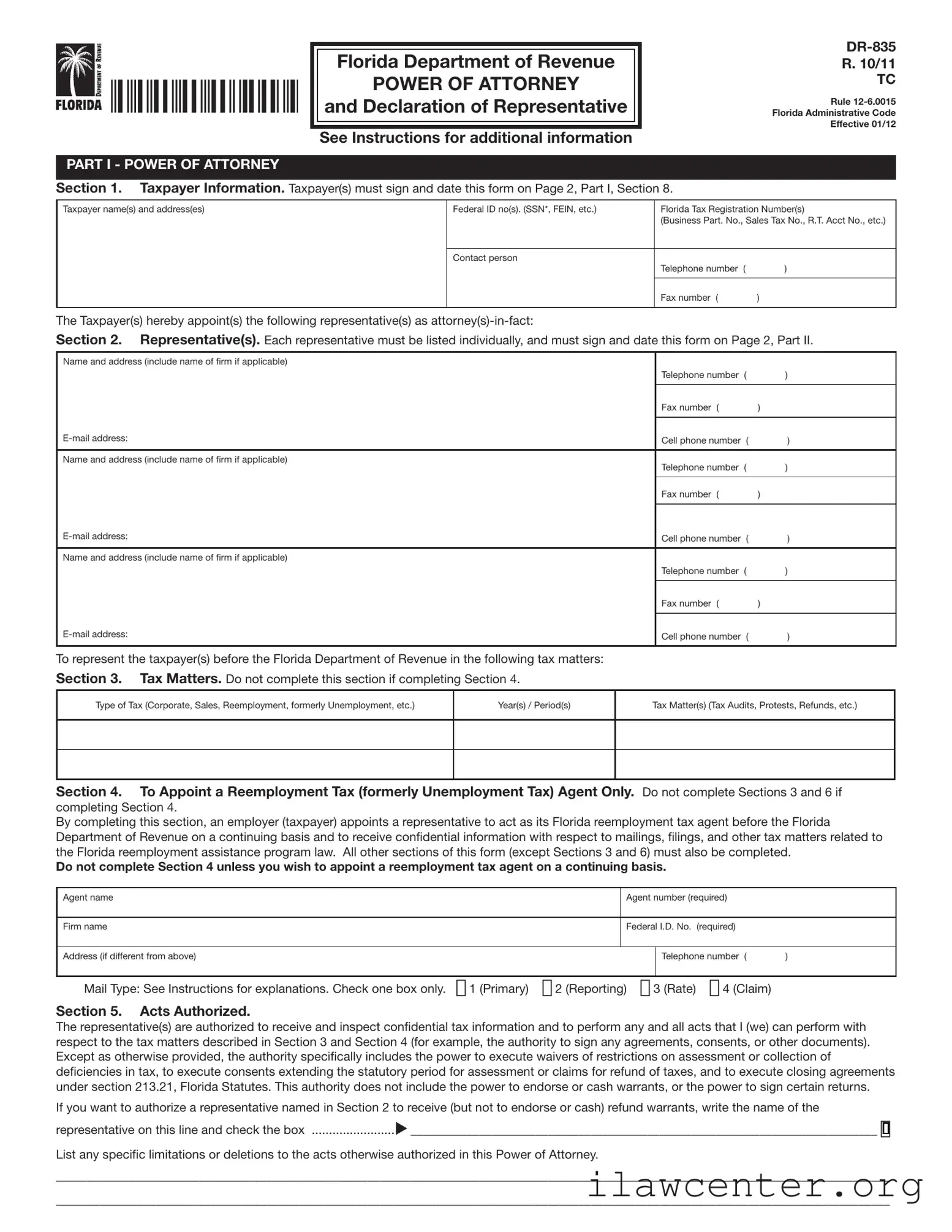
Florida Department of Revenue
POWER OF ATTORNEY
and Declaration of Representative
DR-835
R. 10/11
TC
Rule 12-6.0015
Florida Administrative Code
Effective 01/12
See Instructions for additional information
PART I - POWER OF ATTORNEY
Section 1. Taxpayer Information. Taxpayer(s) must sign and date this form on Page 2, Part I, Section 8.
Taxpayer name(s) and address(es) Federal ID no(s). (SSN*, FEIN, etc.) Florida Tax Registration Number(s)
(Business Part. No., Sales Tax No., R.T. Acct No., etc.)
Contact person
Telephone number ( )
Fax number ( )
The Taxpayer(s) hereby appoint(s) the following representative(s) as attorney(s)-in-fact:
Section 2. Representative(s). Each representative must be listed individually, and must sign and date this form on Page 2, Part II.
Name and address (include name of rm if applicable)
Telephone number ( )
Fax number ( )
E-mail address:
Cell phone number ( )
Name and address (include name of rm if applicable)
Telephone number ( )
Fax number ( )
E-mail address:
Cell phone number ( )
Name and address (include name of rm if applicable)
Telephone number ( )
Fax number ( )
E-mail address:
Cell phone number ( )
To represent the taxpayer(s) before the Florida Department of Revenue in the following tax matters:
Section 3. Tax Matters. Do not complete this section if completing Section 4.
Type of Tax (Corporate, Sales, Reemployment, formerly Unemployment, etc.) Year(s) / Period(s) Tax Matter(s) (Tax Audits, Protests, Refunds, etc.)
Section 4. To Appoint a Reemployment Tax (formerly Unemployment Tax) Agent Only. Do not complete Sections 3 and 6 if
completing Section 4.
By completing this section, an employer (taxpayer) appoints a representative to act as its Florida reemployment tax agent before the Florida
Department of Revenue on a continuing basis and to receive condential information with respect to mailings, lings, and other tax matters related to
the Florida reemployment assistance program law. All other sections of this form (except Sections 3 and 6) must also be completed.
Do not complete Section 4 unless you wish to appoint a reemployment tax agent on a continuing basis.
Agent name Agent number (required)
Firm name Federal I.D. No. (required)
Address (if different from above) Telephone number ( )
Mail Type: See Instructions for explanations. Check one box only. 1 (Primary) 2 (Reporting) 3 (Rate) 4 (Claim)
Section 5. Acts Authorized.
The representative(s) are authorized to receive and inspect condential tax information and to perform any and all acts that I (we) can perform with
respect to the tax matters described in Section 3 and Section 4 (for example, the authority to sign any agreements, consents, or other documents).
Except as otherwise provided, the authority specically includes the power to execute waivers of restrictions on assessment or collection of
deciencies in tax, to execute consents extending the statutory period for assessment or claims for refund of taxes, and to execute closing agreements
under section 213.21, Florida Statutes. This authority does not include the power to endorse or cash warrants, or the power to sign certain returns.
If you want to authorize a representative named in Section 2 to receive (but not to endorse or cash) refund warrants, write the name of the
representative on this line and check the box ........................u ___________________________________________________________________________
List any specic limitations or deletions to the acts otherwise authorized in this Power of Attorney.
I
111111111111111111111111111111111111111
_______________________________________________________________________________________ ________________________________________ _________________________________________
_______________________________________________________________________________________
_______________________________________________________________________________________ ________________________________________ _________________________________________
_______________________________________________________________________________________
DR-835
R. 10/11
Page 2
Florida Tax Registration Number:
Taxpayer Name(s): Federal Identication Number:
Taxpayer(s) must complete Page 1 of this Power of Attorney or it will not be processed.
Section 6. Notices and Communication. Do not complete Section 6 if completing Section 4.
Notices and other written communications will be sent to the rst representative listed in Part I, Section 2, unless the taxpayer selects one of the
options below. Receipt by either the representative or the taxpayer will be considered receipt by both.
a. If you want notices and communications sent to both you and your representative, check this box ............................... u
b. If you want notices or communications sent to you and not your representative, check this box.................................... u
Certain computer-generated notices and other written communications cannot be issued in duplicate due to current system constraints. Therefore, we
will send these communications to only the taxpayer at his or her tax registration address.
Section 7. Retention / Nonrevocation of Prior Power(s) of Attorney.
The ling of this Power of Attorney will not revoke earlier Power(s) of Attorney on le with the Florida Department of Revenue,
even for the same tax matters and years or periods covered by this document. If you want to revoke a prior Power of
Attorney, check this box............................................................................................................................................. u
You must attach a copy of any Power of Attorney you wish to revoke.
Section 8. Signature of Taxpayer(s).
If a tax matter concerns a joint return, both husband and wife must sign if joint representation is requested. If signed by a corporate ofcer,
partner, member/managing member, guardian, tax matters partner/person, executor, receiver, administrator, trustee, or duciary on behalf of the
taxpayer, I declare under penalties of perjury that I have the authority to execute this form on behalf of the taxpayer.
Under penalties of perjury, I (we) declare that I (we) have read the foregoing document, and the facts stated in it are true.
If this Power of Attorney is not signed and dated, it will be returned.
Signature Date Title (if applicable)
Print name
Signature Date Title (if applicable)
Print name
PART II - DECLARATION OF REPRESENTATIVE
Under penalties of perjury, I declare that:
I am familiar with the mandatory standards of conduct governing representation before the Department of Revenue, including Rules 12-6.006
and 28-106.107 of the Florida Administrative Code, as amended.
I am familiar with the law and facts related to this matter and am qualied to represent the taxpayer(s) in this matter.
I am authorized to represent the taxpayer(s) identied in Part I for the tax matter(s) specied therein, and to receive and inspect condential
taxpayer information.
I am one of the following:
a. Attorney - a member in good standing of the bar of the highest court of the jurisdiction shown below.
b. Certied Public Accountant - duly qualied to practice as a certied public accountant in the jurisdiction shown below.
c. Enrolled Agent enrolled as an agent pursuant to the requirements of Treasury Department Circular Number 230.
d. Former Department of Revenue Employee. As a representative, I cannot accept representation in a matter upon which I had direct
involvement while I was a public employee.
e. Reemployment Tax Agent authorized in Section 4 of this form.
f. Other Qualied Representative
I have read the foregoing Declaration of Representative and the facts stated in it are true.
If this Declaration of Representative is not signed and dated, it will not be processed.
Designation – Insert
Letter from Above (a -f)
Jurisdiction (State) and
Enrollment Card No. (if any)
Signature Date
Made fillable by FormsPal.
DR-835
R. 10/11
Page 3
POWER OF ATTORNEY INSTRUCTIONS
Purpose of this form
A Power of Attorney (Form DR-835) signed by the taxpayer and the
representative is required by the Florida Department of Revenue
in order for the taxpayer’s representative to perform certain acts
on behalf of the taxpayer and to receive and inspect condential
tax information. You and your representative must complete, sign,
and return Form DR-835 if you want to grant Power of Attorney
to an attorney, certied public accountant, enrolled agent, former
Department employee, reemployment tax agent, or any other qualied
individual. A Power of Attorney is a legal document authorizing
someone other than yourself to act as your representative.
You may use this form for any matters affecting any tax administered
by the Department of Revenue. This includes both the audit and
collection processes. A Power of Attorney will remain in effect until
you revoke it. If you provide more than one Power of Attorney with
respect to a tax and tax period, the Department employee handling
your case will address notices and correspondence relative to that
issue to the rst person listed on the latest Power of Attorney.
A Power of Attorney Form is generally not required, if the
representative is, or is accompanied by: a trustee, a receiver, an
administrator, an executor of an estate, a corporate ofcer, or an
authorized employee of the taxpayer.
Photocopies and fax copies of Form DR-835 are usually acceptable.
E-mail transmissions or other types of Powers of Attorney are not
acceptable. Copies of Form DR-835 are readily available by visiting
our Internet site (www.oridarevenue.com/forms).
How to Complete Form DR-835, Power of Attorney
PART I POWER OF ATTORNEY
Section 1 – Taxpayer Information
For individuals and sole proprietorships: Enter your name,
address, social security number, and telephone number(s) in the
spaces provided. Enter your federal employer identication number
(FEIN), if you have one. If a joint return is involved, and you and
your spouse are designating the same attorney(s)-in-fact, also enter
your spouse’s name and social security number, and your spouse’s
address if different from yours.
For a corporation, limited liability company, or partnership:
Enter the name, business address, FEIN, a contact person familiar
with this matter, and telephone number(s).
For a trust: Enter the name, title, address, and telephone
number(s) of the duciary, and name and FEIN of the trust.
For an estate: Enter the name, title, address, and telephone
number(s) of the decedent’s personal representative, and the name
and identication number of the estate. The identication number
for an estate includes both the FEIN if the estate has one and the
decedent’s social security number.
For any other entity: Enter the name, business address, FEIN,
and telephone number(s), as well as the name of a contact person
familiar with this matter.
Identication Number: The Department may have assigned you
a Florida tax registration number such as a sales tax number, a
reemployment tax account number, or a business partner number.
These numbers further assist the Department in identifying your
particular tax matter, and you should enter them in the appropriate
box. If you do not provide this information, the Department may not
be able to process the Power of Attorney.
Section 2 – Representative(s)
Enter the individual name, rm name (if applicable), address,
telephone number(s), and fax number of each individual appointed as
attorney-in-fact and representative. If the representatives have the
same address, simply write “same” in the appropriate box. If you wish
to appoint more than three representatives, you should attach a letter
to Form DR-835 listing those additional individuals.
Section 3 – Tax Matters
Enter the type(s) of tax this Power of Attorney authorization applies to
and the years or periods for which the Power of Attorney is granted.
The word “All” is not specic enough. If your tax situation does not t
into a tax type or period (for example, a specic administrative appeal,
audit, or collection matter), describe it in the blank space provided
for “Tax Matters.” The Power of Attorney can be limited to specic
reporting period(s) that can be stated in year(s), quarter(s), month(s),
etc., or can be granted for an indenite period. You must indicate
the tax types, periods, and/or matters for which you are authorizing
representation by your attorney-in-fact.
Examples:
Sales and Use Tax First and second quarter 2008
Corporate Income Tax 7/1/07 6/30/08
Communications Services Tax 2006 thru 2008
Insurance Premium Tax 1/1/06 12/31/08
Technical Assistance Advisement Request dated 8/6/08
Claim for Refund 3/7/07
Section 4 – To Appoint a Reemployment Tax Agent
Complete this section only if you wish to appoint an agent for
reemployment taxes on a continuing basis. You should not complete
Section 3 or Section 6, but you must complete the remaining sections
of Form DR-835.
Enter the agent’s name. It must be the same name as found in
Section 2. Enter the rm name and address. You do not need to
complete the address line if you reported that information in Section 2.
1. Enter the agent number. The agent number is a seven-digit
number assigned by the Department of Revenue.
2. Enter the federal employer identication number. The FEIN is a
nine-digit number assigned to the agent by the Internal Revenue
Service.
3. Select the mail type.
Primary Mail. If you select primary mail, the agent will receive
all documents fr
om the Department of Revenue related to this
reemployment tax account, and will be authorized to receive
condential information and discuss matters related to the tax and
wage report, benet information, claims, and the employer’s rate.
Reporting Mail. If you select reporting mail, the agent will receive
the Employer’s Quarterly Report (Form RT-6), certication, and
correspondence related to reporting. The agent will be authorized to
receive condential information and discuss the tax and wage report,
certication, and correspondence with the Department.
Rate Mail. If you select rate mail, the agent will receive tax rate
notices and correspondence related to the rate and will be authorized
to receive condential information and discuss the employer’s rate
notices and rate with the Department.
Claims Mail. If you select claims mail, the agent will receive the
notice of benets paid, and will be authorized to receive condential
information and discuss matters related to benets.
Note: Duplicate copies of certain computer-generated notices and
other written communications cannot be issued due to current system
constraints and therefore, these communications will be sent only to
the representative.




DR-835
R. 10/11
Page 4
Note: If you wish to appoint a representative to act on your behalf in
a specic and non-continuing reemployment tax matter, you should
complete Section 3 and Section 6 and not Section 4. For example,
if you hire a representative to assist you with a single matter, such as
a reemployment tax audit or contesting the payment of a claim, and
wish that representative to handle just that one matter, you should
not complete Section 4 to authorize that representation. Instead, you
should ll out Section 3 and specify the exact matter the representative
is handling.
Section 5 – Acts Authorized
Your signature on the back of the Power of Attorney authorizes the
individual(s) you designate (your representative or “attorney-in-fact”)
to perform any act you can perform with respect to your tax matters,
except that your representative may not sign certain returns for you
nor may your representative negotiate or cash your refund warrant.
This authority includes signing consents to a change in tax liability,
consents to extend the time for assessing or collecting tax, closing
agreements, and compromises. You may authorize your representative
to receive, but not negotiate or cash, your refund warrant by checking
the box in Section 5 and writing the name of the representative on the
line below. If you wish to limit the authority of your representative other
than in the manner previously described, you must describe those
limits on the lines provided in Section 5.
Section 6 – Mailing of Notices and Communications
If you do not check a box, the Department will send notices and other
written communications to the rst representative listed in Section 2,
unless you select another option. If you wish to have no documents
sent to your representative, or documents sent to both you and your
representative, you should check the appropriate box in Section 6.
Check the second box if you wish to have notices and other written
communications sent to you and not to your representative. In
certain instances, the Department can only send documents to the
taxpayer. Therefore, the taxpayer has the responsibility of keeping the
representative informed of tax matters.
Note: Taxpayers completing Section 4 (To Appoint a Reemployment
Tax Agent Only) should not complete Section 6. See Section 4 of these
instructions for information regarding notices and communications sent
to a reemployment tax agent.
Section 7 – Retention/Nonrevocation of Prior Power(s) of Attorney
The most recent Power of Attorney will take precedence over, but will
not revoke, prior Powers of Attorney. If you wish to revoke a prior
Power of Attorney, you must check the box on the form and attach a
copy of the old Power of Attorney.
Section 8 – Signature of Taxpayer(s)
The Power of Attorney is not valid until signed and dated by the
taxpayer. The individual signing the Power of Attorney is representing,
under penalties of perjury, that he or she is the taxpayer or authorized
to execute the Power of Attorney on behalf of the taxpayer.
For a corporation, trust, estate, or any other entity: A corporate
ofcer or person having authority to bind the entity must sign.
For partnerships: All partners must sign unless one partner is
authorized to act in the name of the partnership.
For a sole proprietorship: The owner of the sole proprietorship
must sign.
For a joint return: Both husband and wife must sign if the
representative represents both. If the representative only
represents one spouse, then only that spouse should sign.
PART II – DECLARATION OF REPRESENTATIVE
Any party who appears before the Department of Revenue has the
right, at his or her own expense, to be represented by counsel or by a
qualied representative. The representative(s) you name must declare,
under penalties of perjury, that he or she is qualied to represent you in
this matter and will comply with the mandatory standards of conduct
governing representation before the Department of Revenue. The
representative(s) must also declare, under penalties of perjury, that he
or she has been authorized to represent the taxpayer(s) in this matter
and authorized by the taxpayer(s) to receive condential taxpayer
information.
The representative(s) you name must sign and date this declaration
and enter the designation (i.e., items a-f) under which he or she is
authorized to represent you before the Department of Revenue.
a. Attorney – Enter the two-letter abbreviation for the state (for
example “FL” for Florida) in which admitted to practice, along with
your bar number.
b. Certied Public Accountant – Enter the two-letter abbreviation
for the state (for example “FL” for Florida) in which licensed to
practice.
c. Enrolled Agent – Enter the enrollment card number issued by the
Internal Revenue Service.
d. Former Department of Revenue Employee – Former employees
may not accept representation in matters in which they were
dir
ectly involved, and in certain cases, on any matter for a period
of two years following termination of employment. If a former
Department of Revenue employee is also an attorney or CPA,
then the additional designation, jurisdiction, and enrollment card
should also be entered.
e. Reemployment Tax Agent – A person(s) appointed under
Section 4 of the Power of Attorney to handle reemployment tax
matters on a continuing basis. A separate Power of Attorney
form must be completed in order for a reemployment tax agent to
handle a specic and non-continuing matter such as a protest of a
reemployment tax rate.
f. Other Qualied Representative – An individual may represent
a taxpayer before the Department of Revenue if training and
experience qualies that person to handle a specic matter.
Rule 28-106.107, Florida Administrative Code, sets out mandatory
standards of conduct for all qualied representatives. A representative
shall not:
(a) Engage in conduct involving dishonesty, fraud, deceit, or
misrepresentation.
(b) Engage in conduct that is prejudicial to the administration of
justice.
(c) Handle a matter that the repr
esentative knows or should know
that he or she is not competent to handle.
(d) Handle a legal or factual matter without adequate preparation.
*Social security numbers (SSNs) are used by the Florida
Department of Revenue as unique identiers for the administration of
Florida’
s taxes. SSNs obtained for tax administration purposes are
condential under sections 213.053 and 119.071, Florida Statutes,
and not subject to disclosure as public records. Collection of your
SSN is authorized under state and federal law. Visit our Internet
site at www.oridarevenue.com and select “Privacy Notice” for
more information regarding the state and federal law governing the
collection, use, or release of SSNs, including authorized exceptions.
Where to Mail Form DR-835
If Form DR-835 is for a specic matter, mail or fax it to the ofce or
employee handling the specic matter. You may send it with the
document to which it relates.
If Form DR-835 is for a reemployment tax matter and the taxpayer has
completed Section 4, mail it to the Florida Department of Revenue,
P.O. Box 6510, Tallahassee FL 32314-6510, or fax it to 850-488-5997.

File Properties

Fact Name Description
Purpose The Tax POA DR 835 form is used to authorize an individual or entity to represent a taxpayer before the Department of Revenue.
Governing Law This form is governed by the state tax laws applicable in the jurisdiction where it is filed, which may vary by state.
Filing Requirements Taxpayers must complete and sign the form, ensuring it includes all necessary information to avoid processing delays.
Duration of Authority The authority granted by the form remains in effect until revoked by the taxpayer or until the specified period of representation expires.

Instructions on Utilizing Tax POA dr 835

When you're ready to grant someone the authority to represent you in tax matters, filling out the Tax POA DR 835 form is the next step. This document allows your chosen representative to communicate with the tax authorities on your behalf. Follow these steps carefully to ensure the form is completed correctly.

  1. Begin by entering your name in the designated field at the top of the form.
  2. Provide your address, including street, city, state, and zip code, in the next section.
  3. Fill in your Social Security Number or Employer Identification Number, as applicable.
  4. Identify the representative you are granting authority to by entering their name in the appropriate box.
  5. Include the representative’s address, ensuring to provide all necessary details like street, city, state, and zip code.
  6. Indicate the type of authority you are granting by checking the relevant boxes on the form.
  7. Sign and date the form at the bottom, confirming your consent.

After completing the form, review it for accuracy. Ensure that all names, addresses, and numbers are correct. Once verified, submit the form according to the instructions provided by the tax authority. This will allow your representative to act on your behalf effectively.

Important Facts about Tax POA dr 835

What is the Tax POA DR 835 form?

The Tax POA DR 835 form is a Power of Attorney document specifically used in tax matters. It allows an individual, known as the principal, to designate another person, referred to as the agent, to represent them in dealings with the tax authorities. This can include filing tax returns, receiving confidential information, and handling other tax-related issues on behalf of the principal.

Who can be designated as an agent on the Tax POA DR 835 form?

Any individual who is capable of acting on your behalf can be designated as your agent. This could be a family member, friend, accountant, or tax professional. It's important to choose someone you trust, as they will have access to sensitive tax information and the authority to make decisions regarding your tax matters.

How do I fill out the Tax POA DR 835 form?

To fill out the Tax POA DR 835 form, you will need to provide your personal information, such as your name, address, and Social Security number. You will also need to include the agent's information. After completing the form, both you and your agent must sign and date it. Make sure to double-check all the information for accuracy before submitting it.

Do I need to submit the Tax POA DR 835 form to the IRS?

No, the Tax POA DR 835 form is typically submitted to the state tax authority rather than the IRS. However, if you want to grant power of attorney for federal tax matters, you would need to use the IRS Form 2848 instead. Always verify which form is appropriate for your specific situation.

Is there a fee associated with the Tax POA DR 835 form?

Generally, there is no fee for completing and submitting the Tax POA DR 835 form. However, if you choose to have a tax professional assist you with the process, they may charge a fee for their services. It’s advisable to discuss any potential costs upfront.

Can I revoke the Tax POA DR 835 form once it is submitted?

Yes, you can revoke the Tax POA DR 835 form at any time. To do this, you will need to submit a written notice of revocation to the state tax authority. It's also a good practice to inform your agent that you are revoking their authority. Make sure to keep a copy of the revocation for your records.

How long is the Tax POA DR 835 form valid?

The Tax POA DR 835 form remains valid until you revoke it or until the agent no longer wishes to act on your behalf. Additionally, if the principal passes away or becomes incapacitated, the power of attorney is typically terminated automatically.

What if I need to make changes to the Tax POA DR 835 form after submitting it?

If you need to make changes to the Tax POA DR 835 form after it has been submitted, you will need to complete a new form with the updated information. This includes changes to your personal information, the agent's details, or any other relevant sections. Always ensure that the most current version is submitted to avoid any confusion.

Where can I obtain the Tax POA DR 835 form?

You can typically obtain the Tax POA DR 835 form from your state tax authority's website. Many states provide downloadable forms in PDF format, which you can fill out and print. If you have difficulty finding the form online, consider contacting your state tax office directly for assistance.

Common mistakes

Filling out the Tax Power of Attorney (POA) DR 835 form can be a straightforward process, but many individuals make common mistakes that can lead to delays or complications. Understanding these pitfalls can help ensure that the form is completed correctly and efficiently.

One frequent error is failing to provide complete information about the taxpayer. The form requires specific details such as the taxpayer’s name, address, and Social Security number. Omitting any of this information can result in the form being rejected. It is crucial to double-check that all sections are filled out accurately before submission.

Another mistake often seen is not signing the form. While it may seem obvious, some individuals forget to include their signature or the date. The IRS requires a signature to validate the authorization, and without it, the form will not be considered valid. Always ensure that the form is signed and dated appropriately.

People also sometimes overlook the importance of specifying the scope of authority granted to the representative. The form allows taxpayers to delineate what powers they are granting. Failing to do so can lead to confusion about what actions the representative is authorized to take. Clarity in this section is essential to avoid misunderstandings later.

Additionally, individuals may neglect to check the expiration date of the form. The Tax POA DR 835 form does not remain valid indefinitely. If the form is submitted after its expiration date, the IRS will not recognize it. Regularly reviewing and updating the form can help maintain its validity.

Lastly, some people submit the form without verifying that the representative is eligible. The IRS has specific requirements regarding who can act as a representative. If the chosen individual does not meet these criteria, the form may be rejected. It is advisable to confirm the eligibility of the representative before completing the form.

Documents used along the form

The Tax Power of Attorney (POA) DR 835 form is an important document that allows an individual to appoint someone else to handle their tax matters. Along with this form, several other documents may be required or beneficial for a complete tax representation. Below is a list of commonly used forms and documents that complement the Tax POA DR 835.

  • IRS Form 2848: This is the federal power of attorney form that allows taxpayers to authorize an individual to represent them before the IRS. It covers a broad range of tax matters and is essential for federal tax issues.
  • IRS Form 4506: This form requests a copy of a taxpayer's tax return or transcript. It is often used when a representative needs to obtain past tax information to assist in current tax matters.
  • IRS Form 8821: This form allows taxpayers to designate someone to receive and inspect their tax information without granting them the authority to represent them. It is useful for those who want to share information without full representation.
  • State Tax Power of Attorney Form: Each state may have its own version of a power of attorney for tax purposes. This form allows an individual to appoint a representative for state tax matters, ensuring compliance with local tax laws.
  • Form W-9: This form is used to provide a taxpayer's correct taxpayer identification number to others. It is often necessary when a representative needs to complete tax filings or transactions on behalf of the taxpayer.

Using the Tax POA DR 835 form alongside these documents can streamline the process of tax representation. Ensuring that all necessary forms are completed and submitted can lead to more effective management of tax obligations.

Similar forms

The Tax POA DR 835 form, which allows individuals to designate a representative to act on their behalf in tax matters, shares similarities with several other important documents. Below are four such documents, each with a brief explanation of how they relate to the Tax POA DR 835 form.

  • IRS Form 2848 (Power of Attorney and Declaration of Representative): This form serves a similar purpose by allowing taxpayers to appoint someone to represent them before the IRS. Like the Tax POA DR 835, it grants authority to handle tax-related matters but is specifically tailored for federal tax issues.
  • IRS Form 8821 (Tax Information Authorization): This document permits individuals to authorize someone to receive and inspect their confidential tax information. While it does not grant the same level of authority as the Tax POA DR 835, it still allows for communication between the taxpayer and the appointed representative.
  • State-Specific Power of Attorney Forms: Many states have their own power of attorney forms that allow individuals to appoint someone to manage various legal and financial matters. These forms often mirror the intent of the Tax POA DR 835 by enabling representation in state tax issues.
  • Form 4506 (Request for Copy of Tax Return): This form allows individuals to request copies of their tax returns from the IRS. While it does not authorize representation, it is often used in conjunction with the Tax POA DR 835 to ensure that the representative has access to necessary documents.

Dos and Don'ts

When filling out the Tax Power of Attorney (POA) Form DR 835, it is essential to approach the process with care and attention to detail. Below are ten important guidelines to consider, divided into things you should do and things you should avoid.

Things You Should Do:

  • Read the instructions thoroughly before starting the form.
  • Provide accurate and complete information for both the taxpayer and the representative.
  • Sign and date the form where required to ensure its validity.
  • Use clear and legible handwriting or type the information to avoid any misunderstandings.
  • Keep a copy of the completed form for your records.

Things You Shouldn't Do:

  • Do not leave any required fields blank; this could delay processing.
  • Do not use nicknames or abbreviations for names; always use full legal names.
  • Do not forget to check for any additional documentation that may be required.
  • Do not submit the form without verifying that all information is correct.
  • Do not assume that electronic submissions are always accepted; check the submission guidelines.

By following these guidelines, you can help ensure that your Tax POA Form DR 835 is completed accurately and efficiently, minimizing the risk of complications. Remember, attention to detail is key in legal matters.

Misconceptions

Understanding the Tax Power of Attorney (POA) Form DR 835 can be tricky. Many people hold misconceptions about this important document. Let's clear up some of the confusion.

  1. Misconception 1: The Tax POA DR 835 form is only for individuals with complex tax situations.

    This form can be useful for anyone needing assistance with their tax matters, regardless of the complexity of their situation.

  2. Misconception 2: You can only use the Tax POA DR 835 form for federal tax issues.

    This form is applicable for state tax matters as well, allowing you to designate someone to represent you in various tax-related issues.

  3. Misconception 3: Once you submit the form, you cannot revoke it.

    You can revoke the Tax POA DR 835 at any time by submitting a written notice to the relevant tax authority.

  4. Misconception 4: The form must be notarized to be valid.

    Notarization is not a requirement for the Tax POA DR 835; simply signing the form is sufficient.

  5. Misconception 5: Only tax professionals can be designated as representatives.

    You can appoint a friend, family member, or any trusted individual to act on your behalf, not just tax professionals.

  6. Misconception 6: The Tax POA DR 835 form is only needed for audits.

    This form can be beneficial for various situations, including filing returns, responding to inquiries, and negotiating with tax authorities.

  7. Misconception 7: You must submit the form every year.

    The Tax POA DR 835 remains in effect until you revoke it or the specific tax matter is resolved.

  8. Misconception 8: You cannot limit the powers of the representative.

    You can specify the exact powers you are granting to your representative, making it a flexible option.

  9. Misconception 9: The Tax POA DR 835 form is the same as a general power of attorney.

    While both documents allow someone to act on your behalf, the Tax POA DR 835 is specifically tailored for tax matters.

By understanding these misconceptions, you can better navigate your tax responsibilities and make informed decisions about using the Tax POA DR 835 form.

Key takeaways

When filling out and using the Tax POA DR 835 form, it is important to understand the following key points:

  • The form grants someone the authority to act on your behalf regarding tax matters.
  • Ensure that all required information is complete and accurate to avoid delays.
  • Sign and date the form to validate it; an unsigned form may not be accepted.
  • Submit the form to the appropriate tax authority to ensure it is processed correctly.
  • Keep a copy of the completed form for your records.
  • Review the form periodically to ensure it remains up to date with your current needs.