Fillable Teacher Letter Recommendation Document

Fillable Teacher Letter Recommendation Document

The Teacher Letter Recommendation form is a document used to gather insights and evaluations from educators regarding a student's abilities, character, and potential. This form plays a crucial role in the college application process, providing admissions committees with valuable perspectives. To ensure a comprehensive recommendation, it is important to fill out the form accurately and thoroughly; click the button below to get started.

Article Guide

When applying for college or graduate school, students often need to submit a Teacher Letter Recommendation form as part of their application package. This form serves as a vital tool for educators to provide insights into a student's academic performance, character, and potential for success in higher education. Typically, it includes sections for the teacher's personal information, the student's name, and details about the relationship between the teacher and the student. Additionally, the form may prompt teachers to evaluate the student's strengths and weaknesses, as well as their involvement in class and extracurricular activities. By capturing these elements, the Teacher Letter Recommendation form not only aids admissions committees in making informed decisions but also allows students to present a more holistic view of their capabilities and achievements. Understanding the nuances of this form can significantly enhance a student's application, making it essential for both teachers and students to approach it thoughtfully.

Teacher Letter Recommendation Preview

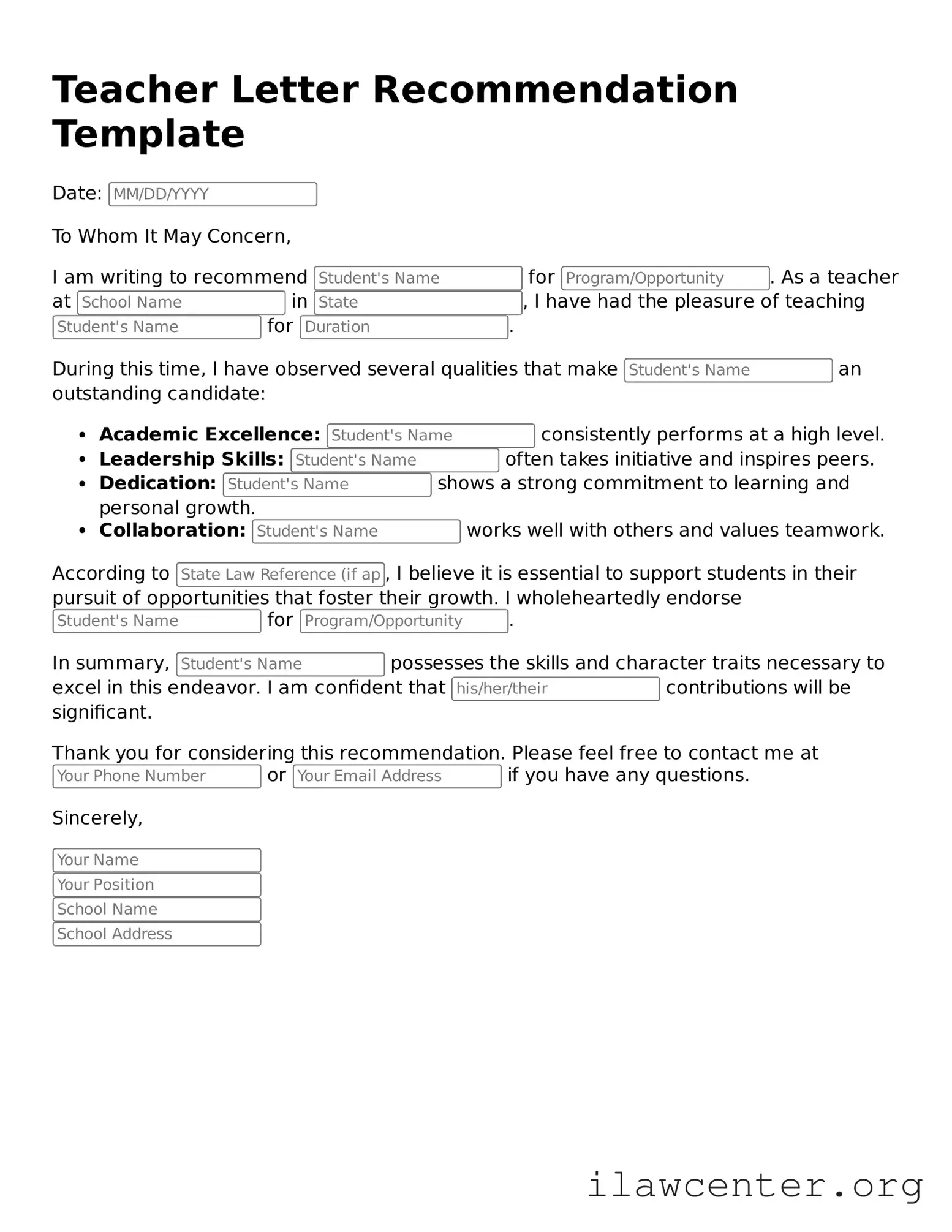
Teacher Letter Recommendation Template

Date:

To Whom It May Concern,

I am writing to recommend for . As a teacher at in , I have had the pleasure of teaching for .

During this time, I have observed several qualities that make an outstanding candidate:

  • Academic Excellence: consistently performs at a high level.
  • Leadership Skills: often takes initiative and inspires peers.
  • Dedication: shows a strong commitment to learning and personal growth.
  • Collaboration: works well with others and values teamwork.

According to , I believe it is essential to support students in their pursuit of opportunities that foster their growth. I wholeheartedly endorse for .

In summary, possesses the skills and character traits necessary to excel in this endeavor. I am confident that contributions will be significant.

Thank you for considering this recommendation. Please feel free to contact me at or if you have any questions.

Sincerely,


PDF Form Characteristics

Fact Name Description
Purpose The Teacher Letter Recommendation form is used to provide insights into a student’s academic performance and character from a teacher's perspective.
State-Specific Forms Some states may have specific forms that align with local education regulations, such as California Education Code § 49061.
Submission Process Typically, the completed form should be submitted directly to the educational institution or organization requesting the recommendation.
Confidentiality In many cases, the content of the recommendation is kept confidential, allowing teachers to provide honest feedback without concern for the student's reaction.

Instructions on Utilizing Teacher Letter Recommendation

Filling out the Teacher Letter Recommendation form is an important step in supporting a student's application process. Completing this form accurately will help ensure that the student's strengths and achievements are well represented. Below are the steps to guide you through the process.

  1. Begin by gathering all necessary information about the student, including their full name, grade level, and any specific achievements or extracurricular activities you want to highlight.
  2. Open the Teacher Letter Recommendation form on your computer or print it out if you prefer to fill it out by hand.
  3. Start with the basic information section. Enter the student's name, contact information, and the date.
  4. In the section dedicated to your relationship with the student, describe how long you have known them and in what capacity (e.g., as their teacher, advisor, etc.).
  5. Next, provide specific examples of the student’s strengths, skills, and accomplishments. Be sure to include any relevant experiences that showcase their character and abilities.
  6. After detailing the student's qualifications, move on to the conclusion section. Here, summarize your recommendation and express your confidence in the student’s potential.
  7. Finally, sign and date the form. If you are submitting it electronically, follow the instructions for digital submission.

Once you have completed the form, ensure that it is submitted according to the specified guidelines. This may involve sending it directly to the institution or providing it to the student for their application package.

Important Facts about Teacher Letter Recommendation

What is the Teacher Letter Recommendation form?

The Teacher Letter Recommendation form is a document that allows teachers to provide insights and evaluations about a student’s performance, character, and potential. This form is often used for college applications, scholarship opportunities, or special programs. It helps admissions committees or organizations gain a better understanding of the student from someone who has observed them in an academic setting.

Who should fill out the Teacher Letter Recommendation form?

Typically, a teacher who knows the student well should complete this form. This could be a teacher from a core subject, such as English or Math, or a teacher from an elective class where the student has excelled. It’s important that the teacher can provide a detailed and honest assessment of the student’s abilities and character.

How do I request a letter of recommendation from my teacher?

To request a letter of recommendation, approach your teacher politely, preferably in person. Explain why you need the letter and provide any relevant details, such as the purpose of the recommendation and deadlines. It’s also helpful to share your accomplishments, goals, and any specific points you would like the teacher to address in their letter. This information can assist them in writing a more personalized recommendation.

What information should be included in the Teacher Letter Recommendation form?

The form typically asks for the teacher’s assessment of the student’s academic performance, work ethic, and interpersonal skills. It may also include sections for the teacher to discuss the student’s strengths, areas for improvement, and any notable achievements. Providing specific examples can enhance the recommendation and make it more impactful.

Is there a deadline for submitting the Teacher Letter Recommendation form?

Yes, there is usually a deadline associated with the submission of the Teacher Letter Recommendation form. This deadline is often determined by the college, scholarship program, or organization requesting the letter. It’s crucial to communicate this deadline clearly to your teacher to ensure they have enough time to write a thoughtful recommendation.

Can I see the letter before it is submitted?

Generally, it is considered polite to allow teachers to write their recommendations without interference. However, some teachers may be willing to share their letter with you, especially if you have built a good rapport. If you would like to see the letter, ask your teacher if they are comfortable sharing it. Respect their decision if they prefer to keep it confidential.

What should I do if my teacher is unable to write a recommendation?

If your teacher is unable to write a recommendation, it’s important to respect their decision. There could be various reasons for this, such as a lack of familiarity with your work or time constraints. In this case, consider asking another teacher or a mentor who knows you well and can provide a strong recommendation. Always express gratitude to the teacher for their time and consideration, regardless of their response.

Common mistakes

When filling out a Teacher Letter Recommendation form, many individuals overlook important details that can impact the quality of the recommendation. One common mistake is failing to provide specific examples of the student’s achievements or qualities. Generic statements do not effectively convey the student's strengths. Instead, including concrete instances of the student's work, participation, or growth can make a recommendation much more compelling.

Another frequent error is neglecting to tailor the recommendation to the specific program or opportunity the student is applying for. A one-size-fits-all approach can diminish the effectiveness of the letter. It is crucial to align the content with the requirements and values of the institution or program, highlighting relevant skills and experiences that resonate with their goals.

Additionally, some individuals forget to proofread the form before submission. Spelling and grammatical errors can detract from the professionalism of the recommendation. Taking the time to review the letter ensures clarity and shows respect for the reader's time and attention. A polished letter reflects well on both the recommender and the student.

Another mistake involves providing insufficient context about the relationship between the recommender and the student. Without this context, readers may struggle to understand the basis of the recommendation. Clearly stating how long the recommender has known the student and in what capacity can add credibility and depth to the letter.

Lastly, some recommenders may fail to meet submission deadlines. Timeliness is crucial in the recommendation process. Late submissions can jeopardize a student’s application, potentially affecting their chances of acceptance. Keeping track of deadlines and submitting the letter on time is essential for supporting the student effectively.

Documents used along the form

When applying for educational opportunities, several documents often accompany the Teacher Letter Recommendation form. Each of these documents plays a crucial role in providing a comprehensive view of a student's qualifications and character. Below is a list of commonly used forms and documents.

  • Application Form: This document gathers essential information about the applicant, including personal details, academic history, and extracurricular activities.
  • Resume or CV: A summary of the applicant's educational background, work experience, and skills. This document highlights achievements and relevant experiences.
  • Personal Statement: A narrative that allows the applicant to express their motivations, goals, and why they are pursuing a particular opportunity.
  • Transcript: An official record of the applicant's academic performance, including grades and courses taken. This document provides insight into the applicant's academic abilities.
  • Standardized Test Scores: Results from tests such as the SAT or ACT, which may be required for certain applications. These scores can demonstrate the applicant's readiness for academic challenges.
  • Additional Letters of Recommendation: Letters from other individuals, such as coaches or community leaders, who can provide further insights into the applicant's character and abilities.
  • Portfolio: A collection of work samples, projects, or other evidence of the applicant's skills and accomplishments, particularly in creative fields.

These documents collectively support the application process, offering a well-rounded perspective of the applicant. Each piece contributes to understanding the individual's strengths and potential for success.

Similar forms

  • College Application Essay: Like the Teacher Letter Recommendation form, a college application essay provides insight into a student's character, aspirations, and experiences. Both documents aim to present a holistic view of the applicant to the admissions committee.

  • Resume: A resume summarizes a student's academic achievements, extracurricular activities, and work experience. Similar to the Teacher Letter Recommendation form, it highlights the strengths and qualifications that make the student a suitable candidate for a program or institution.

  • Personal Statement: This document allows students to articulate their motivations and goals. Like the Teacher Letter Recommendation form, it serves to provide context and depth to the applicant's experiences and aspirations.

  • Scholarship Application: Scholarship applications often require letters of recommendation, which serve a similar purpose to the Teacher Letter Recommendation form. Both documents aim to validate the applicant's qualifications and potential for success.

  • Job Application Letter: A job application letter introduces the candidate to potential employers. Similar to the Teacher Letter Recommendation form, it emphasizes the candidate's skills and experiences, providing a narrative that supports their application.

  • Internship Recommendation Letter: This letter is written by someone who knows the applicant well, much like a teacher's recommendation. Both documents aim to endorse the applicant's abilities and suitability for the opportunity they are pursuing.

  • Graduate School Application: Graduate school applications often include letters of recommendation, similar to the Teacher Letter Recommendation form. Both types of documents are intended to provide an assessment of the applicant's readiness and potential for success in advanced studies.

Dos and Don'ts

When filling out a Teacher Letter Recommendation form, it's important to approach the task thoughtfully. Here’s a list of things you should and shouldn’t do:

  • Do provide accurate information about the student.
  • Do highlight the student’s strengths and achievements.
  • Do keep your tone professional and positive.
  • Do include specific examples to support your claims.
  • Do proofread your letter for grammar and spelling errors.
  • Don't use vague language or generalizations.
  • Don't include irrelevant personal information.
  • Don't write a letter that is overly long or too short.
  • Don't provide negative feedback about the student.
  • Don't forget to submit the letter by the deadline.

Misconceptions

Misconceptions about the Teacher Letter Recommendation form can lead to confusion for both teachers and students. Here are nine common misunderstandings:

  1. All teachers must write a recommendation letter.

    Not every teacher is required to write a recommendation letter. Students should select teachers who know them well and can provide meaningful insights.

  2. Recommendation letters are the same as a resume.

    While both documents highlight achievements, recommendation letters focus on personal qualities and experiences from a teacher's perspective.

  3. Letters should only highlight academic performance.

    While academic performance is important, letters can also discuss a student’s character, leadership skills, and extracurricular involvement.

  4. Teachers can write a letter at any time.

    Timing matters. Teachers often have deadlines to meet, so students should request letters well in advance.

  5. Recommendation letters are not important for college applications.

    This is a misconception. Many colleges place significant weight on recommendation letters as they provide context to a student's application.

  6. One letter fits all applications.

    Each letter should be tailored to the specific school or program. Generic letters may not convey the student's unique fit for a particular institution.

  7. Teachers can access student grades for writing letters.

    Teachers typically do not have direct access to all grades. Students should provide relevant information to help teachers write informed letters.

  8. Recommendation letters are optional.

    For many applications, recommendation letters are required. Students should check the specific requirements for each application.

  9. Students should not follow up after requesting a letter.

    Following up is acceptable and can be helpful. A polite reminder can ensure that the letter is submitted on time.

Key takeaways

Filling out and utilizing the Teacher Letter Recommendation form can be a pivotal step in a student's academic journey. Here are some key takeaways to consider:

  • Choose the Right Teacher: Select a teacher who knows you well and can speak positively about your strengths and achievements.
  • Provide Relevant Information: Share your academic interests, extracurricular activities, and future goals with your teacher to help them write a more personalized letter.
  • Request in Advance: Ask for the recommendation well before the deadline. This gives your teacher ample time to craft a thoughtful letter.
  • Follow Up Politely: A gentle reminder as the deadline approaches can be helpful, but ensure it is done respectfully and without pressure.
  • Express Gratitude: Always thank your teacher for their time and effort in writing the recommendation. A simple note can go a long way.

By keeping these points in mind, students can enhance the effectiveness of their Teacher Letter Recommendation form and ensure a smoother application process.