Test Drive PDF Template

Test Drive PDF Template

The Test Drive Agreement is a document that allows customers to take a vehicle for a test drive while outlining the terms and conditions of that use. It includes essential information such as the customer's details, vehicle specifications, and responsibilities during the test drive. If you're ready to experience your next vehicle, fill out the form by clicking the button below.

Article Guide

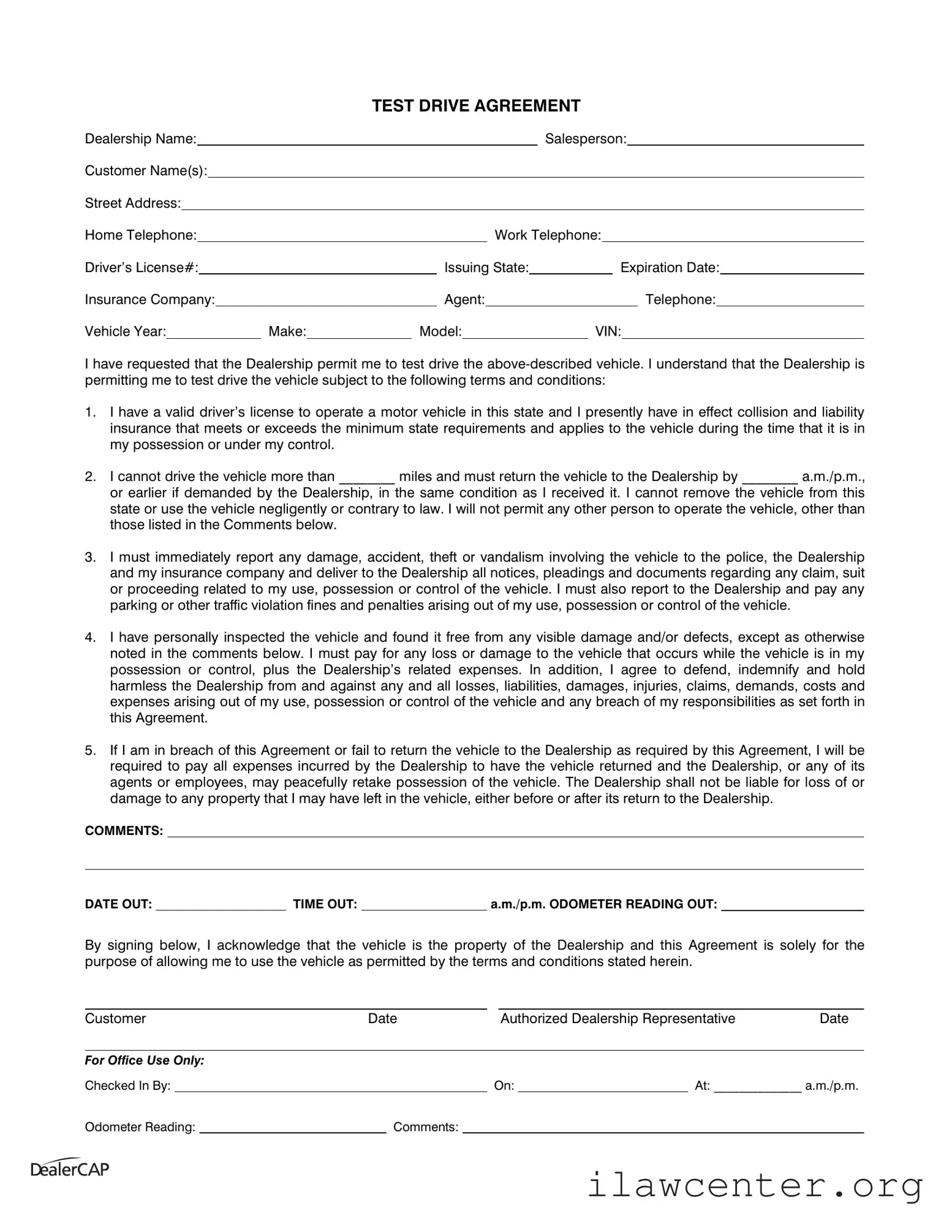
The Test Drive form is an essential document that facilitates the process of allowing potential buyers to experience a vehicle before making a purchase decision. It captures critical information about the dealership, the salesperson, and the customer, ensuring that both parties are clear on the terms of the test drive. This form requires the customer to provide personal details, including their name, address, and contact information, along with the specifics of the vehicle being tested, such as its make, model, and VIN. The agreement outlines the customer's responsibilities, including the requirement to hold a valid driver's license and maintain appropriate insurance coverage. Additionally, it sets limits on mileage and emphasizes the importance of returning the vehicle in the same condition it was received. The customer must also report any incidents that occur during the test drive, ensuring that both the dealership and the customer are protected. By signing the form, the customer acknowledges the dealership's ownership of the vehicle and agrees to abide by the outlined terms, fostering a transparent and respectful relationship between the dealership and the potential buyer.

Test Drive Preview

Dealership Name: Salesperson:
Customer Name(s):
Street Address:
Home Telephone: Work Telephone:
Driver’s License#: Issuing State: Expiration Date:
Insurance Company: Agent: Telephone:
Vehicle Year: Make: Model: VIN:
I have requested that the Dealership permit me to test drive the above-described vehicle. I understand that the Dealership is
permitting me to test drive the vehicle subject to the following terms and conditions:
1. I have a valid driver’s license to operate a motor vehicle in this state and I presently have in effect collision and liability
insurance that meets or exceeds the minimum state requirements and applies to the vehicle during the time that it is in
my possession or under my control.
2. I cannot drive the vehicle more than ________ miles and must return the vehicle to the Dealership by ________ a.m./p.m.,
or earlier if demanded by the Dealership, in the same condition as I received it. I cannot remove the vehicle from this
state or use the vehicle negligently or contrary to law. I will not permit any other person to operate the vehicle, other than
those listed in the Comments below.
3. I must immediately report any damage, accident, theft or vandalism involving the vehicle to the police, the Dealership
and my insurance company and deliver to the Dealership all notices, pleadings and documents regarding any claim, suit
or proceeding related to my use, possession or control of the vehicle. I must also report to the Dealership and pay any
parking or other traffic violation fines and penalties arising out of my use, possession or control of the vehicle.
4. I have personally inspected the vehicle and found it free from any visible damage and/or defects, except as otherwise
noted in the comments below. I must pay for any loss or damage to the vehicle that occurs while the vehicle is in my
possession or control, plus the Dealership’s related expenses. In addition, I agree to defend, indemnify and hold
harmless the Dealership from and against any and all losses, liabilities, damages, injuries, claims, demands, costs and
expenses arising out of my use, possession or control of the vehicle and any breach of my responsibilities as set forth in
this Agreement.
5. If I am in breach of this Agreement or fail to return the vehicle to the Dealership as required by this Agreement, I will be
required to pay all expenses incurred by the Dealership to have the vehicle returned and the Dealership, or any of its
agents or employees, may peacefully retake possession of the vehicle. The Dealership shall not be liable for loss of or
damage to any property that I may have left in the vehicle, either before or after its return to the Dealership.
COMMENTS:
DATE OUT: TIME OUT: a.m./p.m. ODOMETER READING OUT:
By signing below, I acknowledge that the vehicle is the property of the Dealership and this Agreement is solely for the
purpose of allowing me to use the vehicle as permitted by the terms and conditions stated herein.
Customer Date Authorized Dealership Representative Date
For Office Use Only:
Checked In By: On: At: ______________ a.m./p.m.
Odometer Reading: Comments:
TEST DRIVE AGREEMENT

File Properties

Fact Name Details
Dealership Information The form requires the dealership name and salesperson's name for identification.
Customer Details Customers must provide their name, address, and contact numbers.
Driver’s License Requirement Customers must possess a valid driver's license from the issuing state.
Insurance Coverage Customers must have collision and liability insurance that meets state requirements.
Mileage Limitation The form specifies a mileage limit for the test drive, which must be filled in by the customer.
Return Condition The vehicle must be returned in the same condition as received, barring noted damages.
Reporting Incidents Customers must report any damage, theft, or accidents immediately to the dealership and police.
Inspection Acknowledgment Customers confirm they have inspected the vehicle for visible damage before the test drive.
Indemnification Clause Customers agree to indemnify the dealership against any claims arising from their use of the vehicle.
Governing Laws State-specific laws govern the terms of the agreement; check local regulations for details.

Instructions on Utilizing Test Drive

Filling out the Test Drive form is a straightforward process that requires attention to detail. Completing this form accurately ensures that both the dealership and the customer understand the terms of the test drive. Below are the steps to guide you through the process.

  1. Enter Dealership Information: Fill in the name of the dealership and the salesperson assisting you.
  2. Provide Your Information: Write your full name, street address, home telephone number, and work telephone number.
  3. Driver’s License Details: Enter your driver’s license number, the state that issued it, and its expiration date.
  4. Insurance Information: List your insurance company, the name of your insurance agent, and their telephone number.
  5. Vehicle Details: Specify the year, make, model, and VIN (Vehicle Identification Number) of the vehicle you wish to test drive.
  6. Distance and Return Time: Indicate the maximum number of miles you can drive the vehicle and the time by which you will return it.
  7. Comments Section: Note any additional comments or specific conditions regarding the vehicle.
  8. Date and Time: Fill in the date and time you are taking the vehicle out for a test drive.
  9. Odometer Reading: Record the odometer reading at the time of departure.
  10. Signatures: Sign the form to acknowledge your understanding of the terms and conditions, and have an authorized dealership representative sign as well.

Important Facts about Test Drive

What is the purpose of the Test Drive form?

The Test Drive form is designed to outline the terms and conditions under which a customer can test drive a vehicle from a dealership. It serves as a legal agreement that ensures both the customer and the dealership understand their responsibilities during the test drive period.

What information do I need to provide on the form?

Customers are required to fill out personal details such as their name, address, and contact information. Additionally, the form asks for information about the vehicle being test-driven, including its year, make, model, and VIN. Insurance details and a valid driver’s license number are also necessary to ensure compliance with legal requirements.

What are my responsibilities while test driving the vehicle?

While test driving the vehicle, customers must adhere to several responsibilities. They must possess a valid driver’s license and maintain insurance that meets state requirements. The vehicle cannot be driven beyond a specified mileage or removed from the state. Customers should also report any incidents such as damage or accidents immediately to the appropriate parties.

What happens if I damage the vehicle during the test drive?

If any damage occurs while the vehicle is in the customer’s possession, they are responsible for covering the costs of repairs and any related expenses incurred by the dealership. This includes any loss or damage that happens during the test drive period.

Can someone else drive the vehicle while I am test driving it?

Only individuals listed in the comments section of the form are permitted to operate the vehicle during the test drive. This restriction is in place to ensure that the dealership can maintain control over who is responsible for the vehicle at all times.

What should I do if I encounter an accident or theft?

In the event of an accident, theft, or vandalism, customers must report the incident immediately to the police, the dealership, and their insurance company. Additionally, any related documents or notices must be delivered to the dealership promptly to ensure proper handling of the situation.

What does it mean to indemnify the dealership?

Indemnifying the dealership means that the customer agrees to protect the dealership from any losses or claims that may arise from their use of the vehicle. This includes covering legal costs or damages that the dealership might incur due to the customer's actions during the test drive.

What are the consequences of not returning the vehicle on time?

If a customer fails to return the vehicle as specified in the agreement, they may be liable for any expenses the dealership incurs to retrieve the vehicle. The dealership retains the right to reclaim the vehicle peacefully, and the customer may face additional consequences for breaching the agreement.

What happens to my personal property left in the vehicle?

The dealership is not responsible for any personal property left inside the vehicle, whether before or after its return. Customers should ensure they remove all belongings prior to returning the vehicle to avoid any loss.

How do I acknowledge my understanding of the agreement?

By signing the Test Drive form, customers acknowledge that they understand the terms and conditions outlined in the agreement. This signature indicates their acceptance of the responsibilities and liabilities associated with the test drive.

Common mistakes

When filling out the Test Drive form, individuals often encounter several common mistakes that can lead to complications. Understanding these pitfalls can help ensure a smoother experience. One frequent error is neglecting to provide complete personal information. Fields such as Customer Name(s), Street Address, and Telephone Numbers must be filled out accurately. Incomplete or incorrect information can delay the process and create issues when the dealership attempts to contact the customer.

Another mistake is failing to verify the validity of the driver’s license. It is crucial that the Driver’s License# and Issuing State fields are filled in correctly. If a customer presents an expired license or one that does not match the information provided, the dealership may refuse the test drive. This can lead to frustration and wasted time for both parties.

Additionally, customers often overlook the importance of insurance details. The form requires information about the Insurance Company and Agent. Omitting this information can raise concerns about liability during the test drive. A customer must have current insurance that meets state requirements, and not disclosing this can lead to complications if an incident occurs.

Another common oversight involves the mileage limit. The form specifies a maximum distance that the vehicle can be driven. Failing to fill in this blank or misunderstanding the mileage restriction can result in penalties or the inability to complete the test drive. Customers should ensure they understand and comply with this requirement.

Time management is also a critical aspect of the test drive agreement. Customers sometimes forget to note the DATE OUT and TIME OUT fields. These details are essential for the dealership to track the vehicle's return and ensure compliance with the agreement. Inaccurate timing can create misunderstandings regarding the vehicle's return.

Furthermore, many individuals neglect to inspect the vehicle before signing the agreement. The form requires customers to acknowledge that they have inspected the vehicle for visible damage. Failing to do so can lead to disputes over responsibility for any pre-existing issues. Customers should take the time to examine the vehicle thoroughly.

Another mistake involves the comments section. This area allows for the notation of any existing damage or special conditions. Customers often leave this section blank, which can lead to confusion later. It is important to document any concerns to avoid misunderstandings regarding the vehicle's condition.

Lastly, customers may not fully understand the implications of the agreement. The terms outline responsibilities and liabilities, and failing to read them carefully can lead to unintended consequences. It is advisable for individuals to take the time to understand their obligations under the agreement before signing.

In conclusion, by being mindful of these common mistakes, individuals can facilitate a more efficient and trouble-free test drive experience. Attention to detail in filling out the form can prevent unnecessary complications and ensure a smoother interaction with the dealership.

Documents used along the form

When engaging in a test drive, several other documents and forms may accompany the Test Drive Agreement. Each of these documents serves a specific purpose, ensuring a smooth and transparent process for both the dealership and the customer. Understanding these forms can help clarify responsibilities and expectations.

  • Vehicle Purchase Agreement: This document outlines the terms of sale for a vehicle. It includes details such as the purchase price, payment method, and any warranties or guarantees provided by the dealership.
  • Insurance Verification Form: This form confirms that the customer has valid insurance coverage for the vehicle being test-driven. It typically requires the customer to provide their insurance policy details.
  • Driver’s License Copy: A copy of the customer’s driver’s license is often required to verify their identity and ensure they are legally allowed to operate a vehicle.
  • Liability Waiver: This document releases the dealership from liability for any accidents or damages that occur during the test drive. It emphasizes the customer’s responsibility for the vehicle while in their possession.
  • Odometer Disclosure Statement: This form records the odometer reading at the time of the test drive. It helps prevent disputes regarding the vehicle’s mileage when it is returned.
  • Credit Application: If the customer is considering financing the vehicle, a credit application may be necessary. This document collects personal and financial information to assess creditworthiness.
  • Inspection Checklist: This checklist allows the customer to document the condition of the vehicle before the test drive. It helps identify any pre-existing damage or issues.

Each of these documents plays a vital role in the test drive process. They help protect both the customer and the dealership, ensuring that all parties are informed and accountable. Properly completing and understanding these forms can lead to a more positive experience when exploring vehicle options.

Similar forms

  • Rental Agreement: Similar to the Test Drive form, a rental agreement outlines the terms and conditions for using a vehicle. It specifies the renter's responsibilities, insurance requirements, and limitations on vehicle use.
  • Lease Agreement: This document details the terms under which a vehicle is leased. It includes payment terms, duration, and the lessee's obligations regarding maintenance and insurance, much like the responsibilities listed in the Test Drive form.
  • Insurance Policy: An insurance policy provides coverage details for vehicles. Like the Test Drive form, it requires proof of insurance and outlines the consequences of accidents or damage.
  • Vehicle Purchase Agreement: This agreement is similar in that it documents the sale of a vehicle. It includes buyer and seller responsibilities, payment terms, and any warranties, akin to the terms for vehicle care in the Test Drive form.
  • Loan Agreement: A loan agreement for vehicle financing shares similarities with the Test Drive form in that it specifies the borrower's obligations and the lender's rights, particularly regarding the vehicle's use and condition.
  • Service Agreement: This document details the terms for vehicle maintenance services. It outlines responsibilities for both the service provider and the vehicle owner, similar to the maintenance obligations in the Test Drive form.
  • Vehicle Title Transfer Document: This document is used when ownership of a vehicle changes hands. It includes information about the vehicle and parties involved, paralleling the identification details in the Test Drive form.
  • Power of Attorney for Vehicle Transactions: This document allows one person to act on behalf of another in vehicle-related matters. It shares similarities with the Test Drive form in that it authorizes actions regarding vehicle use and management.

Dos and Don'ts

When filling out the Test Drive form, it’s important to follow certain guidelines to ensure a smooth process. Here’s a list of things you should and shouldn’t do:

  • Do provide accurate information for all fields, including your name and contact details.
  • Do confirm that your driver’s license is valid and not expired.
  • Do list any additional drivers in the comments section if applicable.
  • Do check the vehicle for visible damage before signing the form.
  • Don’t leave any fields blank; incomplete forms may delay your test drive.
  • Don’t forget to read the terms and conditions carefully before signing.
  • Don’t allow anyone else to drive the vehicle unless they are listed on the form.
  • Don’t exceed the mileage limit specified on the form during your test drive.

Following these guidelines will help ensure that your experience is both enjoyable and compliant with the dealership's requirements.

Misconceptions

Misconceptions about the Test Drive form can lead to misunderstandings and potential issues during the vehicle test drive process. Here are seven common misconceptions, along with clarifications:

  • Misconception 1: The Test Drive form is just a formality.
  • Many people believe that signing the form is merely a formality. In reality, it serves as a legal agreement outlining responsibilities and liabilities during the test drive.

  • Misconception 2: I can let anyone drive the test vehicle.
  • Some assume they can allow friends or family to drive the vehicle. However, the agreement explicitly states that only individuals listed in the comments section may operate the vehicle.

  • Misconception 3: Insurance coverage is not necessary for a test drive.
  • It's a common belief that insurance is not required during a test drive. The form clearly indicates that valid insurance must be in effect and applicable to the vehicle while in the driver’s possession.

  • Misconception 4: The dealership is responsible for any damages during the test drive.
  • Some may think that the dealership will cover any damages incurred during the test drive. In fact, the driver is responsible for any loss or damage that occurs while the vehicle is in their possession.

  • Misconception 5: I can drive the vehicle anywhere without restrictions.
  • There is a misconception that test drivers can take the vehicle anywhere. The agreement specifies that the vehicle cannot be removed from the state and must be returned by a certain time.

  • Misconception 6: I don’t need to report minor damages or incidents.
  • Some individuals believe that only major incidents need to be reported. However, the form requires immediate reporting of any damage, theft, or vandalism, regardless of severity.

  • Misconception 7: The dealership cannot reclaim the vehicle once it's been test-driven.
  • Lastly, many think that once they have the vehicle, the dealership cannot take it back. The agreement states that the dealership has the right to peacefully retake possession if the terms are violated.

Key takeaways

When filling out and using the Test Drive form, keep these key points in mind:

  • Provide accurate information: Ensure all fields, such as your name, address, and contact numbers, are filled out correctly.
  • Driver’s license: You must have a valid driver’s license from your state. This is essential for the test drive.
  • Insurance coverage: Confirm that you have collision and liability insurance that meets state requirements for the vehicle.
  • Mileage limit: Be aware of the mileage limit set on the form. Do not exceed this limit during your test drive.
  • Return conditions: Return the vehicle in the same condition as received. Note any existing damage in the comments section.
  • Report incidents: If any damage or accidents occur, report them immediately to the police, the dealership, and your insurance company.
  • Inspection: Inspect the vehicle before driving. Note any visible damage or defects in the comments.
  • Return time: Return the vehicle by the specified time. The dealership may request earlier returns if necessary.
  • Liability: Understand that you are responsible for any damages or losses that occur while the vehicle is in your possession.

Following these guidelines will help ensure a smooth and enjoyable test drive experience.