Attorney-Verified  Affidavit of Correction Document for Texas

Attorney-Verified Affidavit of Correction Document for Texas

The Texas Affidavit of Correction form is a legal document used to correct mistakes in public records, such as deeds or other official filings. This form helps ensure that the information accurately reflects the intended details, allowing for proper documentation and clarity. To get started on correcting your records, fill out the form by clicking the button below.

Article Guide

The Texas Affidavit of Correction form serves as a crucial tool for individuals seeking to amend errors in official documents. Whether it’s a mistake in a property deed, a birth certificate, or any other legal record, this form allows for the correction of inaccuracies that may have occurred during the original filing process. By providing a clear statement of the error and the desired correction, the affidavit helps to ensure that public records accurately reflect the true information. This form must be completed carefully, as it requires specific details such as the type of document being corrected, the nature of the error, and the correct information that should replace the erroneous entry. Once properly filled out and notarized, the affidavit must be filed with the appropriate county office to make the correction official. Understanding the requirements and implications of this form can help individuals navigate the often complex landscape of legal documentation with confidence.

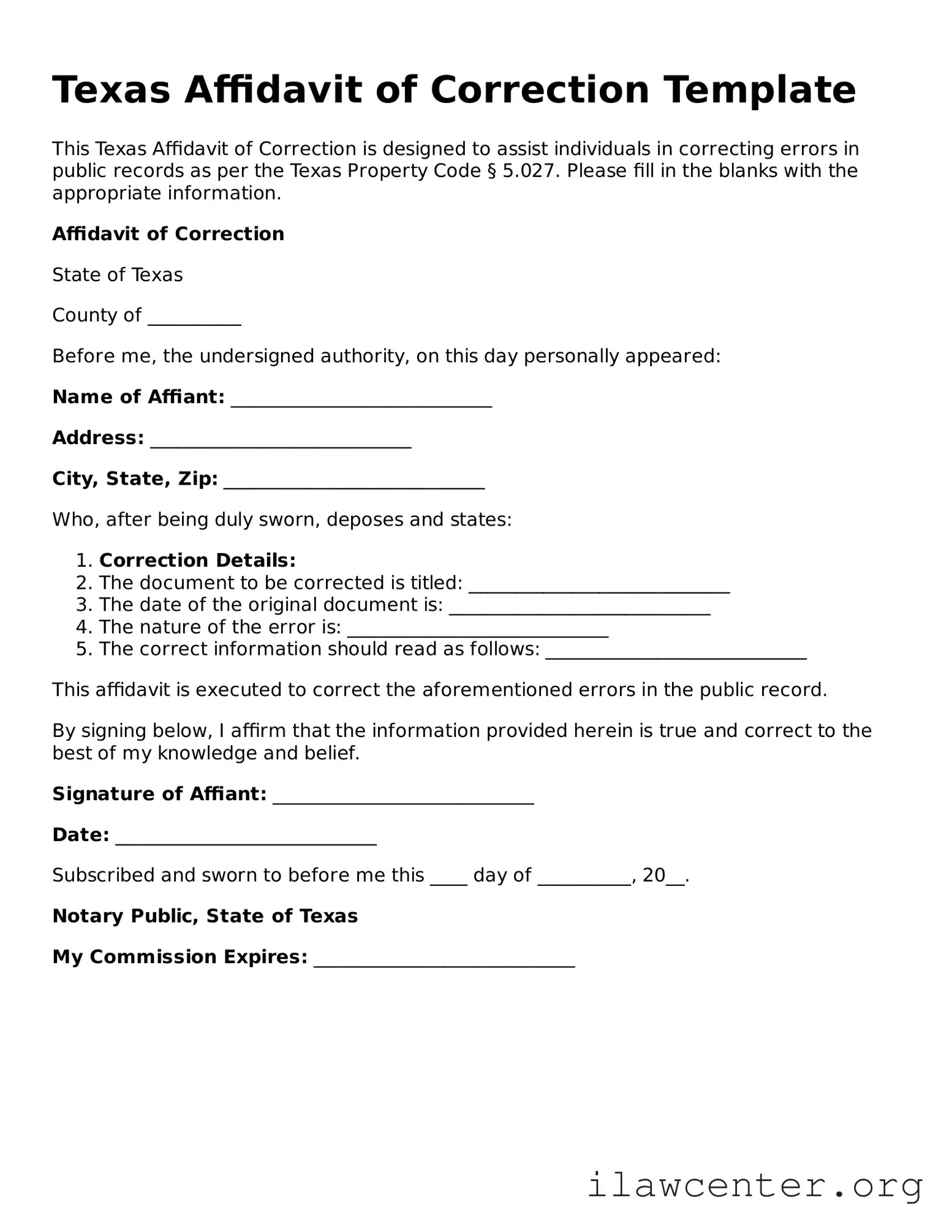
Texas Affidavit of Correction Preview

Texas Affidavit of Correction Template

This Texas Affidavit of Correction is designed to assist individuals in correcting errors in public records as per the Texas Property Code § 5.027. Please fill in the blanks with the appropriate information.

Affidavit of Correction

State of Texas

County of __________

Before me, the undersigned authority, on this day personally appeared:

Name of Affiant: ____________________________

Address: ____________________________

City, State, Zip: ____________________________

Who, after being duly sworn, deposes and states:

  1. Correction Details:
  2. The document to be corrected is titled: ____________________________
  3. The date of the original document is: ____________________________
  4. The nature of the error is: ____________________________
  5. The correct information should read as follows: ____________________________

This affidavit is executed to correct the aforementioned errors in the public record.

By signing below, I affirm that the information provided herein is true and correct to the best of my knowledge and belief.

Signature of Affiant: ____________________________

Date: ____________________________

Subscribed and sworn to before me this ____ day of __________, 20__.

Notary Public, State of Texas

My Commission Expires: ____________________________

PDF Form Characteristics

Fact Name Details
Purpose The Texas Affidavit of Correction form is used to correct clerical errors in public records.
Governing Law The form is governed by Texas Property Code § 5.028.
Eligibility Any individual or entity that identifies an error in a recorded document may file this affidavit.
Filing Process The affidavit must be filed with the county clerk in the county where the original document was recorded.
Content Requirements The affidavit must include a description of the error and the correct information to be recorded.

Instructions on Utilizing Texas Affidavit of Correction

After obtaining the Texas Affidavit of Correction form, it's essential to ensure all information is accurate and complete. This document allows you to correct certain errors in previously filed documents. Follow the steps below to fill out the form correctly.

  1. Begin by downloading the Texas Affidavit of Correction form from the official website or obtaining a physical copy from the appropriate office.
  2. Read the instructions carefully to understand the requirements for filling out the form.
  3. In the first section, provide your name and contact information. Ensure that all details are accurate and up-to-date.
  4. Next, identify the document that contains the error. Include the title of the document, the date it was filed, and any relevant identification numbers.
  5. Clearly state the specific correction that needs to be made. Be concise and precise in your wording to avoid confusion.
  6. In the designated area, sign the affidavit. Your signature must match the name provided at the beginning of the form.
  7. Have the affidavit notarized. This step is crucial, as it validates the document and ensures its acceptance by the relevant authorities.
  8. Make copies of the completed affidavit for your records before submission.
  9. Submit the affidavit to the appropriate office or agency. Ensure you follow any additional submission guidelines they may have.

Important Facts about Texas Affidavit of Correction

What is the Texas Affidavit of Correction form?

The Texas Affidavit of Correction form is a legal document used to correct errors in public records. These errors may include mistakes in property descriptions, names, or other important details that have been improperly recorded. This form helps ensure that the public record accurately reflects the true information.

Who can file an Affidavit of Correction in Texas?

Any individual or entity that is named in the public record or has an interest in the document can file an Affidavit of Correction. This includes property owners, their representatives, or anyone who has a legal interest in the affected document.

What types of errors can be corrected using this form?

The form can be used to correct a variety of errors, such as typographical mistakes, incorrect legal descriptions, or misspelled names. However, it cannot be used to change the substance of the original document or to alter the legal rights of the parties involved.

How is the Affidavit of Correction filed?

The completed Affidavit of Correction must be filed with the county clerk's office in the county where the original document is recorded. It is important to ensure that the form is signed and notarized before submission to validate the corrections.

Is there a fee associated with filing the Affidavit of Correction?

Yes, there is typically a filing fee associated with submitting the Affidavit of Correction. This fee varies by county, so it is advisable to check with the local county clerk's office for the specific amount required.

Does the Affidavit of Correction need to be notarized?

Yes, the Affidavit of Correction must be notarized to be legally valid. This requirement ensures that the person making the corrections is properly identified and that the document is executed in accordance with Texas law.

What happens after the Affidavit of Correction is filed?

Once the Affidavit of Correction is filed and accepted by the county clerk, it becomes part of the public record. The corrections will then be reflected in the official records, ensuring that future inquiries will show the corrected information.

Can I use the Affidavit of Correction to change my property ownership?

No, the Affidavit of Correction cannot be used to change ownership of property. It is strictly for correcting errors in existing records. To transfer ownership, a different legal document, such as a deed, would be required.

Common mistakes

Filling out the Texas Affidavit of Correction form can be a straightforward process, but there are common mistakes that individuals often make. One frequent error is providing inaccurate or incomplete information. When filling out the form, it is crucial to ensure that all details, such as names, dates, and document numbers, are correct. Missing or incorrect information can lead to delays or even rejection of the correction.

Another mistake involves failing to sign the affidavit. The signature is a vital part of the document, as it indicates that the person submitting the affidavit is affirming the truth of the information provided. Without a signature, the form may be considered invalid, which can complicate the correction process.

People sometimes overlook the importance of having the affidavit notarized. In Texas, a notary public must witness the signing of the affidavit to confirm its authenticity. Skipping this step can result in the form being rejected by the appropriate authorities. Notarization serves as an additional layer of verification that the information is accurate and that the signer is who they claim to be.

Another common mistake is not following the specific instructions for the form. Each section of the affidavit must be completed according to the guidelines provided. Failing to adhere to these instructions can lead to confusion and errors, which may ultimately affect the validity of the document. It is advisable to carefully read all instructions before proceeding.

Lastly, individuals may neglect to keep copies of the submitted affidavit. Retaining a copy is important for personal records and can be helpful if any issues arise later. Having documentation of what was submitted can assist in clarifying any misunderstandings or disputes that may occur in the future.

Documents used along the form

The Texas Affidavit of Correction form is often used to rectify errors in public records. Alongside this form, several other documents may be necessary to ensure compliance with legal requirements and to facilitate the correction process. Below is a list of other forms and documents that are commonly used in conjunction with the Texas Affidavit of Correction.

  • Certificate of Correction: This document is used to officially amend a previously filed certificate, such as a certificate of formation for a corporation or limited liability company, to correct errors in the original filing.
  • Notice of Intent to File Correction: This notice informs interested parties of the intent to file a correction, ensuring transparency and giving them an opportunity to respond if necessary.
  • Original Document: The original document that contains the error must often be submitted alongside the affidavit to provide context and support for the correction being requested.
  • Supporting Affidavit: In some cases, an additional affidavit may be required to provide further evidence or testimony regarding the nature of the error and the need for correction.
  • Cover Letter: A cover letter may accompany the affidavit and other documents, summarizing the corrections being made and outlining any relevant details for the reviewing authority.
  • Filing Fee Payment Receipt: If there is a fee associated with filing the affidavit or any related documents, a receipt or proof of payment may be required to complete the submission.
  • Identification Documents: Depending on the nature of the correction, identification documents may be needed to verify the identity of the person submitting the affidavit.
  • Consent Forms: If multiple parties are involved in the correction, consent forms from all affected parties may be necessary to ensure agreement on the changes being made.

Understanding these associated documents can help streamline the process of correcting public records in Texas. It is essential to prepare and submit all necessary forms accurately to avoid delays or complications.

Similar forms

  • Affidavit of Identity: This document is used to confirm an individual's identity, often in situations where there is a dispute or confusion regarding personal information. Like the Affidavit of Correction, it is sworn under oath and serves to clarify details.
  • Affidavit of Support: Commonly used in immigration processes, this document provides a guarantee of financial support for a visa applicant. It requires the sponsor to affirm their commitment, similar to how an Affidavit of Correction affirms the accuracy of information.
  • Affidavit of Residence: This form verifies an individual's place of residence, often required for legal proceedings or applications. It serves a similar purpose of confirming factual information, akin to the Affidavit of Correction.
  • Affidavit of Service: Used in legal proceedings to confirm that documents were properly delivered to a party, this affidavit ensures transparency and accountability, much like the correction of errors in an Affidavit of Correction.
  • Declaration of Facts: This document outlines specific facts related to a case or situation. It is similar to the Affidavit of Correction in that it presents information that may need to be verified or corrected.
  • Power of Attorney: This legal document allows one person to act on behalf of another. While it serves a different purpose, both documents require a sworn statement and can impact legal rights and responsibilities.
  • Certification of Accuracy: Often used in various legal and administrative contexts, this document certifies that certain information is accurate, similar to the intent behind an Affidavit of Correction.
  • Quitclaim Deed: This real estate document transfers interest in property but may also correct errors in previous deeds. It parallels the Affidavit of Correction in its function to clarify and rectify legal documents.
  • Notice of Correction: This document is filed to correct or clarify information previously recorded in public records. It serves a similar purpose as the Affidavit of Correction by ensuring that accurate information is publicly available.
  • Legal Disclaimer: This document clarifies the limitations of liability or responsibility in certain situations. While not an affidavit, it serves to correct misconceptions or assumptions, much like the Affidavit of Correction aims to rectify inaccuracies.

Dos and Don'ts

When filling out the Texas Affidavit of Correction form, it's important to approach the task with care. Here are some essential do's and don'ts to guide you through the process.

  • Do ensure that you have the correct form for your specific needs. Using the right version is crucial.
  • Do read the instructions thoroughly before you begin. Understanding the requirements can save you time and effort.
  • Do provide accurate and complete information. Double-checking your details helps prevent delays.
  • Do sign the affidavit in the presence of a notary public. This step is essential for the document's validity.
  • Don't leave any sections blank. If a question does not apply to you, indicate that clearly.
  • Don't use white-out or other correction fluids on the form. Mistakes should be crossed out neatly and initialed.

By following these guidelines, you can help ensure that your Texas Affidavit of Correction is completed correctly and efficiently.

Misconceptions

Understanding the Texas Affidavit of Correction form is essential for ensuring that errors in public records are properly addressed. However, several misconceptions can lead to confusion about its purpose and use. Here are eight common misconceptions:

  • Only Notaries Can File the Affidavit: Many believe that only a notary public can file this form. In reality, any individual who has the authority to correct the record can complete and submit the affidavit.
  • It Can Only Correct Minor Errors: Some people think that the affidavit is limited to minor mistakes, such as typos. However, it can also be used to correct significant errors, provided they are clearly documented.
  • It Requires a Court Order: There is a common belief that a court order is necessary to file an affidavit of correction. This is not true; the affidavit itself serves as a formal declaration to correct the record.
  • Filing the Affidavit is Complicated: Many assume that the process is overly complicated. In fact, the form is straightforward, and guidance is often available to assist individuals in completing it.
  • It Only Applies to Real Estate Records: Some think that the affidavit is only relevant for real estate documents. However, it can be used for various public records, including vital records and business filings.
  • Once Filed, It Cannot Be Changed: There is a misconception that filing an affidavit of correction is a one-time action. In truth, if further corrections are needed, additional affidavits can be submitted.
  • It Can Be Used for Fraudulent Changes: Some individuals believe they can use the affidavit to make fraudulent changes to records. This is illegal and can lead to serious legal consequences.
  • All Errors Can Be Corrected with This Form: While the affidavit can address many errors, it cannot resolve every issue. Certain matters may require different legal processes or documentation.

By dispelling these misconceptions, individuals can better navigate the process of correcting records in Texas and ensure that their documents accurately reflect the intended information.

Key takeaways

Filling out and using the Texas Affidavit of Correction form can be a straightforward process if you keep a few key points in mind. Here are some essential takeaways to consider:

  • The Texas Affidavit of Correction is used to correct mistakes in public records, such as deeds or other legal documents.
  • Ensure that the form is completed accurately to avoid further complications. Double-check all information before submission.
  • The affidavit must be signed in the presence of a notary public to be legally binding.
  • Include all relevant details about the original document, including the type of document, date of filing, and the specific errors to be corrected.
  • Once completed, file the affidavit with the same office where the original document was recorded. This is crucial for the correction to take effect.
  • Keep a copy of the filed affidavit for your records. This can be useful for future reference or if any questions arise regarding the correction.

By following these guidelines, you can navigate the process of correcting public records in Texas more effectively.