Attorney-Verified  Affidavit of Death Document for Texas

Attorney-Verified Affidavit of Death Document for Texas

The Texas Affidavit of Death form is a legal document used to officially declare the death of an individual. This form serves as a vital record for various administrative purposes, including settling estates and transferring property. To ensure proper handling of these matters, it’s essential to fill out the form accurately; click the button below to get started.

Article Guide

In the state of Texas, navigating the aftermath of a loved one's passing can be overwhelming, especially when it comes to handling their estate and ensuring that all legal matters are properly addressed. One important document that can simplify this process is the Texas Affidavit of Death form. This form serves as a formal declaration confirming the death of an individual, which can be crucial for settling various legal and financial obligations. It is commonly used to transfer property ownership, settle debts, and facilitate the distribution of assets. By providing essential details such as the deceased's name, date of death, and relevant identification, the affidavit helps establish a clear record that can be used in various legal contexts. Understanding how to properly complete and file this document can alleviate some of the burdens during a challenging time, allowing families to focus on honoring their loved ones while ensuring that their affairs are in order.

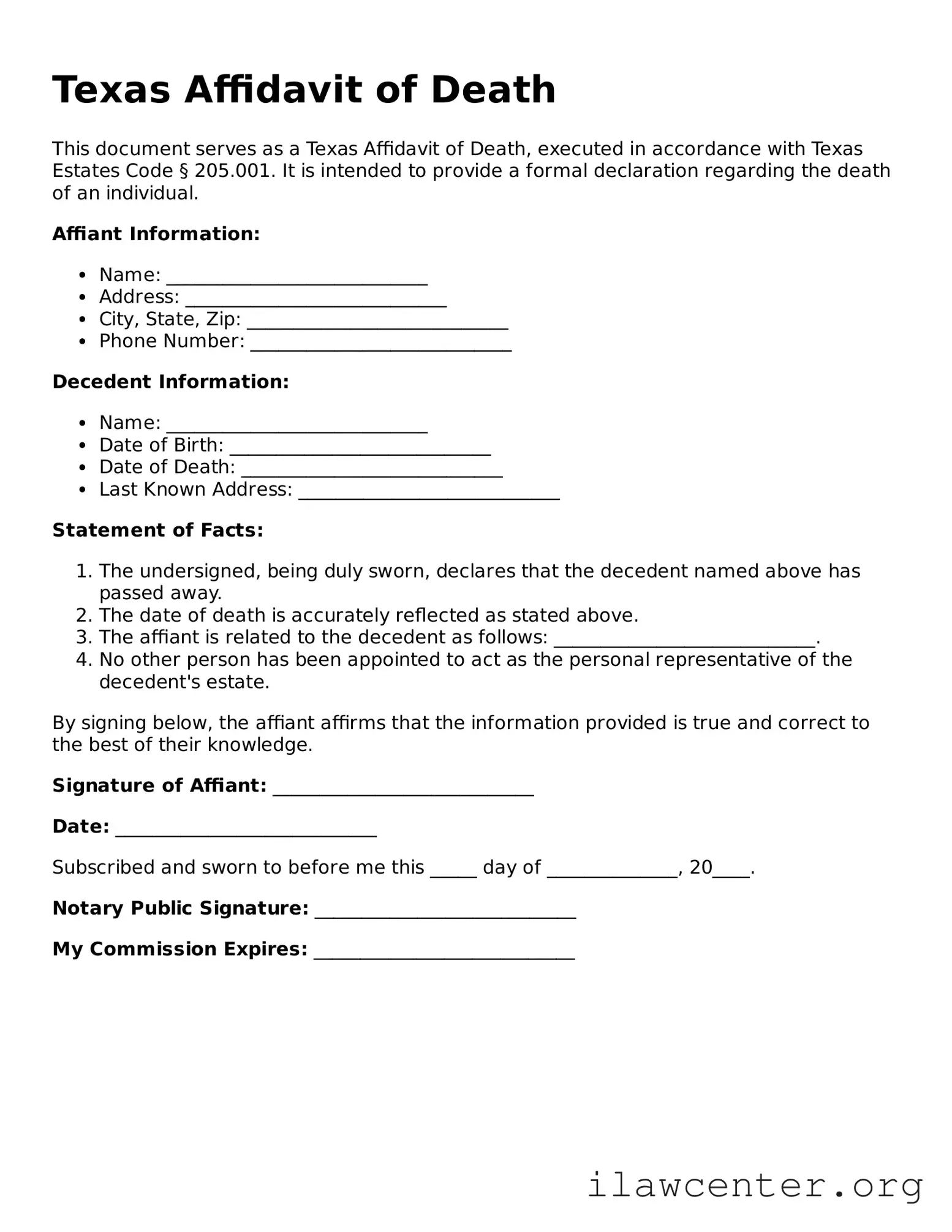
Texas Affidavit of Death Preview

Texas Affidavit of Death

This document serves as a Texas Affidavit of Death, executed in accordance with Texas Estates Code § 205.001. It is intended to provide a formal declaration regarding the death of an individual.

Affiant Information:

  • Name: ____________________________
  • Address: ____________________________
  • City, State, Zip: ____________________________
  • Phone Number: ____________________________

Decedent Information:

  • Name: ____________________________
  • Date of Birth: ____________________________
  • Date of Death: ____________________________
  • Last Known Address: ____________________________

Statement of Facts:

  1. The undersigned, being duly sworn, declares that the decedent named above has passed away.
  2. The date of death is accurately reflected as stated above.
  3. The affiant is related to the decedent as follows: ____________________________.
  4. No other person has been appointed to act as the personal representative of the decedent's estate.

By signing below, the affiant affirms that the information provided is true and correct to the best of their knowledge.

Signature of Affiant: ____________________________

Date: ____________________________

Subscribed and sworn to before me this _____ day of ______________, 20____.

Notary Public Signature: ____________________________

My Commission Expires: ____________________________

PDF Form Characteristics

Fact Name Description
Purpose The Texas Affidavit of Death form is used to legally declare that an individual has passed away.
Governing Law This form is governed by Texas Probate Code, specifically Section 51.001.
Who Can File Any interested party, such as a family member or executor of the estate, can file the affidavit.
Required Information The form requires the deceased's full name, date of death, and place of death.
Notarization The affidavit must be signed in front of a notary public to be considered valid.
Filing Location The completed form is typically filed with the county clerk in the county where the deceased resided.

Instructions on Utilizing Texas Affidavit of Death

After obtaining the Texas Affidavit of Death form, you will need to complete it accurately. This document will require specific information about the deceased and the affiant. Following the steps below will help ensure that the form is filled out correctly.

  1. Begin by entering the full name of the deceased individual in the designated space.
  2. Provide the date of death. This should be the exact date as recorded on the death certificate.
  3. Fill in the place of death, including the city and county where the individual passed away.
  4. Next, include your full name as the affiant. This is the person making the affidavit.
  5. List your relationship to the deceased. This could be a spouse, child, sibling, or another relation.
  6. Indicate your address, including the city, state, and zip code.
  7. Sign the form in the designated area. Your signature must be dated on the same day you complete the form.
  8. Have the affidavit notarized. A notary public will need to witness your signature and stamp the document.

Once the form is completed and notarized, it can be filed with the appropriate authorities or used as needed for legal matters related to the deceased's estate.

Important Facts about Texas Affidavit of Death

What is a Texas Affidavit of Death form?

The Texas Affidavit of Death form is a legal document used to officially declare the death of an individual. This form serves as a means to provide evidence of a person's passing, often required for various legal and administrative purposes. It can be utilized in situations such as settling an estate, transferring property ownership, or addressing matters related to life insurance. The affidavit is typically signed by an individual who has personal knowledge of the deceased's death, such as a family member or close friend.

Who can complete and sign the Affidavit of Death?

Generally, any person who has firsthand knowledge of the death can complete and sign the Affidavit of Death. This often includes relatives, friends, or anyone who was present at the time of death. It is important for the signer to provide accurate information regarding the deceased, including their full name, date of birth, and date of death. In some cases, a notary public may be required to witness the signing of the affidavit to ensure its validity.

What information is required on the Affidavit of Death form?

The Affidavit of Death form typically requires specific information to be filled out. This includes the full name of the deceased, their date of birth, and the date of death. Additionally, the affidavit may ask for the address of the deceased at the time of death and the name and relationship of the person completing the affidavit. Providing accurate and complete information is crucial, as this document may be used in legal proceedings or to settle the deceased's affairs.

Where do I file the Affidavit of Death after it is completed?

Once the Affidavit of Death is completed and signed, it should be filed with the appropriate local authorities. This often means submitting the affidavit to the county clerk’s office in the county where the deceased lived or where the death occurred. In some cases, it may also be necessary to file the affidavit with the probate court if the deceased had a will or if there are estate matters to address. It is wise to keep copies of the filed affidavit for personal records and any future legal needs.

Is there a fee associated with filing the Affidavit of Death?

Filing fees for the Affidavit of Death can vary depending on the county and the specific office where the document is filed. Typically, there may be a nominal fee charged by the county clerk’s office. It is advisable to check with the local office for the exact amount and payment methods accepted. Additionally, if the affidavit is part of a larger estate matter, there may be other associated costs, such as court fees, that should be considered.
Common mistakes

When filling out the Texas Affidavit of Death form, individuals often encounter various pitfalls that can lead to complications. One common mistake is failing to provide accurate personal information. This includes the full name of the deceased, the date of death, and other identifying details. Any discrepancies can result in delays or even the rejection of the affidavit.

Another frequent error is neglecting to include the correct signatures. The form requires the signatures of the affiant and, in some cases, witnesses. Omitting a signature can render the document invalid. It is essential to ensure that all required parties have signed the affidavit before submission.

Many people overlook the importance of notarization. The Texas Affidavit of Death must be notarized to be considered legally binding. Failing to have the affidavit notarized can lead to issues with its acceptance in legal proceedings. Always check that a notary public has properly stamped and signed the document.

In addition, individuals sometimes use outdated forms. The Texas Affidavit of Death may be updated periodically, and using an old version can cause confusion or rejection. It is advisable to obtain the most current version of the form from a reliable source.

Another mistake involves the lack of supporting documentation. While the affidavit itself is crucial, including additional documents, such as a death certificate, can strengthen the submission. This helps verify the information provided and can facilitate the processing of the affidavit.

Lastly, people often fail to read the instructions carefully. Each section of the form has specific requirements, and overlooking these can lead to incomplete or incorrect submissions. Taking the time to thoroughly review the instructions can prevent many common errors and ensure a smoother process.

Documents used along the form

When dealing with the Texas Affidavit of Death form, several other documents may be required to ensure a smooth process. Each of these forms serves a specific purpose and helps clarify the circumstances surrounding the death. Below is a list of commonly used documents that often accompany the Affidavit of Death.

  • Death Certificate: This official document is issued by the state and confirms the individual's death. It provides vital information such as the date, place, and cause of death, and is often necessary for legal and financial matters.
  • Will: If the deceased left a will, this document outlines their wishes regarding the distribution of their assets. It is crucial for settling the estate and can impact how the Affidavit of Death is utilized.
  • Letters Testamentary: Issued by a probate court, these letters authorize the executor named in the will to manage the deceased's estate. They are often needed to prove authority when dealing with the deceased's assets.
  • Affidavit of Heirship: This document is used when there is no will. It establishes the heirs of the deceased and their respective shares of the estate, helping to clarify ownership and distribution of assets.

Understanding these documents can simplify the process of handling affairs after a loved one's passing. Each form plays a vital role in ensuring that the deceased's wishes are honored and that their estate is settled appropriately.

Similar forms

The Affidavit of Death form serves specific purposes in legal and administrative processes. Here are four documents that share similarities with the Affidavit of Death:

  • Death Certificate: This official document is issued by a government authority and confirms the fact of a person's death. Like the Affidavit of Death, it serves as proof for settling estates and other legal matters.
  • Will: A will outlines how a deceased person's assets should be distributed. Both documents are crucial in the probate process, helping to clarify the deceased's wishes and facilitate the transfer of property.
  • Letters Testamentary: Issued by a court, these letters authorize an executor to manage the deceased's estate. Similar to the Affidavit of Death, they establish the legal authority to act on behalf of the deceased.
  • Affidavit of Heirship: This document is used to establish the heirs of a deceased person when no will exists. It shares the purpose of confirming death and is often used in conjunction with the Affidavit of Death to settle estate matters.

Dos and Don'ts

When filling out the Texas Affidavit of Death form, it's important to pay attention to detail. Here’s a list of things you should and shouldn’t do to ensure the process goes smoothly.

  • Do read the instructions carefully before starting.
  • Do gather all necessary information about the deceased, including full name, date of birth, and date of death.
  • Do ensure that the form is signed in front of a notary public.
  • Do provide accurate information; double-check names and dates.
  • Do keep a copy of the completed form for your records.
  • Don’t leave any required fields blank; fill in all sections completely.
  • Don’t use white-out or make corrections that aren’t initialed by the signer.
  • Don’t rush through the process; take your time to ensure accuracy.
  • Don’t forget to check the filing requirements for the county where the form will be submitted.
  • Don’t assume that all notaries are familiar with the Affidavit of Death; confirm their experience if needed.

Misconceptions

The Texas Affidavit of Death form is an important legal document used to establish the death of an individual. However, several misconceptions surround this form. Below are ten common misunderstandings, along with explanations to clarify them.

  1. The form is only for use in Texas. Many believe this form is exclusive to Texas, but it can be used in other jurisdictions if they recognize Texas law.
  2. Only family members can file the affidavit. While family members often file it, anyone with knowledge of the death can submit the affidavit.
  3. The affidavit must be notarized. Not all versions of the affidavit require notarization, but it is highly recommended for legal validity.
  4. It can be filed anytime after the death. There is no strict deadline, but filing it promptly can help avoid complications with estate matters.
  5. The affidavit is the same as a death certificate. The affidavit serves a different purpose than a death certificate, which is an official record issued by the state.
  6. It can be used to settle an estate. The affidavit itself does not settle an estate; it is a preliminary step in the estate administration process.
  7. All affidavits are the same. Different situations may require different forms or additional documentation, depending on the circumstances of the death.
  8. Filing the affidavit is a lengthy process. Generally, completing and filing the affidavit is straightforward and can often be done quickly.
  9. Once filed, the affidavit is permanent and cannot be changed. While the affidavit is a formal declaration, it can be amended if necessary.
  10. Legal advice is not needed. While some may feel comfortable filing on their own, consulting with a legal professional can provide peace of mind and ensure accuracy.

Understanding these misconceptions can help individuals navigate the process more effectively. It is always wise to seek clarity when dealing with legal matters to ensure compliance and protect one’s interests.

Key takeaways

When dealing with the Texas Affidavit of Death form, it’s essential to understand its purpose and how to complete it correctly. Here are some key takeaways to keep in mind:

  • Purpose: The Texas Affidavit of Death serves as a legal document that confirms the death of an individual. It is often used to transfer property or settle estate matters.
  • Who Can File: Typically, the affidavit can be filed by a close relative or someone with a vested interest in the deceased's estate.
  • Required Information: You will need to provide essential details, including the deceased's full name, date of birth, date of death, and place of death.
  • Signature Requirement: The affidavit must be signed in the presence of a notary public. This adds an extra layer of authenticity to the document.
  • Filing Location: Once completed, the affidavit should be filed with the county clerk in the county where the deceased resided at the time of death.
  • Legal Consequences: Filing a false affidavit can lead to serious legal repercussions, including potential charges of perjury.
  • Accessing the Form: The Texas Affidavit of Death form can often be found online through the Texas Secretary of State's website or at local county offices.

Understanding these points can help ensure that the process of filing the Texas Affidavit of Death goes smoothly and legally.