Attorney-Verified  Affidavit of Gift Document for Texas

Attorney-Verified Affidavit of Gift Document for Texas

The Texas Affidavit of Gift form is a legal document used to declare the transfer of property or assets as a gift. This form helps clarify ownership and ensures that the transfer is recognized by the state. If you’re ready to complete this process, fill out the form by clicking the button below.

Article Guide

The Texas Affidavit of Gift form serves as a vital document for individuals looking to transfer ownership of property without the exchange of money. This form is particularly important when it comes to gifting vehicles, real estate, or other significant assets, ensuring that the transfer is legally recognized and properly documented. By completing this affidavit, the giver affirms their intent to gift the property, while the recipient acknowledges acceptance of the gift. The form includes essential details such as the names and addresses of both parties, a description of the property being gifted, and any relevant conditions tied to the gift. Additionally, it requires signatures from both the giver and the recipient, often necessitating notarization to enhance its validity. Understanding the importance of this form can help individuals navigate the gifting process smoothly, ensuring that all legal requirements are met and that both parties are protected in the transaction.

Texas Affidavit of Gift Preview

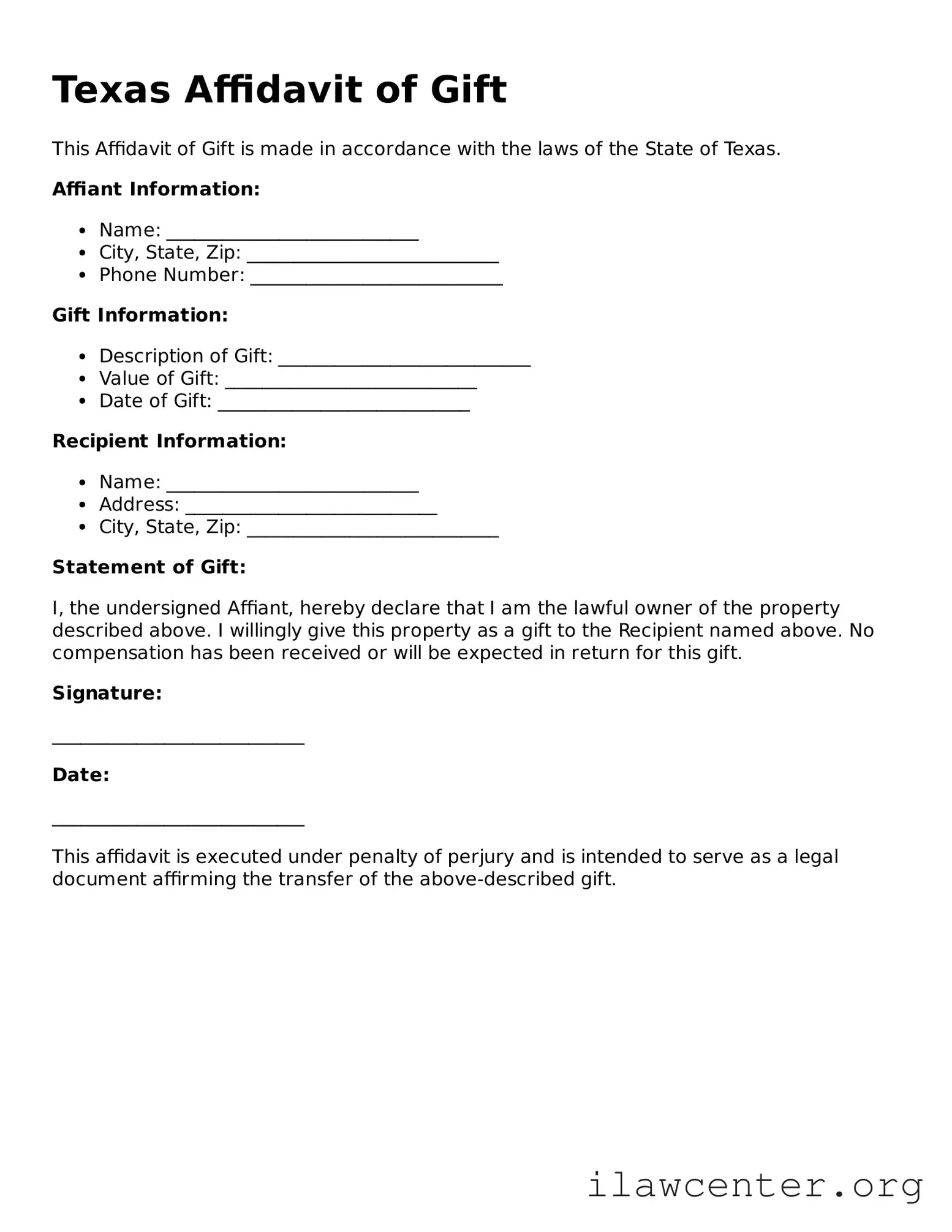
Texas Affidavit of Gift

This Affidavit of Gift is made in accordance with the laws of the State of Texas.

Affiant Information:

  • Name: ___________________________
  • City, State, Zip: ___________________________
  • Phone Number: ___________________________

Gift Information:

  • Description of Gift: ___________________________
  • Value of Gift: ___________________________
  • Date of Gift: ___________________________

Recipient Information:

  • Name: ___________________________
  • Address: ___________________________
  • City, State, Zip: ___________________________

Statement of Gift:

I, the undersigned Affiant, hereby declare that I am the lawful owner of the property described above. I willingly give this property as a gift to the Recipient named above. No compensation has been received or will be expected in return for this gift.

Signature:

___________________________

Date:

___________________________

This affidavit is executed under penalty of perjury and is intended to serve as a legal document affirming the transfer of the above-described gift.

PDF Form Characteristics

Fact Name Details
Definition The Texas Affidavit of Gift form is a legal document used to transfer ownership of property or assets as a gift without consideration.
Governing Law This form is governed by Texas Property Code, Title 1, Chapter 23, which outlines the requirements for gifts and transfers.
Purpose It serves to provide a clear record of the gift for both the donor and the recipient, ensuring legal clarity in the transfer.
Signature Requirement The form must be signed by the donor in the presence of a notary public to be considered valid.
Tax Implications Gifts may have tax implications. Donors should consult a tax professional to understand potential gift tax responsibilities.

Instructions on Utilizing Texas Affidavit of Gift

Once you have the Texas Affidavit of Gift form ready, you'll need to fill it out carefully. This form is important for documenting the transfer of property or gifts. Follow the steps below to ensure you complete it correctly.

  1. Begin by entering the date at the top of the form.
  2. Provide your full name in the designated section. Make sure to include any middle names.
  3. Fill in your address, including city, state, and ZIP code.
  4. Next, enter the recipient's full name. This should be the person receiving the gift.
  5. Include the recipient's address, ensuring it is complete with city, state, and ZIP code.
  6. Describe the gift in detail. Include information such as the type of property and any relevant identifying details.
  7. Sign the form in the designated area. Your signature confirms the information is accurate.
  8. Have the form notarized. A notary public will verify your identity and witness your signature.

After completing the form, make sure to keep a copy for your records. The signed and notarized affidavit should then be submitted to the appropriate authorities or kept with your important documents, depending on your situation.

Important Facts about Texas Affidavit of Gift

What is the Texas Affidavit of Gift form?

The Texas Affidavit of Gift form is a legal document used to transfer ownership of property or assets from one individual to another without any exchange of money. This form is commonly utilized for gifts of real estate, vehicles, or personal property. It serves to establish the intent of the donor to gift the property and provides a record of the transaction for both parties involved.

Who needs to use the Texas Affidavit of Gift form?

What information is required on the form?

The Texas Affidavit of Gift form requires specific information from both the donor and the recipient. This includes the names and addresses of both parties, a description of the property being gifted, and the date of the gift. Additionally, the donor must provide a statement of intent to gift the property. Signatures from both parties are also necessary to validate the document.

Is the Texas Affidavit of Gift form legally binding?

Yes, the Texas Affidavit of Gift form is legally binding once it is properly completed and signed by both the donor and the recipient. However, it is important to ensure that the form complies with any relevant state laws regarding property transfers. Consulting with a legal professional may be advisable to confirm that all legal requirements are met.

Do I need to notarize the Texas Affidavit of Gift form?

Notarization is not always required for the Texas Affidavit of Gift form. However, having the document notarized can provide an additional layer of authenticity and may be beneficial in case of disputes. Some institutions, such as banks or title companies, may require notarization for their records, especially for real estate transactions.

Can the Texas Affidavit of Gift form be revoked?

Once the Texas Affidavit of Gift form is executed and the property is transferred, the gift generally cannot be revoked. However, the donor may have the ability to revoke the gift if it was made under certain conditions, such as fraud or undue influence. Legal advice may be necessary to navigate such situations.

Are there any tax implications associated with using the Texas Affidavit of Gift form?

Gifting property may have tax implications for both the donor and the recipient. The IRS has specific rules regarding gift taxes, including annual exclusion limits. It is important for both parties to understand these implications and consult with a tax professional if needed. Proper documentation, such as the Texas Affidavit of Gift form, can be helpful for tax reporting purposes.

Where can I obtain a Texas Affidavit of Gift form?

The Texas Affidavit of Gift form can typically be obtained from various sources, including legal stationery stores, online legal document providers, or local government offices. It is important to ensure that the version used is current and complies with Texas laws. Additionally, legal assistance may be sought to ensure the form is filled out correctly.
Common mistakes

Filling out the Texas Affidavit of Gift form can be straightforward, but many people make common mistakes that can lead to delays or complications. Understanding these pitfalls can help ensure that your form is completed correctly.

One frequent error is not providing all required information. Every section of the form is important, and leaving blanks can raise questions or cause the application to be rejected. Make sure to double-check that all fields are filled out completely.

Another mistake is failing to sign the form. The Affidavit of Gift requires signatures from both the donor and the recipient. Without these signatures, the document is not valid. Always remember to sign and date the form before submitting it.

People often forget to include the correct identification details. The form requires specific information about both the donor and the recipient, such as their full names and addresses. Omitting this information can lead to confusion and delays in processing.

Additionally, using outdated versions of the form is a common issue. Ensure you are using the most current version of the Texas Affidavit of Gift form. Using an older version may result in problems during the filing process.

Another mistake is not providing sufficient proof of the gift. Supporting documents, such as receipts or appraisals, may be necessary to validate the gift's value. Failing to include these documents can complicate matters later on.

Some individuals overlook the importance of clarity in their descriptions. When describing the gift, be as detailed as possible. Vague descriptions can lead to misunderstandings about what is being transferred.

People also sometimes forget to keep copies of the completed form. It’s wise to maintain a record for your own files. This can be helpful if any questions arise in the future regarding the gift.

Another common mistake involves not understanding the implications of the gift. Donors should be aware of any potential tax consequences associated with their gift. Consulting with a tax professional can provide valuable insight.

Finally, some individuals submit the form without reviewing it thoroughly. A quick review can catch mistakes before they become an issue. Taking the time to proofread can save a lot of hassle down the line.

By avoiding these common mistakes, you can ensure a smoother process when filling out the Texas Affidavit of Gift form. Careful attention to detail will make a significant difference in the outcome.

Documents used along the form

The Texas Affidavit of Gift form is often used in various transactions involving the transfer of property or assets without consideration. However, it is typically accompanied by other forms and documents that help clarify the transaction and ensure legal compliance. Below is a list of documents commonly used alongside the Affidavit of Gift.

  • Deed of Gift: This document formally transfers ownership of real property from one person to another without any payment. It outlines the specifics of the property and the parties involved.
  • Bill of Sale: Used for the transfer of personal property, this document serves as proof of the sale and includes details about the items being transferred.
  • Gift Letter: A simple letter that states the donor's intention to give a gift. It often includes the value of the gift and may be required by financial institutions for certain transactions.
  • IRS Form 709: This form is used to report gifts that exceed the annual exclusion limit set by the IRS. It helps ensure compliance with federal tax laws regarding gift taxes.
  • Warranty Deed: This document provides a guarantee that the property being transferred is free from any liens or encumbrances, offering protection to the recipient.
  • Power of Attorney: In some cases, a donor may appoint someone to act on their behalf in executing the Affidavit of Gift or related documents. This document grants that authority.
  • Affidavit of Identity: This form may be required to confirm the identity of the parties involved in the transaction, ensuring that all information is accurate and legitimate.
  • Title Transfer Form: For vehicles or other titled assets, this form is necessary to officially change ownership from the donor to the recipient.
  • Estate Planning Documents: Wills or trusts may be relevant if the gift is part of a larger estate plan, outlining how assets should be distributed after death.
  • Tax Documentation: Any relevant documents related to the donor’s tax situation may be necessary, especially if the gift impacts the donor’s tax liabilities.

Using these forms and documents in conjunction with the Texas Affidavit of Gift can help ensure a smooth transfer process. Each document serves a specific purpose and provides necessary information that can protect both the donor and the recipient in the transaction.

Similar forms

  • Bill of Sale: This document transfers ownership of personal property from one party to another. Like an Affidavit of Gift, it requires signatures and serves as proof of the transaction.
  • Deed of Gift: Similar to the Affidavit of Gift, this document formally transfers ownership of real property without any exchange of money. It outlines the terms of the gift and is often recorded with the county.
  • Gift Letter: A simple letter that confirms a gift has been made. It includes details about the gift and the donor's intent, similar to the Affidavit of Gift in establishing intent.
  • Power of Attorney: This document allows one person to act on behalf of another. While it’s not a gift itself, it can facilitate the transfer of assets, similar to how an Affidavit of Gift works.
  • Trust Agreement: This document establishes a trust, allowing assets to be managed for the benefit of another. Like an Affidavit of Gift, it details the transfer of assets but often involves more complex arrangements.
  • Donation Receipt: A receipt given to a donor after a gift is made. It serves as proof of the donation, similar to how an Affidavit of Gift documents the intent and details of the gift.
  • Transfer of Ownership Form: Used for transferring ownership of vehicles or other assets, this form functions similarly to an Affidavit of Gift by documenting the change in ownership.
  • Charitable Contribution Form: This form is used to document donations made to charities. It shares the purpose of recording a gift, akin to the Affidavit of Gift.
  • Release of Claim: This document relinquishes any claims to a property or asset. It can be similar to an Affidavit of Gift when it confirms that a gift has been made and accepted.
  • Settlement Agreement: Often used in legal disputes, this document outlines the terms of a settlement. It can include gifts as part of the resolution, similar to how an Affidavit of Gift formalizes a transfer.

Dos and Don'ts

When filling out the Texas Affidavit of Gift form, it is important to follow specific guidelines to ensure accuracy and compliance. Below is a list of things to do and avoid during this process.

  • Do read the entire form carefully before starting.
  • Do provide accurate and complete information.
  • Do sign and date the form where required.
  • Do ensure that all parties involved in the gift are identified.
  • Do keep a copy of the completed form for your records.
  • Don't leave any sections blank unless instructed to do so.
  • Don't use correction fluid or tape on the form.
  • Don't submit the form without reviewing it for errors.
  • Don't forget to check if additional documentation is required.
  • Don't rush through the process; take your time to ensure accuracy.

Misconceptions

The Texas Affidavit of Gift form is a crucial document for transferring ownership of property, often used in gift transactions. However, several misconceptions surround this form. Let’s clarify these misunderstandings to help you navigate the process more effectively.

  1. It’s only for real estate. Many believe the Affidavit of Gift is exclusively for real estate transactions. In reality, it can be used for various types of property, including personal items and vehicles.
  2. It requires a notary signature. Some think that a notary is mandatory for the Affidavit of Gift to be valid. While notarization can enhance credibility, it is not always required.
  3. Only the giver needs to sign. A common misconception is that only the person giving the gift must sign the form. In fact, both the giver and the recipient should sign to acknowledge the transfer.
  4. It’s a legally binding contract. Many assume that the Affidavit of Gift acts like a formal contract. However, it primarily serves as a declaration of intent rather than a binding agreement.
  5. All gifts are taxable. Some people worry that every gift reported on the Affidavit will incur taxes. Fortunately, there are annual exclusions that allow for tax-free gifting up to a certain amount.
  6. It can be used for any type of transfer. It’s a misconception that the Affidavit of Gift is suitable for all transfers. It’s specifically designed for gifts, not for sales or exchanges.
  7. Filing is mandatory for small gifts. Many think they must file the Affidavit for even the smallest gifts. In truth, it is often unnecessary for minor gifts or informal transfers.
  8. It’s the same as a bill of sale. Some confuse the Affidavit of Gift with a bill of sale. While both documents involve property transfer, the Affidavit specifically indicates a gift without compensation.
  9. It can be completed after the gift is given. A frequent misunderstanding is that the form can be filled out retroactively. Ideally, it should be completed at the time of the gift to ensure clarity and intent.
  10. It’s only necessary for large gifts. Many believe that only substantial gifts require an Affidavit. However, it’s a good practice to document any significant transfer, regardless of the value.

Understanding these misconceptions can help you make informed decisions regarding the Texas Affidavit of Gift form. Clarity in the gifting process not only fosters transparency but also ensures compliance with state regulations.

Key takeaways

When it comes to the Texas Affidavit of Gift form, understanding its purpose and proper use is essential. Here are some key takeaways to keep in mind:

  • Purpose of the Form: The Texas Affidavit of Gift is used to formally document the transfer of property or assets as a gift. This is crucial for tax and legal records.
  • Eligibility: Anyone can give or receive a gift, but certain conditions apply, especially regarding the value of the gift and the relationship between the parties involved.
  • Filling Out the Form: Complete the form with accurate information. This includes the names of the giver and receiver, a description of the gift, and any relevant details about the property.
  • Signature Requirements: Both the giver and the receiver must sign the affidavit. This ensures that both parties acknowledge the gift and its terms.
  • Record Keeping: Keep a copy of the completed affidavit for your records. This can be important for future reference, especially for tax purposes.

By following these guidelines, you can navigate the process of gifting property in Texas with confidence and clarity.