Attorney-Verified  Affidavit of Residency Document for Texas

Attorney-Verified Affidavit of Residency Document for Texas

The Texas Affidavit of Residency form serves as a legal document that allows individuals to affirm their residency status in the state of Texas. This form is often required for various purposes, such as enrolling in schools or obtaining certain benefits. Understanding how to complete this form correctly is essential for ensuring compliance with Texas regulations.

Ready to fill out the Texas Affidavit of Residency form? Click the button below to get started!

Article Guide

The Texas Affidavit of Residency form serves as an essential document for individuals seeking to establish their residency in the state of Texas. This form is often required for various purposes, such as enrolling in public schools, obtaining a driver's license, or applying for certain government benefits. By completing this affidavit, individuals declare their primary residence within Texas, providing important details about their living situation. The form typically requires personal information, including the name and address of the affiant, as well as the duration of residency. Additionally, it may ask for the signatures of witnesses or notaries to validate the information provided. Understanding the requirements and implications of this affidavit is crucial for anyone looking to navigate the legal landscape of residency in Texas. Properly filling out the form can facilitate access to essential services and ensure compliance with state regulations.

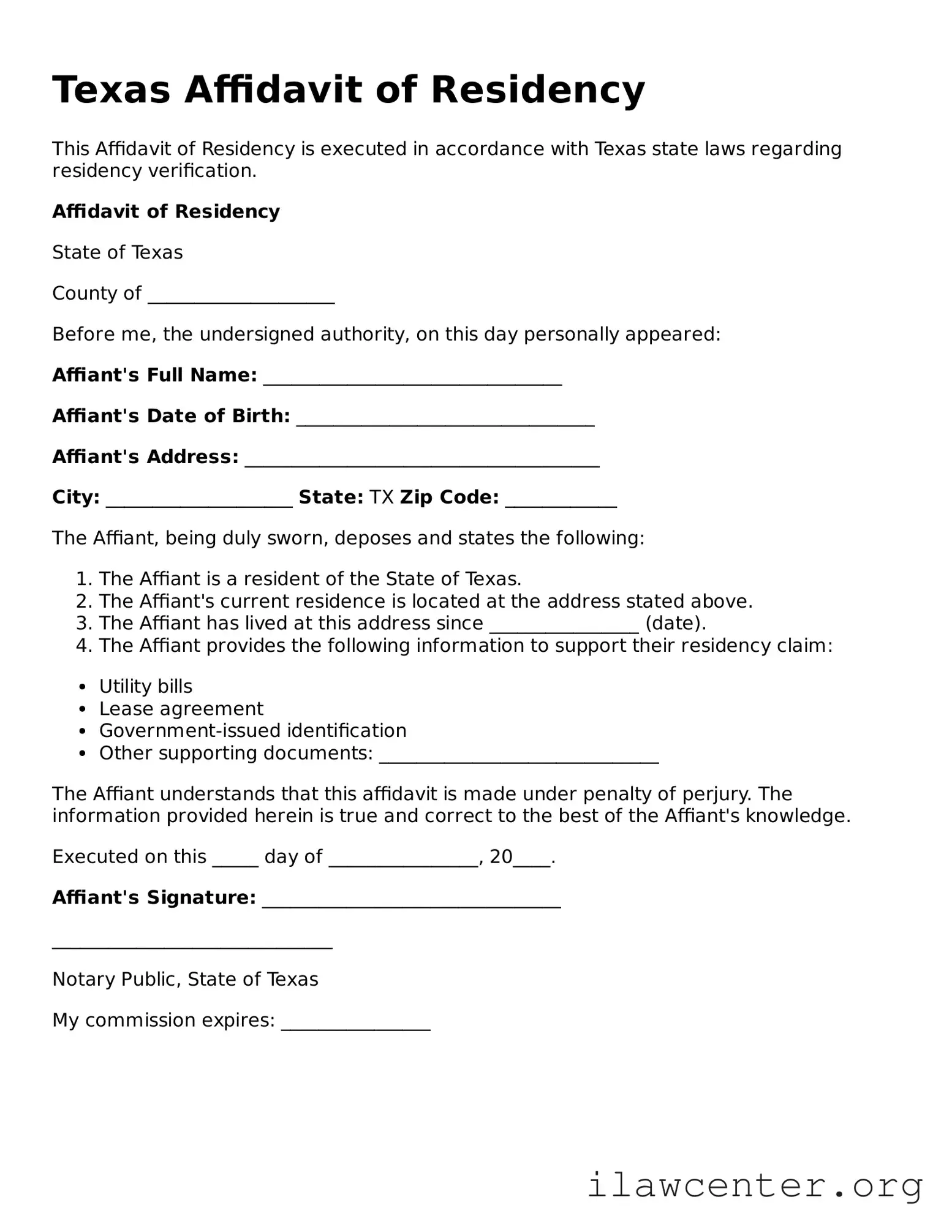
Texas Affidavit of Residency Preview

Texas Affidavit of Residency

This Affidavit of Residency is executed in accordance with Texas state laws regarding residency verification.

Affidavit of Residency

State of Texas

County of ____________________

Before me, the undersigned authority, on this day personally appeared:

Affiant's Full Name: ________________________________

Affiant's Date of Birth: ________________________________

Affiant's Address: ______________________________________

City: ____________________ State: TX Zip Code: ____________

The Affiant, being duly sworn, deposes and states the following:

  1. The Affiant is a resident of the State of Texas.
  2. The Affiant's current residence is located at the address stated above.
  3. The Affiant has lived at this address since ________________ (date).
  4. The Affiant provides the following information to support their residency claim:
  • Utility bills
  • Lease agreement
  • Government-issued identification
  • Other supporting documents: ______________________________

The Affiant understands that this affidavit is made under penalty of perjury. The information provided herein is true and correct to the best of the Affiant's knowledge.

Executed on this _____ day of ________________, 20____.

Affiant's Signature: ________________________________

______________________________

Notary Public, State of Texas

My commission expires: ________________

PDF Form Characteristics

Fact Name Description
Purpose The Texas Affidavit of Residency form is used to verify a person's residency in Texas for various legal and administrative purposes.
Governing Law This form is governed by Texas Family Code, Section 1.105, which outlines residency requirements for certain legal matters.
Who Can Use It Any individual seeking to establish residency in Texas can utilize this form, including students, military personnel, and new residents.
Submission Process The completed affidavit must be submitted to the appropriate local authority or organization that requires proof of residency.

Instructions on Utilizing Texas Affidavit of Residency

Once you have obtained the Texas Affidavit of Residency form, you will need to complete it accurately to ensure it meets the necessary requirements. After filling out the form, you will submit it to the appropriate authority, which may vary depending on your specific situation.

  1. Begin by downloading the Texas Affidavit of Residency form from the official website or obtaining a physical copy from a designated office.
  2. Carefully read the instructions provided with the form to understand the information required.
  3. In the first section, fill in your full name, including your middle name if applicable.
  4. Provide your current residential address, ensuring that it is complete and accurate.
  5. Next, indicate the length of time you have resided at this address.
  6. In the designated area, provide the name and address of the person who will be signing the affidavit, if applicable.
  7. Sign and date the form in the appropriate spaces provided.
  8. If required, have the affidavit notarized by a licensed notary public to validate your signature.
  9. Make a copy of the completed form for your records before submission.
  10. Submit the form to the appropriate authority, following any specific submission guidelines they may have.

Important Facts about Texas Affidavit of Residency

What is the Texas Affidavit of Residency form?

The Texas Affidavit of Residency form is a legal document used to verify a person's residence in Texas. It is often required for various purposes, such as enrolling a child in school, obtaining a driver's license, or applying for certain government benefits. The form serves as a sworn statement confirming that the individual resides at a specific address within the state.

Who needs to complete the Affidavit of Residency?

Typically, anyone who needs to prove their residency in Texas may need to complete this form. This includes parents or guardians enrolling their children in public schools, individuals applying for state services, or those who need to update their address with government agencies. It’s important to check specific requirements based on the situation.

How do I fill out the Texas Affidavit of Residency form?

To fill out the form, start by providing your personal information, including your name and current address. Next, you will need to state your relationship to the person or entity requiring the affidavit. Make sure to include any necessary details that support your residency claim. After completing the form, sign it in the presence of a notary public, who will then notarize the document to confirm its authenticity.

Where can I obtain the Texas Affidavit of Residency form?

You can obtain the Texas Affidavit of Residency form from various sources. Many school districts and government agencies provide the form on their websites. Additionally, you can find it at local government offices, such as county clerks or tax assessor-collector offices. If you’re unsure where to start, a quick online search or a visit to your local office can help you locate the form.

Common mistakes

Filling out the Texas Affidavit of Residency form is a crucial step for individuals seeking to establish residency in Texas. However, many make common mistakes that can lead to delays or complications. One major error is failing to provide accurate personal information. This includes not using the full legal name or incorrect addresses. Inaccurate details can cause confusion and may result in the rejection of the affidavit.

Another frequent mistake is neglecting to sign the affidavit. A signature is essential; without it, the form is incomplete. Additionally, some individuals forget to have their signature notarized. Notarization is a requirement for the affidavit to be considered valid. Skipping this step can lead to further issues down the line.

People often overlook the importance of providing supporting documentation. The affidavit must be accompanied by proof of residency, such as utility bills or lease agreements. Failing to include these documents can lead to delays in processing the application. Always check that all required documents are attached.

Some applicants also misinterpret the residency requirements. It's important to understand what constitutes residency in Texas. Misleading information about residency status can lead to legal complications. Ensure that you are clear on the definition of residency before filling out the form.

Additionally, individuals may not review their completed forms before submission. Simple typos or omitted information can cause significant issues. Always double-check your work to ensure that everything is correct and complete. A thorough review can save time and prevent unnecessary complications.

Finally, individuals sometimes submit the affidavit without understanding the implications of their declaration. This document is a legal statement, and any false information can lead to serious consequences. Be aware of what you are affirming and ensure that all statements are truthful and accurate.

Documents used along the form

When completing the Texas Affidavit of Residency form, several other documents may be required or beneficial to support your residency claim. These documents can help verify your identity and address, ensuring a smoother process for whatever purpose you are pursuing. Here are some commonly used forms and documents that often accompany the Affidavit of Residency:

  • Texas Driver's License or ID Card: This document serves as a primary form of identification. It includes your name, photo, and address, helping to confirm your identity and residency status.
  • Utility Bill: A recent utility bill, such as electricity or water, can serve as proof of your current address. It should display your name and the service address to validate your residency.
  • Lease Agreement: If you are renting your home, a lease agreement can provide evidence of your residency. This document outlines the terms of your rental and includes your name and the address of the property.
  • Bank Statement: A bank statement showing your name and address can also be useful. It adds another layer of verification regarding your residency and financial stability.

Having these documents ready can simplify the process of establishing your residency in Texas. Each document serves a unique purpose, and together, they create a comprehensive picture of your living situation. Ensure that all documents are current and clearly display your name and address for the best results.

Similar forms

  • Declaration of Domicile: This document serves to affirm an individual's permanent residence in a specific location. Like the Affidavit of Residency, it establishes where a person lives for legal purposes.

  • Lease Agreement: A lease agreement outlines the terms of renting property. It indicates the address where the tenant resides, similar to how the Affidavit of Residency confirms an individual's residence.

  • Utility Bill: A utility bill can provide proof of residence by showing the name and address of the account holder. This is akin to the Affidavit of Residency, which also verifies an individual's living situation.

  • Voter Registration Card: This card lists the registered address of a voter. It functions similarly to the Affidavit of Residency by confirming where a person resides for voting purposes.

  • Tax Return: A tax return may include the taxpayer's address. This document can validate residency, paralleling the purpose of the Affidavit of Residency in establishing where someone lives.

Dos and Don'ts

When filling out the Texas Affidavit of Residency form, it's important to approach the process carefully. Here are some guidelines to help you navigate this task effectively.

  • Do: Ensure that all information is accurate and up-to-date. Double-check your address and personal details to avoid any discrepancies.
  • Do: Sign and date the form in the appropriate sections. Your signature is crucial for the validity of the affidavit.
  • Do: Provide any required supporting documents. This may include proof of residency, such as utility bills or lease agreements.
  • Do: Keep a copy of the completed form for your records. This can be helpful in case any questions arise later.
  • Don't: Leave any sections blank. Incomplete forms may be rejected or delayed in processing.
  • Don't: Use incorrect or outdated forms. Always ensure you have the latest version of the affidavit.
  • Don't: Provide false information. Misrepresentation can lead to serious legal consequences.
  • Don't: Forget to check the submission guidelines. Different agencies may have specific requirements for how the form should be submitted.

Misconceptions

The Texas Affidavit of Residency form is often misunderstood. Here are eight common misconceptions:

  1. It can only be used for voting purposes.

    Many people think this form is solely for registering to vote. In reality, it can also be used for various other residency verification needs, such as obtaining a driver's license or enrolling in school.

  2. Anyone can fill it out.

    Some believe that anyone can sign the form, but it must be completed by a person who has personal knowledge of the residency of the individual in question.

  3. It is not legally binding.

    This form carries legal weight. Providing false information can lead to serious consequences, including potential criminal charges.

  4. It does not require notarization.

    People often think notarization is optional, but the affidavit must be notarized to be valid.

  5. It is only for Texas residents.

    While it is a Texas form, it can be used by individuals who have recently moved to Texas and need to establish residency.

  6. Once submitted, it cannot be changed.

    Some think that the information is permanent. However, if circumstances change, a new affidavit can be submitted to reflect the updated residency status.

  7. It is a complicated process.

    Many feel intimidated by the form. In truth, it is straightforward and can be completed with minimal information.

  8. It can be submitted online.

    While some forms can be submitted online, the Affidavit of Residency must be printed, signed, and submitted in person or via mail.

Understanding these misconceptions can help individuals navigate the residency verification process more effectively.

Key takeaways

When filling out and using the Texas Affidavit of Residency form, it's important to keep several key points in mind. This form serves as a declaration of where a person resides and can be crucial for various legal and administrative purposes.

  • Eligibility: Ensure that you meet the eligibility requirements to use the affidavit. Typically, this form is used by individuals who need to confirm their residency status for legal reasons, such as enrolling in school or obtaining a driver's license.
  • Accurate Information: Fill out the form with accurate and truthful information. Any discrepancies can lead to legal issues or complications in processing your application.
  • Signature Requirement: The affidavit must be signed in front of a notary public. This step is essential as it verifies your identity and the authenticity of the document.
  • Supporting Documents: Be prepared to provide supporting documents that may be required to prove your residency. This can include utility bills, lease agreements, or other official correspondence showing your name and address.
  • Submission Process: Understand where and how to submit the completed affidavit. Depending on its purpose, you may need to file it with a government agency, school district, or another entity.

By keeping these takeaways in mind, you can ensure a smoother process when using the Texas Affidavit of Residency form.