Attorney-Verified  Affidavit of Service Document for Texas

Attorney-Verified Affidavit of Service Document for Texas

The Texas Affidavit of Service form is a legal document that verifies the delivery of legal papers to a party involved in a lawsuit. This form serves as proof that the recipient has been properly notified, ensuring that the legal process can move forward without delays. To ensure compliance and accuracy, consider filling out the form by clicking the button below.

Article Guide

The Texas Affidavit of Service form plays a crucial role in the legal process, particularly in ensuring that all parties involved in a case are properly notified. This document serves as proof that legal papers, such as summons or complaints, have been delivered to the intended recipients. It includes essential details such as the names of the parties, the date and method of service, and the signature of the person who performed the service. Proper completion of this form is vital, as it verifies that the service was conducted in accordance with Texas law. Failing to adhere to these requirements can lead to complications in legal proceedings, including delays or dismissals. Understanding the components and significance of the Texas Affidavit of Service form is essential for anyone involved in a legal matter in Texas.

Texas Affidavit of Service Preview

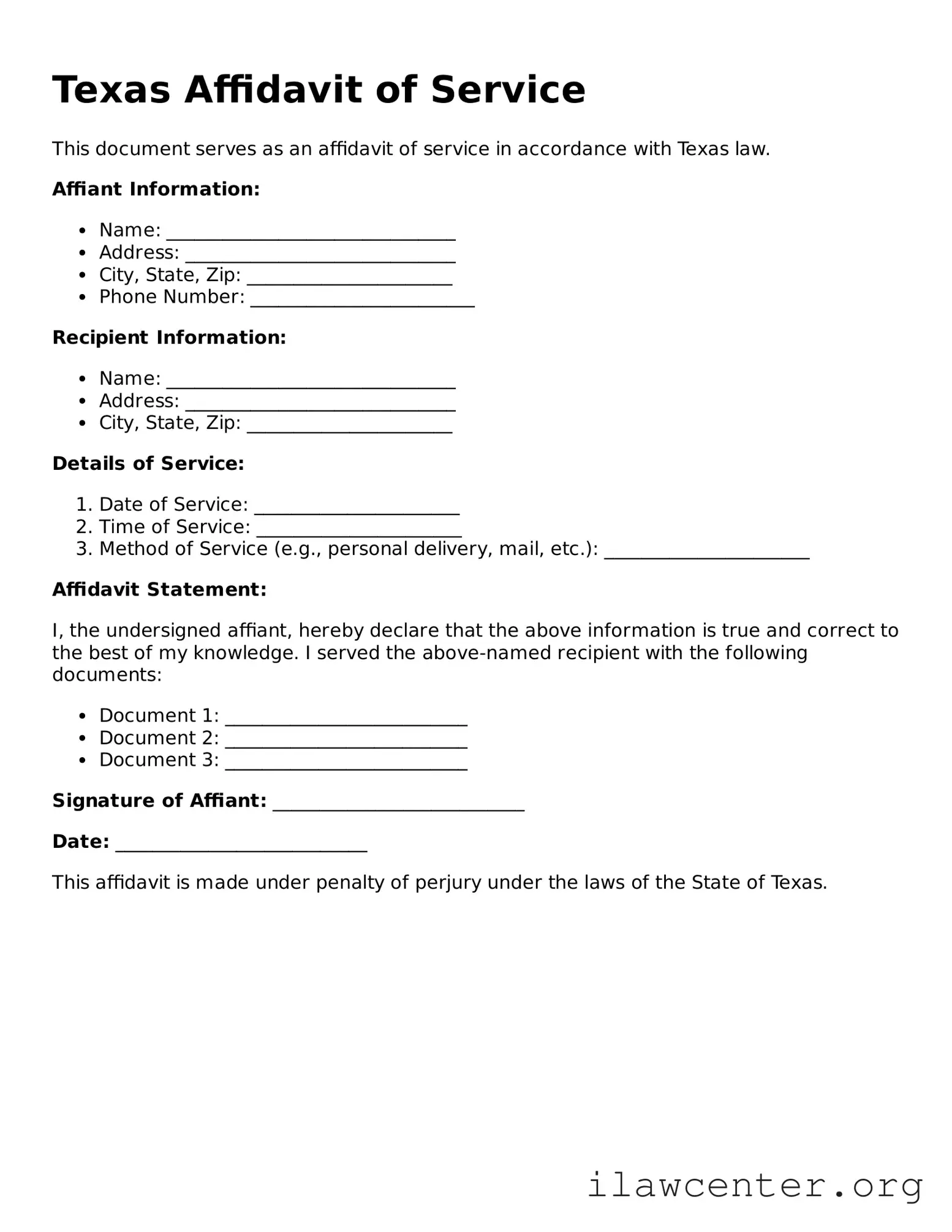
Texas Affidavit of Service

This document serves as an affidavit of service in accordance with Texas law.

Affiant Information:

  • Name: _______________________________
  • Address: _____________________________
  • City, State, Zip: ______________________
  • Phone Number: ________________________

Recipient Information:

  • Name: _______________________________
  • Address: _____________________________
  • City, State, Zip: ______________________

Details of Service:

  1. Date of Service: ______________________
  2. Time of Service: ______________________
  3. Method of Service (e.g., personal delivery, mail, etc.): ______________________

Affidavit Statement:

I, the undersigned affiant, hereby declare that the above information is true and correct to the best of my knowledge. I served the above-named recipient with the following documents:

  • Document 1: __________________________
  • Document 2: __________________________
  • Document 3: __________________________

Signature of Affiant: ___________________________

Date: ___________________________

This affidavit is made under penalty of perjury under the laws of the State of Texas.

PDF Form Characteristics

Fact Name Description
Purpose The Texas Affidavit of Service form is used to provide proof that legal documents have been delivered to a party involved in a legal proceeding.
Governing Law This form is governed by the Texas Rules of Civil Procedure, specifically Rule 107, which outlines service of process requirements.
Who Can Serve Any person who is at least 18 years old and not a party to the case can serve the documents and complete the affidavit.
Contents Required The affidavit must include details such as the date and time of service, the method of service, and the name of the person served.
Filing After completing the affidavit, it must be filed with the court to provide official proof of service.
Notarization The affidavit typically requires notarization to verify the identity of the person who served the documents.
Deadline for Service Legal documents generally must be served within a specific timeframe, often within 30 days of filing the case.
Importance Filing the affidavit is crucial as it ensures that the court acknowledges that the other party has been properly notified of the legal action.

Instructions on Utilizing Texas Affidavit of Service

Filling out the Texas Affidavit of Service form is an important step in ensuring that legal documents are properly served. Once completed, this form will need to be submitted to the appropriate court or agency as part of your legal proceedings.

  1. Begin by downloading the Texas Affidavit of Service form from the official Texas court website or obtain a physical copy from your local courthouse.
  2. In the top section of the form, fill in the name of the court where the case is being filed.
  3. Provide the case number associated with your legal matter. This number is usually assigned when the case is initiated.
  4. Next, enter the names of the parties involved in the case, including both the plaintiff and the defendant.
  5. In the section designated for the server’s information, write your name, address, and contact details. Ensure that this information is accurate, as it will be used for verification.
  6. Indicate the date on which the service was completed. This is crucial for establishing a timeline in your case.
  7. Describe the method of service used (e.g., personal delivery, mail, etc.). Be as specific as possible to provide clear information.
  8. Sign the form in the designated area, affirming that the information you have provided is true and correct to the best of your knowledge.
  9. If required, have the affidavit notarized. This adds an extra layer of authenticity to your document.

Once you have completed the form, review it carefully to ensure all information is accurate. After that, submit the affidavit to the appropriate court or agency as required by your case. Keeping a copy for your records is also advisable, as it may be needed in the future.

Important Facts about Texas Affidavit of Service

What is a Texas Affidavit of Service?

The Texas Affidavit of Service is a legal document used to confirm that a particular legal document has been delivered to a specific individual or entity. This form serves as proof that the recipient has been properly notified of legal proceedings or actions involving them. It is an essential component in ensuring that the legal process is followed correctly.

Who can complete a Texas Affidavit of Service?

Typically, a Texas Affidavit of Service can be completed by a process server, a sheriff, or any person who is over the age of 18 and not a party to the case. This ensures that the person serving the documents is impartial and can provide an unbiased account of the service.

What information is required on the form?

The form generally requires details such as the name and address of the person being served, the date and time of service, and the type of documents delivered. Additionally, the server must provide their own name, signature, and sometimes a notary acknowledgment to validate the affidavit.

Why is the Affidavit of Service important?

This affidavit is crucial because it provides evidence that the legal documents were served in accordance with the law. Without this documentation, the court may question whether the individual was properly notified, which could affect the outcome of the case.

How do I file the Affidavit of Service?

After completing the Affidavit of Service, it must be filed with the court where the original case is pending. This can usually be done in person or, in some jurisdictions, electronically. Ensure that you keep a copy for your records as well.

What happens if the person cannot be served?

If the individual cannot be served after reasonable attempts, the server may need to file a motion with the court for alternative service methods. This could include posting the notice in a public place or sending it via certified mail, depending on the circumstances and court rules.

Can the Affidavit of Service be challenged?

Yes, the Affidavit of Service can be challenged in court. If the recipient claims they were not properly served, they may file a motion to contest the service. The court will then review the evidence, including the affidavit, to determine if proper service occurred.

Is there a fee associated with filing the Affidavit of Service?

There may be a fee for filing the Affidavit of Service, which can vary by jurisdiction. It is advisable to check with the local court clerk’s office for specific fee amounts and payment methods. Some courts may also offer fee waivers for individuals who qualify based on financial need.

Common mistakes

Filling out the Texas Affidavit of Service form is an important step in the legal process, but mistakes can happen. One common error is failing to provide complete information about the person being served. It's essential to include their full name, address, and any other identifying details. Incomplete information can lead to delays or even the dismissal of a case.

Another frequent mistake is not signing the affidavit in the correct place. The affidavit must be signed by the person who performed the service, and it should be notarized. If the signature is missing or placed incorrectly, it can render the document invalid. Always double-check that the signature is present and properly executed.

Many people overlook the importance of providing the date of service. This date is crucial for establishing timelines in legal proceedings. If the date is omitted or incorrect, it can create confusion and complicate the case. Always ensure that the date is clearly noted on the form.

Finally, individuals often forget to keep a copy of the completed affidavit for their records. This document serves as proof of service and may be needed later in the legal process. Keeping a copy ensures that you have the necessary documentation if any questions arise. Always make a photocopy or save a digital version of the affidavit before submitting it.

Documents used along the form

The Texas Affidavit of Service form is an essential document in the legal process, serving as proof that a legal document has been delivered to a party. However, it is often accompanied by other forms and documents that help to ensure the smooth progression of a case. Below is a list of commonly used documents that may accompany the Texas Affidavit of Service.

  • Citation: This document notifies the defendant of the legal action being taken against them. It includes information about the court, the parties involved, and instructions on how to respond.
  • Summons: Similar to a citation, a summons formally orders an individual to appear in court. It outlines the time and place of the court appearance and the nature of the case.
  • Complaint or Petition: This document outlines the claims being made against the defendant. It provides the factual basis for the lawsuit and the legal grounds for the court's jurisdiction.
  • Proof of Service: This is a document that confirms the delivery of legal papers. It may include details such as the date and method of service, and it is often signed by the person who completed the service.
  • Motion for Default Judgment: If the defendant fails to respond to the complaint, this motion requests the court to issue a judgment in favor of the plaintiff based on the lack of response.
  • Notice of Hearing: This document informs parties of the date and time of a scheduled hearing. It ensures that all involved parties are aware of when they need to appear in court.
  • Response or Answer: This is the formal reply from the defendant to the complaint. It addresses the claims made and may include defenses or counterclaims.
  • Affidavit of Non-Military Service: This affidavit certifies that the defendant is not currently serving in the military, which can affect the legal proceedings and rights to a fair trial.
  • Subpoena: A subpoena is a document that orders an individual to appear in court or produce documents relevant to the case. It ensures that witnesses or evidence are available for the proceedings.

Each of these documents plays a vital role in the legal process, helping to maintain clarity and order as a case unfolds. Understanding their purposes and how they interconnect can significantly enhance the efficiency of legal proceedings.

Similar forms

The Affidavit of Service form is a crucial document in legal proceedings, particularly for confirming that legal papers have been delivered to the appropriate parties. Several other documents serve similar purposes in the legal landscape. Below are four documents that share similarities with the Affidavit of Service:

  • Proof of Service: This document also verifies that legal documents have been delivered. It typically includes details such as the date of service, the method used, and the individual served, ensuring that all parties are aware of the delivery status.
  • Certificate of Mailing: This document is used to confirm that a particular item was sent through the mail. It includes information about the recipient and the date of mailing, providing a record that the documents were dispatched.
  • Return of Service: Similar to the Affidavit of Service, this document is completed by the server. It outlines the specifics of how and when the documents were served, thus providing a formal acknowledgment of the service process.
  • Service of Process Statement: This statement details the steps taken to serve legal documents. It includes information about the server, the recipient, and the method of service, ensuring transparency in the service process.

Understanding these documents can aid in navigating legal procedures effectively. Each plays a role in ensuring that all parties are informed and that the legal process is upheld.

Dos and Don'ts

When filling out the Texas Affidavit of Service form, it's important to follow specific guidelines to ensure accuracy and compliance. Below is a list of things you should and shouldn't do.

  • Do read the entire form carefully before starting.
  • Do provide accurate information regarding the parties involved.
  • Do sign the affidavit in front of a notary public.
  • Do keep a copy of the completed affidavit for your records.
  • Don't leave any required fields blank.
  • Don't use white-out or erase any mistakes on the form.
  • Don't submit the form without verifying all information is correct.

Misconceptions

The Texas Affidavit of Service form is an important document in the legal process. However, several misconceptions exist regarding its purpose and usage. Below is a list of ten common misconceptions along with clarifications.

  1. The Affidavit of Service is only for court cases. Many believe this form is exclusively for court-related matters. In reality, it can also be used in various legal situations, including administrative hearings and other formal processes.
  2. Anyone can serve documents. While it may seem that anyone can deliver legal documents, Texas law requires that the person serving the documents be at least 18 years old and not a party to the case.
  3. The Affidavit of Service must be filed with the court. Some assume that the affidavit must be submitted to the court immediately after service. In fact, it is typically kept with the case file by the serving party and only filed if required by the court.
  4. It is unnecessary to have a witness when serving documents. Many people think a witness is not needed. However, having a witness can strengthen the validity of the affidavit, especially in contested cases.
  5. Once the affidavit is signed, it cannot be changed. There is a belief that the affidavit is final once signed. In truth, if errors are discovered, an amended affidavit can be filed to correct the information.
  6. The Affidavit of Service is the same as a proof of service. Some confuse these two terms. While they are related, the affidavit is a sworn statement, whereas proof of service may refer to any documentation that verifies service occurred.
  7. Service can only be done in person. A common misconception is that documents must be served in person. Texas law allows for various methods of service, including mail or even electronic service in certain situations.
  8. The recipient must sign the affidavit. Many believe that the person receiving the documents must acknowledge receipt by signing the affidavit. However, this is not a requirement; the affidavit only needs to be signed by the server.
  9. There is a specific form that must be used. Some think there is only one official form for the affidavit. Texas does not mandate a specific format, but the affidavit must contain certain essential elements to be valid.
  10. Filing the affidavit guarantees the case will proceed smoothly. Finally, it is a misconception that submitting the affidavit ensures no further issues will arise. While it is an important step, other factors can affect the case's progression.

Understanding these misconceptions can help individuals navigate the legal process more effectively and ensure proper compliance with Texas law regarding the Affidavit of Service.

Key takeaways

When filling out and using the Texas Affidavit of Service form, consider the following key takeaways:

  1. Accurate Information: Ensure that all details regarding the service of process are filled out accurately. This includes the names of the parties involved and the date of service.
  2. Signature Requirement: The affidavit must be signed by the person who served the documents. Their signature verifies that the information provided is true and correct.
  3. Notarization: In Texas, the affidavit typically needs to be notarized. This adds an extra layer of authenticity to the document.
  4. Filing with the Court: After completing the affidavit, it must be filed with the appropriate court. This serves as proof that the service of process was properly executed.
  5. Deadline Awareness: Be aware of any deadlines for filing the affidavit. Timely submission is crucial to avoid complications in your legal proceedings.