Attorney-Verified  Commercial Lease Agreement Document for Texas

Attorney-Verified Commercial Lease Agreement Document for Texas

A Texas Commercial Lease Agreement form is a legal document that outlines the terms and conditions under which a landlord allows a tenant to occupy commercial property. This essential agreement protects the rights of both parties and ensures clarity in their relationship. Ready to secure your commercial space? Fill out the form by clicking the button below.

Article Guide

When entering into a commercial lease in Texas, understanding the intricacies of the Texas Commercial Lease Agreement form is essential for both landlords and tenants. This legally binding document outlines the terms and conditions governing the rental of commercial properties, ensuring that both parties are clear on their rights and responsibilities. Key aspects of the form include the lease duration, rental amount, and payment terms, as well as provisions for property maintenance, utilities, and insurance. Additionally, it addresses the use of the premises, modifications to the property, and the consequences of default or termination. By clearly delineating these elements, the Texas Commercial Lease Agreement helps to prevent disputes and fosters a positive landlord-tenant relationship, making it a crucial tool in the realm of commercial real estate transactions.

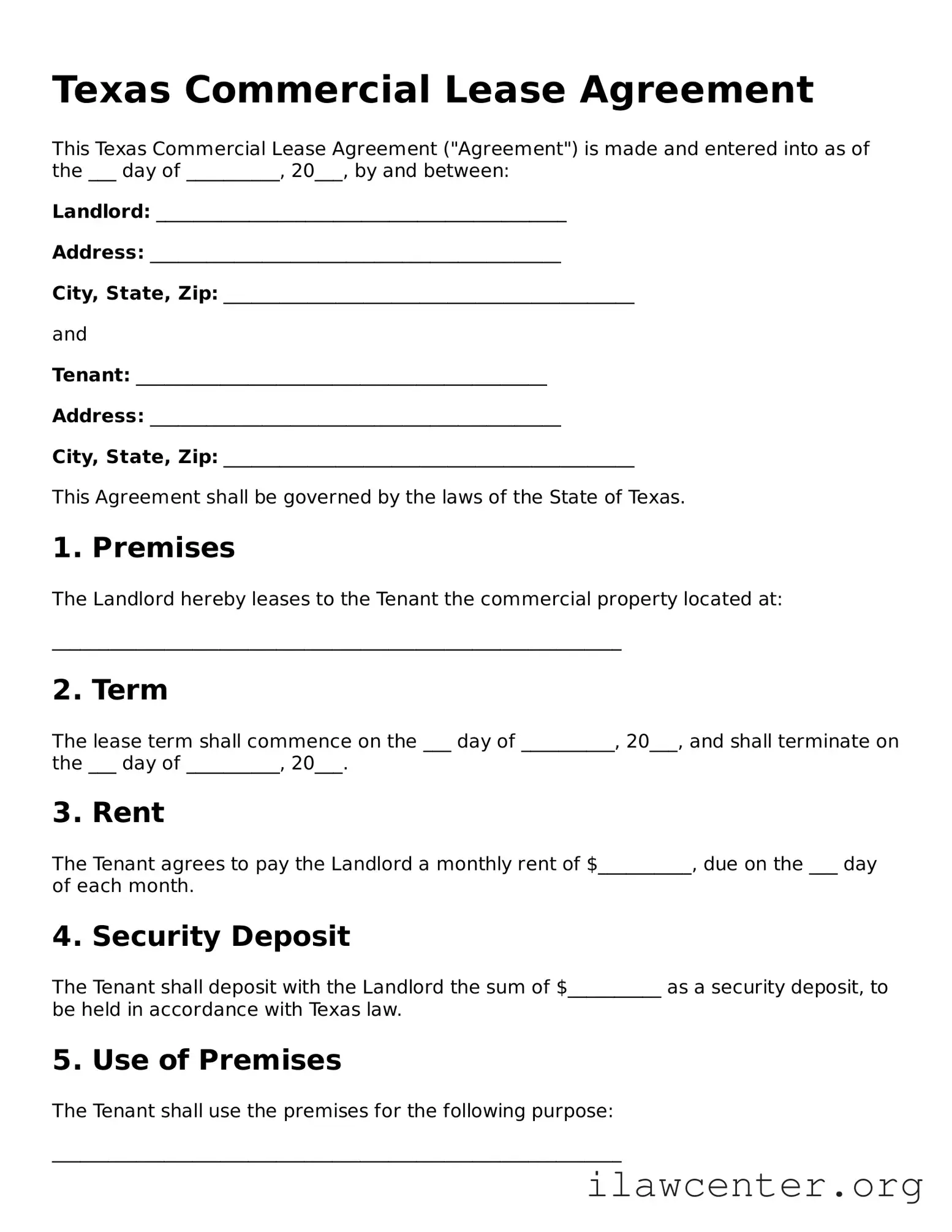
Texas Commercial Lease Agreement Preview

Texas Commercial Lease Agreement

This Texas Commercial Lease Agreement ("Agreement") is made and entered into as of the ___ day of __________, 20___, by and between:

Landlord: ____________________________________________

Address: ____________________________________________

City, State, Zip: ____________________________________________

and

Tenant: ____________________________________________

Address: ____________________________________________

City, State, Zip: ____________________________________________

This Agreement shall be governed by the laws of the State of Texas.

1. Premises

The Landlord hereby leases to the Tenant the commercial property located at:

_____________________________________________________________

2. Term

The lease term shall commence on the ___ day of __________, 20___, and shall terminate on the ___ day of __________, 20___.

3. Rent

The Tenant agrees to pay the Landlord a monthly rent of $__________, due on the ___ day of each month.

4. Security Deposit

The Tenant shall deposit with the Landlord the sum of $__________ as a security deposit, to be held in accordance with Texas law.

5. Use of Premises

The Tenant shall use the premises for the following purpose:

_____________________________________________________________

6. Maintenance and Repairs

The Tenant shall maintain the premises in good condition and shall be responsible for:

  • Routine cleaning and upkeep
  • Minor repairs
  • Compliance with local health and safety codes

7. Utilities

The Tenant shall be responsible for payment of all utilities, including:

  • Electricity
  • Water
  • Gas
  • Internet and phone services

8. Alterations

The Tenant shall not make any alterations or improvements to the premises without the prior written consent of the Landlord.

9. Termination

Either party may terminate this Agreement by providing written notice of ___ days to the other party.

10. Governing Law

This Agreement shall be governed by and construed in accordance with the laws of the State of Texas.

IN WITNESS WHEREOF, the parties hereto have executed this Agreement as of the date first above written.

Landlord Signature: _______________________________

Date: ________________

Tenant Signature: _______________________________

Date: ________________
PDF Form Characteristics

Fact Name Description
Governing Law The Texas Commercial Lease Agreement is governed by Texas state law.
Purpose This form outlines the terms and conditions for leasing commercial property in Texas.
Parties Involved The agreement involves a lessor (landlord) and a lessee (tenant).
Key Components It typically includes rent amount, lease duration, and maintenance responsibilities.

Instructions on Utilizing Texas Commercial Lease Agreement

Filling out the Texas Commercial Lease Agreement form requires attention to detail and accuracy. This process involves entering specific information related to the property, the parties involved, and the terms of the lease. Following these steps will help ensure that the form is completed correctly.

  1. Obtain a copy of the Texas Commercial Lease Agreement form.
  2. Begin by entering the date at the top of the form.
  3. Provide the names and addresses of the landlord and tenant in the designated sections.
  4. Describe the property being leased, including the address and any relevant details.
  5. Specify the lease term, including the start and end dates.
  6. Detail the rental amount and payment schedule, including due dates and acceptable payment methods.
  7. Include any additional terms or conditions that apply to the lease.
  8. Review the completed form for accuracy and completeness.
  9. Sign and date the form in the appropriate sections.
  10. Provide copies to all parties involved in the lease agreement.

Important Facts about Texas Commercial Lease Agreement

What is a Texas Commercial Lease Agreement?

A Texas Commercial Lease Agreement is a legal document that outlines the terms and conditions under which a landlord leases commercial property to a tenant. This agreement typically includes details such as the rental amount, lease duration, maintenance responsibilities, and other important terms that govern the relationship between the landlord and tenant.

What are the key components of a Commercial Lease Agreement?

Key components often include the names of the parties involved, the property description, the lease term, rent amount, payment schedule, security deposit requirements, maintenance obligations, and provisions for lease termination. Each of these elements is crucial for ensuring clarity and protecting the interests of both parties.

How long does a typical commercial lease last?

The duration of a commercial lease can vary widely. Some leases are short-term, lasting only a year or two, while others can extend for several years or even decades. The specific length is usually negotiated between the landlord and tenant and should be clearly stated in the lease agreement.

Can a tenant negotiate the terms of a Commercial Lease Agreement?

Yes, tenants can negotiate the terms of a commercial lease. It is common for tenants to seek modifications to rent amounts, lease duration, or maintenance responsibilities. Open communication with the landlord can lead to a mutually beneficial agreement. It's advisable to document any changes in writing.

What happens if a tenant wants to terminate the lease early?

If a tenant wishes to terminate the lease early, they should review the lease agreement for any clauses related to early termination. Some agreements may allow for this under certain conditions, while others may impose penalties. It is important to discuss this with the landlord and understand any financial implications before making a decision.

Are there any laws specific to commercial leases in Texas?

Yes, Texas has specific laws that govern commercial leases, including rules about disclosures, security deposits, and lease termination. These laws are designed to protect both landlords and tenants. It is essential for both parties to be aware of these regulations to ensure compliance and avoid potential disputes.

Common mistakes

When filling out the Texas Commercial Lease Agreement form, many individuals make common mistakes that can lead to complications down the line. One frequent error is failing to clearly define the premises. It is essential to specify the exact location and boundaries of the leased property. Without this clarity, disputes may arise regarding what is included in the lease.

Another mistake often encountered is neglecting to include the lease term. The duration of the lease should be explicitly stated, including the start and end dates. Omitting this information can result in misunderstandings about the length of the tenancy and the obligations of both parties.

Many people also overlook the importance of detailing the rent payment terms. This section should outline the amount due, the due date, and acceptable payment methods. Inadequate information can lead to confusion and potential late fees, which could be avoided with clear communication.

Additionally, some individuals fail to address maintenance responsibilities. It is crucial to specify who is responsible for repairs and upkeep of the property. This oversight can lead to disputes and dissatisfaction if one party assumes the other will handle certain tasks.

Another common error is not including security deposit details. The amount, conditions for its return, and any deductions should be clearly outlined in the lease. Without this information, misunderstandings may occur when the lease ends.

People often make the mistake of not reviewing the zoning regulations applicable to the property. Understanding what activities are permitted under local zoning laws is vital. Failing to do so can lead to legal issues and potential penalties for violating regulations.

In some cases, individuals do not consult with a legal professional before signing the lease. This can be a significant mistake, as an attorney can provide valuable insights and ensure that the agreement meets all legal requirements. Ignoring this step may result in unforeseen challenges.

Another frequent oversight is neglecting to include provisions for termination of the lease. Clear terms regarding how either party can end the agreement, including notice periods and conditions, should be specified. This clarity can prevent conflicts if circumstances change.

Lastly, many people fail to fully understand the dispute resolution process outlined in the lease. It is important to know how conflicts will be handled, whether through mediation, arbitration, or litigation. Being informed about this process can save time and resources if disagreements arise.

Documents used along the form

When entering into a commercial lease agreement in Texas, several additional forms and documents may be needed to ensure a smooth transaction. These documents help clarify terms, protect both parties, and provide necessary legal protections. Below is a list of commonly used forms alongside the Texas Commercial Lease Agreement.

  • Letter of Intent (LOI): This document outlines the preliminary terms of the lease before the formal agreement is drafted. It serves as a starting point for negotiations.
  • Commercial Lease Application: Potential tenants fill out this application to provide their financial and business information. Landlords use it to assess the suitability of applicants.
  • Personal Guaranty: This form is often required when a business is a new entity without a strong credit history. It holds an individual personally responsible for the lease obligations.
  • Estoppel Certificate: This document confirms the current status of the lease and any obligations. It is often used in transactions involving the sale of the property.
  • Sublease Agreement: If a tenant wishes to lease part or all of the space to another party, a sublease agreement outlines the terms and conditions of that arrangement.
  • Rules and Regulations: These are additional guidelines that tenants must follow while occupying the leased space. They cover aspects like noise, maintenance, and use of common areas.
  • Disclosure Statements: Depending on the property type, landlords may need to provide disclosures about the condition of the property or any known issues that could affect tenants.
  • Security Deposit Receipt: This document acknowledges the receipt of a security deposit from the tenant. It specifies the amount and conditions under which the deposit may be retained or returned.

These documents play a crucial role in commercial leasing. They help clarify expectations and protect the rights of both landlords and tenants. Always consider consulting with a legal professional to ensure all necessary forms are completed correctly and meet your specific needs.

Similar forms

  • Residential Lease Agreement: Similar to a Commercial Lease Agreement, this document outlines the terms and conditions for renting residential property. It specifies the duration of the lease, payment terms, and responsibilities of both the landlord and tenant.
  • Sublease Agreement: This document allows a tenant to lease a property to another individual. It includes similar terms regarding rent and responsibilities, but it also addresses the relationship between the original tenant and the subtenant.
  • Rental Agreement: A more general document that can apply to both residential and commercial properties. It details the rental terms, including duration, payment, and maintenance responsibilities.
  • Property Management Agreement: This document outlines the relationship between a property owner and a property management company. It includes terms about rent collection, maintenance, and tenant interactions, akin to the responsibilities outlined in a lease.
  • Commercial Purchase Agreement: While focused on the sale of commercial property, it shares similarities in detailing terms, conditions, and responsibilities related to property use and transfer.
  • Joint Venture Agreement: This document is used when two or more parties collaborate on a business project. It shares similarities in outlining roles, responsibilities, and financial arrangements, much like a lease agreement does for tenants and landlords.

Dos and Don'ts

When filling out the Texas Commercial Lease Agreement form, it’s important to approach the task with care. Here are some key dos and don’ts to consider:

  • Do read the entire lease agreement thoroughly before filling it out.
  • Do provide accurate and complete information in all sections of the form.
  • Don’t rush through the process. Take your time to ensure everything is correct.
  • Don’t leave any blank spaces unless the form specifically instructs you to do so.

Misconceptions

Understanding the Texas Commercial Lease Agreement is crucial for both landlords and tenants. However, several misconceptions can lead to misunderstandings and disputes. Here are six common misconceptions:

  1. All lease agreements are the same.

    This is not true. Each commercial lease can be tailored to fit the specific needs of the parties involved. Terms can vary significantly based on the type of property, location, and intended use.

  2. Verbal agreements are sufficient.

    While verbal agreements can hold some weight, they are often difficult to enforce. A written lease provides clarity and protection for both parties, detailing the rights and responsibilities involved.

  3. Only the landlord can modify the lease.

    In reality, both parties have the right to negotiate terms before signing. Tenants should feel empowered to request changes that reflect their needs, such as lease duration or maintenance responsibilities.

  4. Security deposits are always refundable.

    This is misleading. While many security deposits are refundable, conditions apply. Landlords may retain part or all of the deposit for damages or unpaid rent, depending on the lease terms.

  5. All lease terms are negotiable.

    While many terms can be negotiated, some may be non-negotiable due to market conditions or the landlord’s policies. Understanding which terms are flexible is essential for effective negotiation.

  6. Once signed, a lease cannot be changed.

    This is incorrect. Leases can be amended if both parties agree to the changes in writing. It is important to communicate any needed modifications promptly to avoid potential conflicts.

Being informed about these misconceptions can help parties approach the Texas Commercial Lease Agreement with greater confidence and clarity. Awareness of the nuances in lease agreements is essential for fostering positive landlord-tenant relationships.

Key takeaways

Filling out and using the Texas Commercial Lease Agreement form requires careful attention to detail. Here are some key takeaways to consider:

  • Understand the Terms: Familiarize yourself with the specific terms of the lease, including duration, rent amount, and any additional fees.
  • Identify Responsibilities: Clearly outline the responsibilities of both the landlord and tenant regarding maintenance, repairs, and property use.
  • Review Local Laws: Ensure compliance with local regulations and zoning laws that may affect the lease agreement.
  • Document Everything: Keep thorough records of all communications and modifications related to the lease to avoid disputes in the future.