Attorney-Verified  Deed Document for Texas

Attorney-Verified Deed Document for Texas

A Texas Deed form is a legal document used to transfer ownership of real property in the state of Texas. This form outlines the details of the transaction, including the parties involved and the property description. To ensure a smooth transfer of ownership, consider filling out the Texas Deed form by clicking the button below.

Article Guide

The Texas Deed form serves as a crucial document in real estate transactions, facilitating the transfer of property ownership between parties. This form outlines essential details such as the names of the grantor and grantee, the legal description of the property, and the specific type of deed being utilized, whether it is a warranty deed, quitclaim deed, or another variant. Additionally, the form includes spaces for the signatures of both parties, ensuring that the transfer is executed legally and binding. It is important to understand the implications of each type of deed, as they vary in terms of the guarantees provided to the grantee regarding the title. Furthermore, the form must be properly notarized and recorded with the county clerk to ensure public notice of the ownership change. By addressing these key components, the Texas Deed form plays a vital role in the real estate process, providing clarity and security for all parties involved.

Texas Deed Preview

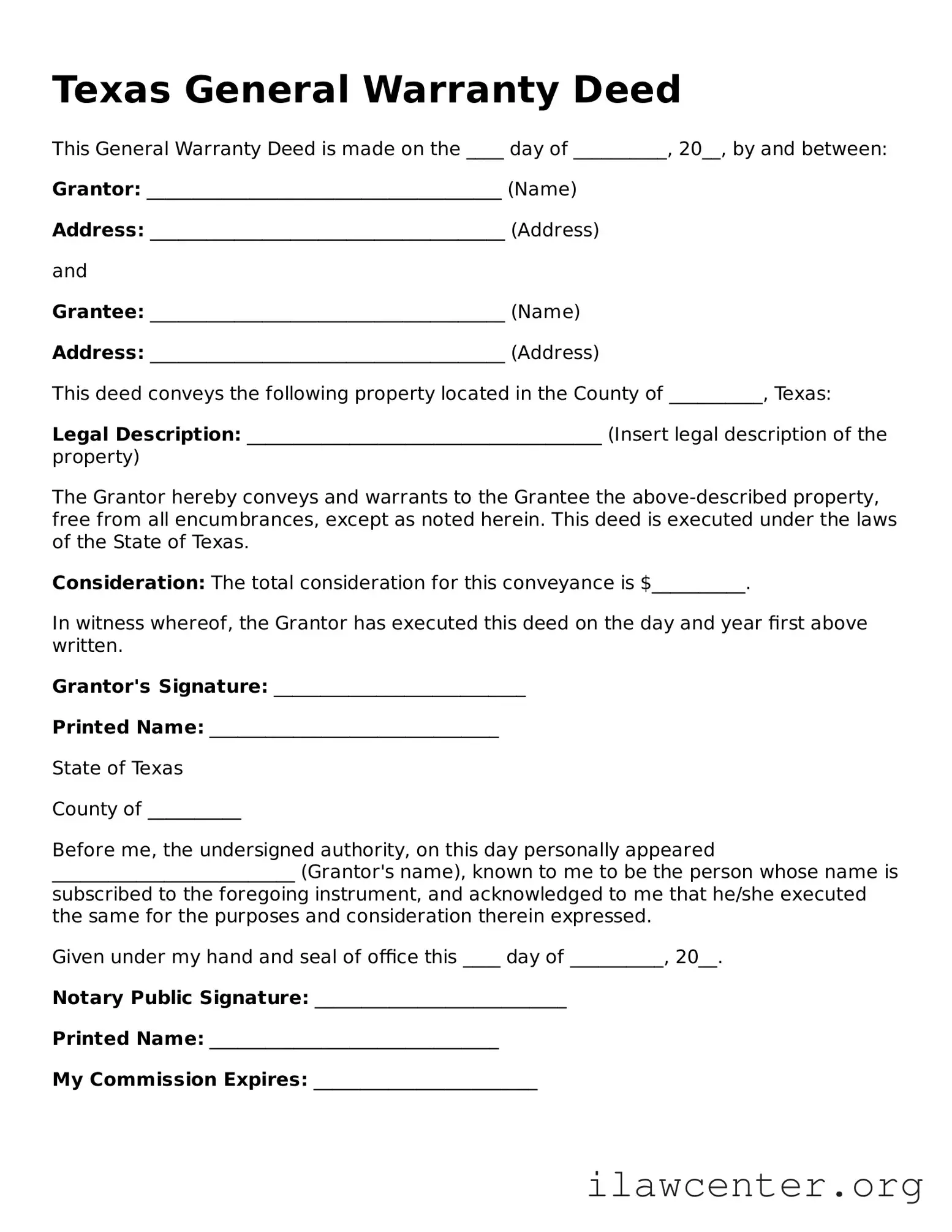
Texas General Warranty Deed

This General Warranty Deed is made on the ____ day of __________, 20__, by and between:

Grantor: ______________________________________ (Name)

Address: ______________________________________ (Address)

and

Grantee: ______________________________________ (Name)

Address: ______________________________________ (Address)

This deed conveys the following property located in the County of __________, Texas:

Legal Description: ______________________________________ (Insert legal description of the property)

The Grantor hereby conveys and warrants to the Grantee the above-described property, free from all encumbrances, except as noted herein. This deed is executed under the laws of the State of Texas.

Consideration: The total consideration for this conveyance is $__________.

In witness whereof, the Grantor has executed this deed on the day and year first above written.

Grantor's Signature: ___________________________

Printed Name: _______________________________

State of Texas

County of __________

Before me, the undersigned authority, on this day personally appeared __________________________ (Grantor's name), known to me to be the person whose name is subscribed to the foregoing instrument, and acknowledged to me that he/she executed the same for the purposes and consideration therein expressed.

Given under my hand and seal of office this ____ day of __________, 20__.

Notary Public Signature: ___________________________

Printed Name: _______________________________

My Commission Expires: ________________________

PDF Form Characteristics

Fact Name Description
Governing Law The Texas Deed form is governed by the Texas Property Code.
Types of Deeds Common types include General Warranty Deed, Special Warranty Deed, and Quitclaim Deed.
Signature Requirements The deed must be signed by the grantor (seller) and notarized.
Consideration A nominal consideration is often stated, such as "for $10 and other valuable considerations."
Recording To be effective against third parties, the deed must be recorded in the county where the property is located.
Legal Description A detailed legal description of the property must be included in the deed.
Grantee Information The full name and address of the grantee (buyer) must be clearly stated.
Tax Implications Transfer taxes may apply, and it's important to check local regulations.

Instructions on Utilizing Texas Deed

After you complete the Texas Deed form, you'll need to submit it to the appropriate county office for recording. This process helps ensure that the transfer of property is officially recognized and documented.

  1. Start by downloading the Texas Deed form from a reliable source.
  2. Fill in the names of the grantor (the person transferring the property) and the grantee (the person receiving the property).
  3. Provide the legal description of the property. This can usually be found in previous deeds or property tax records.
  4. Include the address of the property for clarity.
  5. State the consideration amount, which is the value exchanged for the property.
  6. Sign the form in the presence of a notary public. Ensure that the notary also signs and seals the document.
  7. Make copies of the completed deed for your records.
  8. Submit the original deed to the county clerk’s office where the property is located for recording.

Important Facts about Texas Deed

What is a Texas Deed form?

A Texas Deed form is a legal document used to transfer ownership of real property from one party to another in the state of Texas. This form outlines the details of the property being transferred, the parties involved, and any conditions or restrictions related to the transfer. It serves as a public record of the transaction and is essential for establishing legal ownership.

What types of deeds are available in Texas?

Texas recognizes several types of deeds, including General Warranty Deeds, Special Warranty Deeds, and Quitclaim Deeds. A General Warranty Deed provides the highest level of protection to the buyer, ensuring that the seller has clear title to the property and will defend against any claims. A Special Warranty Deed offers similar assurances but only for claims arising during the seller's ownership. A Quitclaim Deed, on the other hand, transfers whatever interest the seller may have without any warranties, making it less secure for the buyer.

How do I complete a Texas Deed form?

Completing a Texas Deed form requires accurate information about the property and the parties involved. Start by identifying the grantor (seller) and grantee (buyer), including their full names and addresses. Next, provide a legal description of the property, which can often be found in previous deeds or property tax documents. Finally, the grantor must sign the deed in the presence of a notary public. It is advisable to consult with a real estate attorney to ensure all legal requirements are met.

Do I need to have the deed notarized?

Yes, in Texas, a deed must be notarized to be legally valid. The grantor must sign the deed in front of a notary public, who will then affix their seal. This step is crucial as it helps prevent fraud and ensures that the signatures are legitimate. After notarization, the deed should be filed with the county clerk’s office where the property is located.

What is the role of the county clerk in the deed process?

The county clerk plays a vital role in the deed process by maintaining public records of property transactions. Once a deed is filed with the county clerk’s office, it becomes part of the public record, which anyone can access. This filing protects the interests of the new owner and provides notice to others regarding the ownership of the property. It is important to file the deed promptly after it has been executed.

Are there any fees associated with filing a Texas Deed?

Yes, there are fees associated with filing a Texas Deed. These fees vary by county and typically depend on the number of pages in the deed and whether it includes additional documents. It is important to check with the local county clerk’s office for the exact fee schedule. Additionally, there may be other costs involved, such as notary fees and potential title insurance.

What happens if I do not file the deed?

If a deed is not filed, the transfer of property ownership may not be recognized legally. This can lead to complications, especially if disputes arise regarding ownership. Without proper filing, the previous owner may still appear as the legal owner in public records, which can create challenges when selling the property or obtaining financing. Therefore, it is crucial to file the deed promptly after its execution.
Common mistakes

When filling out the Texas Deed form, individuals often make several common mistakes that can lead to complications in property transfer. One frequent error is failing to provide accurate legal descriptions of the property. A precise legal description is essential to clearly identify the property being transferred. Omitting this detail can result in disputes or confusion regarding ownership.

Another mistake involves incorrect names or titles of the parties involved. It is crucial to ensure that the names of both the grantor (seller) and grantee (buyer) are spelled correctly and match their legal documents. Any discrepancies can cause delays or invalidate the deed.

Many people overlook the requirement for signatures. The deed must be signed by the grantor, and in some cases, additional signatures may be necessary. Not obtaining the proper signatures can render the deed ineffective, preventing the transfer of ownership.

Not having the deed notarized is another common error. In Texas, a deed must be acknowledged by a notary public to be valid. Failing to complete this step can lead to issues with the deed's acceptance by the county clerk or other entities.

Some individuals neglect to include the date of execution on the deed. This date is important as it establishes when the transfer of ownership takes effect. Without it, there may be confusion regarding the timeline of the property transfer.

Additionally, people often forget to record the deed with the county clerk's office after completing it. Recording the deed is crucial for public notice and protects the grantee's ownership rights. If not recorded, the deed may not be enforceable against third parties.

Finally, many individuals do not seek legal advice when filling out the deed. While the form may seem straightforward, nuances in property law can lead to significant issues down the line. Consulting with a legal professional can help avoid these pitfalls and ensure a smooth transfer of property ownership.

Documents used along the form

When transferring property in Texas, the Deed form is essential, but it often works in conjunction with several other important documents. These documents help clarify ownership, ensure compliance with local laws, and facilitate the smooth transfer of property. Here are five commonly used forms and documents that accompany the Texas Deed form:

  • Title Insurance Policy: This document protects the buyer against any future claims or disputes regarding the property’s title. It ensures that the buyer has clear ownership and can help cover legal costs if issues arise.
  • Property Survey: A survey outlines the exact boundaries of the property. It can help identify any encroachments or easements that might affect the property’s use and value.
  • Affidavit of Heirship: If the property is being transferred due to inheritance, this document establishes the heirs’ rights to the property. It provides a legal declaration of the family relationship and can simplify the transfer process.
  • Closing Statement: This document summarizes all the financial details of the transaction. It includes the sale price, closing costs, and any adjustments made, ensuring that both parties understand the financial aspects of the sale.
  • Transfer Tax Form: In Texas, certain property transfers may require a transfer tax. This form is used to report the transfer and calculate any applicable taxes that need to be paid at closing.

These documents play a crucial role in the property transfer process in Texas. Ensuring that all necessary forms are completed and filed correctly can help prevent future legal issues and provide peace of mind for both buyers and sellers.

Similar forms

The Deed form is an important legal document, but it shares similarities with several other documents in the realm of property and legal transactions. Understanding these similarities can help clarify the purpose and function of a Deed. Below is a list of eight documents that are similar to the Deed form, along with a brief explanation of how each one relates:

  • Title: The Title is a document that indicates ownership of a property. Like a Deed, it serves to establish who has legal rights to a piece of real estate.
  • Bill of Sale: A Bill of Sale transfers ownership of personal property from one party to another. Similar to a Deed, it formalizes the exchange of ownership rights.
  • Lease Agreement: A Lease Agreement outlines the terms under which one party rents property from another. It is akin to a Deed in that it establishes rights and responsibilities related to property use.
  • Mortgage Agreement: A Mortgage Agreement secures a loan with the property as collateral. Like a Deed, it involves the transfer of rights, although it focuses on financial obligations.
  • Trust Agreement: A Trust Agreement allows a trustee to hold property for the benefit of another. Similar to a Deed, it involves the management and transfer of property rights.
  • Power of Attorney: A Power of Attorney grants someone the authority to act on another’s behalf. It can relate to property transactions, much like a Deed, by allowing someone to execute documents for another party.
  • Quitclaim Deed: A Quitclaim Deed transfers any ownership interest one may have in a property without guaranteeing that interest. It is a type of Deed but is less formal than a standard Deed.
  • Warranty Deed: A Warranty Deed provides a guarantee that the grantor holds clear title to the property. Like a Deed, it is used to convey property ownership but offers additional assurances to the buyer.

Each of these documents plays a vital role in property transactions and legal agreements. By recognizing their similarities to the Deed form, one can better appreciate the importance of clarity and formality in legal matters.

Dos and Don'ts

When filling out the Texas Deed form, attention to detail is crucial. Here are some important dos and don'ts to ensure the process goes smoothly.

  • Do ensure all names are spelled correctly.
  • Do include the correct legal description of the property.
  • Do provide the date of the transaction.
  • Do sign the form in the presence of a notary public.
  • Don't leave any required fields blank.
  • Don't use abbreviations for names or addresses.
  • Don't forget to check for any specific county requirements.
  • Don't submit the form without reviewing it for accuracy.

By following these guidelines, you can help ensure that your Texas Deed form is completed correctly and efficiently. Taking the time to double-check your work can prevent future complications and make the process more seamless.

Misconceptions

When dealing with Texas Deed forms, many misconceptions can lead to confusion. Here are seven common misunderstandings:

  1. All Deeds Are the Same: Many people believe that all deed forms are interchangeable. In reality, there are different types of deeds, such as warranty deeds and quitclaim deeds, each serving a unique purpose.
  2. A Deed Must Be Notarized: Some think that notarization is always required for a deed to be valid. While notarization is often recommended, it is not always necessary for the deed to be legally binding in Texas.
  3. Deeds Are Only for Selling Property: A common belief is that deeds are only used during property sales. However, deeds can also be used for gifting property or transferring ownership between family members.
  4. Verbal Agreements Are Sufficient: Many assume that a verbal agreement is enough to transfer property. This is incorrect. A deed must be in writing to be enforceable.
  5. Once Signed, a Deed Cannot Be Changed: Some people think that once a deed is signed, it cannot be altered. In fact, deeds can be amended or revoked, provided the correct legal procedures are followed.
  6. Only Lawyers Can Prepare Deeds: While legal assistance is beneficial, it is not mandatory. Many individuals can prepare their own deeds using templates, as long as they comply with Texas laws.
  7. All Deeds Are Recorded: There is a misconception that every deed must be recorded to be valid. While recording a deed is important for public notice, a deed can still be valid even if it is not recorded.

Understanding these misconceptions can help ensure that property transactions in Texas are handled correctly and efficiently.

Key takeaways

When filling out and using the Texas Deed form, keep these key takeaways in mind:

  1. Identify the parties clearly. Include the full names of the grantor (seller) and grantee (buyer) to avoid confusion.
  2. Provide a legal description of the property. This should be accurate and detailed, including lot numbers and boundaries.
  3. Include the consideration amount. State the price or value exchanged for the property, even if it’s a nominal amount.
  4. Sign the deed in front of a notary. All parties involved must sign the document, and a notary public must witness the signatures.
  5. Check for additional requirements. Some transactions may require additional documents or disclosures, depending on local laws.
  6. File the deed with the county clerk. After signing, submit the deed to the appropriate county office to make it official.
  7. Keep copies for your records. Always retain a copy of the signed and filed deed for future reference.
  8. Understand the types of deeds. Familiarize yourself with warranty deeds, quitclaim deeds, and special warranty deeds, as they serve different purposes.
  9. Consult a professional if needed. If you're unsure about any aspect of the deed, consider seeking legal advice to ensure compliance.