Attorney-Verified  Gift Deed Document for Texas

Attorney-Verified Gift Deed Document for Texas

A Texas Gift Deed form is a legal document that allows an individual to transfer ownership of property as a gift to another person without any exchange of money. This form ensures that the transfer is documented properly, providing clarity and protection for both the giver and the recipient. To get started with your own Gift Deed, click the button below.

Article Guide

The Texas Gift Deed form serves as a crucial legal instrument for individuals wishing to transfer property without the exchange of money. This document outlines the intent of the donor to give a gift, ensuring that the recipient receives full ownership rights. Key elements of the form include the names and addresses of both the donor and the recipient, a detailed description of the property being gifted, and any conditions or limitations that may apply to the transfer. Additionally, the form requires the signatures of both parties and may need to be notarized to be legally binding. Understanding the implications of this deed is essential, as it can affect tax liabilities and future ownership disputes. By using the Texas Gift Deed, individuals can simplify the process of gifting real estate, while also providing clarity and legal protection for both the giver and the receiver.

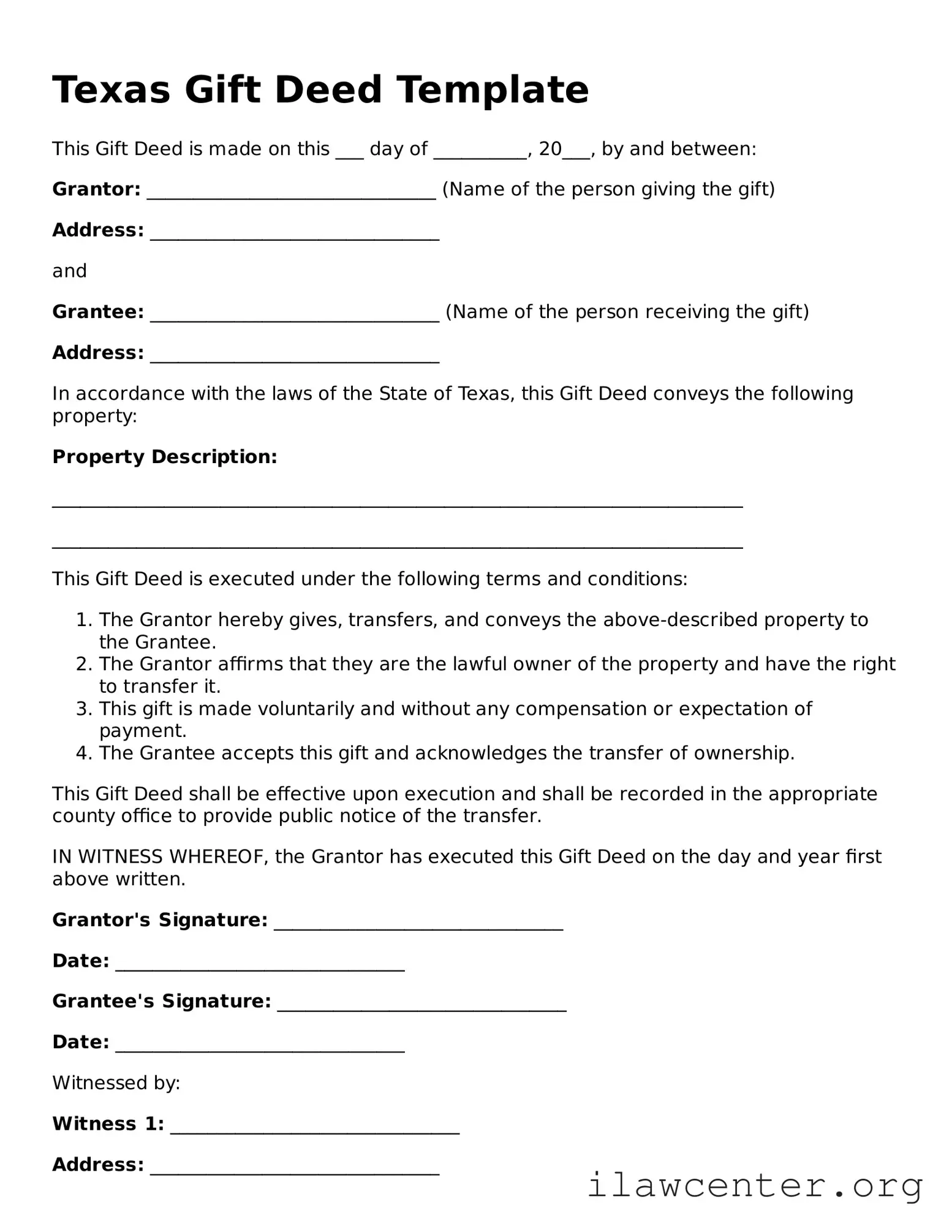
Texas Gift Deed Preview

Texas Gift Deed Template

This Gift Deed is made on this ___ day of __________, 20___, by and between:

Grantor: _______________________________ (Name of the person giving the gift)

Address: _______________________________

and

Grantee: _______________________________ (Name of the person receiving the gift)

Address: _______________________________

In accordance with the laws of the State of Texas, this Gift Deed conveys the following property:

Property Description:

__________________________________________________________________________

__________________________________________________________________________

This Gift Deed is executed under the following terms and conditions:

  1. The Grantor hereby gives, transfers, and conveys the above-described property to the Grantee.
  2. The Grantor affirms that they are the lawful owner of the property and have the right to transfer it.
  3. This gift is made voluntarily and without any compensation or expectation of payment.
  4. The Grantee accepts this gift and acknowledges the transfer of ownership.

This Gift Deed shall be effective upon execution and shall be recorded in the appropriate county office to provide public notice of the transfer.

IN WITNESS WHEREOF, the Grantor has executed this Gift Deed on the day and year first above written.

Grantor's Signature: _______________________________

Date: _______________________________

Grantee's Signature: _______________________________

Date: _______________________________

Witnessed by:

Witness 1: _______________________________

Address: _______________________________

Signature: _______________________________

Date: _______________________________

Witness 2: _______________________________

Address: _______________________________

Signature: _______________________________

Date: _______________________________

This document is intended to comply with Texas Property Code and should be reviewed for legal sufficiency.

PDF Form Characteristics

Fact Name Description
Definition A Texas Gift Deed is a legal document that transfers ownership of property as a gift without any exchange of money.
Governing Law The Texas Gift Deed is governed by Texas Property Code, particularly Section 5.021 and Section 5.041.
Requirements The deed must be in writing, signed by the donor, and must clearly identify the property being gifted.
Consideration No monetary consideration is required for a gift deed, distinguishing it from a sale or exchange.
Acceptance The recipient of the gift must accept the gift for the transfer to be valid, although acceptance can be implied.
Recording To protect the interests of the recipient, it is advisable to record the gift deed with the county clerk’s office.
Tax Implications Gifting property may have tax implications, including potential gift tax responsibilities for the donor.
Revocation Once executed and delivered, a gift deed cannot typically be revoked unless specific conditions are met.

Instructions on Utilizing Texas Gift Deed

After obtaining the Texas Gift Deed form, it’s important to carefully complete it to ensure that the transfer of property is valid and recognized. Follow these steps to fill out the form accurately.

  1. Begin by entering the name of the grantor, the person giving the gift. Include their full legal name.
  2. Next, provide the name of the grantee, the person receiving the gift. Again, use their full legal name.
  3. Fill in the property description. This should include the address and any legal description of the property being transferred.
  4. Specify the date on which the gift is being made. This is important for record-keeping purposes.
  5. Sign the form in the presence of a notary public. The notary will verify your identity and witness your signature.
  6. After notarization, ensure that all parties receive a copy of the signed deed for their records.

With the form completed, the next step involves filing the deed with the appropriate county clerk's office to officially record the transfer. This ensures that the gift is legally recognized and protects the interests of both the grantor and grantee.

Important Facts about Texas Gift Deed

What is a Texas Gift Deed?

A Texas Gift Deed is a legal document used to transfer ownership of real property from one person to another without any exchange of money. This form is commonly used when a property owner wants to give their property as a gift to a family member or friend. The deed must be properly executed and recorded to be valid.

What information is required to complete a Texas Gift Deed?

To complete a Texas Gift Deed, you will need the names and addresses of both the giver (donor) and the receiver (grantee). Additionally, a description of the property being gifted is necessary. This typically includes the property’s legal description, which can be found on the current deed or tax records. You will also need to specify that the transfer is a gift and not a sale.

Do I need to have the Gift Deed notarized?

Yes, a Texas Gift Deed must be notarized. Both the donor and the grantee should sign the deed in the presence of a notary public. This step ensures that the signatures are authentic and that the document is legally binding. Notarization also adds an extra layer of protection against disputes in the future.

Is there a tax implication when giving a property as a gift in Texas?

While Texas does not have a state gift tax, federal gift tax rules may apply. If the value of the property exceeds the annual exclusion limit set by the IRS, the donor may need to file a gift tax return. It's advisable to consult with a tax professional to understand any potential tax consequences before proceeding with the gift.

How do I record the Gift Deed?

To record the Gift Deed, you must take the signed and notarized document to the county clerk’s office in the county where the property is located. There may be a small fee for recording the deed. Once recorded, the deed becomes part of the public record, providing official proof of the transfer of ownership.

Can a Gift Deed be revoked?

Once a Gift Deed is executed and recorded, it is generally considered irrevocable. This means that the donor cannot take back the gift unless specific conditions are met or unless the grantee agrees to return the property. If there are concerns about the irrevocability of the gift, it’s important to discuss options with a legal professional.

What happens if the donor dies after executing a Gift Deed?

If the donor dies after executing a Gift Deed, the property will belong to the grantee as per the terms of the deed. The transfer is complete, and the grantee will not need to go through probate for that property. However, it’s essential to ensure that the deed is properly recorded to avoid any complications.

Common mistakes

Filling out a Texas Gift Deed form can seem straightforward, but many people make common mistakes that can lead to complications down the road. One frequent error is failing to include the correct legal description of the property. A vague or incorrect description can create confusion about what is being transferred. Always ensure that the legal description matches the one found in the property’s title documents.

Another mistake is neglecting to identify the grantor and grantee properly. The grantor is the person giving the gift, while the grantee is the recipient. Omitting full names or using nicknames can lead to issues with the deed’s validity. It’s essential to use the full legal names of both parties as they appear on their identification documents.

People often overlook the importance of signatures. Both the grantor and any witnesses must sign the deed for it to be valid. Failing to obtain the necessary signatures can render the deed ineffective. Moreover, if the grantor is married, the spouse may also need to sign to relinquish any claims to the property.

Inadequate notarization is another common pitfall. Texas law requires that the Gift Deed be notarized to be enforceable. Without a notary’s acknowledgment, the deed may not hold up in court. Ensure that the notary is present when the grantor signs the document and that all required details are filled out correctly.

Some individuals forget to record the Gift Deed with the county clerk. Recording the deed is crucial as it provides public notice of the transfer. If you do not record it, future buyers or lenders may be unaware of the gift, leading to disputes over ownership. Always file the deed promptly after signing and notarizing it.

Another mistake is not considering tax implications. While gifts may not incur immediate tax consequences, there could be future implications for both the giver and the recipient. It’s wise to consult with a tax professional to understand any potential liabilities associated with the gift.

Lastly, people sometimes assume that a Gift Deed is the same as a sale. This misconception can lead to misunderstandings about the rights and responsibilities associated with the property. A Gift Deed transfers ownership without consideration, while a sale involves a transaction. Understanding this distinction is vital to avoid future legal issues.

Documents used along the form

When completing a Texas Gift Deed, several additional forms and documents may be necessary to ensure the process is thorough and legally sound. These documents help clarify the intent of the gift, provide necessary disclosures, and facilitate the transfer of property. Below is a list of commonly used documents alongside the Texas Gift Deed.

  • Affidavit of Gift: This document serves as a sworn statement affirming that the property is a gift and not a sale. It outlines the details of the transaction and can help prevent future disputes regarding the nature of the transfer.
  • Property Description: A detailed description of the property being gifted is essential. This document includes specifics such as the property address, legal description, and any relevant identifying information.
  • Quitclaim Deed: Although less common, a quitclaim deed may be used to transfer any interest in the property from the giver to the recipient. This document is particularly useful if the giver has an uncertain claim to the property.
  • Tax Affidavit: This form provides information regarding any potential tax implications of the gift. It is crucial for both parties to understand their tax responsibilities following the transfer.
  • Title Insurance Policy: A title insurance policy protects the recipient against any claims or issues that may arise regarding the property’s title. This document provides peace of mind and financial protection.
  • Transfer Tax Form: Depending on the value of the gift, a transfer tax form may be required. This document ensures that any applicable taxes are properly calculated and paid to the state.

These documents work together with the Texas Gift Deed to ensure a smooth and legally compliant transfer of property. Proper preparation and understanding of each form can help both the giver and recipient navigate the gifting process effectively.

Similar forms

The Gift Deed form shares similarities with several other legal documents. Each of these documents serves a specific purpose in the transfer of property or rights. Below is a list of eight documents that are similar to a Gift Deed, along with a brief explanation of how they relate.

  • Will: A will outlines how a person's assets will be distributed after their death, similar to how a Gift Deed transfers ownership while the donor is still alive.
  • Trust Agreement: A trust agreement allows a person to place assets into a trust for the benefit of another, akin to the intent of a Gift Deed to benefit the recipient.
  • Quitclaim Deed: A quitclaim deed transfers any interest the grantor has in a property without warranty, similar to how a Gift Deed transfers ownership without consideration.
  • Sales Agreement: A sales agreement outlines the terms of a property sale, while a Gift Deed specifies the terms of a property transfer without payment.
  • Property Transfer Form: This form is used to officially transfer property ownership, similar to the function of a Gift Deed.
  • Power of Attorney: A power of attorney grants someone the authority to act on another's behalf, which can include transferring property, similar to a Gift Deed's intent.
  • Lease Agreement: A lease agreement allows one party to use property owned by another for a specified time, which can be seen as a temporary transfer of rights, contrasting with the permanent transfer in a Gift Deed.
  • Beneficiary Designation Form: This form designates who will receive assets upon death, similar to how a Gift Deed specifies the recipient of a gift while the donor is alive.

Dos and Don'ts

When filling out the Texas Gift Deed form, there are several important things to keep in mind. Below is a list of what you should and shouldn't do.

  • Do ensure all information is accurate and complete. Double-check names, addresses, and property details.
  • Do sign the form in front of a notary public. This step is crucial for the deed to be legally valid.
  • Do include a clear description of the property being gifted. This helps avoid any confusion later on.
  • Do keep a copy of the completed form for your records. Having documentation can be helpful in the future.
  • Do file the deed with the appropriate county clerk’s office. This ensures the gift is officially recorded.
  • Don't rush through the form. Take your time to read each section carefully.
  • Don't forget to check for any local requirements that may apply. Different counties may have specific rules.
  • Don't leave any sections blank. If a section does not apply, indicate that clearly.
  • Don't forget to date the document. An undated deed can lead to complications.
  • Don't assume verbal agreements are sufficient. Always put the gift in writing to protect all parties involved.

Misconceptions

When it comes to the Texas Gift Deed form, many people hold misconceptions that can lead to confusion or mistakes. Understanding the truth behind these misconceptions is essential for anyone considering a gift deed in Texas. Here are seven common misconceptions:

  1. Gift Deeds are only for family members. Many believe that a gift deed can only be used to transfer property to family members. In reality, anyone can give a gift deed to anyone else, regardless of their relationship.
  2. A Gift Deed must be notarized. While notarization is highly recommended to ensure the document's validity, it is not a strict requirement for a gift deed to be effective. However, having it notarized can help prevent disputes later on.
  3. You cannot revoke a Gift Deed once it’s signed. Some people think that once a gift deed is executed, it cannot be undone. In fact, the donor can revoke the gift deed before the recipient accepts the property.
  4. Gift Deeds are the same as sales contracts. A common misunderstanding is that gift deeds function like sales contracts. Unlike sales contracts, gift deeds do not involve any exchange of money or consideration.
  5. All gifts are tax-free. While many gifts may not incur taxes, there are limits set by the IRS. If the value of the property exceeds a certain threshold, the donor may need to file a gift tax return.
  6. A Gift Deed can be used for any type of property. Some believe that gift deeds are limited to real estate. However, they can also be used for personal property, such as vehicles or valuable items, as long as the transfer is documented.
  7. Once a Gift Deed is filed, the donor loses all rights to the property. This is not entirely accurate. If the gift deed includes a reservation of rights, the donor can retain certain rights to the property even after the deed is executed.

By clearing up these misconceptions, individuals can make informed decisions about using the Texas Gift Deed form and ensure that their intentions are accurately reflected in their property transfers.

Key takeaways

When considering the Texas Gift Deed form, there are several important aspects to keep in mind. This document allows individuals to transfer property as a gift without any monetary exchange. Below are key takeaways to help you navigate the process effectively.

  • Understand the Purpose: A Gift Deed is used to transfer ownership of property without compensation. It’s essential to recognize that this is a voluntary act.
  • Eligibility: Both the donor (the person giving the gift) and the recipient (the person receiving the gift) must be legally competent to enter into the agreement.
  • Property Description: Clearly describe the property being gifted. Include details like the address and any relevant legal descriptions.
  • Consider Tax Implications: Gifting property may have tax consequences. It’s wise to consult a tax professional to understand potential gift taxes.
  • Signatures Required: The Gift Deed must be signed by the donor. Depending on local regulations, the recipient’s signature may also be needed.
  • Notarization: To ensure authenticity, have the document notarized. This adds a layer of legal protection and validity.
  • Record the Deed: After signing, file the Gift Deed with the county clerk’s office where the property is located. This makes the transfer official.
  • Revocation: A Gift Deed cannot be revoked once executed. Ensure you are certain about your decision before proceeding.
  • Consult Legal Advice: It’s beneficial to seek legal advice to ensure the Gift Deed meets all legal requirements and protects your interests.
  • Impact on Future Transactions: Be aware that gifting property may affect future sales or transfers. Understanding these implications is crucial.

By keeping these key points in mind, you can navigate the Texas Gift Deed process with greater confidence and clarity.