Attorney-Verified  Homeschool Letter of Intent Document for Texas

Attorney-Verified Homeschool Letter of Intent Document for Texas

The Texas Homeschool Letter of Intent is a formal document that parents submit to notify the state of their decision to homeschool their children. This form is essential for establishing a home education program and ensuring compliance with Texas regulations. To get started, fill out the form by clicking the button below.

Article Guide

For families in Texas who choose to take charge of their children's education, the Texas Homeschool Letter of Intent form serves as a crucial first step in the homeschooling journey. This simple yet essential document notifies the local school district of your intent to homeschool, ensuring compliance with state regulations. By submitting this letter, parents affirm their commitment to providing a structured learning environment tailored to their child's unique needs. The form typically includes basic information such as the names of the students, the educational approach being adopted, and the intended start date for homeschooling. While the process may seem straightforward, understanding the nuances of the form can empower parents to navigate the homeschooling landscape with confidence. Additionally, this letter marks the beginning of a fulfilling educational experience, allowing families to explore diverse curricula and teaching methods that resonate with their values and goals.

Texas Homeschool Letter of Intent Preview

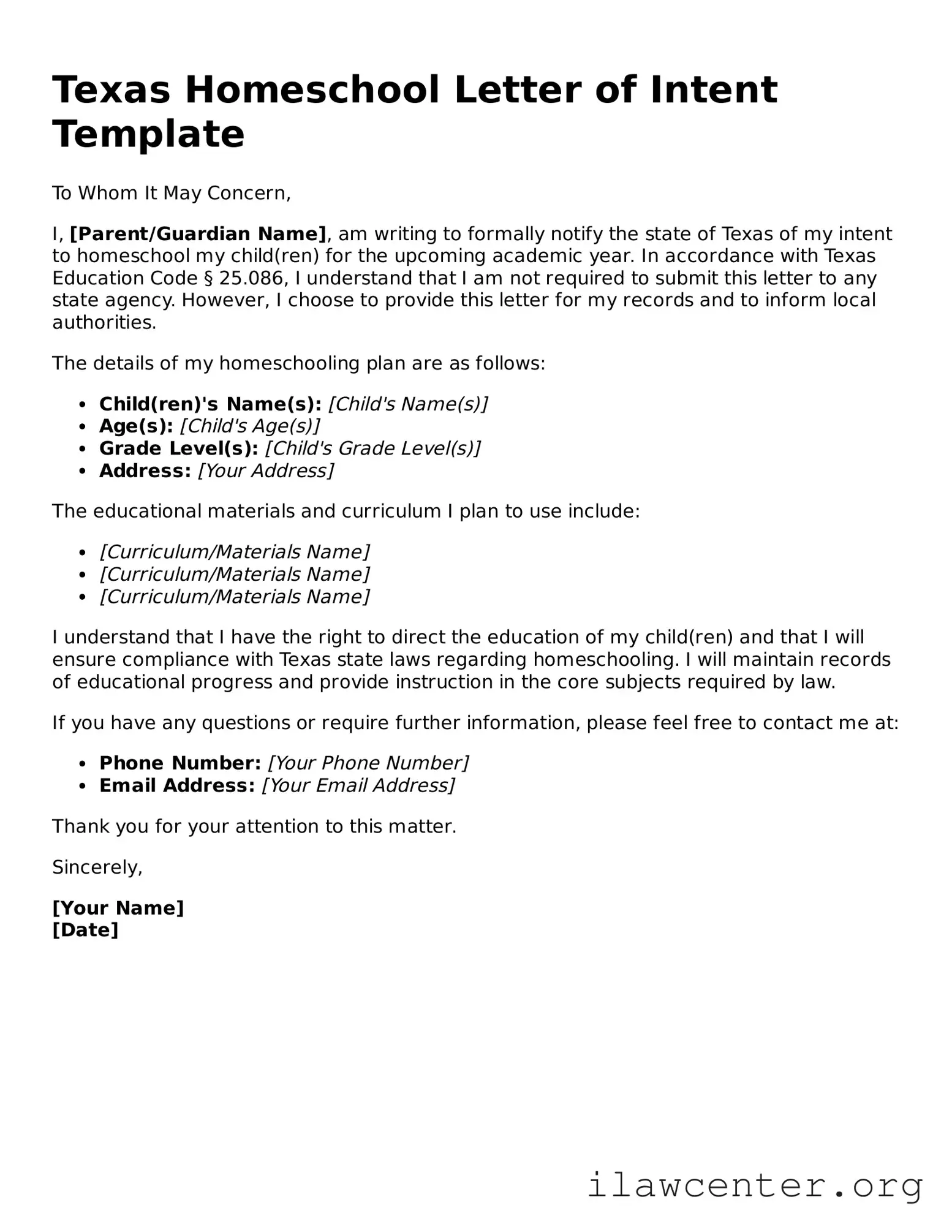
Texas Homeschool Letter of Intent Template

To Whom It May Concern,

I, [Parent/Guardian Name], am writing to formally notify the state of Texas of my intent to homeschool my child(ren) for the upcoming academic year. In accordance with Texas Education Code § 25.086, I understand that I am not required to submit this letter to any state agency. However, I choose to provide this letter for my records and to inform local authorities.

The details of my homeschooling plan are as follows:

  • Child(ren)'s Name(s): [Child's Name(s)]
  • Age(s): [Child's Age(s)]
  • Grade Level(s): [Child's Grade Level(s)]
  • Address: [Your Address]

The educational materials and curriculum I plan to use include:

  • [Curriculum/Materials Name]
  • [Curriculum/Materials Name]
  • [Curriculum/Materials Name]

I understand that I have the right to direct the education of my child(ren) and that I will ensure compliance with Texas state laws regarding homeschooling. I will maintain records of educational progress and provide instruction in the core subjects required by law.

If you have any questions or require further information, please feel free to contact me at:

  • Phone Number: [Your Phone Number]
  • Email Address: [Your Email Address]

Thank you for your attention to this matter.

Sincerely,

[Your Name]
[Date]

PDF Form Characteristics

Fact Name Description
Governing Law The Texas Education Code, Section 26.010 outlines the legal framework for homeschooling in Texas.
Letter of Intent Requirement Parents must submit a Letter of Intent to homeschool their child to the local school district.
Submission Timeline The Letter of Intent should be submitted within 30 days of starting the homeschool program.
Content of the Letter The letter must include the name and age of the child, as well as the educational program being used.
Notification to School District Parents are encouraged to send the letter via certified mail to ensure proof of submission.
Record Keeping While the form itself is not required to be kept, maintaining a copy is advisable for personal records.
Withdrawal from Public School Families must formally withdraw their child from public school before submitting the Letter of Intent.
Duration of Homeschooling Once submitted, the Letter of Intent does not expire; parents can homeschool until they choose to stop.
State Oversight Texas does not require standardized testing or curriculum approval for homeschoolers, providing flexibility.

Instructions on Utilizing Texas Homeschool Letter of Intent

After completing the Texas Homeschool Letter of Intent form, you will submit it to your local school district. This step is essential for officially notifying the district of your intent to homeschool your child.

  1. Obtain the Texas Homeschool Letter of Intent form. You can usually find it on your local school district's website or request it directly from the district office.
  2. Fill in your name and address at the top of the form. Make sure to provide accurate contact information.
  3. Provide the name and date of birth of each child you plan to homeschool. Ensure that the names match their official documents.
  4. Indicate the grade level for each child. This helps the district understand the educational stage of your children.
  5. Sign and date the form at the bottom. Your signature confirms your intent to homeschool.
  6. Make a copy of the completed form for your records before submission.
  7. Submit the form to your local school district office. You may do this in person or by mail, depending on the district’s requirements.

Important Facts about Texas Homeschool Letter of Intent

What is the Texas Homeschool Letter of Intent form?

The Texas Homeschool Letter of Intent is a simple document that parents or guardians submit to formally notify their school district of their intent to homeschool their children. This letter is a way to inform the local education authorities that the family has chosen to educate their children at home, rather than in a traditional school setting.

Who needs to submit the Letter of Intent?

Any parent or guardian who wishes to homeschool their child in Texas must submit this letter. This requirement applies to children who are of compulsory school age, typically between 6 and 19 years old. It is important for parents to ensure that they comply with this requirement to avoid any misunderstandings with local school officials.

When should the Letter of Intent be submitted?

The Letter of Intent should be submitted at the beginning of the homeschooling process, ideally before the school year starts. However, if a family decides to switch to homeschooling mid-year, they can submit the letter at that time as well. Prompt submission helps clarify the family's educational plans to the school district.

Is there a specific format for the Letter of Intent?

While there is no official template mandated by the state, the Letter of Intent should include certain key elements. Parents should clearly state their intention to homeschool, provide the names and ages of the children, and include the address of the homeschooling family. Keeping the letter concise and straightforward is advisable.

Do I need to send the Letter of Intent to anyone besides the school district?

Generally, the Letter of Intent is submitted only to the local school district. However, it may be beneficial to keep a copy for personal records. Some families also choose to inform other relevant parties, such as local homeschooling groups or co-ops, but this is not a legal requirement.

What happens after I submit the Letter of Intent?

Once the Letter of Intent is submitted, families can begin their homeschooling journey. The school district typically does not have any further obligations or requirements after receiving the letter. Parents should remember that they are responsible for creating their own educational curriculum and ensuring their children receive an adequate education.
Common mistakes

Filling out the Texas Homeschool Letter of Intent form can be a straightforward process, but many families encounter common pitfalls that can lead to complications. One frequent mistake is failing to include all required information. The form asks for specific details about the student, such as their name and age. Omitting even one piece of information can delay the approval process and create unnecessary confusion.

Another common error is submitting the form to the wrong entity. In Texas, the letter of intent must be sent to the appropriate school district. Some families mistakenly send it to the state education department or other organizations. This misdirection can result in a lack of acknowledgment and may hinder the homeschooling journey.

Additionally, some parents overlook the importance of keeping a copy of the submitted form. Once the letter of intent is sent, it is wise to retain a copy for personal records. This serves as proof of compliance with state regulations and can be helpful in case of future inquiries.

Timeframes are also critical. Some individuals fail to submit the letter of intent within the designated time frame. Texas law requires that this form be filed before the start of the school year. Missing this deadline can lead to complications, including potential truancy issues.

Lastly, some families do not fully understand the implications of their submission. By sending in the letter of intent, parents are committing to providing an educational program that meets the state's requirements. It is essential to be aware of what this entails, as failure to comply can result in legal challenges or the need to revert to traditional schooling.

Documents used along the form

When families choose to homeschool in Texas, several forms and documents may be required in addition to the Texas Homeschool Letter of Intent. These documents help to ensure compliance with state regulations and support the educational journey of the student.

  • Curriculum Plan: This document outlines the educational materials and subjects that will be taught throughout the school year. It provides a clear roadmap for both parents and students.
  • Attendance Records: Keeping track of daily attendance is essential. These records demonstrate that the student is actively engaged in their homeschooling program.
  • Progress Reports: Regularly documenting the student’s academic progress can help parents assess learning outcomes and make necessary adjustments to the curriculum.
  • Standardized Test Results: While not required, many families choose to administer standardized tests to evaluate their child's academic performance compared to peers.
  • Educational Portfolio: This collection of the student’s work, projects, and assessments showcases their learning journey and achievements over the year.
  • Withdrawal Letter: If a student is transferring from a public or private school to homeschooling, a formal withdrawal letter may be necessary to notify the previous school.
  • Homeschool Affidavit: This document serves as a declaration that the family is committed to homeschooling and outlines the educational philosophy and approach being used.

By preparing these documents, families can create a structured and supportive environment for homeschooling. This organization not only meets legal requirements but also enhances the educational experience for the student.

Similar forms

The Homeschool Letter of Intent form serves as a formal notification to the school district that a parent or guardian intends to homeschool their child. Several other documents share similarities with this form, primarily in their purpose of conveying important information regarding educational choices. Here’s a look at six documents that are comparable to the Homeschool Letter of Intent:

  • Enrollment Form: Similar to the Letter of Intent, an enrollment form is used to officially register a student in a school. Both documents require essential information about the student and the educational plan.
  • Withdrawal Form: This form is used when a parent decides to withdraw their child from a public or private school. Like the Letter of Intent, it communicates a significant change in the child's educational path.
  • Educational Plan: An educational plan outlines the curriculum and learning objectives for a homeschooling family. It is akin to the Letter of Intent as it details the intended educational approach and goals.
  • Attendance Record: This document tracks a student's daily attendance in a homeschooling setting. It serves a similar function as the Letter of Intent by documenting the educational commitment made by the parent.
  • Report Card: A report card provides an assessment of a student's progress and achievements. Like the Letter of Intent, it is a formal record that reflects the educational journey of the child.
  • Curriculum Approval Form: Some states require parents to submit a curriculum approval form to ensure that the chosen educational materials meet state standards. This document, like the Letter of Intent, is part of the regulatory process surrounding homeschooling.

Dos and Don'ts

When filling out the Texas Homeschool Letter of Intent form, it is essential to approach the process with care and attention to detail. Below is a list of things you should and shouldn't do to ensure your submission is complete and accurate.

  • Do ensure that you provide accurate information about your child, including their full name and date of birth.
  • Do include your address and contact information, as this helps the school district reach you if necessary.
  • Do submit the form to the appropriate school district office. Each district may have specific submission guidelines.
  • Do keep a copy of the completed form for your records. This can be helpful for future reference.
  • Don't forget to check for any specific requirements or additional documents that your district may require.
  • Don't leave any fields blank. Incomplete forms may lead to delays or rejection.
  • Don't submit the form late. Adhering to deadlines is crucial to ensure compliance with state regulations.
  • Don't panic if you make a mistake. You can usually correct errors by contacting the district office for guidance.

Misconceptions

When considering homeschooling in Texas, many families encounter the Texas Homeschool Letter of Intent form. Unfortunately, several misconceptions can cloud understanding of this important document. Here are nine common misconceptions clarified:

  1. Homeschooling requires prior approval from the state. Many believe that they need permission from the state to start homeschooling. In Texas, no formal approval is necessary; parents simply need to submit a Letter of Intent.
  2. The Letter of Intent must be submitted annually. Some think they need to submit a new Letter of Intent every year. In reality, once submitted, it remains valid until the child is no longer homeschooled or the family moves.
  3. There are specific subjects that must be taught. A common belief is that the state mandates a specific curriculum. Texas law requires that parents provide an education that includes reading, spelling, grammar, mathematics, and citizenship, but it does not dictate how these subjects must be taught.
  4. Parents must follow the same schedule as public schools. Many assume that homeschooling must adhere to a traditional school calendar. However, families can create their own schedules that fit their unique needs and lifestyles.
  5. Submitting the Letter of Intent is complicated. Some people think the process is overly complex. In fact, the Letter of Intent is straightforward and can often be completed in just a few minutes.
  6. Homeschooling is only for certain types of families. There's a misconception that only certain families can successfully homeschool. In truth, families from all backgrounds and circumstances can choose this educational path.
  7. There are strict record-keeping requirements. Many fear they will be overwhelmed by paperwork. While keeping records is recommended, Texas law does not impose strict requirements on how or what to document.
  8. Homeschooling limits socialization opportunities. Some believe that homeschooled children miss out on social interactions. In reality, many homeschooling families actively seek out social opportunities through co-ops, sports, and community events.
  9. Parents must be certified teachers to homeschool. A common myth is that parents need teaching credentials. In Texas, parents do not need to have any formal teaching qualifications to educate their children at home.

Understanding these misconceptions can help families navigate the homeschooling process more confidently. With the right information, parents can make informed decisions that best suit their children's educational needs.

Key takeaways

When filling out and using the Texas Homeschool Letter of Intent form, keep these key points in mind:

  1. Understand the Requirements: Texas law requires parents to submit a Letter of Intent to homeschool their children.
  2. Provide Accurate Information: Ensure that all details, such as your name, address, and the names of your children, are correct.
  3. Submit on Time: It's important to submit the form before the school year begins or as soon as you decide to homeschool.
  4. No Approval Needed: Once submitted, you do not need to wait for approval. You can begin homeschooling immediately.
  5. Keep a Copy: Always keep a copy of the Letter of Intent for your records. This can be helpful for future reference.
  6. Be Aware of Attendance: Texas does not require you to submit attendance records, but it’s wise to keep track for your own organization.
  7. Stay Informed: Familiarize yourself with Texas homeschooling laws and requirements to ensure compliance and a smooth homeschooling experience.