Attorney-Verified  Independent Contractor Agreement Document for Texas

Attorney-Verified Independent Contractor Agreement Document for Texas

The Texas Independent Contractor Agreement form is a legal document that outlines the terms and conditions between a business and an independent contractor. This agreement helps clarify the responsibilities and expectations of both parties, ensuring a mutual understanding of the working relationship. To get started on your own agreement, please fill out the form by clicking the button below.

Article Guide

The Texas Independent Contractor Agreement form serves as a crucial document in establishing the working relationship between a business and an independent contractor. This form outlines the specific terms and conditions under which the contractor will provide services, ensuring clarity and mutual understanding. Key components typically include the scope of work, payment terms, and duration of the agreement. Additionally, it addresses confidentiality, intellectual property rights, and the independent contractor's status, which differentiates them from an employee. By detailing these aspects, the agreement protects both parties and helps mitigate potential disputes. Furthermore, the form may also include provisions for termination and dispute resolution, which are essential for maintaining a professional relationship. Overall, the Texas Independent Contractor Agreement form is designed to create a clear framework for the services rendered, ensuring that both the contractor and the hiring entity have aligned expectations.

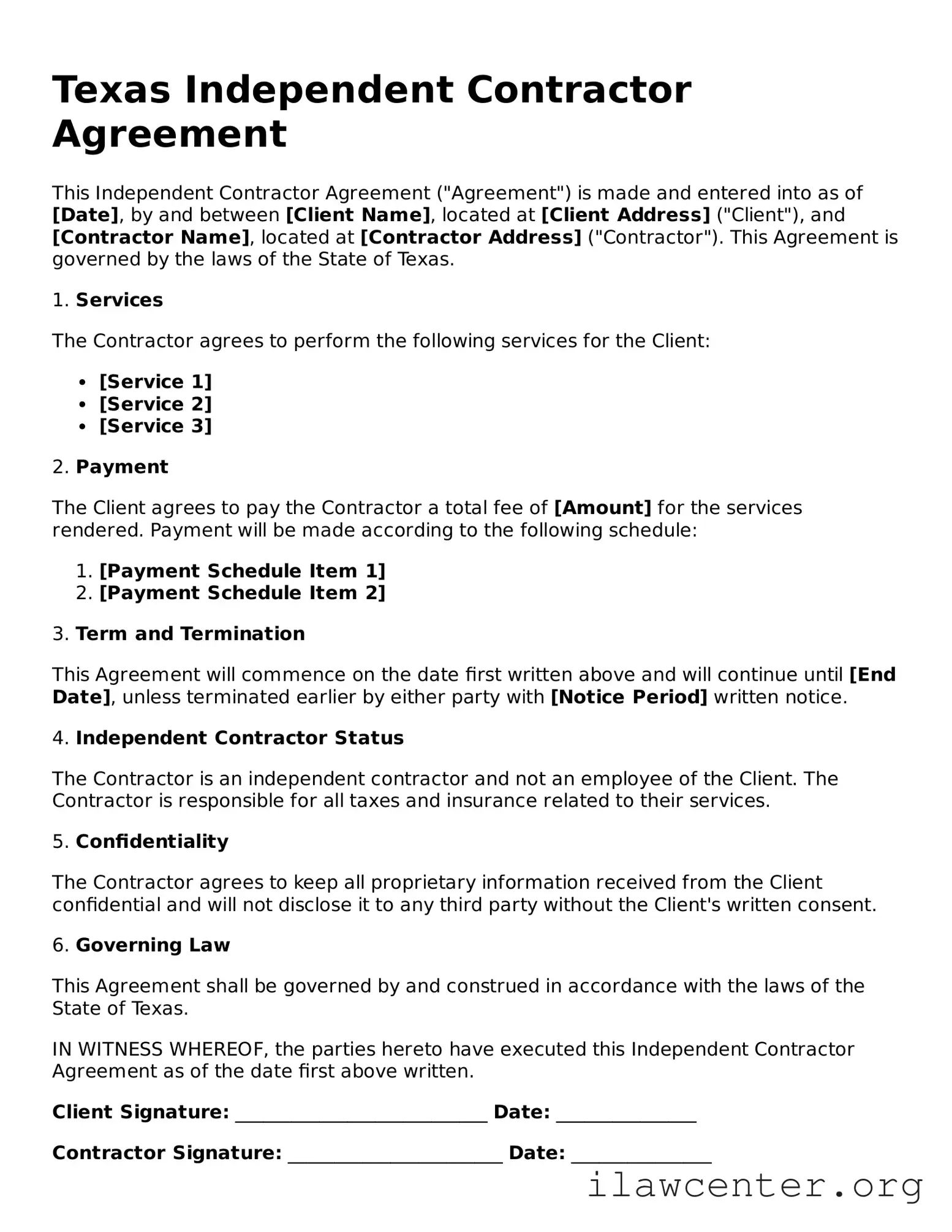
Texas Independent Contractor Agreement Preview

Texas Independent Contractor Agreement

This Independent Contractor Agreement ("Agreement") is made and entered into as of [Date], by and between [Client Name], located at [Client Address] ("Client"), and [Contractor Name], located at [Contractor Address] ("Contractor"). This Agreement is governed by the laws of the State of Texas.

1. Services

The Contractor agrees to perform the following services for the Client:

  • [Service 1]
  • [Service 2]
  • [Service 3]

2. Payment

The Client agrees to pay the Contractor a total fee of [Amount] for the services rendered. Payment will be made according to the following schedule:

  1. [Payment Schedule Item 1]
  2. [Payment Schedule Item 2]

3. Term and Termination

This Agreement will commence on the date first written above and will continue until [End Date], unless terminated earlier by either party with [Notice Period] written notice.

4. Independent Contractor Status

The Contractor is an independent contractor and not an employee of the Client. The Contractor is responsible for all taxes and insurance related to their services.

5. Confidentiality

The Contractor agrees to keep all proprietary information received from the Client confidential and will not disclose it to any third party without the Client's written consent.

6. Governing Law

This Agreement shall be governed by and construed in accordance with the laws of the State of Texas.

IN WITNESS WHEREOF, the parties hereto have executed this Independent Contractor Agreement as of the date first above written.

Client Signature: ___________________________ Date: _______________

Contractor Signature: _______________________ Date: _______________

PDF Form Characteristics

Fact Name Details
Definition A Texas Independent Contractor Agreement outlines the terms of a working relationship between a business and an independent contractor.
Governing Law The agreement is governed by the laws of the State of Texas, ensuring compliance with local regulations.
Key Components Essential elements include the scope of work, payment terms, and confidentiality clauses, which protect both parties.
Tax Implications Independent contractors are responsible for their own taxes, unlike employees, who have taxes withheld by their employer.
Termination Clause The agreement should specify how either party can terminate the contract, providing clarity on notice periods and obligations.

Instructions on Utilizing Texas Independent Contractor Agreement

Filling out the Texas Independent Contractor Agreement form is an important step in establishing a clear understanding between the contractor and the hiring party. This form helps to outline the terms of the working relationship, ensuring that both parties are on the same page regarding expectations, responsibilities, and compensation. Below are the steps to successfully complete the form.

  1. Begin by entering the date at the top of the form. This marks when the agreement is being created.
  2. Provide the name and address of the hiring party. This is typically the business or individual that is engaging the contractor.
  3. Next, fill in the name and address of the independent contractor. This identifies the person who will be providing the services.
  4. Clearly state the scope of work. Describe the specific services the contractor will provide, including any relevant details that clarify expectations.
  5. Indicate the payment terms. Specify the amount to be paid, the payment schedule, and any additional expenses that may be reimbursed.
  6. Outline the duration of the agreement. Include the start date and, if applicable, an end date or conditions under which the agreement may be terminated.
  7. Include any additional clauses that may be relevant, such as confidentiality, non-compete agreements, or intellectual property rights.
  8. Finally, both parties should sign and date the agreement. This formalizes the understanding and makes the contract legally binding.

After completing the form, it is advisable to keep a copy for your records. Both parties should also retain a signed version to refer back to as needed. This ensures clarity and helps prevent misunderstandings in the future.

Important Facts about Texas Independent Contractor Agreement

What is a Texas Independent Contractor Agreement?

A Texas Independent Contractor Agreement is a legal document that outlines the relationship between a business and an independent contractor. This agreement specifies the terms of work, payment, and responsibilities. It helps clarify that the contractor is not an employee, which affects tax obligations and liability. Having a clear agreement protects both parties and ensures everyone understands their rights and obligations.

What are the key components of this agreement?

The key components of a Texas Independent Contractor Agreement typically include the scope of work, payment terms, deadlines, confidentiality clauses, and termination conditions. It may also outline the contractor's status as an independent entity, ensuring that they are responsible for their own taxes and insurance. Including these details helps prevent misunderstandings and provides a clear framework for the working relationship.

How does this agreement benefit both parties?

This agreement benefits both the business and the contractor by establishing clear expectations. For the business, it minimizes liability and clarifies the contractor's responsibilities. For the contractor, it provides a formal outline of their duties and compensation, reducing the risk of disputes. Overall, it fosters a professional working relationship built on mutual understanding.

Is it necessary to have a written agreement?

While verbal agreements can be legally binding, having a written Texas Independent Contractor Agreement is highly recommended. A written document serves as proof of the terms agreed upon, which can be crucial if disputes arise. It also allows for easier reference and helps both parties stay accountable. In short, a written agreement is a valuable tool for protecting your interests.

Common mistakes

Filling out the Texas Independent Contractor Agreement form can be a straightforward process, but many individuals make common mistakes that can lead to complications later on. One frequent error is not providing complete information. It is essential to fill in all required fields accurately. Missing details can delay the agreement's processing and create confusion about the terms.

Another common mistake is failing to clarify the scope of work. The agreement should clearly outline what services the contractor will provide. Vague descriptions can lead to misunderstandings and disputes down the line. It is important to be as specific as possible to ensure both parties are on the same page.

People also often overlook the importance of payment terms. The agreement should specify how much the contractor will be paid, when payments are due, and the method of payment. Without clear payment terms, both parties may have different expectations, which can lead to frustration.

Additionally, some individuals forget to include a termination clause. This clause is vital as it outlines the conditions under which either party can terminate the agreement. Without this clause, it may be challenging to end the working relationship if issues arise.

Another mistake is not considering tax implications. Independent contractors are responsible for their taxes, and the agreement should state that the contractor is not an employee. This distinction is crucial for both parties to avoid future legal issues with the IRS.

People sometimes neglect to review the entire agreement before signing. Taking the time to read through the document ensures that all terms are understood and agreed upon. Signing without a thorough review can lead to unintentional commitments or obligations.

Lastly, individuals may forget to keep a copy of the signed agreement. It is important to have a record of the contract for future reference. Both parties should retain a copy to ensure that they can refer back to the terms if needed.

Documents used along the form

When engaging independent contractors in Texas, several additional forms and documents may be required to ensure a smooth working relationship. These documents help clarify responsibilities, protect both parties, and outline the terms of the engagement. Below is a list of commonly used forms alongside the Texas Independent Contractor Agreement.

  • W-9 Form: This form is used to collect the contractor's taxpayer identification information. It is essential for reporting income to the IRS and ensuring compliance with tax regulations.
  • Invoice: Contractors typically submit invoices to request payment for their services. An invoice details the work performed, the amount due, and payment terms.
  • Non-Disclosure Agreement (NDA): An NDA protects sensitive information shared between the contractor and the hiring party. It prevents the contractor from disclosing proprietary information to third parties.
  • Scope of Work (SOW): This document outlines the specific tasks and responsibilities of the contractor. It provides clarity on project deliverables, timelines, and expectations.
  • Insurance Certificate: Contractors may need to provide proof of insurance coverage. This certificate demonstrates that the contractor has liability insurance, protecting both parties in case of accidents or damages.
  • Termination Letter: In case the working relationship needs to end, a termination letter formally notifies the contractor. It should outline the reasons for termination and any final obligations.

Utilizing these documents in conjunction with the Texas Independent Contractor Agreement can help establish a clear understanding between the parties involved. Proper documentation not only protects rights but also fosters a professional working environment.

Similar forms

  • Employment Agreement: Similar to an Independent Contractor Agreement, an Employment Agreement outlines the terms of a working relationship. However, it typically establishes an employer-employee relationship, which includes benefits and obligations that differ from those of independent contractors.
  • Service Agreement: This document details the terms under which services will be provided. Like the Independent Contractor Agreement, it specifies deliverables, timelines, and payment terms, but it may not focus solely on independent contractors.
  • Consulting Agreement: A Consulting Agreement is often used when hiring a consultant to provide expert advice. It shares similarities with the Independent Contractor Agreement in defining the scope of work and compensation but may emphasize intellectual property and confidentiality more heavily.
  • Freelance Agreement: This document governs the relationship between a freelancer and a client. It resembles the Independent Contractor Agreement by outlining project specifics, deadlines, and payment, but it may be less formal and more flexible.
  • Partnership Agreement: While not directly related to independent contracting, a Partnership Agreement sets the terms for a business partnership. It shares the need for clear terms and responsibilities, similar to an Independent Contractor Agreement.
  • Non-Disclosure Agreement (NDA): An NDA protects confidential information shared during a working relationship. While it does not establish the work terms, it is often used alongside Independent Contractor Agreements to safeguard sensitive information.
  • Joint Venture Agreement: This document outlines the terms of a collaboration between two or more parties. Like the Independent Contractor Agreement, it defines roles and responsibilities, though it typically involves a shared business goal rather than individual services.
  • Licensing Agreement: A Licensing Agreement allows one party to use another's intellectual property. It is similar in that it requires clear terms and conditions, but it focuses more on the use of intellectual property than on service provision.

Dos and Don'ts

When filling out the Texas Independent Contractor Agreement form, it is essential to approach the task with care. Here are four key things to keep in mind:

  • Do read the entire agreement thoroughly before filling it out. Understanding the terms will help avoid any misunderstandings later.
  • Do provide accurate and complete information. This includes your name, address, and any relevant business details.
  • Don't leave any sections blank. If a section does not apply to you, indicate that clearly, rather than skipping it.
  • Don't rush through the form. Take your time to ensure all information is correct and that you understand your obligations.

By following these guidelines, you can help ensure that your Independent Contractor Agreement is filled out correctly and effectively.

Misconceptions

When it comes to the Texas Independent Contractor Agreement, several misconceptions can lead to confusion. Understanding these misconceptions is essential for both contractors and businesses. Here are five common misunderstandings:

  1. Independent contractors have no rights.

    This is not true. While independent contractors do not have the same protections as employees, they still have rights under various laws. For instance, they can file complaints regarding discrimination or unsafe working conditions.

  2. All independent contractor agreements are the same.

    In reality, these agreements can vary significantly. Each contract should be tailored to the specific needs and expectations of both parties. It's important to read and understand the terms of each agreement before signing.

  3. Independent contractors do not need to pay taxes.

    This misconception can lead to serious financial issues. Independent contractors are responsible for paying their own taxes, including self-employment taxes. It's crucial to set aside funds for tax obligations.

  4. Independent contractors cannot negotiate their agreements.

    Many people believe that these agreements are set in stone. However, independent contractors have the right to negotiate terms. This includes payment rates, deadlines, and project scope.

  5. Signing an independent contractor agreement means you are an employee.

    This is a common misunderstanding. Signing the agreement establishes a contractor relationship, not an employment relationship. The distinction is important for legal and tax purposes.

By clarifying these misconceptions, both independent contractors and businesses can foster better working relationships and ensure compliance with applicable laws.

Key takeaways

When working with independent contractors in Texas, understanding the Texas Independent Contractor Agreement form is crucial. Here are some key takeaways to keep in mind:

  • Clarity of Terms: Clearly outline the scope of work, payment terms, and deadlines. This helps both parties understand their responsibilities and reduces the potential for disputes.
  • Tax Implications: Recognize that independent contractors are responsible for their own taxes. Ensure that the agreement specifies that the contractor will receive a 1099 form instead of a W-2.
  • Confidentiality and Non-Disclosure: If sensitive information is involved, consider including clauses that protect confidential information. This can safeguard your business interests.
  • Termination Conditions: Define the conditions under which either party can terminate the agreement. This provides a clear exit strategy if the working relationship does not meet expectations.

Utilizing the Texas Independent Contractor Agreement form effectively can lead to a more structured and productive working relationship.