Attorney-Verified  Lease Agreement Document for Texas

Attorney-Verified Lease Agreement Document for Texas

A Texas Lease Agreement form is a legal document that outlines the terms and conditions between a landlord and tenant for renting a residential or commercial property in Texas. This essential agreement protects the rights of both parties and ensures a clear understanding of responsibilities. To get started on your lease, fill out the form by clicking the button below.

Article Guide

The Texas Lease Agreement form serves as a crucial document in the rental process, establishing the legal relationship between landlords and tenants. This form outlines essential terms such as the duration of the lease, the amount of rent due, and the responsibilities of each party. Key provisions often include details about security deposits, maintenance obligations, and rules regarding pets or alterations to the property. Furthermore, the agreement typically specifies the consequences of lease violations, ensuring that both parties understand their rights and obligations. By clearly articulating these aspects, the Texas Lease Agreement aims to prevent misunderstandings and disputes, fostering a more harmonious rental experience. Understanding the intricacies of this form is vital for anyone involved in the leasing process in Texas, whether they are seasoned landlords or first-time tenants.

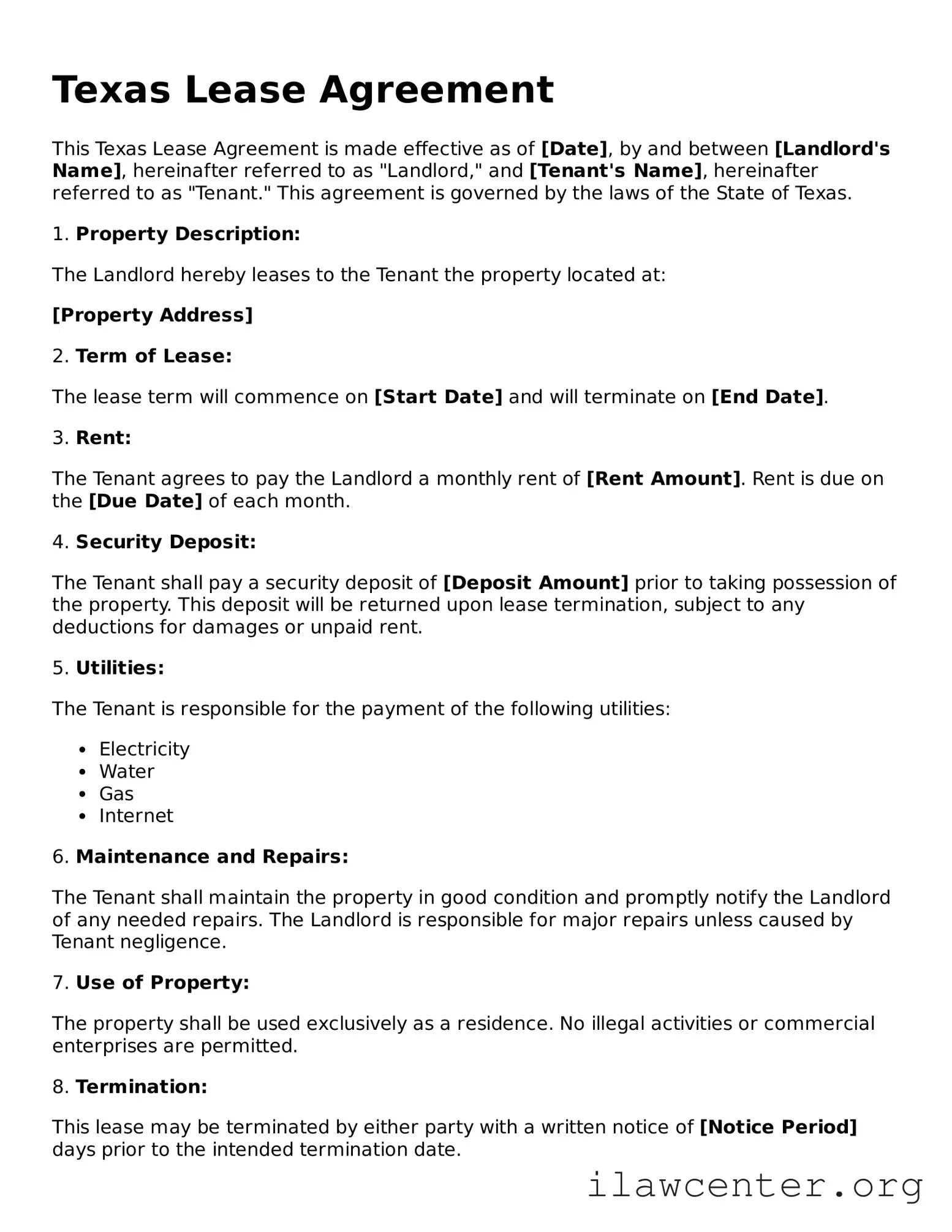
Texas Lease Agreement Preview

Texas Lease Agreement

This Texas Lease Agreement is made effective as of [Date], by and between [Landlord's Name], hereinafter referred to as "Landlord," and [Tenant's Name], hereinafter referred to as "Tenant." This agreement is governed by the laws of the State of Texas.

1. Property Description:

The Landlord hereby leases to the Tenant the property located at:

[Property Address]

2. Term of Lease:

The lease term will commence on [Start Date] and will terminate on [End Date].

3. Rent:

The Tenant agrees to pay the Landlord a monthly rent of [Rent Amount]. Rent is due on the [Due Date] of each month.

4. Security Deposit:

The Tenant shall pay a security deposit of [Deposit Amount] prior to taking possession of the property. This deposit will be returned upon lease termination, subject to any deductions for damages or unpaid rent.

5. Utilities:

The Tenant is responsible for the payment of the following utilities:

  • Electricity
  • Water
  • Gas
  • Internet

6. Maintenance and Repairs:

The Tenant shall maintain the property in good condition and promptly notify the Landlord of any needed repairs. The Landlord is responsible for major repairs unless caused by Tenant negligence.

7. Use of Property:

The property shall be used exclusively as a residence. No illegal activities or commercial enterprises are permitted.

8. Termination:

This lease may be terminated by either party with a written notice of [Notice Period] days prior to the intended termination date.

9. Governing Law:

This agreement shall be governed by the laws of the State of Texas.

IN WITNESS WHEREOF, the parties hereto have executed this Lease Agreement as of the day and year first above written.

_________________________ Landlord's Signature

_________________________ Date

_________________________ Tenant's Signature

_________________________ Date

PDF Form Characteristics

Fact Name Description
Governing Law The Texas Lease Agreement is governed by the Texas Property Code.
Parties Involved The lease agreement involves a landlord and a tenant.
Duration The lease can be for a fixed term or a month-to-month basis.
Security Deposit Texas law limits the security deposit to one month's rent for most residential leases.
Notice Requirements Both parties must provide written notice for lease termination or renewal.
Maintenance Responsibilities The landlord is responsible for maintaining the property in a habitable condition.
Late Fees Late fees must be reasonable and specified in the lease agreement.
Pet Policies Pet policies can vary and should be clearly outlined in the lease.
Subletting Subletting often requires the landlord's written consent.
Dispute Resolution Many leases include clauses for resolving disputes, often through mediation or arbitration.

Instructions on Utilizing Texas Lease Agreement

Completing the Texas Lease Agreement form requires attention to detail and accurate information. This document will serve as a binding contract between the landlord and tenant, outlining the terms of the lease. The following steps will guide you through the process of filling out the form.

  1. Begin by entering the date at the top of the form.
  2. Provide the names of the landlord and tenant in the designated fields.
  3. Fill in the property address, including the city, state, and ZIP code.
  4. Specify the lease term, indicating the start and end dates of the lease.
  5. Detail the monthly rent amount and the due date for payment.
  6. Include any security deposit information, including the amount and terms for its return.
  7. Outline the utilities that will be covered by the landlord and those that the tenant will be responsible for.
  8. Review any additional terms or conditions that may apply, such as pet policies or maintenance responsibilities.
  9. Both parties should sign and date the form at the bottom to indicate their agreement.

Important Facts about Texas Lease Agreement

What is a Texas Lease Agreement?

A Texas Lease Agreement is a legal document that outlines the terms and conditions under which a landlord rents property to a tenant in Texas. This agreement includes details such as the rental amount, duration of the lease, responsibilities of both parties, and any rules regarding the property. It serves to protect the rights of both the landlord and the tenant, ensuring clarity in the rental relationship.

What key elements should be included in a Texas Lease Agreement?

Essential elements of a Texas Lease Agreement typically include the names of the landlord and tenant, the property address, the lease term (length of the rental period), the amount of rent and payment due dates, security deposit details, maintenance responsibilities, and any specific rules or restrictions. Including these elements helps to avoid misunderstandings later on.

How long is a typical lease term in Texas?

In Texas, lease terms can vary widely. Most commonly, leases are signed for a duration of one year, but they can also be month-to-month or for shorter or longer periods. The length of the lease should be clearly stated in the agreement to ensure both parties are aware of their commitments.

Can a landlord increase rent during a lease term in Texas?

Generally, a landlord cannot increase rent during a fixed lease term unless the lease agreement specifically allows for it. However, if the lease is month-to-month, the landlord may increase rent with proper notice, typically 30 days in advance. It is important for tenants to review their lease agreement for any clauses related to rent increases.

What is a security deposit, and how is it handled in Texas?

A security deposit is a sum of money collected by the landlord to cover potential damages or unpaid rent. In Texas, there are no specific laws regulating the amount of the security deposit, but it is commonly one month's rent. Landlords must return the deposit within 30 days after the tenant moves out, minus any deductions for damages. A detailed list of deductions should be provided to the tenant.

What happens if a tenant wants to break the lease early?

If a tenant wishes to break the lease early, they may face penalties, including losing their security deposit or being required to pay rent until a new tenant is found. However, certain circumstances, such as domestic violence or military service, may allow for lease termination without penalties. It is crucial to review the lease terms and communicate with the landlord about the situation.

Are there any tenant rights in Texas that I should know about?

Yes, tenants in Texas have several rights, including the right to a habitable living environment, the right to privacy, and the right to receive proper notice before eviction. Additionally, tenants cannot be discriminated against based on race, gender, religion, or other protected characteristics. Understanding these rights can help tenants navigate their rental experience more effectively.

What should I do if I have a dispute with my landlord?

If a dispute arises with a landlord, the first step is to communicate directly with them to try to resolve the issue amicably. If that fails, tenants can seek mediation or legal assistance. In some cases, filing a complaint with local housing authorities may be appropriate. Keeping records of all communications and agreements is essential for any potential legal actions.
Common mistakes

When filling out the Texas Lease Agreement form, many people make common mistakes that can lead to confusion or disputes later on. One frequent error is not providing accurate personal information. It’s essential to include the correct names and contact details for all parties involved. Missing or incorrect information can cause issues when trying to enforce the lease.

Another mistake is failing to specify the rental amount clearly. The lease should state the exact monthly rent and when it is due. If this information is vague or omitted, it can lead to misunderstandings between the landlord and tenant.

People often overlook the importance of detailing the lease term. Not indicating the start and end dates of the lease can create uncertainty. It is crucial to clarify how long the agreement lasts to avoid any potential disputes about the duration of the tenancy.

Additionally, some individuals forget to include information about security deposits. The lease should outline the amount of the deposit and the conditions under which it will be returned. This helps protect both parties and sets clear expectations.

Another common error is neglecting to describe the property in detail. The lease should include the full address and any specific features of the rental unit. This ensures that both parties know exactly what is being rented.

People sometimes fail to address maintenance responsibilities. It is important to specify who is responsible for repairs and upkeep. Clear guidelines can prevent conflicts regarding maintenance issues during the lease period.

Lastly, not reading the lease thoroughly before signing is a mistake many make. It’s vital to understand all terms and conditions. Taking the time to review the document can help avoid future problems and ensure that both parties are on the same page.

Documents used along the form

The Texas Lease Agreement is an essential document for establishing the terms of a rental arrangement between a landlord and tenant. However, several other forms and documents are often used in conjunction with this agreement to ensure clarity and protect the rights of both parties. Below is a list of these commonly associated documents.

  • Rental Application: This document is completed by prospective tenants to provide personal information, rental history, and references. It helps landlords assess the suitability of applicants.
  • Credit Check Authorization: A form that allows landlords to obtain a tenant's credit report. This helps in evaluating the financial responsibility of the applicant.
  • Move-In Checklist: A detailed list that outlines the condition of the rental property at the time of move-in. Both parties sign this document to avoid disputes over damages later.
  • Security Deposit Receipt: A written acknowledgment that the landlord has received the security deposit from the tenant. It outlines the amount and conditions for its return.
  • Lease Addendum: An additional document that modifies or adds specific terms to the original lease agreement. This can include pet policies or maintenance responsibilities.
  • Notice to Vacate: A formal notification given by either party indicating their intent to terminate the lease. This document specifies the notice period required by Texas law.
  • Pet Agreement: A specific document that outlines the rules and responsibilities regarding pet ownership within the rental property. It may include additional fees or deposits.
  • Sublease Agreement: This document allows a tenant to rent out the property or a portion of it to another individual. It must be approved by the landlord and includes terms of the sublet.
  • Rent Receipt: A document provided by the landlord to the tenant upon receiving rent payment. It serves as proof of payment for the tenant's records.

Using these documents alongside the Texas Lease Agreement can help ensure a smooth rental experience for both landlords and tenants. Proper documentation aids in clarifying expectations and protecting the interests of all parties involved.

Similar forms

A Lease Agreement is a crucial document in real estate transactions, but it shares similarities with several other legal documents. Here are six documents that resemble a Lease Agreement, along with explanations of how they are alike:

  • Rental Agreement: This document is very similar to a Lease Agreement, as it outlines the terms under which a tenant can occupy a property. Both agreements specify rental amounts, duration, and responsibilities of both parties.
  • Sublease Agreement: A Sublease Agreement allows a tenant to rent out a portion or the entirety of their leased property to another party. Like a Lease Agreement, it includes terms about rent and responsibilities, but it specifically addresses the relationship between the original tenant and the subtenant.
  • Property Management Agreement: This document is used when a property owner hires a management company to oversee their rental property. Similar to a Lease Agreement, it outlines terms and conditions, but it focuses on the responsibilities of the management company rather than the tenant.
  • Commercial Lease Agreement: For businesses renting commercial space, this agreement functions much like a residential Lease Agreement. It details rental terms, responsibilities, and use of the property, but it is tailored to the needs of commercial tenants.
  • Tenancy Agreement: Often used interchangeably with a Lease Agreement, a Tenancy Agreement outlines the rights and responsibilities of both landlords and tenants. It covers similar ground, detailing rental terms and conditions for occupying a property.
  • Letter of Intent: While not a formal lease, a Letter of Intent can precede a Lease Agreement. It expresses the intention to lease a property and outlines key terms. Both documents aim to clarify the agreement between parties, though the Letter of Intent is more of a preliminary step.

Dos and Don'ts

When filling out the Texas Lease Agreement form, it is crucial to approach the process with care and attention. Here are five important dos and don'ts to keep in mind:

  • Do read the entire lease agreement thoroughly before signing.
  • Do ensure that all personal information is accurate and up-to-date.
  • Do clarify any unclear terms or conditions with the landlord before proceeding.
  • Don't rush through the form; take your time to understand each section.
  • Don't sign the lease if you feel uncomfortable or pressured.

By adhering to these guidelines, you can help ensure a smoother leasing experience and protect your rights as a tenant.

Misconceptions

Below are nine common misconceptions about the Texas Lease Agreement form, along with explanations to clarify each point.

  1. All lease agreements are the same. Many people believe that lease agreements are standardized across all states. However, each state has its own laws and requirements, and Texas lease agreements are specifically tailored to comply with Texas law.
  2. Verbal agreements are sufficient. Some individuals think that a verbal agreement is enough to establish a lease. In Texas, it is advisable to have a written lease agreement to ensure clarity and legal enforceability.
  3. Security deposits are not regulated. There is a misconception that landlords can charge any amount for a security deposit. In Texas, while there is no limit on the amount, landlords must return the deposit within 30 days after the tenant vacates the property, barring any deductions.
  4. All lease terms are negotiable. While many terms can be negotiated, certain aspects, such as compliance with local laws, cannot be altered. Both parties must adhere to Texas law regardless of personal agreements.
  5. Landlords can enter the property at any time. Some tenants believe that landlords have unrestricted access to the rental property. In Texas, landlords must provide reasonable notice, typically 24 hours, unless there is an emergency.
  6. Lease agreements are not legally binding. There is a common belief that lease agreements are merely suggestions. In reality, a signed lease agreement is a legally binding contract that outlines the responsibilities of both parties.
  7. Tenants can withhold rent for any reason. Some tenants think they can withhold rent as a form of protest. However, Texas law does not allow withholding rent unless specific legal conditions are met, such as failure to make necessary repairs.
  8. Pets are automatically allowed. Many tenants assume that pets are permitted in rental properties. However, pet policies vary by landlord and must be explicitly stated in the lease agreement.
  9. Lease agreements do not require signatures. Some individuals believe that a lease can be valid without signatures. In Texas, both parties must sign the lease for it to be enforceable.

Key takeaways

When filling out and using the Texas Lease Agreement form, there are several important points to keep in mind. These takeaways can help ensure that both landlords and tenants understand their rights and responsibilities.

  • Clarity is Key: Ensure that all terms and conditions are clearly stated. Ambiguities can lead to misunderstandings and disputes down the line.
  • Complete All Sections: Every section of the lease agreement should be filled out completely. Missing information can invalidate parts of the agreement.
  • Review Local Laws: Familiarize yourself with Texas rental laws. These laws can affect various aspects of the lease, including security deposits and eviction procedures.
  • Signatures Matter: Both parties must sign the lease for it to be legally binding. Without signatures, the agreement may not hold up in court.