Attorney-Verified  Loan Agreement Document for Texas

Attorney-Verified Loan Agreement Document for Texas

The Texas Loan Agreement form is a legal document that outlines the terms and conditions of a loan between a lender and a borrower in the state of Texas. This form serves to protect the interests of both parties by clearly defining repayment terms, interest rates, and other essential details. To ensure a smooth borrowing process, consider filling out the form by clicking the button below.

Article Guide

When it comes to borrowing money in Texas, a Loan Agreement form serves as a crucial document that outlines the terms and conditions between the lender and the borrower. This form typically includes essential details such as the loan amount, interest rate, repayment schedule, and any fees associated with the loan. It also specifies the rights and responsibilities of both parties, ensuring that everyone is on the same page. Additionally, the Loan Agreement may address what happens in the event of default, providing a clear course of action if the borrower fails to meet their obligations. Understanding the components of this form is vital for anyone considering a loan, as it not only protects the lender's interests but also safeguards the borrower's rights. By clearly delineating expectations and legal obligations, the Texas Loan Agreement form plays a fundamental role in fostering trust and transparency in financial transactions.

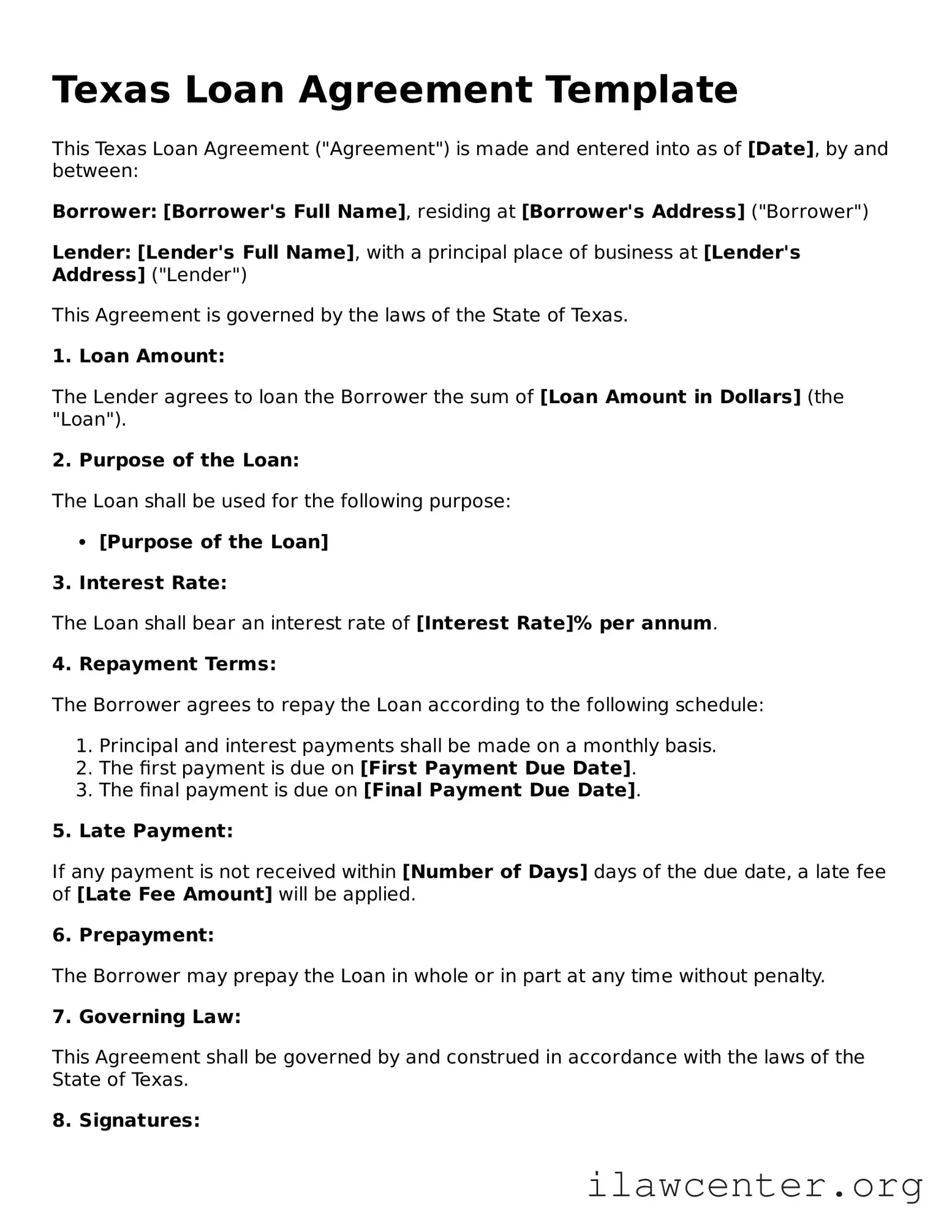
Texas Loan Agreement Preview

Texas Loan Agreement Template

This Texas Loan Agreement ("Agreement") is made and entered into as of [Date], by and between:

Borrower: [Borrower's Full Name], residing at [Borrower's Address] ("Borrower")

Lender: [Lender's Full Name], with a principal place of business at [Lender's Address] ("Lender")

This Agreement is governed by the laws of the State of Texas.

1. Loan Amount:

The Lender agrees to loan the Borrower the sum of [Loan Amount in Dollars] (the "Loan").

2. Purpose of the Loan:

The Loan shall be used for the following purpose:

  • [Purpose of the Loan]

3. Interest Rate:

The Loan shall bear an interest rate of [Interest Rate]% per annum.

4. Repayment Terms:

The Borrower agrees to repay the Loan according to the following schedule:

  1. Principal and interest payments shall be made on a monthly basis.
  2. The first payment is due on [First Payment Due Date].
  3. The final payment is due on [Final Payment Due Date].

5. Late Payment:

If any payment is not received within [Number of Days] days of the due date, a late fee of [Late Fee Amount] will be applied.

6. Prepayment:

The Borrower may prepay the Loan in whole or in part at any time without penalty.

7. Governing Law:

This Agreement shall be governed by and construed in accordance with the laws of the State of Texas.

8. Signatures:

By signing below, both parties agree to the terms and conditions outlined in this Agreement.

______________________________
Borrower's Signature
[Borrower's Printed Name]
Date: ________________

______________________________
Lender's Signature
[Lender's Printed Name]
Date: ________________

PDF Form Characteristics

Fact Name Details
Purpose The Texas Loan Agreement form outlines the terms and conditions of a loan between a lender and a borrower in Texas.
Governing Law This agreement is governed by the laws of the State of Texas, ensuring that all terms comply with Texas regulations.
Key Components The form typically includes details such as loan amount, interest rate, repayment schedule, and any collateral involved.
Signature Requirement Both parties must sign the agreement to make it legally binding, indicating their acceptance of the terms outlined.

Instructions on Utilizing Texas Loan Agreement

Filling out the Texas Loan Agreement form is an important step in formalizing a loan between parties. Completing this form accurately ensures that both the lender and the borrower understand their obligations and rights. Here’s how to fill it out correctly.

  1. Begin by entering the date at the top of the form.
  2. Provide the names and addresses of both the lender and the borrower in the designated sections.
  3. Clearly state the loan amount in the appropriate field. Make sure this amount is accurate and reflects the agreed terms.
  4. Specify the interest rate, if applicable. This should be clearly noted to avoid any misunderstandings later on.
  5. Detail the repayment terms. Include the payment schedule, whether it’s monthly, quarterly, or another arrangement.
  6. Indicate any late fees or penalties for missed payments. This section helps clarify the consequences of not adhering to the repayment schedule.
  7. Include any collateral, if applicable. If the loan is secured by an asset, describe it in this section.
  8. Sign and date the agreement at the bottom. Both parties should do this to validate the agreement.
  9. Consider having a witness or notary public sign the document for added legal protection.

After completing the form, both parties should retain a copy for their records. This ensures that everyone has access to the agreed-upon terms in the future.

Important Facts about Texas Loan Agreement

What is a Texas Loan Agreement form?

A Texas Loan Agreement form is a legal document used to outline the terms of a loan between a lender and a borrower in Texas. This form specifies the amount borrowed, interest rates, repayment schedules, and any collateral involved. It serves to protect both parties by clearly defining their rights and responsibilities.

Who can use a Texas Loan Agreement form?

Anyone in Texas who is lending or borrowing money can use this form. This includes individuals, businesses, and organizations. Whether you’re borrowing for personal needs, a business venture, or any other purpose, having a written agreement is essential for clarity and legal protection.

What are the key components of a Texas Loan Agreement?

A typical Texas Loan Agreement includes several important components. These are the loan amount, interest rate, repayment terms, due dates, and any late fees. Additionally, it may outline the consequences of defaulting on the loan and whether collateral is required. Each element helps ensure that both parties understand their obligations.

Is it necessary to have a lawyer review the Texas Loan Agreement?

While it’s not legally required, having a lawyer review the agreement can be beneficial. A legal expert can help identify any potential issues and ensure that the document complies with Texas laws. This step can provide peace of mind and help prevent disputes down the line.

Can a Texas Loan Agreement be modified after it’s signed?

Yes, a Texas Loan Agreement can be modified after it’s signed, but both parties must agree to the changes. It’s best to document any modifications in writing and have both parties sign the new terms. This helps maintain clarity and avoids misunderstandings in the future.

What happens if the borrower defaults on the loan?

If the borrower defaults, the lender has the right to take specific actions as outlined in the agreement. This may include charging late fees, demanding immediate repayment, or taking possession of any collateral. The exact consequences depend on the terms set forth in the Loan Agreement, so it’s crucial to understand these before signing.

Common mistakes

Filling out a Texas Loan Agreement form requires attention to detail. One common mistake is failing to provide accurate personal information. Borrowers often overlook the importance of entering their full legal name, address, and contact details. Inaccuracies can lead to delays or even rejection of the loan application.

Another frequent error is not specifying the loan amount clearly. Some borrowers write vague figures or fail to mention the exact sum needed. This ambiguity can create confusion and may result in unfavorable loan terms.

Additionally, individuals sometimes neglect to read the terms and conditions thoroughly. Skipping this crucial step can lead to misunderstandings about interest rates, repayment schedules, and other essential details. Always take the time to understand what you are agreeing to.

People also make the mistake of not providing necessary documentation. Lenders typically require proof of income, identification, and other relevant documents. Failing to include these can stall the approval process.

Another pitfall is not disclosing existing debts or financial obligations. Being transparent about your financial situation is vital. Lenders need a complete picture to assess your ability to repay the loan.

Some borrowers forget to sign and date the agreement. A missing signature can render the entire document invalid. Always double-check that you have completed all required fields before submission.

Inaccurate or incomplete descriptions of the loan purpose can also be problematic. Clearly stating why you need the loan helps lenders evaluate your application. Ambiguity can raise red flags during the review process.

Many people fail to ask questions if they do not understand certain terms or conditions. Ignorance can lead to unfavorable outcomes. If something is unclear, it’s essential to seek clarification before proceeding.

Finally, not keeping a copy of the completed Loan Agreement is a mistake many make. Retaining a copy ensures you have a reference for future discussions or disputes. Always keep records of your agreements for your protection.

Documents used along the form

When entering into a loan agreement in Texas, several additional documents may be necessary to ensure clarity and legal protection for all parties involved. Each of these documents serves a unique purpose and helps to outline the terms and conditions of the loan arrangement. Below is a list of commonly used forms and documents that often accompany a Texas Loan Agreement.

  • Promissory Note: This document outlines the borrower's promise to repay the loan, detailing the amount borrowed, interest rate, repayment schedule, and any penalties for late payments.
  • Loan Disclosure Statement: This statement provides borrowers with important information about the loan terms, including fees, interest rates, and the total cost of the loan over its term.
  • Security Agreement: If the loan is secured by collateral, this document specifies the assets that back the loan and the rights of the lender in case of default.
  • Personal Guaranty: This form is used when a third party agrees to take responsibility for the loan if the borrower defaults, providing additional security for the lender.
  • Credit Application: Borrowers typically complete this form to provide lenders with their financial information, allowing the lender to assess creditworthiness before approving the loan.
  • Loan Closing Statement: This document summarizes the final terms of the loan, including the disbursement of funds and any closing costs, ensuring transparency at the loan's conclusion.
  • Amortization Schedule: This schedule details each payment over the life of the loan, showing how much goes toward principal and interest, helping borrowers understand their payment obligations.
  • Default Notice: In the event of missed payments, this document formally notifies the borrower of their default status and outlines the consequences of continued non-payment.
  • Release of Lien: Once the loan is paid off, this document is issued to confirm that the lender has released their claim on any collateral, providing the borrower with clear ownership.

Understanding these documents can help both borrowers and lenders navigate the loan process more effectively. Each form plays a critical role in establishing the terms of the loan and protecting the interests of all parties involved.

Similar forms

  • Promissory Note: This document outlines a borrower's promise to repay a specific amount of money to a lender. Like a loan agreement, it includes terms of repayment, interest rates, and penalties for default.
  • Mortgage Agreement: Similar to a loan agreement, this document secures a loan with real property. It details the terms of the loan and the rights of the lender in case of default.
  • Lease Agreement: This document governs the rental of property. While it primarily focuses on rental terms, it shares similarities with loan agreements in outlining obligations and rights of both parties.
  • Credit Agreement: This document details the terms under which credit is extended to a borrower. It includes interest rates and repayment schedules, much like a loan agreement.
  • Secured Loan Agreement: This document is a specific type of loan agreement where the borrower pledges collateral. It shares many features with standard loan agreements, including terms and conditions for repayment.
  • Personal Loan Agreement: This document outlines the terms of a personal loan, including repayment schedules and interest rates, mirroring many aspects of a traditional loan agreement.
  • Business Loan Agreement: Similar to a personal loan agreement, this document specifies the terms for loans taken out by businesses. It includes details about repayment and interest, akin to a loan agreement.
  • Line of Credit Agreement: This document allows borrowers to draw funds up to a certain limit. It shares features with loan agreements, particularly in terms of interest rates and repayment obligations.
  • Debt Settlement Agreement: While primarily focused on settling existing debts, this document outlines terms that resemble those found in loan agreements, such as payment amounts and timelines.
  • Guaranty Agreement: This document involves a third party guaranteeing the repayment of a loan. It often includes terms and conditions that reflect those found in loan agreements.

Dos and Don'ts

When filling out the Texas Loan Agreement form, it's important to approach the process with care. Here are some key dos and don'ts to keep in mind:

  • Do read the entire agreement carefully before signing. Understanding all terms and conditions is crucial.
  • Do provide accurate information. Double-check names, addresses, and financial details to avoid any discrepancies.
  • Do keep a copy of the completed form for your records. This can be helpful for future reference.
  • Do ask questions if you are unsure about any part of the agreement. Clear communication can prevent misunderstandings.
  • Don't rush through the form. Take your time to ensure everything is filled out correctly.
  • Don't ignore any required fields. Missing information can delay the processing of your loan.

By following these guidelines, you can navigate the Texas Loan Agreement form more effectively and avoid common pitfalls.

Misconceptions

Understanding the Texas Loan Agreement form can be challenging, especially with the many misconceptions that surround it. Here are ten common misunderstandings, along with clarifications to help demystify this important document.

  1. Misconception 1: The Texas Loan Agreement is only for large loans.

    This is not true. The form can be used for loans of various amounts, whether they are small personal loans or larger business financing.

  2. Misconception 2: A verbal agreement is sufficient.

    While verbal agreements can be legally binding, having a written loan agreement provides clarity and protection for both parties involved.

  3. Misconception 3: The form is the same for all types of loans.

    Different types of loans may require different terms and conditions. It’s essential to use the appropriate version of the agreement that fits the specific loan type.

  4. Misconception 4: All loan agreements in Texas must be notarized.

    Notarization is not a requirement for all loan agreements. However, certain situations may benefit from notarization for added legal security.

  5. Misconception 5: The Texas Loan Agreement does not need to be signed by both parties.

    For the agreement to be enforceable, it must be signed by both the lender and the borrower. This mutual consent is crucial.

  6. Misconception 6: Interest rates are fixed by law in Texas.

    Interest rates can vary based on the agreement between the lender and borrower. Texas law does not impose a one-size-fits-all interest rate.

  7. Misconception 7: The Texas Loan Agreement is only for personal loans.

    This form can also be used for business loans, making it versatile for various lending situations.

  8. Misconception 8: Once signed, the terms cannot be changed.

    While the agreement is binding, both parties can negotiate changes if both agree to the modifications in writing.

  9. Misconception 9: The Texas Loan Agreement is not legally enforceable.

    On the contrary, when properly executed, this agreement is legally binding and can be enforced in a court of law.

  10. Misconception 10: You don’t need to read the agreement before signing.

    This is a critical error. Reading and understanding the terms of the agreement before signing is essential to avoid potential disputes later.

By clearing up these misconceptions, individuals can better navigate the Texas Loan Agreement process and make informed decisions regarding their lending needs.

Key takeaways

When filling out and using the Texas Loan Agreement form, there are several important considerations to keep in mind. Here are six key takeaways:

  • Accurate Information: Ensure that all parties involved provide accurate and complete information. This includes names, addresses, and loan amounts.
  • Clear Terms: Clearly outline the terms of the loan, including interest rates, repayment schedules, and any fees associated with the loan.
  • Signatures Required: All parties must sign the agreement for it to be legally binding. Make sure to include the date of signing.
  • Review Before Signing: Both parties should review the document thoroughly before signing to avoid misunderstandings later.
  • Keep Copies: Each party should retain a signed copy of the agreement for their records. This ensures that everyone has access to the terms agreed upon.
  • Consult Professionals: If there are any uncertainties about the agreement, consider consulting a legal or financial professional for guidance.